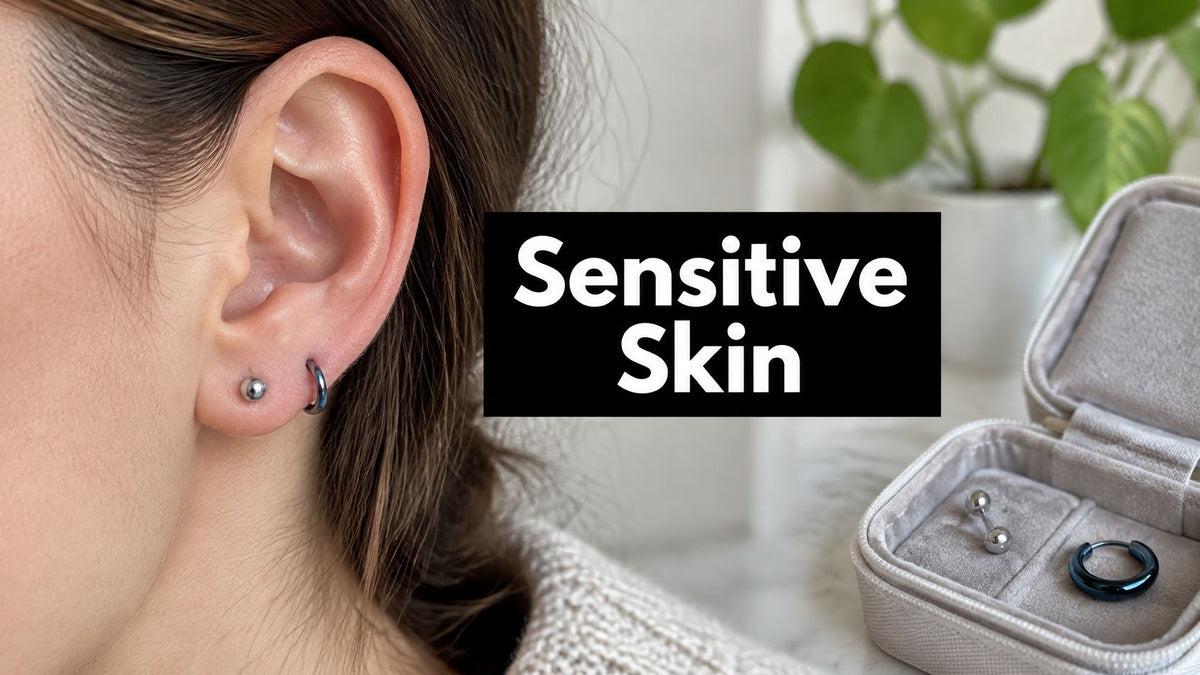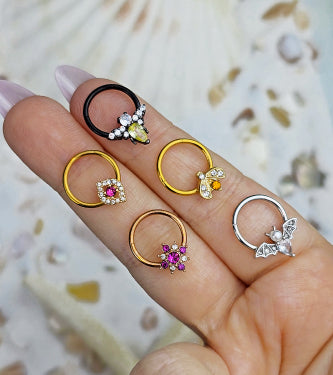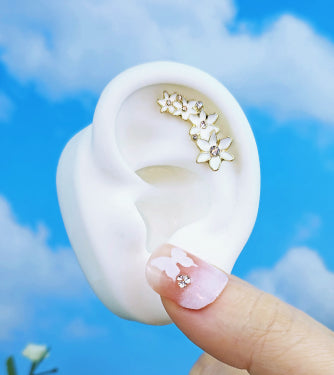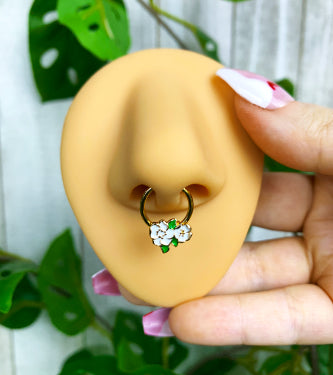



















You swapped in a new nose stud on Friday. By Sunday the skin around it itches, by Monday there's a crust that doesn't look like normal healing, and by Tuesday you're squinting at a product page wondering what "hypoallergenic" was supposed to mean. Or maybe it's the belly ring you wore for one beach weekend, and the skin under the gem is now a red, weeping outline of the charm.
You're pretty sure the problem is nickel, and you're mostly right. The useful version of that answer is narrower, though. The trouble isn't how much nickel sits inside the metal. It's how much nickel leaves the metal and lands on your skin. Those are two different measurements, and only one of them is regulated anywhere in the world.
Once you know which measurement matters, a lot of confusing shopping advice sorts itself out. You can look at an alloy name and judge whether it's a risk worth taking, ask a seller a question they can answer, and stop buying the same mystery metal in a different shape three times in a row.
Why Jewelers Still Use Nickel
A piercer slides a plain titanium labret across the counter for your fresh nostril, and it costs more than the five-pack of steel studs sitting in your cart. That price gap is the entire reason nickel stays in the conversation. Nickel is cheap. It hardens softer metals so a thin post doesn't fold in your sleep, it holds a bright white color that polishes up like silver, and it helps an alloy shrug off sweat and daily abuse.
Those properties make it a favorite in bargain fashion alloys, in some stainless steel posts and clickers, and in certain white gold mixes. No villainy required. Nickel earns its place in the recipe.
The instinct that goes wrong is judging a piece by how much nickel the recipe lists. Your skin never reads the ingredient list. It reacts to nickel that migrates off the finished surface and sits against you, hour after hour. Four things change that migration rate more than the alloy name does:
- Sweat: Moisture pulls nickel ions out of a surface. A piece that's fine in winter can flare in July.
- Friction: A post that rotates, a clasp that rubs, a charm that taps the same square centimeter all day.
- A fresh piercing: Wound fluid and unhealed tissue are a harsher environment than intact skin, which is why the rules for posts are stricter than the rules for necklaces.
- A thinning coating: Plating that looked flawless in the bag wears at the edges first, exposing whatever sits underneath.
Practical rule: A piece can contain nickel and behave beautifully on your skin, or carry a friendly label and still irritate you once the surface wears. Only a release result tells you which one you're holding.
Ahead of you: Europe's weekly release numbers so the word "limit" stops being abstract, a plain description of what a nickel rash looks like so you can tell it from ordinary irritation, and a material shortlist plus a seven-step check you can run on a single piece before it touches your body.
One thing to hold onto in the meantime. A shiny "hypoallergenic" sticker is a clue, not a verdict. And earrings, nose rings and belly rings are the pieces most likely to sit on your skin long enough to matter.
Nickel Release Limits for Skin and Piercings
Two numbers do most of the work in European nickel law, and neither one describes how much nickel is inside the metal.
| Situation | Limit | How it is checked | What to remember |
|---|---|---|---|
| Prolonged skin contact | 0.5 µg/cm²/week | EN 1811, one week in artificial sweat | A migration limit, not the percent of nickel in the alloy |
| Posts in pierced ears or other body parts | Less than 0.2 µg/cm²/week | EN 1811 on the post assembly | Stricter because metal sits in a piercing |
| Nickel under a non-nickel coating | At or below 0.5 µg/cm²/week for at least 2 years of normal use | EN 12472 wear simulation, then EN 1811 | A fresh plate can fail after rub, sweat and friction |
| Lab decision thresholds, not shopping targets | 0.88 for the 0.5 limit; 0.35 for the 0.2 limit | EN 1811:2011+A1:2015 uncertainty | Do not treat these higher numbers as safe goals |
Read the first row slowly, because it's the one that gets misquoted. A necklace, a ring, a watch case or a steel clicker that rests on skin all day must release no more than 0.5 micrograms of nickel per square centimeter per week from its finished surface. That's a measurement of what escapes onto you, averaged across a week.
The second row is the one that matters for a new nostril or a fresh navel. Anything inserted into pierced ears or other pierced body parts, meaning the post that passes through the hole, has to stay under 0.2 micrograms per square centimeter per week.
Why the numbers measure escape, not content
A piece of 316L steel can carry a double-digit percentage of nickel by weight and still pass comfortably, because the nickel is bound inside the alloy and barely moves. A plated brass charm can pass when new and fail four months later once the plate thins over the part that touches you. That's the whole argument in one line.
Europe got here early. The EU's first Nickel Directive grew out of allergy research in 1991 and came into force across the European Community in June 1994, and its core approach was to regulate the amount of nickel released from an item rather than the total nickel content of the alloy. Those rules were later folded into the REACH chemicals framework, which is why the same two figures now get described as REACH limits, as Stuller's reference on the European Nickel Directive explains.
Why piercing posts get the tighter ceiling
A pierced hole isn't skin in the ordinary sense. The jewelry lives in a channel of healing tissue, gets twisted during cleaning, stays damp, and never fully dries out between showers. Putting a lower ceiling on the metal that sits inside you rather than on top of you is the least controversial sentence in this entire article.
Coating a nickel-bearing core doesn't make the question disappear. A plated piece is legal if the non-nickel coating keeps release at or below 0.5 micrograms per square centimeter per week for at least two years of normal use, as the European Chemicals Agency's restriction guidance sets out. Rub, sweat, polishing and friction decide whether it does.
What the lab thresholds actually mean
EN 1811 soaks a sample in artificial sweat for a week and measures how much nickel migrates out. Labs account for measurement uncertainty, so the 2015 revision of the method produced decision thresholds: results near the 0.5 limit were treated as compliant below 0.88 micrograms per square centimeter per week, and piercing post assemblies used 0.35 against the 0.2 limit, per the EN 1811:2011+A1:2015 framework.
Those are laboratory arithmetic, not shopping goals. The legally stated limits stay at 0.5 and below 0.2. A seller who quotes 0.88 as proof of safety has quoted the wrong number.
One more caution sits on top of all of it. Some people who are already sensitized react below the 0.5 threshold, so a legal pass is a good sign rather than a personal guarantee. If your skin has already made up its mind about nickel, a compliant piece may still be the wrong piece for you.
What a Nickel Reaction Looks Like
Start with the mechanism, because it explains why the same earring that was fine for a year suddenly isn't.
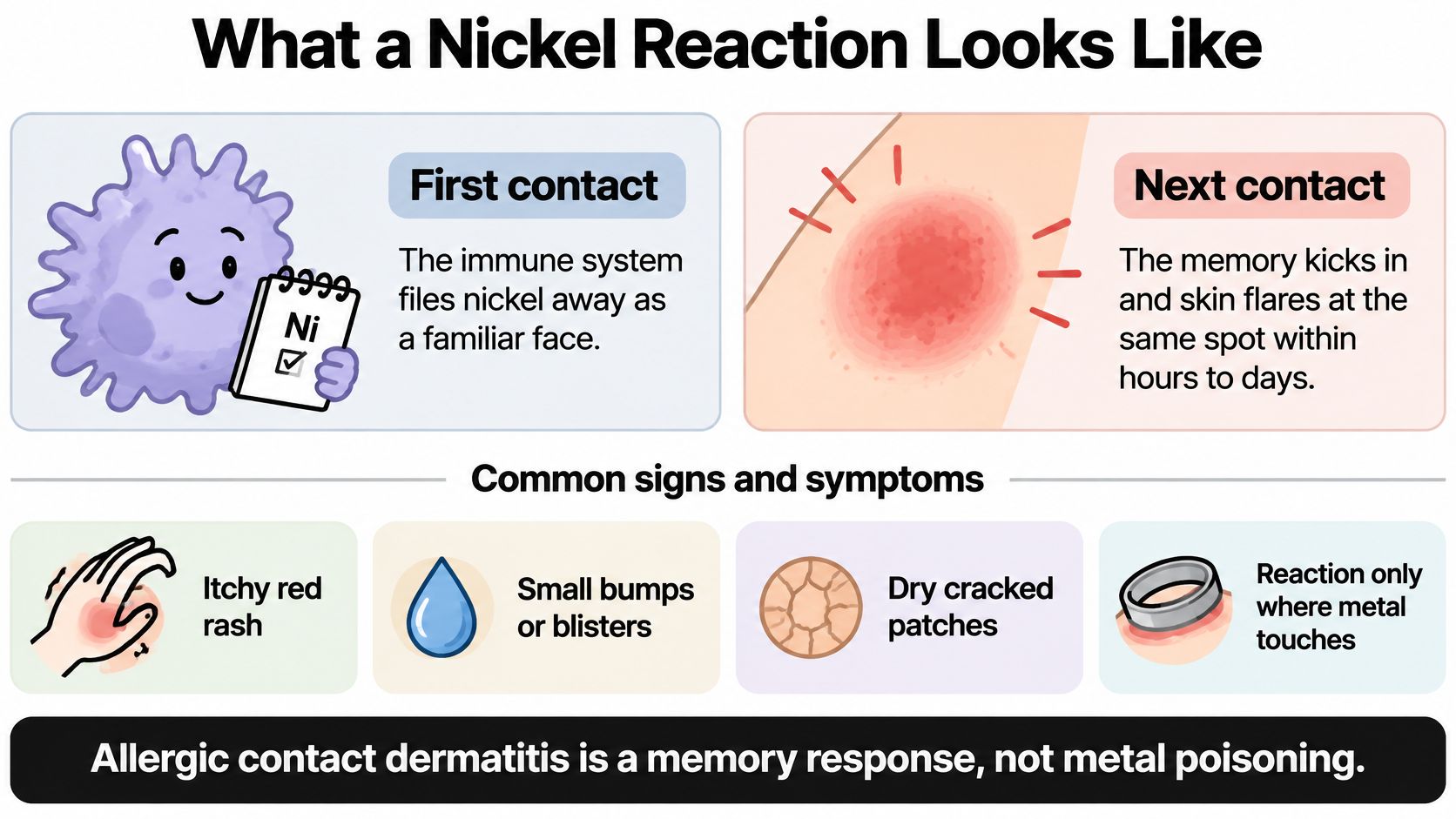
Allergic contact dermatitis is your immune system filing nickel away as a familiar face, then overreacting when it shows up again. The first exposures are the introduction. The reunion is the part nobody wanted. It isn't metal poisoning, and it isn't a sign the jewelry was dirty.
Where the metal rests, you'll notice itch first, then redness, dry or scaly patches, small blisters, swelling, or a rash that weeps and crusts. On a healing piercing, that can look almost identical to ordinary irritation from sleeping on it, snagging it on a towel, or reacting to aftercare products. Don't self-diagnose a piercing that's still healing. Get a piercer or clinician involved when a rash spreads past the jewelry's outline, cracks, or won't settle after a week of clean hands and no fiddling.
How common this actually is
| Finding | Figure |
|---|---|
| Nickel sensitization in Sweden | 8.3% |
| Nickel sensitization in Portugal | 18.5% |
| Everyday items such as earrings, necklaces and hair clasps in market testing | A recurring share released nickel above legal limits |
| Young women checked after regulation reduced nickel exposure | Sensitization still detected |
| NACDG nickel reactions judged clinically relevant, 1994–2014, jewelry the most common source | 55.5% overall |
| Patients positive to nickel sulfate in a 2025 clinic series of 1,085 | 28.1% |
A European population study put sensitization anywhere from 8.3 percent in Sweden to 18.5 percent in Portugal, and North American Contact Dermatitis Group data covering 1994 to 2014 named jewelry the most common source of nickel contact, with 55.5 percent of recorded reactions judged clinically relevant, a share that climbed rather than fell across the period, according to the compiled nickel allergy research record on jewelry exposure. Patch testing turns up nickel allergy in children too, so this is not an adults-only problem.
The allergy stays ordinary among people already being tested for it. A 2025 retrospective study of 1,085 patients at Tokushima University Hospital's Dental Metal Allergy Clinic found 28.1 percent tested positive for nickel sulfate allergy, per the study published in Scientific Reports.
If your skin has already objected to a few metals, our guide to piercing and material sensitivities covers which materials tend to cause trouble and why.
A sore that shows up after you slept on a stud and fades by lunch is pressure. A rash that returns every single time one particular piece goes back in, always in the same outline, is your immune system answering the same way twice.
That distinction is the one worth carrying: fleeting irritation has a cause you can remove, while a repeating rash has a material you need to stop wearing.
Why Hypoallergenic Labels Can Mislead
Hypoallergenic is a marketing word. No release test sits behind it, no number, no standard, no threshold. It means the seller believes you probably won't react, which is a very different claim from knowing how much nickel leaves the piece going through your skin.
Stainless steel and surgical steel are honest material names that tell you almost nothing about nickel risk. Most steel body jewelry contains nickel. A well-polished, documented piece may release very little of it. A cheaper one with a rougher finish and thinner passivation may release plenty. The name on the card cannot separate those two pieces, and neither can the price tag.
Nickel-free and low nickel release are two different promises, and sellers swap them constantly. A coated piece can sit on a nickel-bearing core and still meet the legal limit for as long as the surface holds. A solid nickel-free metal never had a reservoir to leak in the first place. One promise is about composition. The other is about behavior over time, and only one of them survives a year of sweat and friction.
What the earring tests found
A systematic review published in 2025 found that 31.1 percent of sampled North American earrings and 34.5 percent of sampled Asian earrings produced a critical result on dimethylglyoxime screening, and that 24.7 percent of European earrings intended for piercing exceeded the applicable EN 1811 nickel-release limit, as reported in the 2025 systematic review of nickel release from earrings.
Dimethylglyoxime is the pink-dot swab. It turns pink when it finds available nickel on a surface. Fast, cheap, imperfect: a positive is a genuine warning, while a negative only means the swab found nothing where you happened to rub.
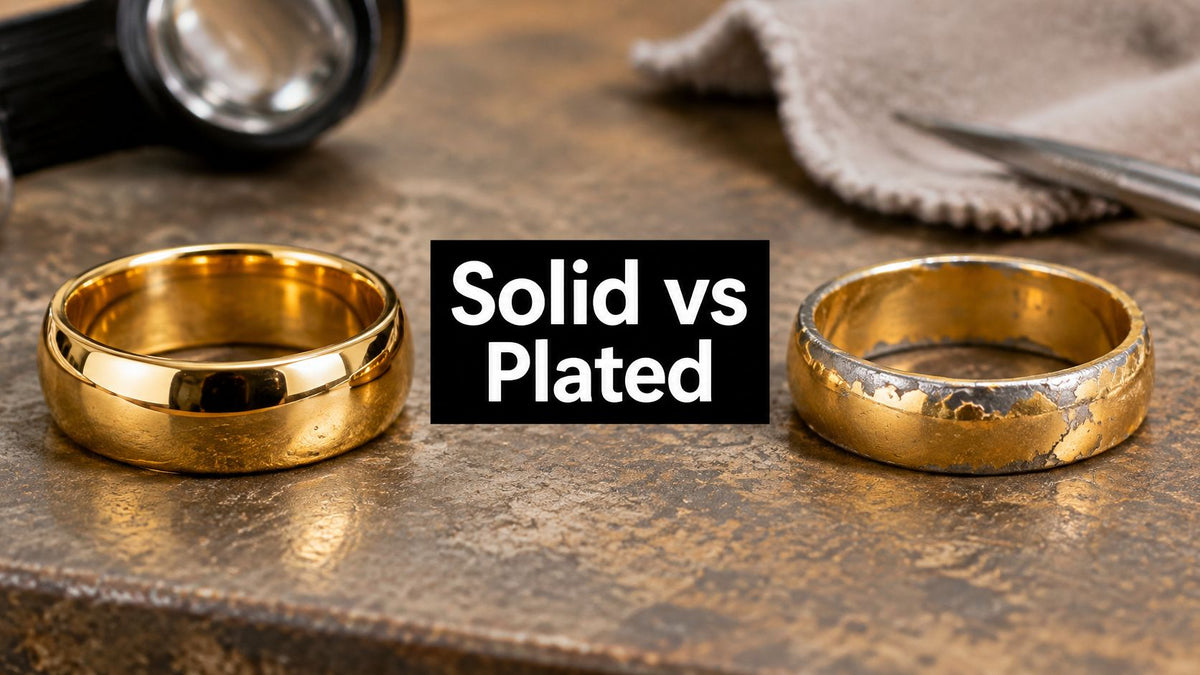
Plating can't be assumed to block nickel either. Gold or silver over a base metal works like paint on a car: it protects until a chip reaches what's underneath, and pierced skin supplies plenty of chipping. Even two pieces with identical alloy chemistry can release different amounts depending on how they were polished and finished, so the alloy spec on a product page is a starting hint rather than an answer.
Appearance and the words on the card are weaker predictors than a release result for that finished item.
Why fresh piercings raise the stakes
A fashion plating that survives a healed lobe for a year might not last a week in a fresh piercing, where the jewelry sits in wound fluid and gets rotated with every salt soak and every accidental snag. Add the tighter release ceiling that applies to posts passing through skin, and a piece that reads as harmless on the shelf starts shedding nickel exactly where your immune system is on high alert.
So bring one question to every product page: what did this finished item release, on the surfaces that touch me, under the test that matches how I wear it? Everything else is decoration.
Metals That Lower Your Nickel Risk
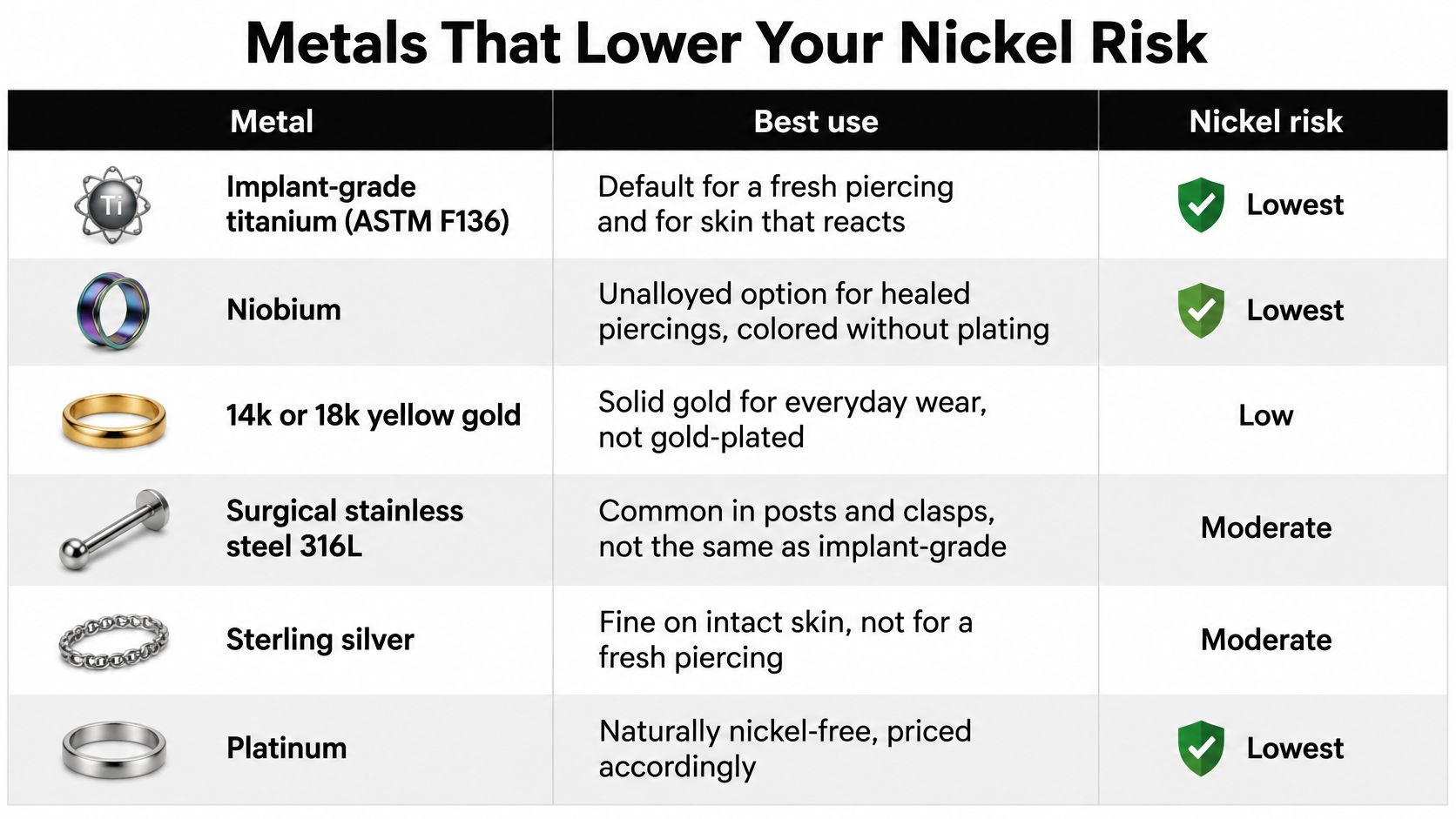
Here's the shortlist as a picture, then as a table you can screenshot for the shop.
| Material | Nickel story | Best use | Watch-out |
|---|---|---|---|
| Implant-grade titanium such as F136 | Generally nickel-free | Fresh piercings and already-reactive skin | Confirm the grade, not just the word titanium |
| Niobium | Nickel-free metal | Healed piercings and anodized color | Less common; verify it is solid niobium |
| Solid 14k or higher gold | Nickel-free only if the alloy is | Healed piercings when the alloy is disclosed | Some white gold uses nickel for its color |
| Platinum | Very low nickel-allergy risk | Fine jewelry for sensitive skin | Price and rarity in fashion body jewelry |
| 316L surgical steel | Usually contains nickel; release can still be low | Healed piercings if the piece is documented | The steel name is not a release test |
| Gold or silver plating over base metal | Nickel may sit under the plate | Short fashion wear | Rub, sweat and friction can expose it |
| Bioplast or acrylic | No nickel metal | Short-term retainers | Not a long-term implant material |
Implant-grade titanium is the default for a fresh piercing and for skin that has already reacted to something. Reputable implant titanium, including ASTM F136, is nickel-free and doesn't care about your sweat. The catch is loose language: "titanium" on a listing can mean a cheap alloy with a titanium-colored finish, so look for the grade.
Niobium is the other nickel-free metal in the room, and it can be anodized into color without plating, which makes it a favorite for anyone who wants something other than gray. It's less common on fashion racks, so verify you're getting solid niobium rather than a coated lookalike.
Gold, steel and the plating problem
Solid 14k or higher gold can be an excellent choice for a healed piercing, on one condition: the alloy itself has to be nickel-free. Yellow gold is the safer mental default. White gold sometimes uses nickel to achieve its color, so the buyer has to ask rather than assume. Platinum is very unlikely to trigger a nickel reaction and priced accordingly, which is why you rarely see it in everyday body jewelry.
316L surgical steel isn't the villain its reputation suggests. It's comfortable for plenty of healed piercings and it's the workhorse of the category. It usually contains nickel, though, which puts it behind a release story rather than in a brand-new or already-angry piercing. A steel piece with a real material note is a different object from a steel piece with a lightning bolt emoji.
Plating over mystery metal is a costume layer, fine until rub, sweat and friction open the base underneath. Bioplast and acrylic avoid nickel metal entirely and work as short-term retainers for a scan, a shift, or a healing appointment. Neither is a forever implant.
If you like the colored look, our guide to anodized titanium jewelry explains how the color is created without a coating to wear through.
Fresh piercing versus healed piercing
Match the row to the moment, not to your aesthetic.
- Fresh or reactive: implant-grade titanium, full stop. Nothing plated, nothing mystery, no exceptions for a wedding photo.
- Healed and calm: verified solid gold with a disclosed alloy, niobium, or documented steel.
- Healed and experimental: plating is fine for a night out as long as it isn't going into a hole that's still healing.
- Retainer needed: bioplast or acrylic for hours, not months.
The mistake people make is buying the jewelry they want for a piercing that isn't ready for it yet. Wait the extra few weeks.
How to Vet Jewelry Before It Touches Skin
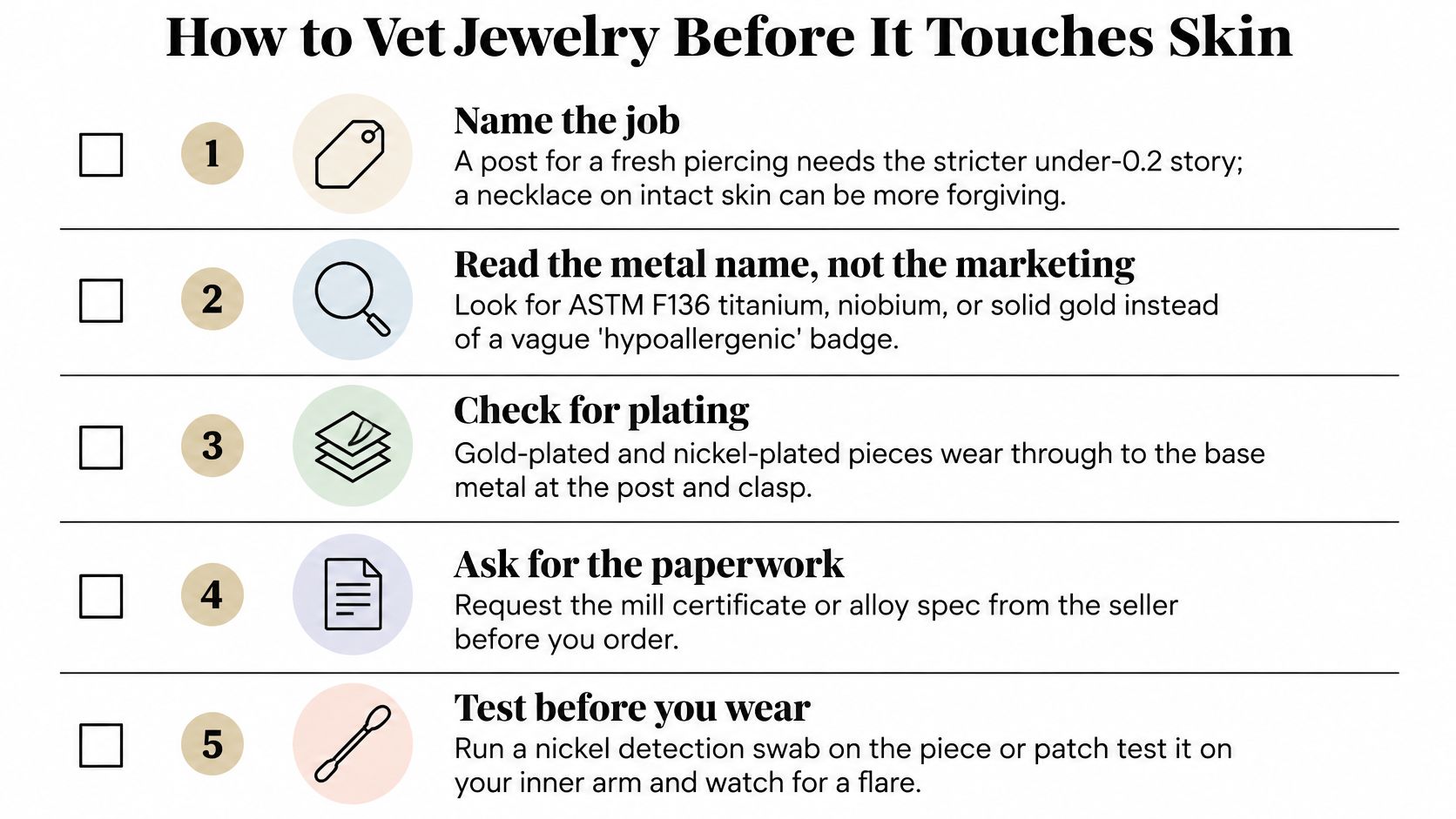
Seven checks, in the order that saves you the most money. Notice what none of them ask: whether the piece contains nickel at all. The question is always whether it releases nickel onto skin, which is why a piece with real paperwork beats a friendly sticker every time.
- Name the job first. A post going into a fresh piercing gets judged against the tighter piercing limit. A necklace on intact skin gets the everyday one. Same metal, different verdict, because the exposure is different.
- Read the metal, not the mood. Look for ASTM F136 titanium, niobium, or a stated solid-gold alloy. "Hypoallergenic," "premium metal" and "surgical grade" are adjectives, not specifications.
- Ask what was tested. A useful answer names the finished article, the surfaces that touch skin, the method, and a release result. EN 1811 measures how much nickel migrates into artificial sweat over a week of exposure, and it applies to piercing posts as well as watch straps, belt buckles and phone parts, per the BSI preview of the EN 1811 test standard.
- Treat plating as a wear question. EN 12472 is the accelerated wear-and-corrosion step run before a release measurement. A coated piece only earns your trust if the coating survives that simulated wear and still keeps release inside the limits, so a report on a freshly plated sample tells you less than it looks like it does.
- Skip the home swab on a healing piercing. Dimethylglyoxime is a screening tool rather than a lab method. On a healed fashion piece, a swab that turns pink means nickel showed up, and that piece is out. A negative result still leaves the question open.
- Retire repeat offenders. If one piece leaves a rash every time it goes back in, it's out. Rotating plated lookalikes into the same hole and blaming your aftercare just keeps the rash on rotation too.
- Let the piercer pick the first post. For a new piercing, start with the implant-grade recommendation and let the fashion pieces wait their turn. Our guide on what jewelry to get pierced with covers the materials piercers reach for and why.
If you'd rather watch the walkthrough than read it, this covers the same ground in video form.
Good paperwork looks like four things in one place: the product identity, the exposed parts, the test method, and a release result below the limit that matches how you wear the piece. Anything less is a vibe.
Choose Lower Risk Jewelry for Your Next Piercing
The verdict fits in two lines. Fresh piercing or skin that already reacts: implant-grade titanium, and leave the plated fashion metal for later. Healed piercing: verified nickel-free choices such as F136 titanium, solid gold with a disclosed alloy, or a clearly nickel-free listing beat a mystery steel post every time.
That's a simpler rule than it sounds, because it replaces a scavenger hunt for the word "hypoallergenic" with a search for a material you can name. At BodyCandy, ear jewelry comes in F136 titanium, 14k gold, 316L surgical steel and nickel-free materials, and titanium pieces for nose rings, septum rings, belly rings, nipple rings, cartilage, flat backs and tongue rings are sold in F136.
Match the metal to the piercing you have, not to the piercing you're planning for next spring. A healed lobe is forgiving. A three-week-old nostril is not.
If you're stuck between two options, describe the piercing and how long you've had it, and ask. That's a much better conversation than guessing at a sale rack.
Start with the metal instead of the marketing, and the rest gets easy. BodyCandy carries body jewelry in F136 titanium, 14k gold and 316L surgical steel, including nickel-free ear styles, so you can pick the piece that matches where you are in healing rather than the one with the friendliest sticker. Browse the titanium and nickel-free options at BodyCandy and put something in your piercing that your skin won't argue with.