Seamless & Segment Septum Rings

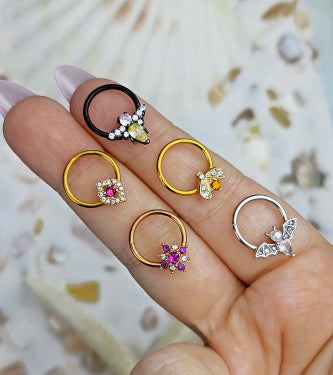
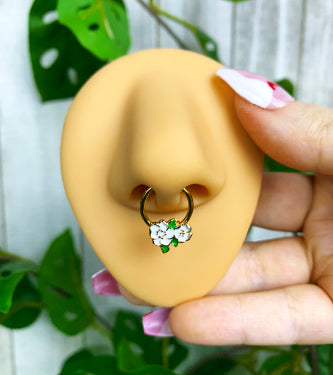
The clean-circle septum look with no ball to find and nothing to unscrew: a hinged segment ring swings open and clicks shut into one smooth hoop, and a seamless ring twists closed with an invisible join. Plain steel, black and gold PVD, opal and CZ, in the septum-standard 16G — and the same hinge in 18G and 20G for nose and cartilage. Since 1999.


Segment vs. Seamless: Fit & Swap Guide

Fit first: septum rings are 16G, with a 5/16 inch (8mm) or 3/8 inch (10mm) inside diameter for most people — snug sits forward and hangs best. In 18G and 20G the same rings become nose hoops and cartilage rings; the product page lists gauge and diameter every time.

Segment or seamless? A hinged segment ring is the easy daily driver: swing the segment open, thread it through, click it shut — no parts come off. A seamless ring is the most minimal hoop made: twist it open sideways like a key ring, never pull it apart, and twist it back to close the join. Seamless takes a steadier hand and a healed piercing; segment forgives everything.

Materials run 316L steel, titanium (the nickel-free pick) and gold; the black, gold and rose finishes here are PVD bonded to the metal.

More ways in:

- Seamless hoops only → Seamless Hoops & Rings

- Every septum style, by size → Septum Rings & Clickers

- Decorative clickers → Septum Clickers

- Flip-up-to-hide → Horseshoe Septum Rings

- Hinged hoops for the nostril → Nose Hoops

FAQ

Both give you the clean full-circle look with no ball. A segment ring has a small section that opens — on ours it swings on a hinge and clicks shut, so nothing comes off. A seamless ring is one continuous hoop you twist open sideways (never pull apart) and twist back closed. Segment is easier to change; seamless is the most minimal.

Same mechanism, different look. A clicker usually has a decorative front; a hinged segment ring is a plain, uniform hoop where the hinge disappears into the circle. If you want the ring to read as one smooth line, this is the page.

16G is the septum standard, in 5/16 inch (8mm) or 3/8 inch (10mm) inside diameter for most people — the septum's sweet spot sits small and forward, so snug hangs best. Match the numbers on the ring you wear now; every product page lists both.

Yes — the same hinge in a thinner gauge is a nose hoop or cartilage ring. 16G is septum, daith and lip; 18G and 20G are nostril, helix and tragus. Pick by the gauge your piercing takes and the diameter that hugs it.

Hold each side of the gap and twist sideways, like opening a key ring — one end toward you, one away. Never pull the ends apart; that widens the circle and it won't close flush again. Twist back the same way to seal the join.

Not in normal use — the hinge is a pin inside the segment and the click is the closure seating. Open it by the segment, not by prying the hoop, and it will outlast your interest in the style. If it ever feels loose, make sure it clicked fully home.