Lip Hoops & Captive Rings

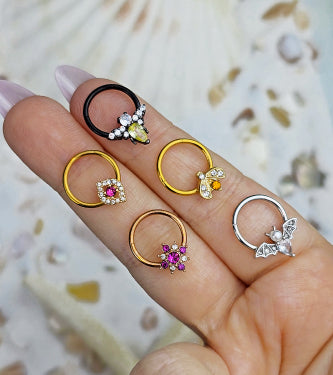
The lip ring that actually rings: hinged segment hoops that click shut, captive bead rings, seamless hoops and horseshoes, wrapped around a labret, side lip, snake bites or spider bites. Plain steel, black and gold PVD, gem and opal accents, nearly all in 16G, 5/16 and 3/8 inch, the sizes a healed lip wants. Since 1999.


Lip Hoop Fit & Closure Guide

Fit: lip piercings are mostly 16G or 14G; match the gauge you were pierced at. Diameter is the inside width of the ring and it has to clear the lip: 5/16 inch (8mm) hugs a thin lower lip, 3/8 inch (10mm) fits most people, and 1/2 inch suits fuller lips and wider side placements. Snug is the goal; a ring that presses into the lip is too small, a ring that swings is too big.

Closures: a hinged segment ring swings open and clicks shut with nothing to lose, the easy daily driver. A captive bead ring holds a bead by tension and gives the classic look; a seamless ring twists open sideways for the cleanest line. Horseshoes unscrew at the ball and flip to hide; they live on their own page below.

Teeth and gums, honestly: a ring moves more than a flat-back stud. Wear the snuggest diameter that clears your lip, favor smooth hinged or seamless hoops over anything with a ball inside the mouth, and stop chewing on it. Hoops are for healed lips; keep the starter in until your piercer clears you. Steel suits most people and holds a trace of nickel in the alloy; titanium is the nickel-free pick.

More ways in:

- Flip-up horseshoes for the lip → Horseshoe Lip Rings

- Flat-back studs for labret, Monroe and Medusa → Labret Studs

- Curved bars for the vertical labret → Vertical Labret Jewelry

- Every lip style → Lip Rings

- Same hoops, sized for the septum → Seamless & Segment Septum Rings

FAQ

Yes, once it is healed. Hoops suit a labret, side lip, snake bites and spider bites: anywhere on the lip edge where the ring can wrap around and clear the lip. A vertical labret takes a curved bar instead, and Monroe and Medusa piercings nearly always wear a stud. Keep the starter in until your piercer clears you, then come shopping.

Most lip piercings are 16G or 14G; match the gauge you were pierced at. Diameter is the inside width of the ring: 5/16 inch (8mm) hugs a thin lower lip, 3/8 inch (10mm) fits most people, and 1/2 inch suits fuller lips and wider side placements. The ring has to clear the lip without pressing into it. Measure the one you wear now; every product page lists both numbers.

Hinged segment rings are the easy daily driver: swing open, thread through, click shut, nothing comes off. Captive bead rings hold a bead by tension and look the most classic; the bead is the clasp. Seamless rings twist open sideways for the most minimal line and want a steady hand. Horseshoes unscrew at the ball. Start hinged if you change often.

A ring moves more than a flat-back stud, so the honest answer is: it can if you let it. Wear the snuggest diameter that clears your lip, choose a smooth hinged or seamless hoop over one with a ball that sits inside, and stop chewing on it. If your dentist is already frowning, swap to a labret stud for daily wear and save the hoop for going out.

It is possible on a well-healed piercing with a small ring, but it is rare for a reason: the upper lip curves the wrong way for a hoop to sit flat, and it rubs. Those placements were made for a flat-back labret stud, and that is where the good jewelry lives.

Mostly 316L surgical steel, with gold-tone, rose and black PVD finishes bonded on; some are titanium, the nickel-free pick for sensitive lips. Steel suits most people and holds a trace of nickel locked in the alloy. Every product page names the metal.