


















Nickel is consistently the most common contact allergen in large patch-test studies, so a red ear, nose, or navel under jewelry is a signal worth taking seriously.
A sticker that says gentle is not a material test. Nickel can sit in the alloy itself or under a thin plated finish, and once the surface wears, skin meets the reactive metal again. Fresh piercings have less margin for error than healed ones.
Hypoallergenic products for sensitive skin only help when you can name the metal, match it to the piercing, and spot irritation before it settles in. I would rather you spend five minutes on the alloy than a week on a rash.
Materials That Suit Sensitive Skin at a Glance
Nickel-free is the default, and implant-grade titanium is the piece I would put in first.
Price, color, and how many styles you can find all change the pick. The fit for reactive skin does not. If a seller will not name the alloy, treat the piece as unknown, not as safe.
| Material | Nickel content | Fit for sensitive skin | Main trade-off |
|---|---|---|---|
| Implant-grade titanium (ASTM F136, Ti-6Al-4V ELI) | Nickel-free | Excellent, first choice for new or reactive skin | Higher price than steel |
| Niobium (ASTM F1295) | Nickel-free | Excellent for reactive skin, including healed and fresh piercings | Fewer everyday styles than steel or titanium |
| Platinum 950 | Nickel-free when it is solid platinum | Excellent | Very high price and a short style list |
| 14K gold | Often contains nickel unless the seller names a nickel-free alloy | Good only when labeled nickel-free | Solid gold can still irritate if alloyed with nickel |
| 316L surgical steel | Contains nickel, low release when intact | Fair, avoid if nickel allergic | Affordable and widely available |
| Bioplast or acrylic | Nickel-free | Good for flexible or tongue jewelry | Less durable and can scratch or warp over time |
Implant-grade titanium marked ASTM F136 is the workhorse. It is nickel-free, it takes a high polish, and it is the metal most piercers trust in a swollen fresh piercing. You pay more than you would for steel, and basic studs cost less than gem-heavy pieces, but you are buying a stable surface, not a trend.
Niobium is the quiet alternative when titanium styles do not match the look you want. It is also nickel-free. Anodizing can shift the color without a plated coating. The trade-off is the catalog. You will find fewer fashion shapes than in steel.
Platinum 950 is the luxury lane. Solid platinum does not need nickel to hold its shape the way many gold alloys do. You will not find it in every gauge or every playful shape, and the price jumps fast.
What the cheaper rows hide
316L surgical steel is the one people get wrong. It contains nickel. A smooth, intact surface releases very little, which is why plenty of healed lobes wear it for years. A scratch, a worn thread, or a known nickel allergy changes that story. If you already react to nickel, I would skip 316L even when the listing says hypoallergenic.
Solid 14K gold is not automatically kind. Jewelers mix gold with other metals so the piece is hard enough to wear. Nickel is a common mixer unless the seller names a nickel-free alloy. Ask for that phrase on the product page. "Real gold" alone does not answer it.
Bioplast or acrylic stays useful for tongue ends and for flexible wear where a rigid bar fights the tissue. They are nickel-free. They also scratch, stain, and warp if you boil them or leave them in harsh cleaner. Replace a cloudy end instead of polishing it back to life.
Practical rule: If your skin history includes any metal rash, shortlist implant-grade titanium or niobium, not "surgical steel" and not unlabeled gold.
Our guide to implant-grade titanium body jewelry walks through why that grade shows up so often in fresh piercings. Pick one or two materials that match your skin history and the placement you want, then use the checks below before you add anything to a cart.
Why Nickel Causes Most Body Jewelry Reactions
Think of nickel allergy as a smoke alarm that learned one smell. The first exposures teach your immune system that nickel ions are a threat. Later, the same ions from a post, a clasp, or a worn plating set the alarm off. The noise stays right where the metal touches. The rest of your skin can look fine.
Those ions do not have to flood the skin. Sweat, soap, and a long wear time are enough for a tiny dose to pass the outer layer. Your immune cells memorize the shape of that metal. The next time the same jewelry sits there, they send a louder signal. That is allergic contact dermatitis, and it shows up as itching, redness, swelling, or a rash in the contact zone.
Why you blame the wrong piece
The timing fools people. This is a delayed reaction. Redness often shows up a day or more after you put the jewelry in, not in the first ten minutes. You wore the new hoop on Friday, the lobe looked angry on Sunday, and you blamed the shampoo you used Saturday. The metal was the match. The delay was the confusion.
Irritant reactions are a different path. Friction, moisture, and a rough finish can sting people with sensitive skin or atopic dermatitis even when no allergy is involved. Nickel and cobalt, both common in metal alloys, are the usual allergy culprits in jewelry. An irritant flare can calm down when you remove pressure. An allergic flare tends to repeat every time that metal returns.
A simple home check is worth doing before you throw out your whole collection.
- Map the rash. If redness sits only under the jewelry and fades after you take it out, nickel is a likely suspect.
- Swap one variable. Put in a nickel-free titanium piece of the same gauge and length. If the spot stays calm, the old alloy was the problem.
- Do not stack new products. A new soap plus a new earring on the same day makes the cause impossible to read.
The alarm does not reset just because a listing sounds gentle. Once your skin has learned that smell, the next nickel post can ring it again.
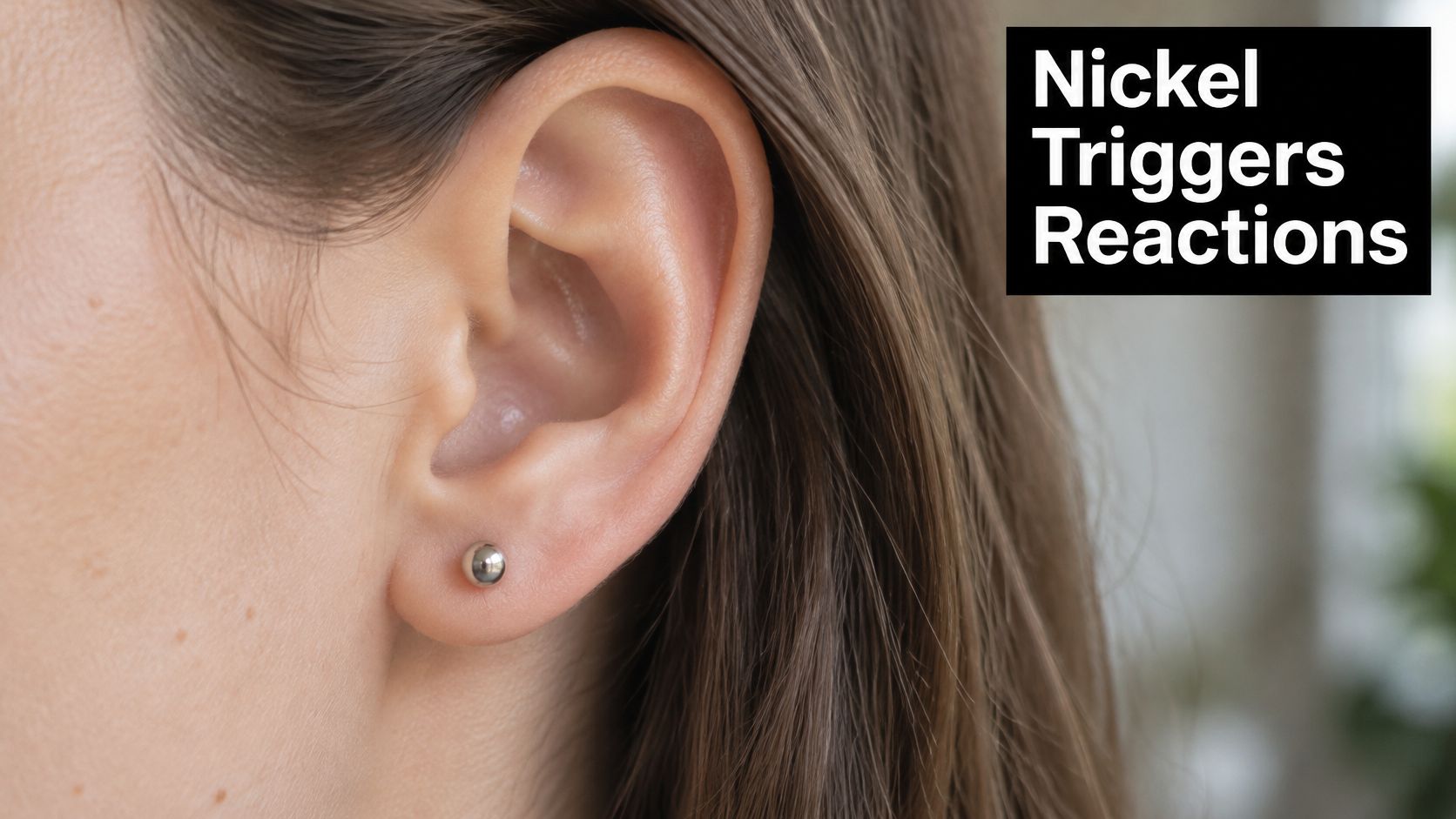
A plain stud is a useful test piece because the contact area is small and easy to watch. If that tiny disc of metal is the only place that itches, you have a location clue, not a mystery rash.
What Hypoallergenic Means and How to Verify a Piece
Hypoallergenic does not mean allergy-proof. In the United States the word has no fixed legal meaning for cosmetics. The FDA's cosmetics safety Q&A on hypoallergenic claims records the history. The agency first proposed a federal regulation in February 1974. That proposal would have required human studies showing a significantly lower rate of adverse skin reactions than similar products without the claim. A final order was signed on May 29, 1975, and published on June 6, 1975. A federal court later invalidated the regulation.
Today there is no federal standard and no national test a brand must pass before it prints the word. A maker can use it to say the product is expected to cause fewer reactions. Expected is not the same as proven, and it is not the same as safe for your immune system.
Treat it like low-calorie on a snack bag. The phrase means less, not zero. You still read the panel.
The FDA's page on allergens in cosmetics is blunt about the labels. "Hypoallergenic," "fragrance-free," and "for sensitive skin" are not enough by themselves to show a product will avoid reactions. There is no federal definition for those claims. The useful move is to learn your own triggers and avoid them. A label tells you how the brand wants to be read. It does not replace the material list, and it does not replace a professional patch test.
Three claims that do not mean what you think
"Hypoallergenic means allergy-proof." It does not. You can still react to a metal, a plating, or a finish that never showed up in someone else's test.
"A sensitive-skin label means the piece was tested." It might mean the brand likes the phrase. It does not mean a dermatologist ran a study, and it does not mean your nickel allergy was part of that study.
"Nickel-free means safe for everyone." Nickel is the big one. Cobalt and other metals can still trigger a reaction. A nickel-free claim that never names the alloy is a slogan, not a spec sheet.
Separate the two kinds of angry skin before you diagnose yourself. An irritant flare comes from friction, trapped moisture, a scratched edge, or a harsh finish. It can hit sensitive skin without a specific allergy. A true allergic flare needs a trigger your immune system already knows. Both can look red. Only one will follow that trigger every time you bring it back.
A six-step check before you buy
- Find the exact alloy or grade. Look for ASTM F136 titanium or a clearly named 316L if you are only comparing steel. "Surgical" without a grade is not a grade.
- Make the nickel-free claim name the alloy. A bare nickel-free badge is weaker than "implant-grade titanium, ASTM F136" or "14K gold, nickel-free alloy."
- Read the plating. Thin gold PVD over a base metal can look perfect in the photo and wear through at the post. Once the base shows, you are wearing whatever was underneath.
- Check the closure and the back. A butterfly clutch can poke, and a too-short bar can press. Flat-back studs use a flat disc so nothing jabs the neck, which matters if you sleep in earrings.
- Note the return window. A delayed rash can show up after the weekend. You want a path to send the piece back if your skin votes no.
- Record known triggers in a notes app. Write "nickel," "cobalt," or "thin gold plate" while you still remember which piece caused which spot. Next time you shop, you are not guessing.
Labels do not identify a safe piece. The alloy name and, when rashes keep returning, a dermatologist's patch test matter more.
Stop wearing anything that stings and do not "push through" a spreading rash to test your patience. Material review is the shopping skill. Professional testing is the medical one.
Matching Material to Piercing Placement and Healing Stage
A new nostril and a healed earlobe are not the same job, even on the same person. The nostril is swollen, wet from mucus and cleanser, and easy to bump. The healed lobe is dry, stable, and mostly annoyed by the wrong alloy. Using one "sensitive skin" hoop for both is how people restart a flare they had already calmed down.
Fresh piercings do better in implant-grade titanium or niobium. Swelling and moisture make any nickel exposure harder to tolerate, and a reactive metal in a brand-new channel has nowhere to hide. Cartilage is the slow one. A tight or cheap fit there deserves more attention than a lobe stud you can swap in a week.
| Placement | Typical healing time | Lower-risk material | Watch for |
|---|---|---|---|
| Earlobe, healed | Already healed | Implant titanium or nickel-free 14K gold | Stretched or thin-lobed piercings can react to any nickel |
| Cartilage (helix, tragus) | Often 6 to 12 months | Implant titanium with a flat or well-fitted back | Tight fit traps moisture and slows healing |
| Nostril | About 2 to 4 months | Implant titanium or niobium | Swelling can cause pressure marks and irritation |
| Navel | Often 6 to 12 months | Implant titanium curved barbell | Friction from clothing and moisture |
| Tongue | About 4 to 8 weeks | Bioplast or acrylic while healing | Metal ends can chip teeth, so stay with flexible ends |
Healing ranges are typical, not a promise. Your piercer should sign off before you swap, because a "healed on average" piercing can still be open on you.
How the rows change the buy
Healed earlobes are where nickel-free 14K can earn a place, after you know your skin tolerates that alloy. A stretched or thin lobe has less tissue between the metal and the surface, so even a small nickel release shows up faster.
Cartilage wants a length that leaves room for swell, then a downsize once the swelling drops. A flat, well-fitted back beats a long decorative bar that knocks on everything. Moisture trapped under a tight disc is a healing problem, not a style problem.
Nostrils hate pressure. A snug decorative back that looked cute in the photo can stamp a pressure mark by day two. Titanium or niobium in the right gauge beats a cute steel piece that sits too short.
Navels live under waistbands. A curved titanium barbell with a smooth end survives friction better than a light fashion piece with a coated surface. Dry the fold after showers. A damp shirt plus a reactive metal is a bad pair.
Edge cases worth a second look
- Healed and calm. You can move a healed piercing to nickel-free gold after a small-area test, not on the morning of a long event.
- Tongue jewelry. Flexible bioplast or acrylic ends are gentler on teeth than a hard metal ball while the piercing is settling. Swap a chewed, cloudy end. Do not wait for a crack.
- Downsizing. Fresh jewelry is often longer on purpose. Switching to a short fashion piece too early pinches the channel.
Check those windows against a piercer's read of your piercing, and use published healing times for popular piercings as a map, not as a finish line. If the tissue is still tender, keep the implant-grade piece in and wait.
Caring for Your Jewelry and Spotting Irritation Early
A good metal still fails if the routine is messy. Clean hands, a boring cleanser, and a dry finish beat any scented "piercing wash" that leaves a film.
- Wash your hands before you touch the piercing. The jewelry is not the only thing that can irritate a fresh channel.
- Clean the jewelry and the piercing with sterile saline or a fragrance-free soap. Skip oils, alcohol, and anything with a perfume hit.
- Rinse thoroughly and pat dry with a clean paper towel. A reused cloth holds bacteria and snags ends.
- Leave it alone while it heals. Turning the jewelry does not "keep the hole open." It drags crust through the channel.
- Store spares dry in a labeled container. A damp dish and a pile of mixed metals is how plated pieces get scratched.
- Test a new piece on a small skin area for 48 hours before an all-day wear. The inner arm is easier to watch than a half-healed nose.
Fragrance and preservatives drive a lot of cosmetic reactions. Jewelry reactions usually trace back to the metal itself. Test the metal first, with no new lotion on the same day, or you will not know which one to blame.
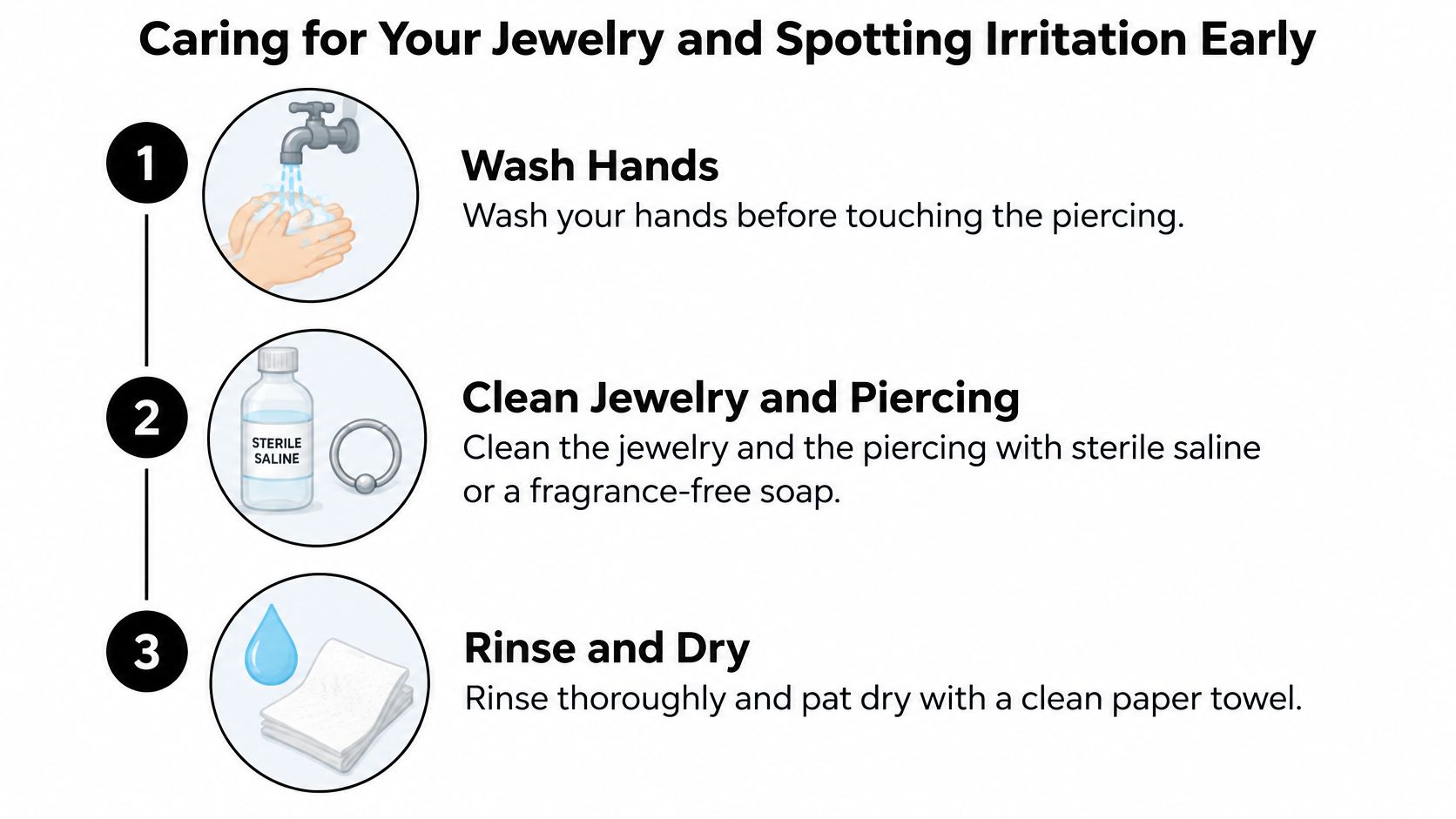
That three-step flow is the whole daily habit. Hands, then saline or fragrance-free soap, then a real rinse and a pat dry. Everything else is optional and often worse.
When to stop guessing
DermNet's jewellery allergy overview puts nickel among the most common causes of allergic contact dermatitis from jewelry, and it names nickel and cobalt as the main metal allergens in alloys. Irritant reactions show up more often in people with sensitive skin or atopic dermatitis. Once a nickel allergy develops, it can last many years and is often lifelong.
If redness, itching, swelling, or a rash keeps returning around earrings, rings, or other body jewelry, do not just buy another piece labeled hypoallergenic. A dermatologist can run a skin patch test and name the metal. That is the point where self-testing should stop.
| Symptom | Likely cause | First fix |
|---|---|---|
| Redness and itching only where metal touches | Nickel or metal sensitivity | Switch to implant titanium and patch test |
| Burning or rash after a new gold piece | Alloy or thin plating | Stop wearing it and choose a named nickel-free alloy |
| Dry, flaky or spreading rash | Allergic contact dermatitis | Stop wearing the piece and book a dermatologist patch test |
| Crusty or yellow discharge with pain | Infection or irritation from cleaning | Clean with saline and see your piercer |
| Raised bump that keeps growing | Hypertrophic scar or keloid | Keep jewelry in place and seek professional advice |
A contact-shaped itch can be a metal problem. Pain plus yellow discharge is a different phone call. Pulling jewelry out of an infected piercing can trap the problem. Leave it in and get a piercer's eyes on it the same day if the pain is climbing.
If the rash spreads past the jewelry, or it returns every time you "try one more hypoallergenic pair," book the patch test instead of another shopping tab.
Sorting normal irritation or a piercing infection is worth doing before you blame the metal. A bump from moisture is not the same fix as a nickel flare, and treating the wrong one keeps both around longer.
Your Step-by-Step Buying Decision
Shop the spec, not the adjective. A calm piercing follows a sequence. Skip a step and you can end up with a pretty piece your skin rejects on day three.
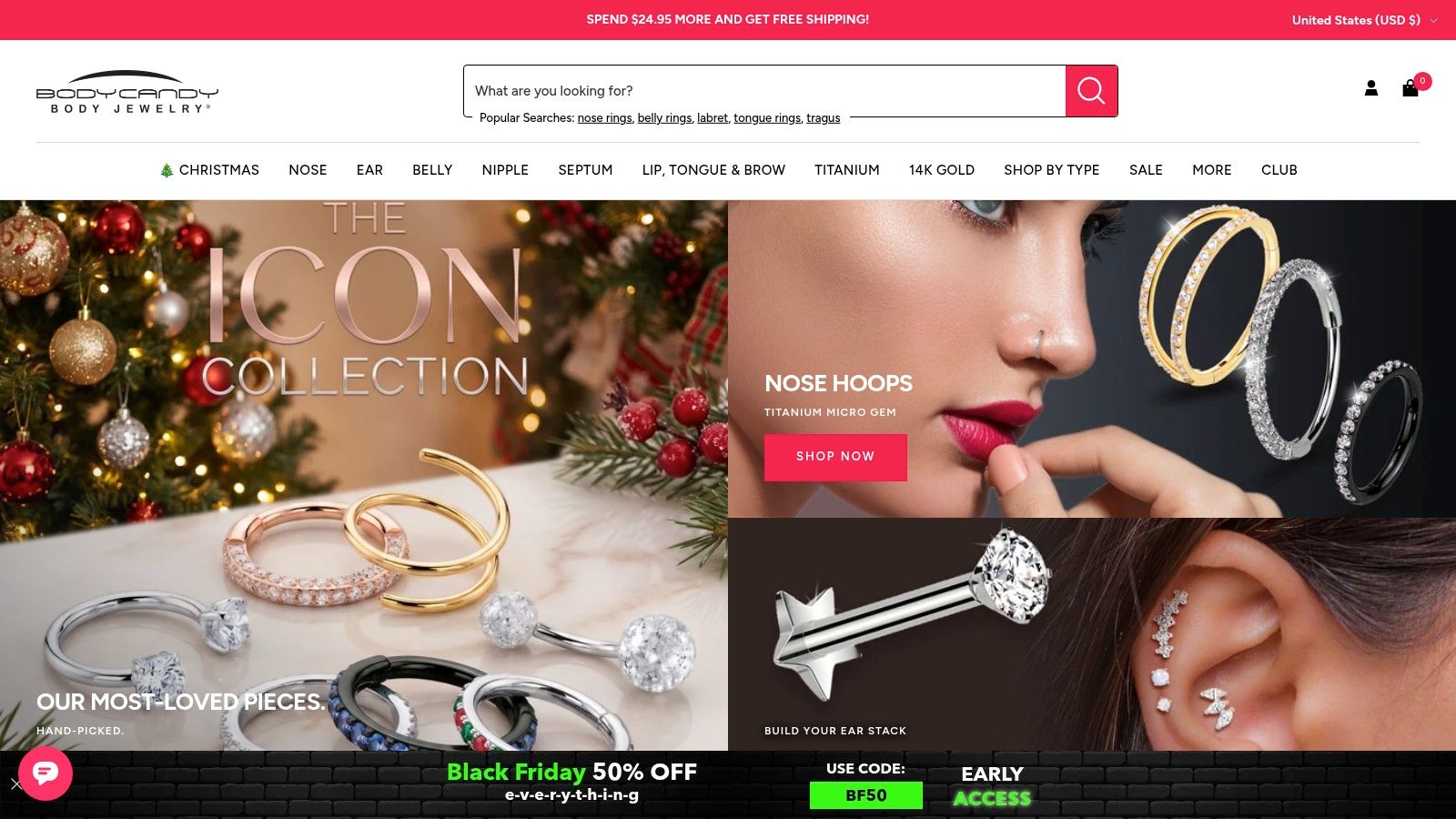
Use the product page the way you would use a spec sheet. The alloy line matters more than a banner that says gentle.
- Pick the default from your skin history. With no known metal allergy, start with implant-grade titanium. With a known nickel allergy, choose a clearly named nickel-free option, such as nickel-free 14K gold, and keep the alloy visible in your notes. I would not "test" 316L just because it is on sale.
- Match the placement. A fresh nostril does not get a tight decorative back sized for a healed cartilage stack. Flat back earrings use a flat disc instead of a butterfly clutch, so nothing pokes your neck and you can sleep or nap in them.
- Confirm the material before the cart. If the page says steel, gold, acrylic, bioplast, or "hypoallergenic" and never names the material clearly, keep looking. For tongue rings, acrylic and bioplast ends are gentler on teeth.
- Buy one piece and run the 48-hour test. One stud or hoop tells you more than a set of five you cannot return in your head. The 36mm steampunk gears industrial barbell is labelled hypoallergenic and described as jewelry for sensitive skin, so check the fit and finish before treating the label as enough.
- Check the feel after a week and write it down. Calm, itchy only at the back, or a delayed rash. That note is your filter for the next order.
After the first week
A piece that is quiet at 48 hours can still annoy you once sweat, sleep, and a waistband join the party. If the skin is calm, you can add a second piece in the same material. If it is not, stop. Do not lay a new soap on top of new metal and call it a skincare mystery.
Price can guide the test order, but it should not replace material checks. BodyCandy lists nose rings under $3 and nipple rings under $5, along with nose ring packs, belly ring packs, and earring packs. The sale menu also includes $0.49 body jewelry, $1.99 body jewelry, under $3 belly rings, and under $5 nipple rings. Specific pieces include the 16G 5/16 3mm Clear CZ Round Gold PVD Medical Grade Titanium Flat Back Earring on sale for $19.99 and the 20G Implant Grade Titanium Triple Sided Micro Gem Hinged Nose Hoop on sale from $39.99.
For sensitive skin, I would spend first on the material and placement that suit the piercing, then use the lower-price categories for styles you already tolerate. Cheyenne J. said, "These are great for sensitive skin people! And they're not heavy so no tension :)" Aislinn D. said, "They also dont irritate my skin. I do reccomend these." Ruby said, "it's easily accessible to get specialty body jewelry from the comfort of my own home."
BodyCandy has ear jewelry in F136 titanium, 14k gold, 316L surgical steel, and nickel-free materials, plus titanium body jewelry such as simple hoops. Piercing tools, replacement balls, and aftercare products sit in the same shop, so a downsize or a lost ball does not push you into a random mall alloy.
If you want a short look at how piercers talk through jewelry choices, this overview is a clean start.
Your turn. Tell us which metal your skin tolerates, and which placement gave you the most trouble. Those details help the next person skip a bad buy.
BodyCandy offers titanium and 14k gold ear jewelry and titanium body jewelry such as simple hoops for people who need hypoallergenic products for sensitive skin, not just a soft-sounding label. Check the material on the product page, start with one piece, and give your skin a real test before you commit to a set. Visit BodyCandy and shop the titanium and nickel-free styles that match your piercing.