












You're scrolling through page after page of belly button rings, and after a while, every curved barbell, dangling charm, and sparkling gem starts to look alike. The tricky part is that a navel ring isn't just a tiny accessory. Style, metal, gauge, length, curvature, and aftercare all affect whether it sits comfortably, suits your anatomy, and works with the clothes you wear.
This guide is the friendly piercer-at-the-counter conversation you wish you could have before clicking buy. You'll learn how the main styles differ, which materials make sense for sensitive skin, how to check sizing, what new and healed piercings need, which symptoms deserve professional attention, and how to finish with a practical buying checklist.
Why Belly Button Rings Deserve a Real Buyer's Guide
A belly button ring can look simple in a product photo, but your body has to live with it. A heavy dangle may look fantastic with swimwear and still catch on a waistband. A low-cost plated piece may suit a one-night outfit but become a poor choice for a healing piercing. Even a beautiful ring can feel wrong if the bar is too short or the decorative end presses against your navel.
Navel jewelry also has a surprisingly established fashion history. It became a mainstream trend in the early 1990s, with a widely cited 1993 milestone when Christy Turlington and Naomi Campbell displayed recently pierced navels at a London fashion show, as documented in the history of navel piercing. A 2005 United Kingdom survey of 10,503 people found that 33% had navel piercings, making the navel the most common body-piercing site in that sample, according to the same reference.
That popularity didn't vanish with one fashion cycle. In a 2022 study of 214 women with navel piercings, 59.8% had kept the piercing for five or more years, the longest reported duration was 24 years, and 87.6% said they always wore their navel jewelry, as reported in this clinical study on navel piercing complications and wear. Those figures help explain why buying the right piece matters. You may be choosing jewelry you'll wear regularly, not a disposable trend item.
What you'll be able to decide
Use the guide to answer these questions before purchasing:
- Style: Do you want a classic, floating, reverse, dangle, or ring design?
- Material: Is your skin reactive, and is the piercing healed?
- Size: Does the gauge and bar length match your current jewelry?
- Care: Can the piece handle your clothing, movement, and routine?
- Safety: Are you seeing ordinary irritation, or a reason to call a professional?
The goal is practical clarity, not marketing sparkle. You should finish knowing what belongs in your cart and what deserves a second look.
The Main Styles of Belly Button Rings Worth Knowing
Think of the display case as a set of solutions. Each style creates a different visual effect, but it also places weight and movement in different areas.
Classic curved barbells
This is the familiar belly button ring: a curved bar with a decorative top and a larger lower end, gem, or charm. It works beautifully for a defined upper navel fold and gives you the traditional belly-ring silhouette.
Double-check the bar length, weight, and bottom decoration. A large dangle can snag on high-rise jeans or press against a shallow navel, especially when you sit.
Reverse or top-mount rings
A reverse belly button ring puts the decorative feature above the piercing, with a smaller end below. Choose this when you want the visible detail higher on your midsection or when a large lower gem doesn't sit naturally.
Look for a smooth, secure setting and enough clearance at the top. If your navel folds inward when you sit, the upper decoration shouldn't dig into surrounding skin.
Dangle and chandelier styles
These add movement through chains, charms, stones, or layered drops. They're fun for festivals, beach cover-ups, and outfits where you want the jewelry to become the focal point.
They're usually a better choice for a fully healed piercing. Check the total weight and snag points before ordering. A shorter drop often works better on a shorter torso, while a longer drop can create a lengthening effect on a longer midsection.
Fixed gem and prong-set designs
A fixed gem gives you sparkle without the swing of a charm. Bezel settings have a smooth rim around the stone, while prong settings hold the stone with small points.
For daily wear, a low-profile bezel can be easier around fabric. With prongs, inspect the setting regularly because loose or rough edges can catch clothing.
Seamless and clicker rings
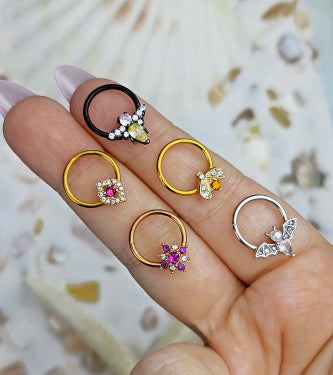
These create a ring-shaped look rather than the classic barbell profile. Hinged clickers open and close with a mechanism, while styles rely on a smooth join.
Reserve them for a fully healed navel unless a qualified piercer specifically recommends otherwise. The ring must match your anatomy closely, or its movement can create pressure and irritation.
Flexible bioplast bars
Flexible bars made from bioplast or PTFE can be useful around pregnancy, changing body shape, or active movement. They're also worth discussing with a professional if rigid jewelry creates pressure.
Don't treat flexibility as a substitute for fit. Pregnancy and sports can change how the area folds and rubs, so ask a piercer about the right length and when to switch.
| Style | Shape | Best For | Watch Out For |
|---|---|---|---|
| Classic curved barbell | Curved bar with top and bottom ends | Everyday traditional styling | Heavy ends and snagging |
| Reverse ring | Decorative end sits above the navel | Top-focused detail | Pressure on shallow anatomy |
| Dangle or chandelier | Hanging charms or layered drops | Festivals, beach looks, statement outfits | Weight, movement, and friction |
| Fixed gem | Low-profile stone or decorative end | Simple daily sparkle | Rough settings or loose stones |
| Seamless or clicker | Circular ring shape | Healed piercings and quick changes | Movement and incorrect diameter |
| Flexible bar | Soft, bendable bar | Pregnancy or active lifestyles | Poor fit and unsuitable materials |
Materials That Matter for Sensitive Skin and Long-Term Wear
Material choice becomes more important when your skin has reacted to earrings, belt buckles, watchbands, or previous body jewelry. The metal that looks affordable in a photograph may not be the metal your piercing tolerates.
Implant-grade titanium
For new piercings and sensitive skin, implant-grade titanium, especially ASTM F136 titanium, is the usual starting point. It's lightweight and corrosion-resistant, and expert guidance commonly favors it for new navel jewelry because lower-biocompatibility or nickel-containing metals can increase irritation risk, as explained in this navel jewelry material guide.
Choose titanium when the piercing is healing, your allergy history is unclear, or you want to reduce avoidable variables. Confirm that the listing identifies the material clearly rather than using a vague label such as “hypoallergenic.”
Surgical steel
316L surgical steel is often chosen as an affordable everyday material. It can work well for some healed piercings, but it may contain nickel, which matters if you've experienced contact dermatitis or persistent irritation.
Ask what grade the seller lists and how your skin has handled steel before. “Surgical” by itself doesn't tell you everything about alloy composition or your personal tolerance.
Solid gold
Solid 14k or 18k gold can suit healed piercings when the alloy is appropriate and the finish is smooth. It offers a polished, jewelry-like look for people who plan to keep one piece in for a long time.
Avoid confusing solid gold with gold plating. Plating is a surface layer that can wear away, exposing the underlying metal. Guidance on navel jewelry commonly lists solid 14k or 18k gold as an option for healed piercings, not as a casual substitute for implant-grade material in a fresh piercing, according to this 2026 navel piercing guide.
Plated, PVD, and flexible materials
Gold-plated and PVD-coated pieces can provide fashion color at a lower cost, but the coating can wear with friction, cleaning, and regular use. Keep them for a settled piercing and monitor your skin.
Bioplast and PTFE flexible bars can be useful for pregnancy or sports, but flexibility doesn't make an unknown material safe. Porous stones and rough finishes can also hold residue, making them less suitable for a healing channel.
Material rule: A healing piercing needs the most predictable, body-compatible jewelry you can choose. Save experimental finishes and fashion coatings for a piercing that has fully settled.
How to Get the Right Gauge and Length Every Time
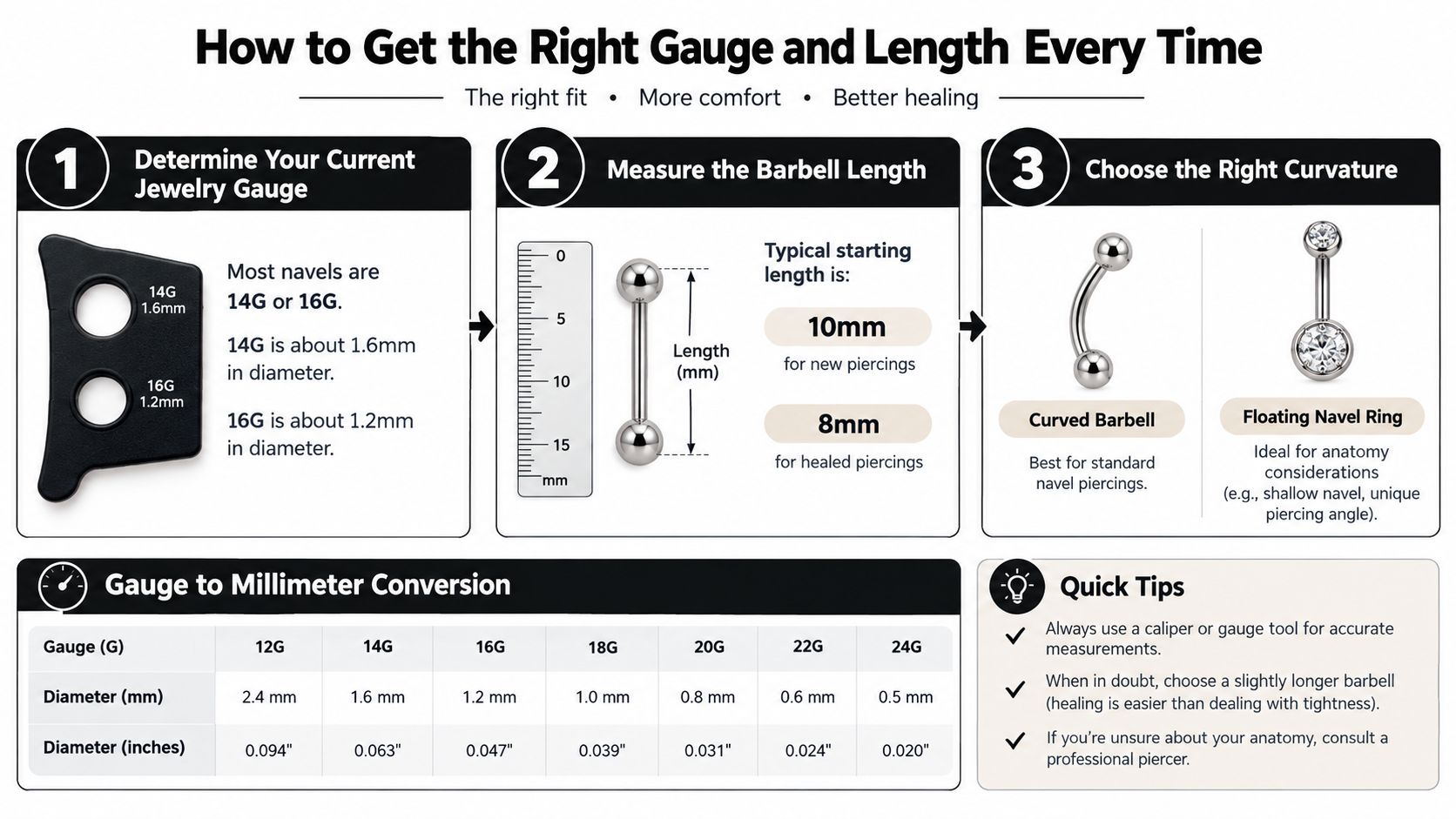
Sizing has three separate parts: gauge, bar length, and curvature. Product listings may show all three, so knowing what each means prevents the classic mistake of buying a ring that looks right but doesn't fit.
Gauge describes the thickness of the bar. Navel jewelry commonly uses 14 gauge, or 1.6 mm, while some listings offer 16 gauge, or about 1.2 mm, as described in this BodyCandy sizing guide. Don't switch thickness casually. A thinner bar can be less stable for some piercings, while a thicker bar may not pass comfortably through your existing channel.
Length measures the wearable bar between the decorative ends. Common navel sizes include 3/8 inch, or 10 mm, and longer options such as 7/16 inch, or 11 mm, or 1/2 inch, or 12 mm, when swelling or anatomy requires extra clearance, according to this belly ring size guide. A bar that's too short can press into tissue. A bar that's too long can move, catch, and irritate the area.
Measure before you order
- Check your current gauge. Look at the original jewelry paperwork, ask your piercer, or use a gauge tool. Don't guess from a product photo.
- Measure the wearable length. Remove the jewelry only if the piercing is fully healed and you can do so safely. Measure the bar between the ends, not the entire decorative piece.
- Account for anatomy. A curved barbell suits many standard navels. A floating navel ring may work better when the lower part of the navel collapses or when a traditional bottom decoration creates pressure.
- Use a paper strip if needed. Place a narrow strip across the piercing area, mark the distance between the entry and exit points, then measure that distance with a ruler. Add only the clearance your piercer recommends.
Aftercare Basics for New and Healed Navel Piercings
A new navel piercing needs a boring routine. That's good news. The fewer unnecessary products and movements you introduce, the easier it is to notice what your skin needs.
For a new piercing
During the early healing period, clean with sterile saline twice daily, usually morning and night. Wash your hands first, spray or apply the saline as directed, let softened residue loosen naturally, and pat the area dry with a clean disposable paper towel.
Avoid fragrance-heavy soaps, alcohol, hydrogen peroxide, and aggressive scrubbing. Skip pools, hot tubs, and other water that can expose the fresh piercing to contamination. Tight waistbands, stomach sleeping, twisting the jewelry, and removing it early can all create extra friction.
Early tenderness, mild redness, and a small amount of crusting can happen during normal healing. A snag from clothing may cause temporary irritation, but repeated trauma can keep the channel unsettled.
For a healed piercing
Healed doesn't mean maintenance-free. Clean the jewelry and surrounding skin as needed, especially after sweat, sunscreen, or swimming, and check that threaded ends remain secure.
Only change jewelry when the piercing is settled. If insertion feels tight, painful, or dry, stop rather than forcing the bar through. A professional piercer can assess the channel and help you choose a safer length or style.
For flexible pregnancy jewelry and fit changes, use a professional reference such as BodyCandy's pregnancy belly ring guide, especially if your abdomen is changing or the jewelry begins to pull.
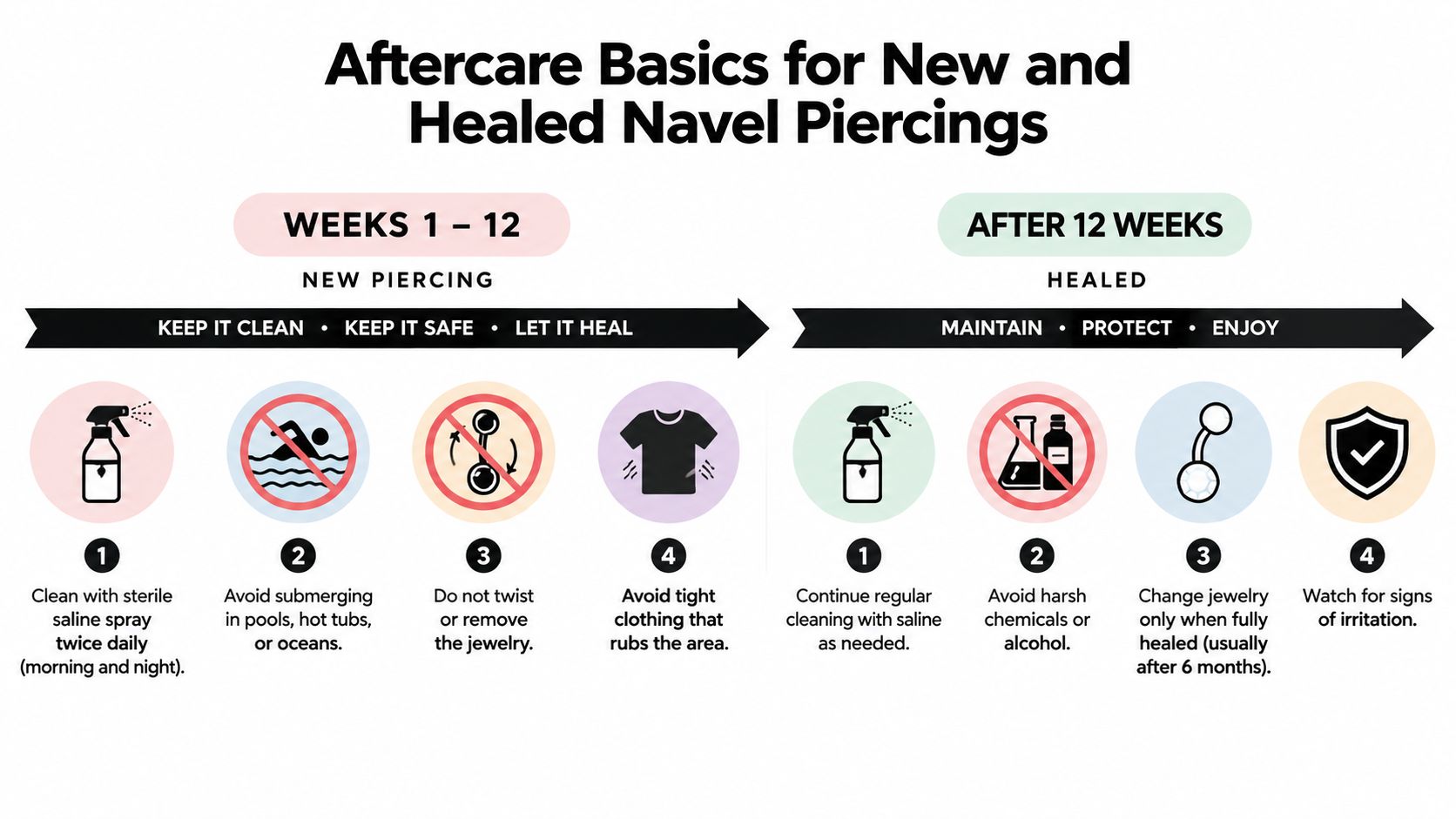
A short visual refresher can help if you're unsure which habits to keep.
Red Flags and When to Stop Self-Treating
Not every bit of redness means infection, and not every problem should be handled with more cleaning. The navel bends, catches on clothing, and experiences friction, so a snag can leave it sore for a while. The important question is whether symptoms are settling or getting worse.
Medical literature describes uncommon but severe complications, including bacterial endocarditis, pyogenic liver abscess, and toxic shock syndrome, in discussions of body-piercing risks documented by the American Academy of Family Physicians. A 2024 study also identified navel piercings among sites associated with reported complications, with 16.7% of people with navel piercings reporting issues in that sample, as documented in this body-piercing complications study.
Compare the pattern, not one symptom
| Symptom | Normal Healing | See a Professional |
|---|---|---|
| Redness | Mild and limited near the holes | Expanding redness around the top or bottom hole |
| Pain | Tender after movement or a recent snag | Hot, throbbing, or steadily worsening pain |
| Discharge | Small amount of light crusting | Yellow or green discharge, especially with a foul smell |
| Swelling | Mild swelling that gradually settles | Persistent swelling past three months or jewelry embedding |
| Skin changes | Temporary irritation after friction | Red streaks radiating outward |
| Whole-body symptoms | None | Fever, chills, or feeling unwell |
A piercer can help with jewelry length, angle, pressure, migration, and mechanical irritation. A doctor should evaluate suspected infection, spreading redness, fever, severe pain, or symptoms involving your whole body.
Don't remove the jewelry on your own when infection is suspected unless a clinician tells you to. Closing the outside of a piercing can trap infection inside, so get medical guidance before making that decision.
Styling Your Navel Ring for Real Wardrobes
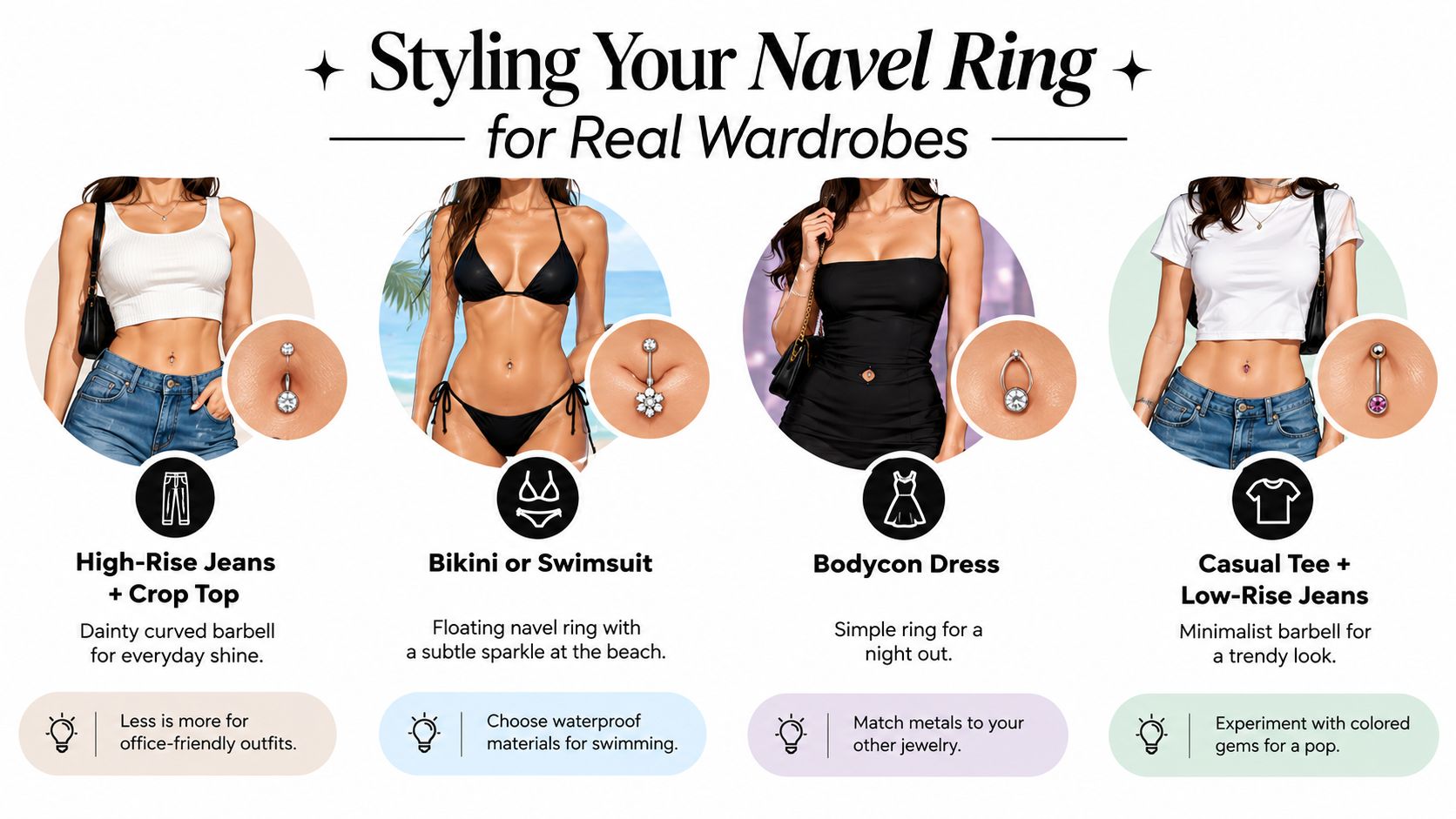
The easiest way to style a navel ring is to start with the clothes you already reach for. A dainty curved barbell brings a small flash of light to high-rise jeans and a crop top without competing with the rest of the outfit. For office-friendly dressing, keep the piece low-profile and let the waistband sit comfortably away from the jewelry.
A floating navel ring works well with swimwear because its lower profile can reduce bulk. Choose a material and finish that suit water exposure, and remember that a healing piercing shouldn't be submerged because the jewelry looks beach-ready.
Match the drop to the outfit
- Everyday denim: Choose a short curved barbell or fixed gem. It's less likely to catch when you sit or tuck in a shirt.
- Bikini or swimsuit: A floating style gives subtle sparkle. Check that the fit doesn't press when you bend.
- Festival or beach cover-up: A dangle or chandelier ring makes the jewelry part of the outfit. Use it with a fully healed piercing and inspect the charm for snag points.
- Night-out dress: A simple ring or polished gem works under a bodycon dress, provided the setting is smooth and the bar doesn't create a visible bump.
- Casual tee and lower-rise jeans: A minimalist barbell keeps the look relaxed. Test the waistband before wearing it for a full day.
Color can do some of the styling work. Clear cubic zirconia suits neutral wardrobes, opal complements softer pastel palettes, and deep blue or emerald tones stand out against jewel-colored clothing.
Your proportions matter too. Shorter dangles can look balanced on a shorter torso, while an elongated drop can draw the eye vertically on a longer midsection. Whichever look you choose, confirm the gauge, bar length, and material before prioritizing the color.
For more outfit ideas, explore bikinis and belly rings together, then filter the look through your piercing's healing stage and fit.
Your Final Checklist Before You Click Add to Cart
A good product page should answer more than “Is it cute?” Before you buy a belly button rings navel ring option, pause over the details that affect comfort and longevity.
Check the jewelry itself
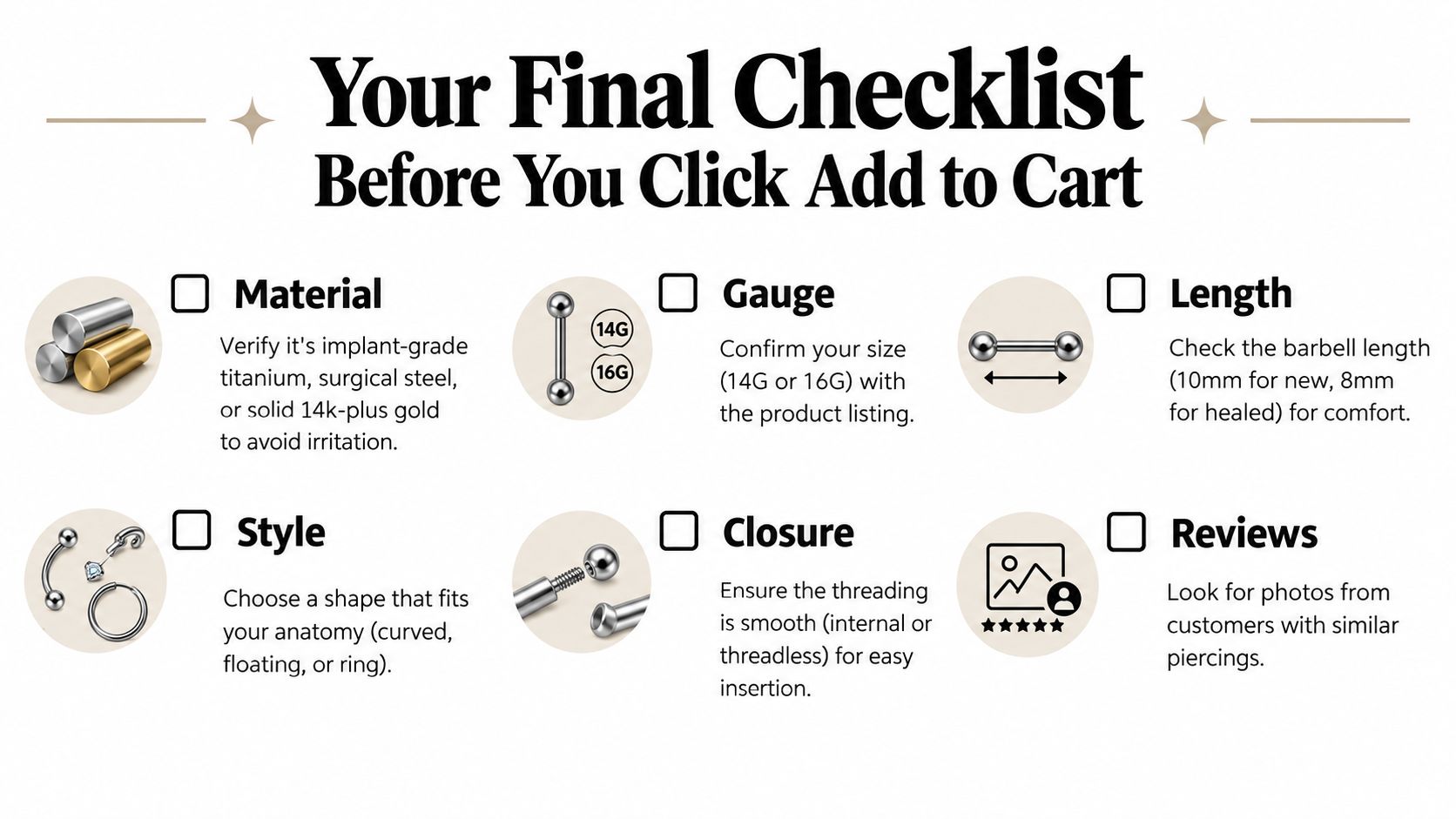
- Material: For sensitive skin, look for clearly identified implant-grade titanium, suitable surgical steel, or solid 14k-plus gold for a healed piercing.
- Gauge: Confirm that the bar matches your current piercing, commonly 14G, or another size verified by your piercer.
- Length: Check the wearable bar length, not just the total jewelry height. Newer or swollen piercings may need more clearance, while settled piercings often use a shorter fit.
- Shape: Choose a curved barbell for a standard fit, a floating design for anatomy that collapses or dislikes lower bulk, or a ring style only when the piercing is fully healed.
- Setting: A bezel can offer a smooth profile. If you choose prongs, inspect them for snagging and make sure the stone is secure.
- Threading: Internal threading or a threadless closure can make insertion more comfortable. The bottom ball should loosen smoothly without force.
- Wear conditions: Consider waistbands, exercise, swimming, sleep position, and whether a dangle will move constantly against fabric.
- Seller details: Look for clear material information, return terms, and any available certification or sterilization details.
- Customer photos: Reviews with photos can help you judge scale, drop length, and how the style sits on bodies with similar anatomy.
Don't use a style photo to estimate fit. Compare the listing's measurements with your current jewelry or ask a professional piercer to confirm what your navel needs.
Once the practical boxes are checked, choose the piece that fits your wardrobe and your personality. BodyCandy offers a dedicated selection of belly rings, including dangle belly rings and J-curve navel jewelry, so you can apply these material, size, and style checks while browsing the catalog.
Ready to choose a navel ring that looks good and makes sense for your piercing? Visit BodyCandy to browse belly button rings in different styles, materials, and silhouettes, then compare each product's gauge, length, and closure before you buy. Bring your shortlist to a professional piercer if you're unsure about fit, healing, or sensitive skin.