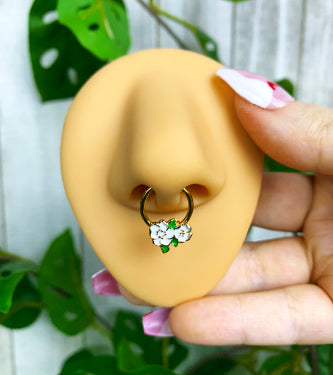








You're outside the piercing studio, or maybe you're scrolling nose rings at 11 p.m., telling yourself you'll book tomorrow. You're excited, nervous, and suddenly wondering whether a nostril or septum piercing hurts more, which metals are safe, and whether you can really handle months of aftercare. Those are the right questions.
A nose piercing is a style choice, but the jewelry you start with is also a healing and safety decision. Placement, fit, material, studio hygiene, and your willingness to leave the jewelry alone will shape the experience long after the initial pinch disappears. This is the pre-appointment checklist that replaces impulse with informed intent.
You Want a Nose Piercing, Now What
Before you book, decide whether the placement fits your face, routine, workplace, and patience. A small nostril stud may look effortless while the channel stays vulnerable for months. A septum can be easier to hide. Bridge and rhino piercings call for more specific anatomy, styling preferences, and long-term commitment.
Book a real consultation, not the fastest available appointment. Your piercer should assess your anatomy, discuss placement, explain healing demands, and recommend jewelry that suits the initial swelling. The starter piece is part of the safety plan, not an accessory you can choose casually afterward.
Choose documented quality over a cheap mystery finish. Implant-grade titanium, correctly fitted starter jewelry, and sterile technique give the piercing a better chance to heal with less irritation. If earrings have caused itching or a rash before, treat nickel reactivity as a serious warning. Gold or platinum may suit people with metal hypersensitivity, while sterile saline and avoiding unnecessary touching help limit irritation. MedicineNet's guidance on infected nose piercings and metal sensitivity explains how metal reactions can resemble infection and why proper care matters.
Ask these questions before you hand over a deposit:
- Which placement suits my anatomy?
- What material and grade is the starter jewelry?
- How much room does it leave for swelling?
- When should I return for a fit check or downsizing?
- Which symptoms require help from the studio or a doctor?
- Will you provide aftercare instructions in writing?
Pay attention to the answers. A reputable studio will explain why a material, size, or placement fits your body, rather than pushing whatever looks cheapest or sells fastest.
The aim is a manageable healing process, with temporary soreness and watery eyes instead of a preventable metal reaction, excessive pressure, or a studio you should never have trusted.
Picking the Right Nose Piercing for You
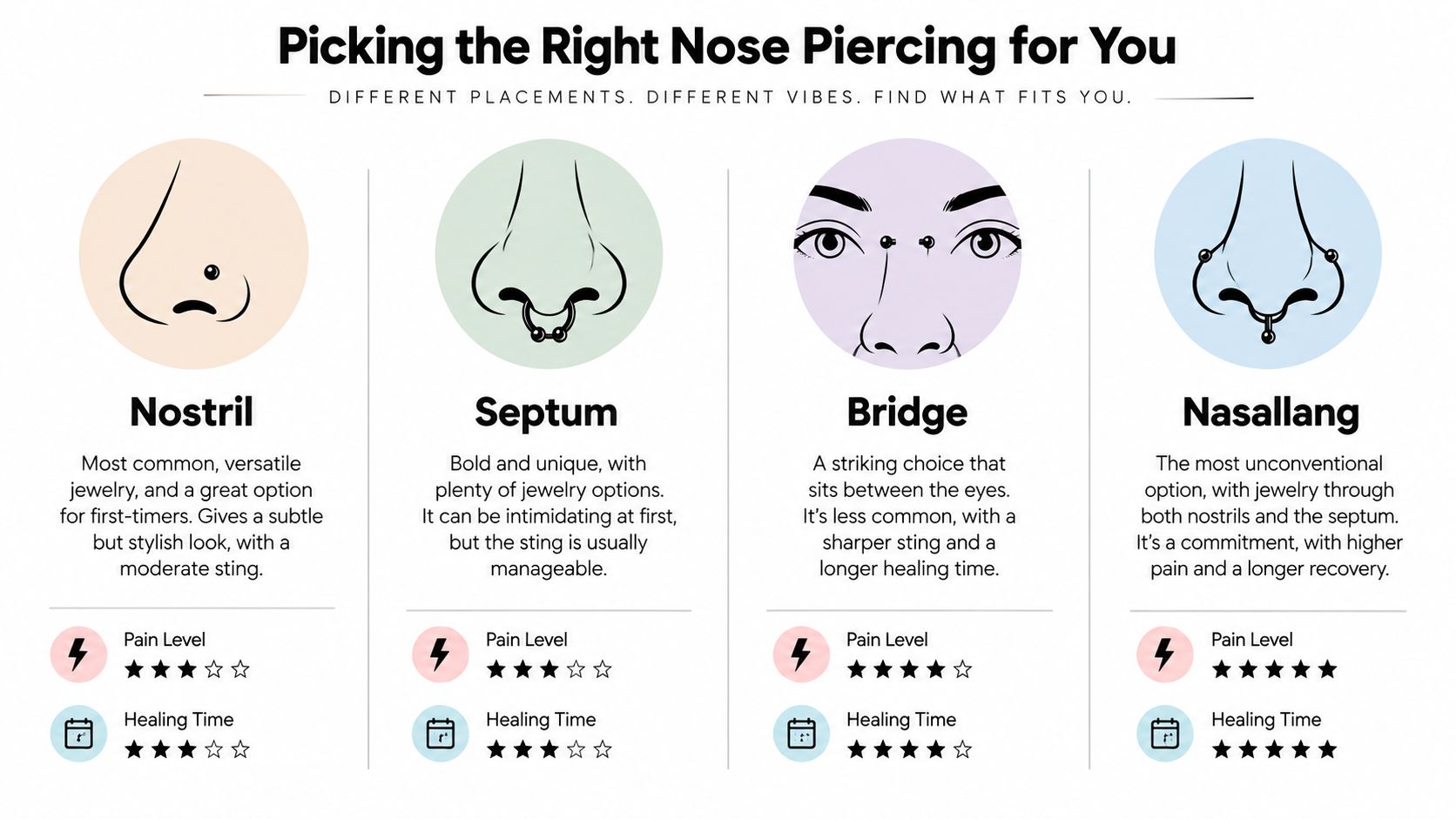
The right nose piercing should fit your anatomy, daily routine, and tolerance for a longer healing process. Nostril, septum, bridge, and rhino piercings place jewelry through different tissue, so the style you like is only part of the decision. Jewelry material matters from the first consultation, especially if earrings have caused itching or a rash. Choose a studio that uses documented-quality starter jewelry, not a mystery finish that could trigger nickel reactivity.
Nostril
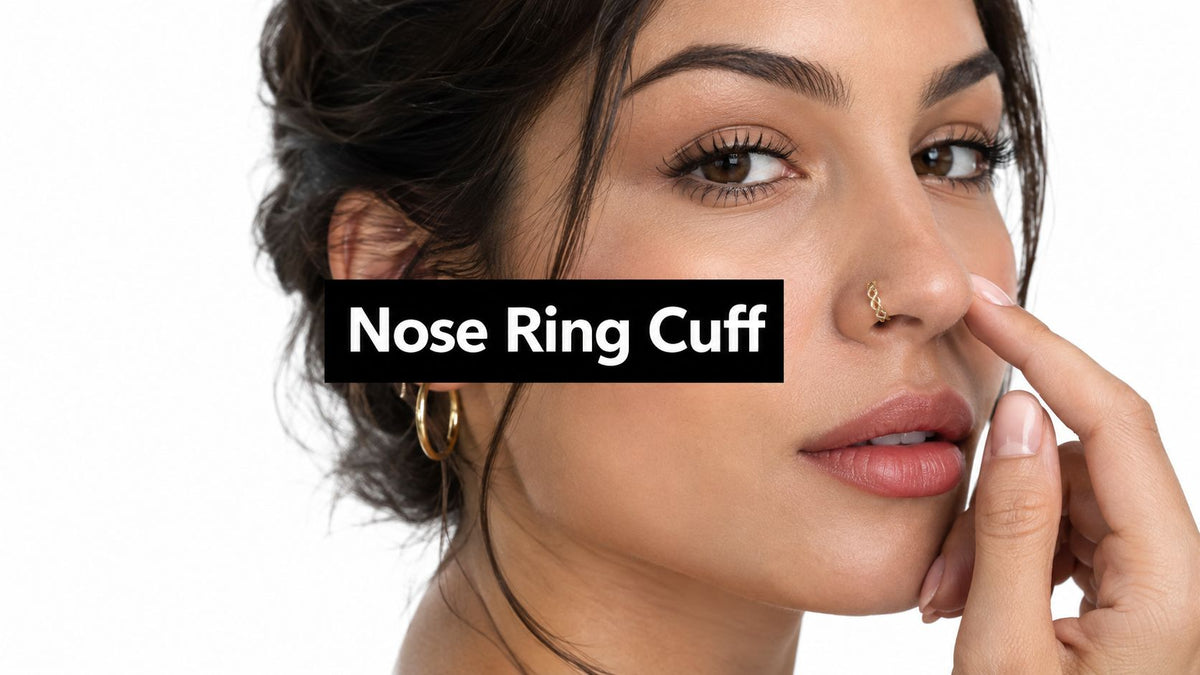
A nostril piercing is a sensible first choice for many people. It passes through nostril tissue and works with flat-back labrets, nostril screws, and L-shaped studs. Once healed, you can switch to a hoop. Expect a quick pinch, warmth, and soreness.
A small top can stay discreet for work or school, while a larger piece makes a clearer statement. Your piercer should assess the nostril's shape and thickness before setting the placement and choosing a post with room for initial swelling. Implant-grade titanium is a strong starter option, particularly if your skin reacts to nickel. Downsizing later should happen after a fit check, not as a guess at home.
Septum
A correctly placed septum passes through the soft tissue between the nostrils, often called the “sweet spot,” rather than thick cartilage. The sensation is usually a brief, intense squeeze. Circular barbells, clickers, captive rings, and retainers give this placement plenty of styling and hiding options.
Accuracy matters more than a dramatic first impression. A crooked or poorly placed septum can create pressure, irritation, and a frustrating healing period. Ask how the starter ring or horseshoe will fit your anatomy, and confirm that the material and finish are suitable before paying a deposit. For names and placement differences, BodyCandy's nose piercing index is a useful reference.
Bridge
A bridge piercing crosses the skin over the nose's bridge, usually with a straight barbell. It creates a bold horizontal look, but it is a surface piercing, so migration or rejection deserves close attention.
Choose it only if you are comfortable with high visibility and careful monitoring. It is a poor first pick for anyone seeking the simplest healing process. Starter jewelry must allow swelling without pressing into the tissue, and the piercer should explain when to return for a fit check.
Rhino or vertical tip
A rhino, also called a vertical tip piercing, travels through the nose tip and shows jewelry at both ends. The tissue is thicker and the placement is more complex, so anatomical assessment, appropriate jewelry fit, and patience all matter.
More complex placements such as rhino or nasallang piercings can take 6 to 9 months to heal. Choose this style because you want it, not because it looks like a quick upgrade. A longer healing timeline leaves even less room for cheap metal or poorly fitted starter jewelry.
What It Feels Like and How Long It Heals
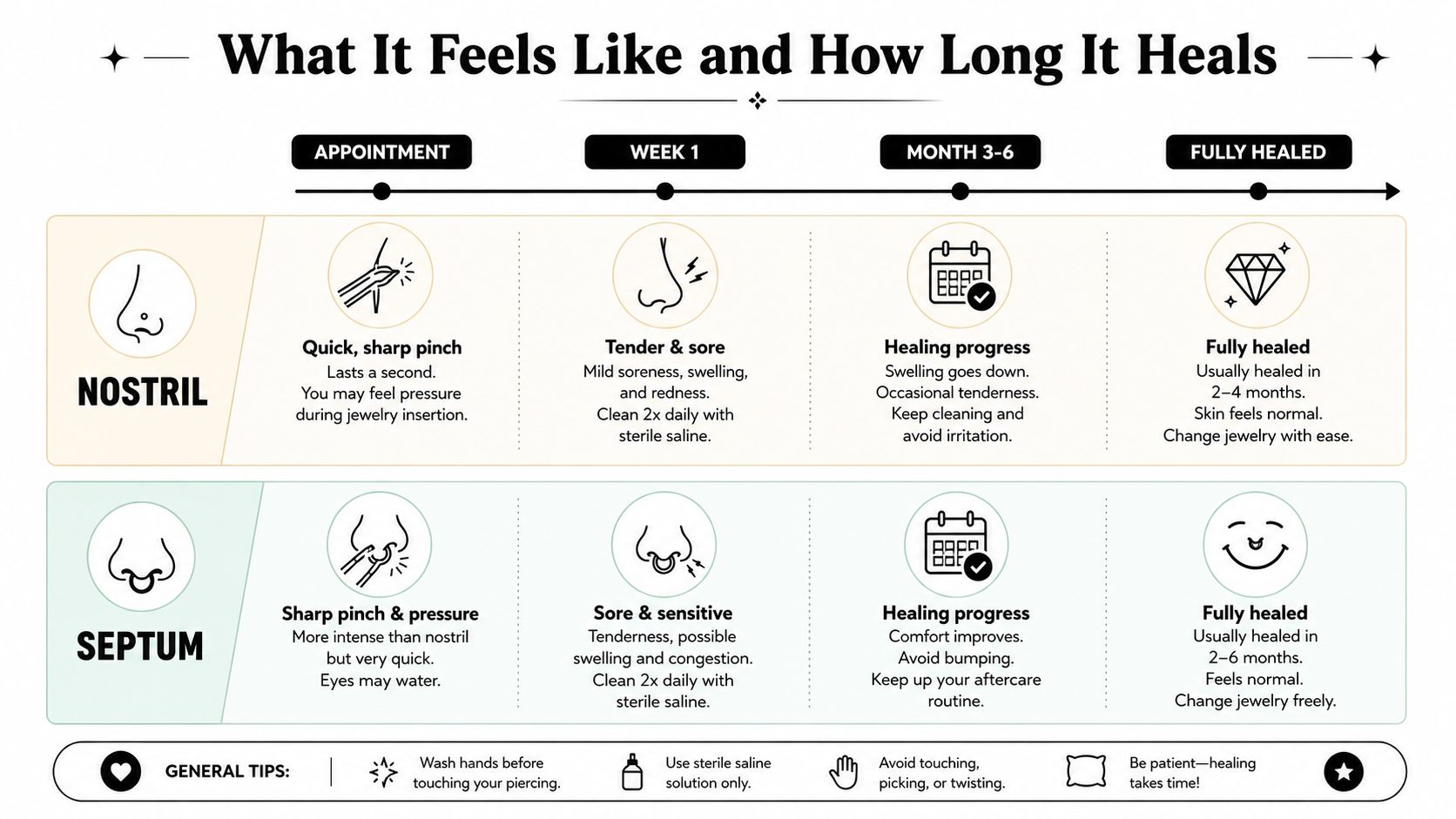
The needle is over quickly. The healing period is where your choices, especially jewelry material and fit, decide whether the piercing settles or stays irritated.
A nostril piercing usually brings a sharp pinch, watery eyes, warmth, and soreness through the rest of the day. A septum can feel like a stronger squeeze lasting several seconds. Bridge piercings may sting and throb longer because jewelry passes through surface tissue. Anatomy, technique, stress, and personal pain tolerance all affect the experience, so someone else's pain rating will not predict yours.
The outside can lie
Nostril piercings usually need about 4 to 6 months to heal. Septum healing often takes 6 to 8 weeks or 2 to 3 months, depending on placement, as summarized by Healthline. More complex placements can take longer. Treating any nose piercing as healed in under 2 months is a poor bet.
A calm surface does not prove the internal channel is ready for a hoop, a new gauge, or frequent jewelry changes. Cartilage-rich areas and thicker tissue mature more slowly than softer placements. Jewelry also matters throughout healing. A properly fitted, low-reactivity starter piece reduces avoidable irritation, while nickel-reactive metal or excessive movement can keep the channel inflamed.
Use this rhythm:
- Early days: Expect tenderness, warmth, mild swelling, and some crusting.
- Several weeks in: The piercing may look calmer, yet pressure and movement can still trigger irritation.
- Months into healing: The outside may appear normal while the inner channel continues strengthening.
- Before a jewelry change: Have your piercer assess stability and fit instead of judging by appearance alone.
The honest timeline: Your nose may look healed before it is healed. Treat the internal channel as the authority.
A WebMD overview of nose piercing safety recommends leaving initial jewelry in place until the piercing is stable internally. Twisting, premature changes, nickel-reactive material, or a poorly fitted post can reopen tiny injuries and prolong healing. Downsize only after your piercer confirms that swelling has settled and the jewelry still leaves appropriate room.
Jewelry Materials and Sizing That Actually Matter
Your first nose jewelry should support healing, not merely match your outfit. Material, fit, and finish determine whether your piercing gets a quiet healing environment or a constant source of irritation. Nickel reactivity belongs in the decision from the start, because a poor material choice can keep a new piercing red, itchy, and uncomfortable.
Implant-grade titanium is my first recommendation for sensitive skin and fresh piercings. Look for a recognized implant specification, such as ASTM F136, instead of trusting “titanium-looking” jewelry or an unspecified alloy. Implant-grade stainless steel, such as ASTM F138, can suit people who already know they tolerate it. Solid gold may work when its karat and construction are appropriate. Plated brass, mystery alloys, and unlabeled “surgical steel” are poor bets for a healing piercing.
Nickel irritation can resemble infection. Persistent itching, redness, or general aggravation may come from the metal, pressure, or both. Choose a documented, low-reactivity material before the piercing is performed, not after problems begin. For a practical comparison of jewelry materials, read The Nose Knows guide to choosing nose jewelry material.
Fit is part of safety
Starter jewelry needs room for initial swelling, but excess length creates its own problems. A post that sticks out catches on towels and clothing. One that is too short can press into swollen tissue, encourage embedding, and make cleaning harder. Ask your piercer to assess the fit during healing, then shorten the post only when the swelling has settled.
Gauge means jewelry thickness. Post length matters for studs and flat-back labrets, while ring diameter matters for hoops. Product photos cannot tell you what fits your anatomy. Have your piercer measure the placement and match the jewelry to the channel.
| Material | Biocompatibility | Nickel risk | Cost range | Best for |
|---|---|---|---|---|
| Implant-grade titanium | High when properly certified | Low | Varies | New piercings and sensitive skin |
| Implant-grade stainless steel | Suitable for many wearers | Can matter for sensitive users | Varies | People who know they tolerate the grade |
| Solid gold | Can be suitable when properly made | Depends on alloy | Varies | A quality look after professional material review |
| Plated or mystery alloy | Unclear | Unclear or higher | Often lower | Not my recommendation for healing |
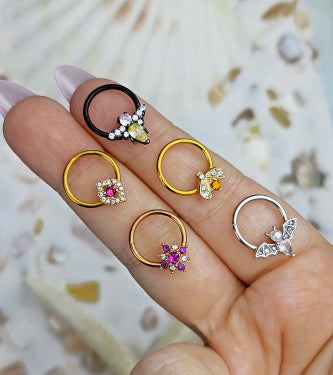
Flat-back labrets are comfortable and stable for many nostril placements. Nostril screws and L-shapes can work, but security and insertion differ by anatomy. Save hoops, clickers, captive rings, and continuous rings for a mature piercing. Starting with a fashionable ring can add movement and pressure before the channel is ready.
How to Spot a Reputable Piercer
A beautiful portfolio doesn't compensate for careless sterilization. Spend a few minutes vetting the studio before you hand anyone your nose.
Look for visible process
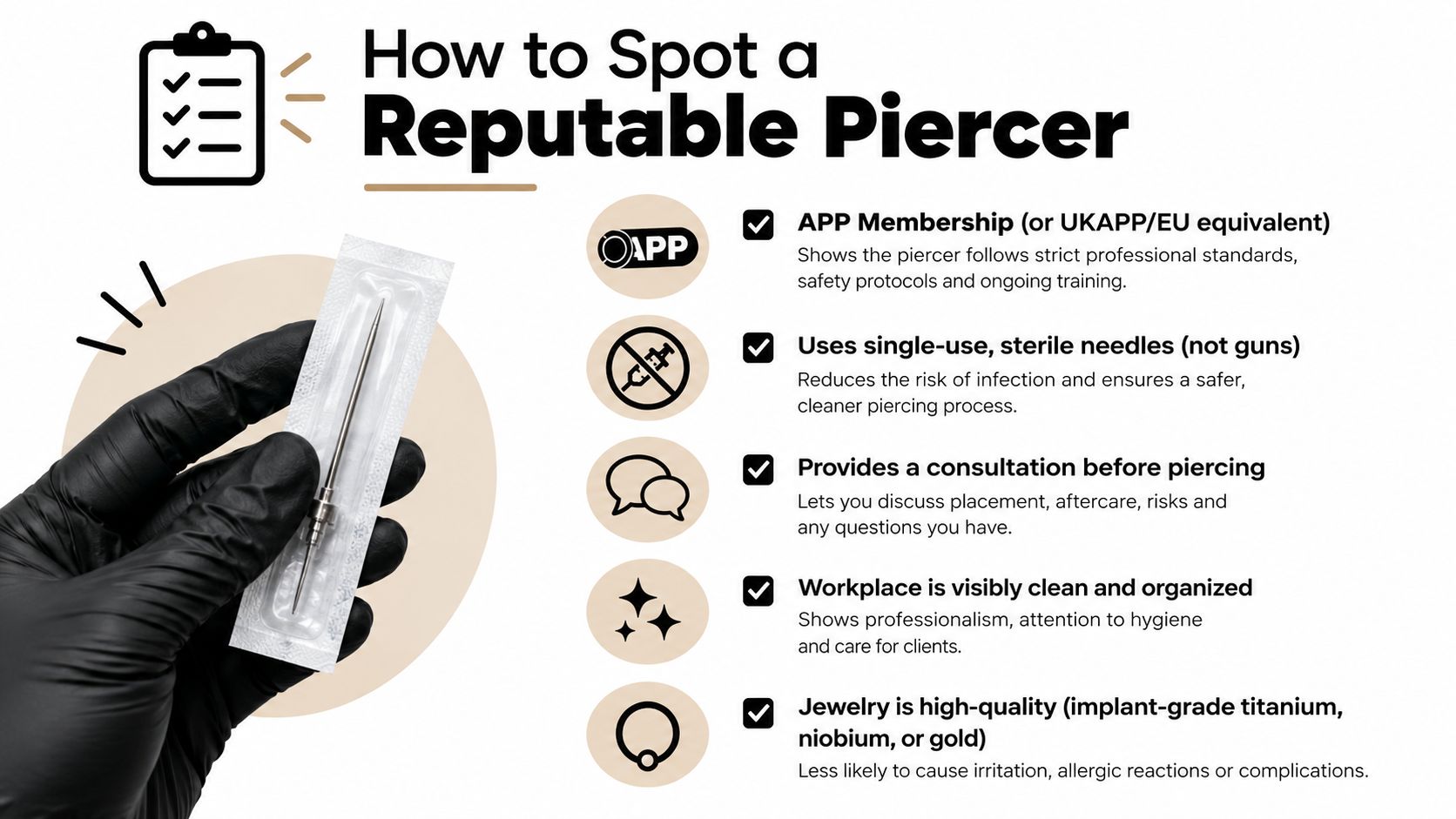
Membership in the Association of Professional Piercers, or an equivalent organization such as UKAPP or a relevant European affiliation, is a useful starting point. It isn't the only qualification, but it signals that the piercer takes standards seriously.
The studio should look organized, clean, and intentionally clinical. Ask whether the shop uses an autoclave, whether sterilization is monitored with spore testing, and whether tools are opened from sealed packaging in front of you. Your piercer should put on fresh gloves immediately before the procedure and use a single-use sterile needle.
A piercing gun is a deal breaker for nose cartilage. Guns create blunt-force trauma and aren't appropriate for this work. If someone says, “We use a gun for cartilage,” leave.
Ask questions that reveal competence
A good piercer won't act offended when you ask about:
- Healed work: Request portfolio photos that show fully healed piercings, not only fresh appointments.
- Jewelry grades: Ask for the exact material and certification, especially if you have sensitive skin.
- Anatomy: Expect an assessment before the piercer agrees to a placement.
- Aftercare: You should receive clear written instructions, not a vague “keep it clean.”
- Follow-up: Ask how fit checks and jewelry adjustments are handled during healing.
Poor hygiene, unsterilized instruments, and unsuitable jewelry are repeatedly identified as contributors to nose piercing infections by Massachusetts Eye and Ear's nose piercing infection guidance.
Check reviews for photos of healed work, not just comments about friendly staff. Local piercing communities can also point you toward studios with consistent results. BodyCandy's professional piercing checklist is a practical reference to keep open while you compare studios.
Booking the Appointment and Showing Up Ready
Call the studio before booking and ask about age, consent, identification, jewelry, and payment rules. In the United States, minors are often pierced with parental consent and may need a parent physically present, with identification for both people. Some states and many European countries set a hard minimum age of 18 for nasal piercings, so don't assume another studio's policy applies to you.
Eat a real meal roughly 1 to 2 hours before the appointment, drink water, and avoid alcohol and blood-thinning painkillers for 24 hours. These preparation recommendations appear in BodyCandy's nose piercing preparation guidance. If a medication is prescribed, don't stop taking it without speaking with your healthcare professional.
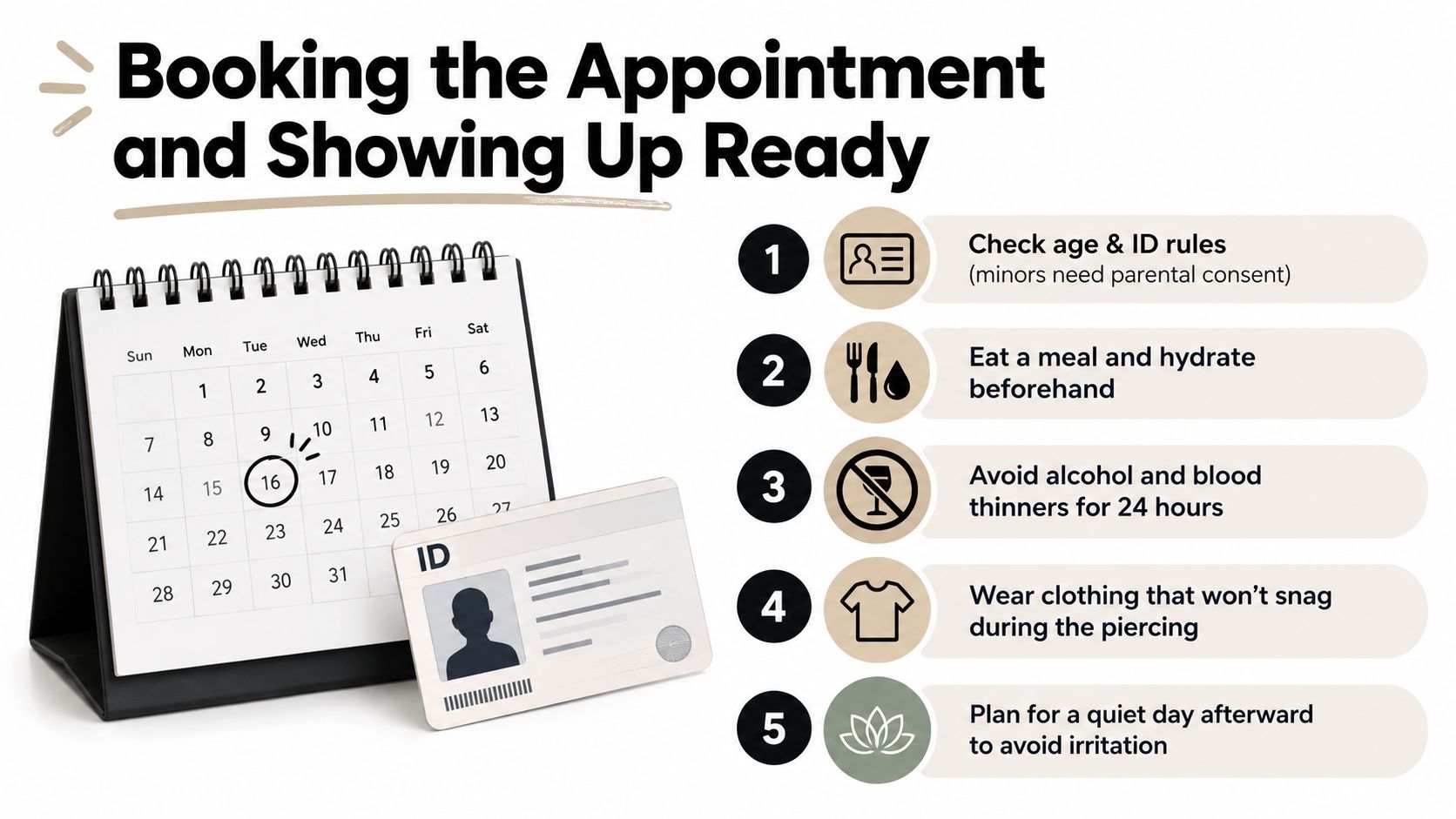
Wear a clean shirt that won't snag the jewelry as you pull it over your head. Skip heavy makeup around the nose, and don't arrive with irritated skin. If you wear contacts and tend to flinch when anything approaches your face, glasses may feel more comfortable that day.
The appointment should include consent forms, a conversation about placement and anatomy, marking, your approval of the mark, sterile setup, the piercing, and aftercare instructions. A reputable piercer may refuse to work over an active sunburn, cold sore, or recent sinus infection. That isn't inconvenient. It's responsible.
Bring:
- Valid photo ID and any required parental documentation
- Your preferred starter jewelry, if the studio hasn't preselected it
- A payment method, since some studios still have specific payment policies
- A calm schedule afterward, without swimming, intense face contact, or unnecessary errands
Aftercare From Day One to Fully Healed
The first week deserves your strictest attention because a fresh nose piercing has a higher infection risk during that period. Cleveland Clinic recommends cleaning twice daily, keeping hands off the piercing, and avoiding swimming until it heals.
Use sterile saline spray as directed by your piercer. If you're using a homemade saline mixture, one referenced approach is one-quarter teaspoon of non-iodized salt in 8 ounces of distilled water, described in BodyCandy's nose piercing aftercare guidance. Prepare it carefully and avoid making the solution overly salty, which can dry and irritate tissue.
Keep the routine boring
- Clean hands first: Wash your hands before going near the area.
- Use gentle saline: Spray or rinse without scrubbing.
- Rinse after showers: Remove shampoo, cleanser, and other residue.
- Dry carefully: Pat around the area with a clean disposable material.
- Leave jewelry alone: Don't twist, rotate, remove, or “test” it.
Alcohol, hydrogen peroxide, harsh cleansers, ointments, and tea tree oil don't belong on a healing piercing. They can damage fragile tissue and make irritation harder to interpret. Cotton swabs can also leave fibers behind or encourage fiddling, so skip them.
Avoid swimming pools, hot tubs, lakes, makeup around the piercing, harsh skincare acids, and face masks that snag. Keep your phone away from the healing nostril, use a clean pillowcase, and avoid sleeping directly on the jewelry.
Your starter post may need professional adjustment once swelling changes. Don't turn that into a DIY jewelry swap. Urban Body Jewelry's aftercare information distinguishes between a piercing that looks healed at the surface in 2 to 3 months and one whose internal tissue may need 4 to 6 months or more before jewelry changes are safe.
Simple rule: Saline, clean hands, no trauma, and patience beat aggressive cleaning every time.
Spotting Trouble Before It Becomes a Problem
Some noise is normal. Early tenderness, mild redness, slight crusting, and occasional throbbing can happen while the tissue settles. What matters is the direction of the symptoms. Improvement followed by spreading redness, increasing heat, worsening pain, or thick yellow or green discharge deserves attention.
Infection risk isn't theoretical. A 2015 Wales public-health review found that 36.3% of clients reported a subsequent skin infection after piercing, with a rate of 28% among clients under age 16 and 38% among those aged 16 and older. A systematic review also summarized earlier research reporting superficial localized infection rates from 10% to 30%, while another study found 45% of American and Australian college students reported an infection at a piercing site. These figures come from broader piercing research and don't mean every nose piercing will become infected, but they explain why studio standards and aftercare matter. See the systematic review of body piercing complications for the cited context.
A bump isn't automatically an infection. Irritation bumps often follow pressure, snagging, overcleaning, or an ill-fitting post. A granuloma may appear as a persistent fleshy bump, while a keloid is a firm overgrowth that extends beyond the original wound and needs professional medical assessment. Itching and redness can also point to metal reactivity, especially when the jewelry's composition is unclear.
| Symptom | Likely normal healing | See your piercer | See a doctor |
|---|---|---|---|
| Tenderness | Mild and gradually settling | Pain returns after improvement | Severe or worsening pain |
| Redness | Limited to the piercing area | Persistent redness with irritation | Spreading redness or red streaking |
| Discharge | Light, clear crusting | Repeated irritation around jewelry | Thick yellow or green discharge |
| Bump | Small irritation bump after friction | Persistent bump or suspected fit issue | Fever, chills, or rapidly worsening swelling |
| Jewelry position | Stable and comfortable | Looks tight, sinks, or migrates | Tissue damage or breathing difficulty |
Don't remove jewelry on your own if you suspect infection. Contact a qualified piercer for a fit and material check, and seek medical care for fever, chills, red streaking, severe swelling, or rapidly worsening symptoms. A doctor, not a salt soak, should handle those warning signs.
BodyCandy offers a broad selection of nose rings and body jewelry in styles suited to different looks, so you can focus on fit and clearly identified materials instead of grabbing the cheapest mystery piece. Visit BodyCandy to browse nose jewelry for your next professionally approved change, and keep your piercer involved whenever a healing piercing needs sizing or material advice.