














You want the nose ring look, but you're not sure you want the needle, the healing process, or a piece of jewelry you'll wear every day forever. Maybe you're getting ready for a festival, planning a photoshoot, or just curious about how a hoop would look on your nose. A nose ring cuff gives you a quick, non-piercing way to test the style before making a permanent choice.
Introduction What a Nose Ring Cuff Really Is
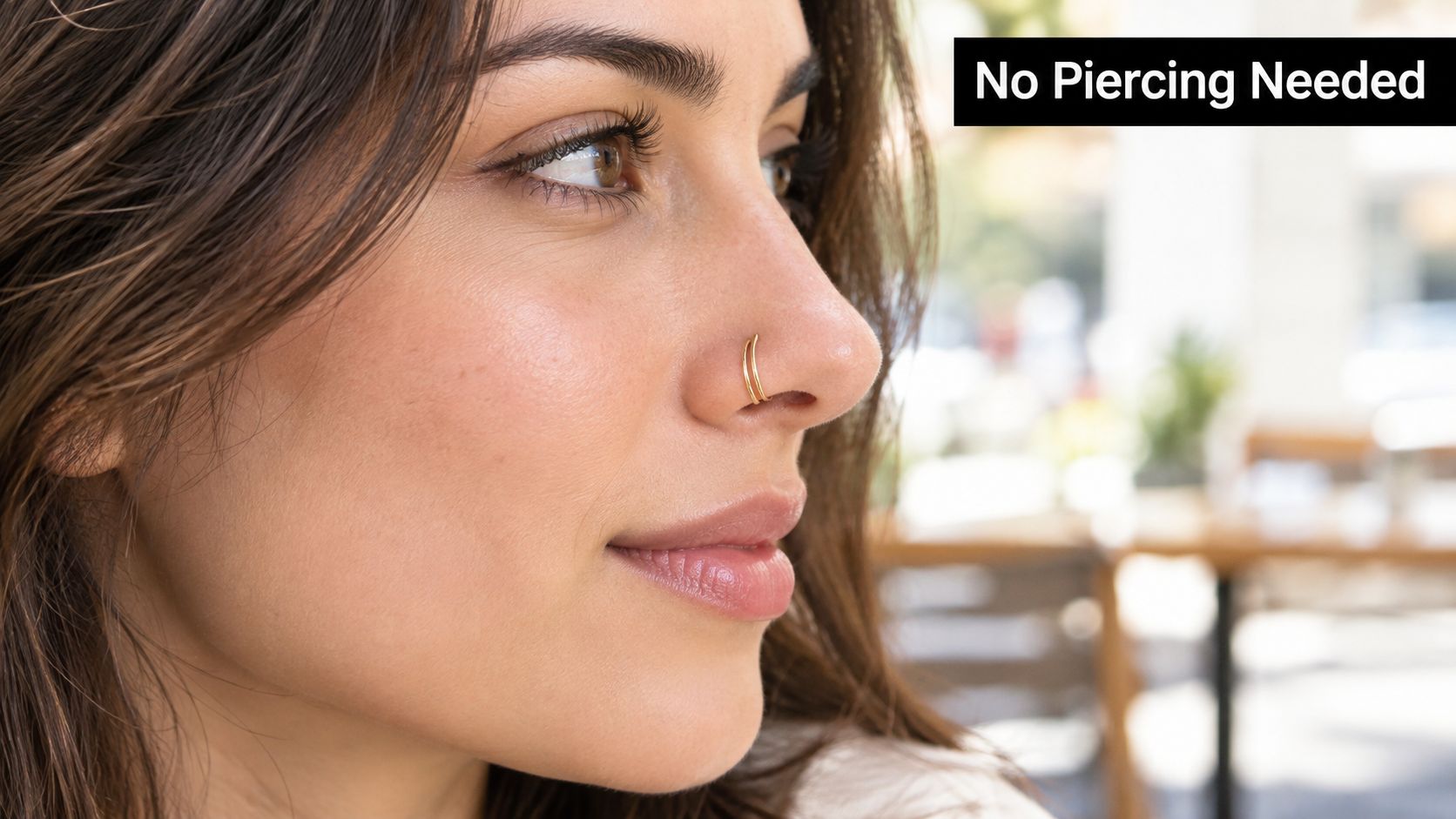
A nose ring cuff is a small piece of jewelry designed to sit around the edge of your nostril or near the septum area without passing through a piercing. Instead of relying on a post or closure inside the nose, it uses a shaped opening and gentle pressure to hug the skin. Think of it as a tiny styling shortcut, you get the visual effect of a hoop without committing to a piercing.
That makes a cuff especially useful when you want to change your look quickly. A slim gold-toned cuff can add a barely-there accent to everyday makeup, while a jeweled design can become the focal point of a festival outfit. You can also switch it out for work, travel, or a low-key day without waiting for a piercing to heal.
Nose jewelry has a long cultural history. Documented nostril piercing records trace back to the Middle East about 4,000 to 5,000 years ago, with some references placing the practice around 1500 BCE (Urban Body Jewelry's history of nose piercing). The style later spread into India by around the 1500s, where nose jewelry became connected with social identity and, in many regions, marital status. The cuff preserves that familiar visual language in a flexible, no-piercing format.
For more ways to experiment with nontraditional jewelry, explore BodyCandy's guide to wraps and cuffs. The important expectation is simple: a cuff can look convincing, but its comfort and stability depend on the fit, your nose shape, the jewelry's material, and what you're doing while wearing it.
How a Nose Ring Cuff Works Without a Piercing
A traditional nostril hoop passes through a piercing channel and forms a complete circle around the jewelry opening. A nose ring cuff works differently. It has an open gap that slides over the nostril edge, then rests against the skin with enough tension to stay in place.
The easiest analogy is a hug versus a pass-through. A pierced hoop passes through your nose, while a cuff hugs the outside edge. That difference explains both the appeal and the limitation. You avoid a needle and healing time, but the cuff must create a comfortable pressure fit to remain secure.
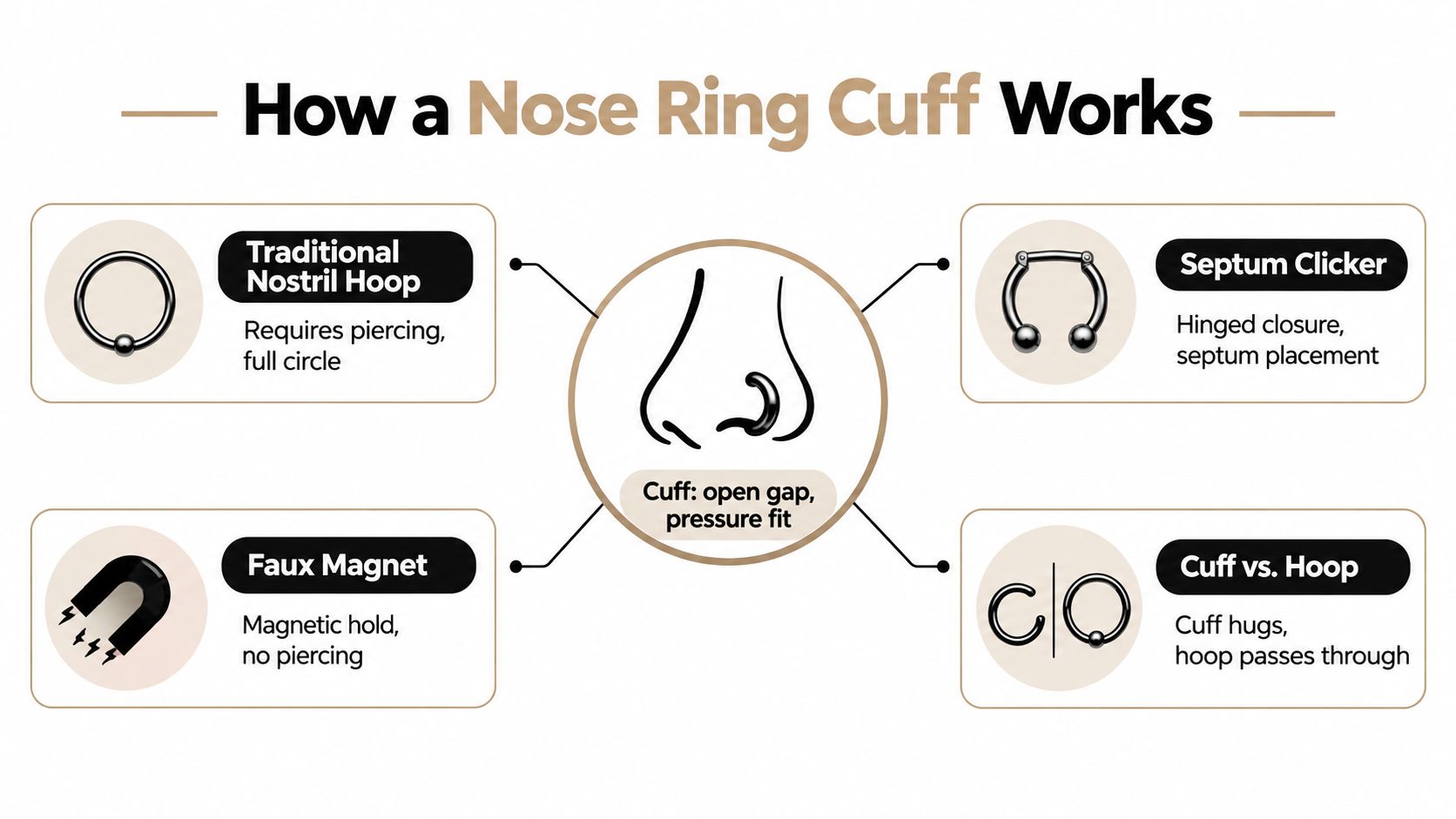
Cuff versus other faux jewelry
A cuff, traditional nostril hoop, septum clicker, and faux magnet may look related, but they stay on your face in different ways.
- Nostril cuff: Uses an open gap and pressure fit on the nostril edge.
- Traditional nostril hoop: Requires a piercing and uses a full circle through the piercing channel.
- Septum clicker: Uses a hinged closure and sits through the septum piercing area.
- Faux magnet: Uses magnetic hold and doesn't require a piercing.
A cuff's hold can change with your anatomy and activity. Recent fashion coverage describes nose cuffs as no-piercing statement accessories, while also noting that their stability varies with nose shape and movement (Vanitha's coverage of the nose cuff trend). That's why a cuff may stay perfectly still during dinner but shift during a workout or a windy outdoor event.
Practical rule: A nose ring cuff should feel secure, not squeezed. If you're constantly checking whether it's still there, the size or shape isn't working for you.
Cuffs are a strong choice for style testing, quick outfit changes, and anyone who doesn't want to manage a healing piercing. If you want to compare more clip-on options, BodyCandy's faux jewelry guide offers additional styling context.
Styles and Materials You Will Love
Once you understand the basic fit, choosing a cuff becomes a style decision. Start with the mood you want, then narrow the material based on how sensitive your skin is and how long you plan to wear the piece.
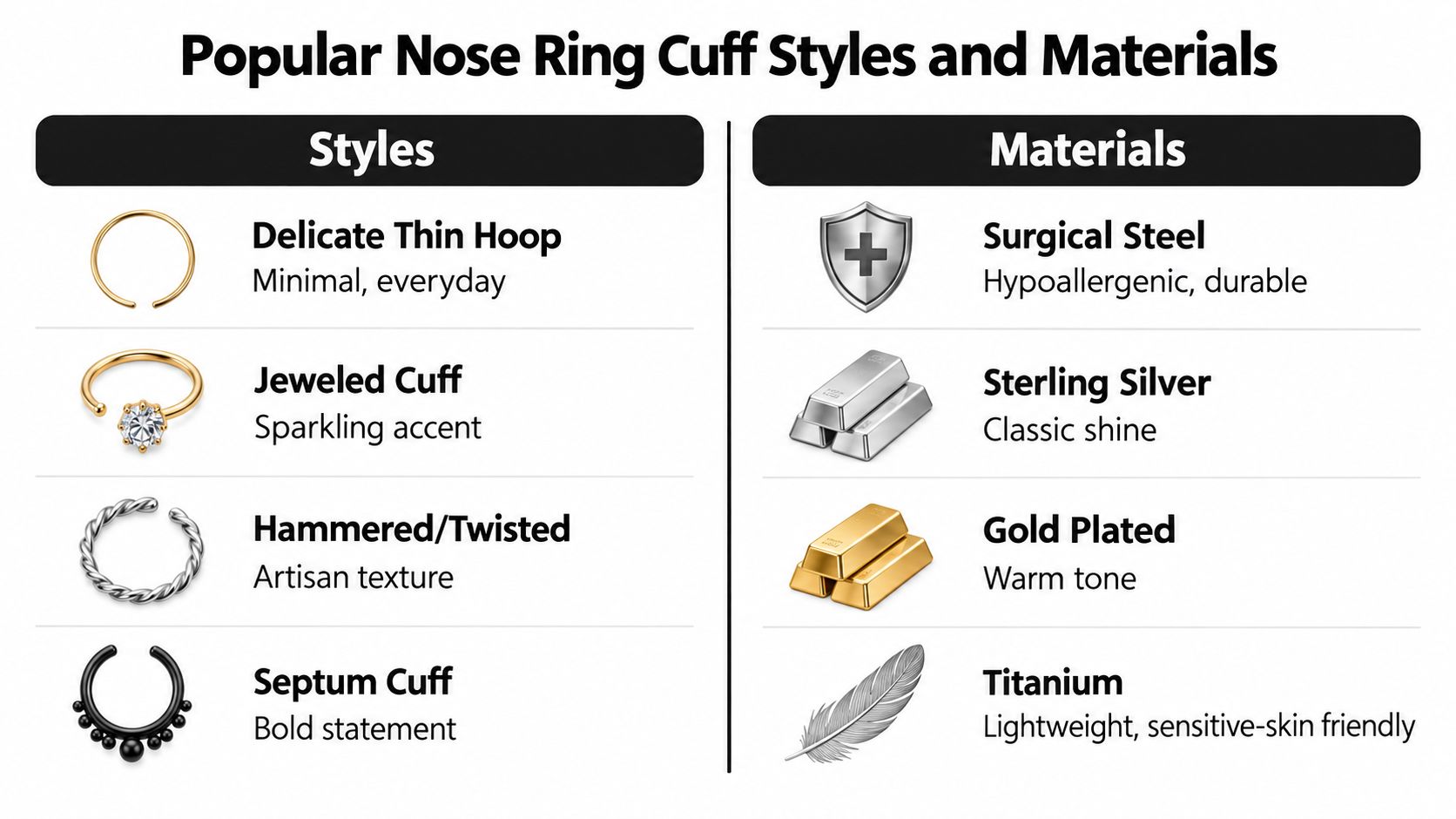
Match the design to your vibe
A delicate thin hoop is the easiest place to start. Its narrow profile creates a subtle accent that pairs well with small studs, simple hoops, or minimal makeup. It also works when you want your jewelry to whisper rather than announce itself.
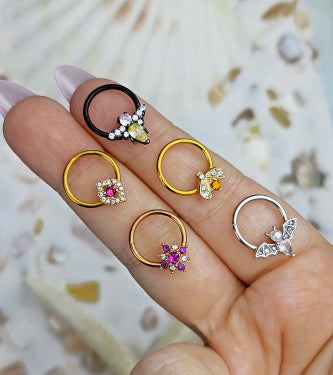
Jeweled cuffs take a different approach. A crystal or colored stone draws attention to the side of your face, so it can replace other statement jewelry instead of competing with it. Keep your earrings simple if you want the nose piece to lead.
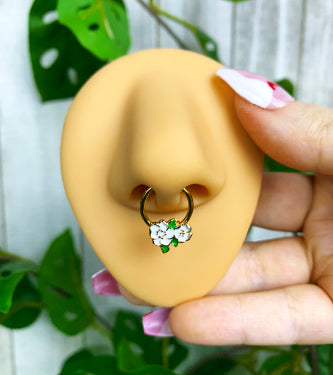
Hammered and twisted finishes add texture without needing a large decoration. These designs suit an earthy, handcrafted look and pair naturally with textured earrings or mixed metal pieces. A septum-style cuff offers the boldest visual shift, especially when you want the jewelry to frame the center of your face.
Choose the material with your skin in mind
For sensitive skin, neutral jewelry guidance commonly points to titanium and surgical steel as hypoallergenic options. Titanium is described as nickel-free, while surgical steel is described as containing very little nickel (Pierced Universe's nose ring material guide).
Implant-grade titanium is a practical choice when you're especially cautious about skin reactions. It's lightweight, corrosion-resistant, and designed for biocompatibility. Surgical steel offers a durable, polished appearance, but you should still verify the material details if nickel sensitivity is a concern.
Gold-toned designs bring warmth and photograph beautifully, but check whether the finish is solid metal or plating. Plated jewelry can become less comfortable as the outer coating wears and exposes the base metal. Sterling silver gives you a classic shine, although it may not be the first choice for highly reactive skin.
Think of the decision as a three-part match:
- Everyday subtlety: Thin hoop in a lightweight material.
- Event-ready sparkle: Jeweled cuff with a secure, comfortable fit.
- Reactive skin: Titanium or clearly specified surgical steel.
- Texture-focused styling: Hammered or twisted finish.
The prettiest cuff is still the wrong choice if its material or weight makes you remove it after a few minutes.
Finding Your Perfect Fit and Size
Sizing sounds technical at first, but you only need to understand two measurements: gauge and inner diameter. Gauge describes the thickness of the wire or metal. Inner diameter describes the distance across the inside of the hoop or cuff.
Most nostril jewelry uses 20g, or 0.8 mm, or 18g, or 1.0 mm, while hoop inner diameters commonly fall between 6 mm and 8 mm (DHgate's nose ring sizing guide). A larger inner diameter gives you a looser drape. A smaller diameter sits closer, but it can create pinch pressure if your anatomy needs more room.
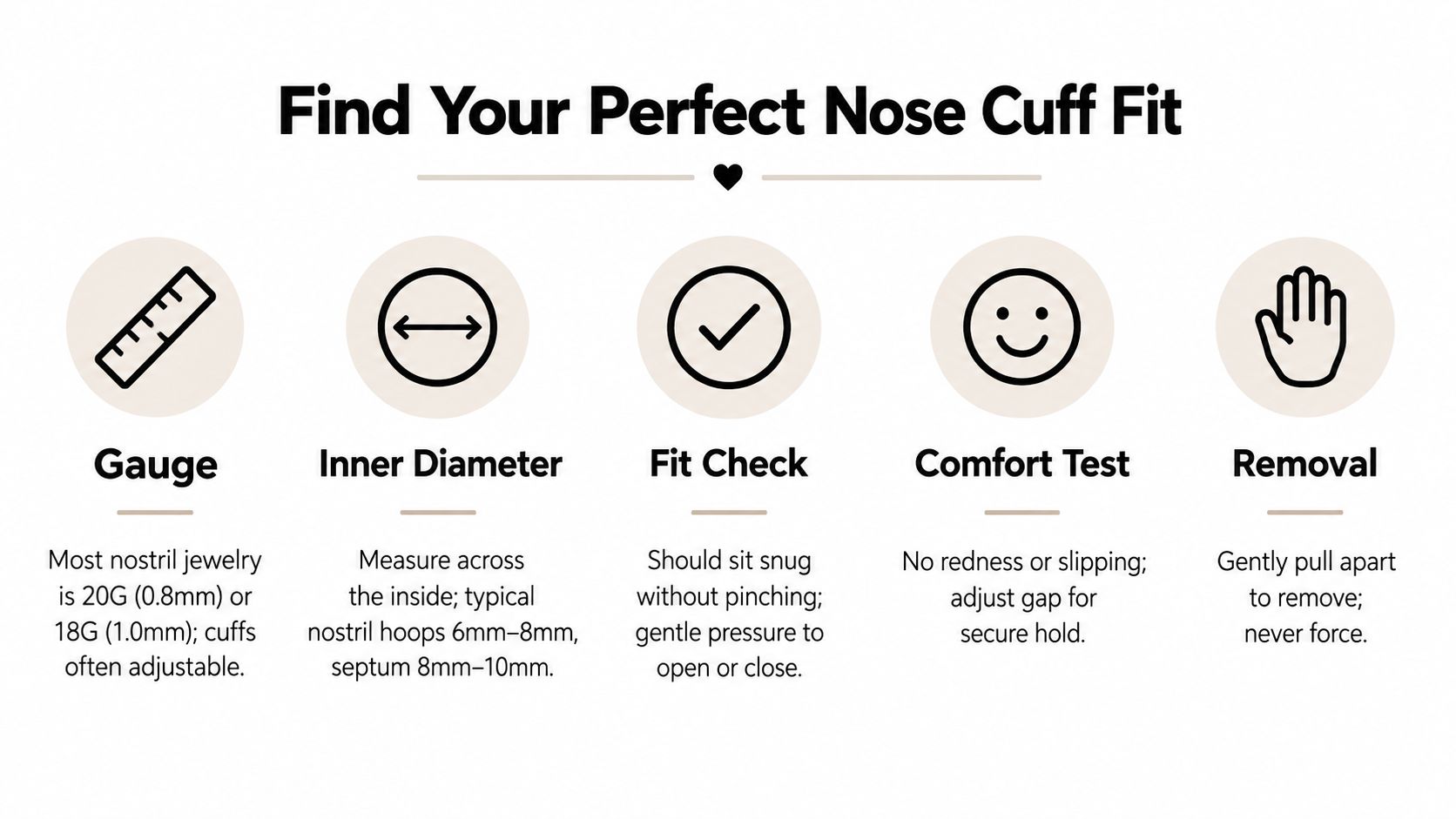
Use the measure-and-subtract method
For a snug cuff, measure from the piercing hole to the bottom of your nostril, even if you're shopping for a non-piercing style. That line gives you a useful reference for how close the cuff should sit to the nostril edge. A fitting guide recommends subtracting about 1 mm from the measured distance when choosing the final diameter, so a 9 mm measurement can lead to an 8 mm cuff choice (RockYourNose's cuff fitting guide).
Use a flexible strip of paper or a ruler with a mirror. Measure carefully rather than guessing from a product photo, because the same cuff can look snug on one nose and looser on another.
| Measurement | What It Means | Fit Tip |
|---|---|---|
| Gauge | The thickness of the wire | Confirm whether the piece is 20g or 18g if it will sit near a piercing |
| Inner diameter | The inside width of the cuff | Smaller sits closer, larger creates more drape |
| Nostril measurement | The distance from the piercing hole to the nostril bottom | Subtract about 1 mm for a snug final choice |
| Gap tension | How firmly the cuff grips the edge | Gentle pressure is useful, pinching isn't |
Check the fit after putting it on
A good cuff should stay in place when you move your face naturally, but it shouldn't leave sharp pressure or immediate redness. If it slips while you talk, smile, or turn your head, the opening may be too wide or the diameter may be too large.
If the piece feels tight, don't force it closed. If the design is adjustable, make a tiny change, try it again, and stop if you feel pinching. Your nose shape, nostril thickness, and the position you choose all affect retention, so comfort matters more than matching a size someone else wears.
How to Wear and Style Your Nose Ring Cuff
Start with clean, dry skin and clean hands. Hold the cuff by its sides, position the opening over the nostril edge, and ease it into place without dragging it across the skin. The jewelry should sit where it looks intentional, not so low that it appears to be falling away from the nostril.
A thin silver-toned cuff can balance a simple ear stack for daytime. For an evening look, try a gold-toned or jeweled design with swept-back hair so the profile stays visible. If you're mixing metals, repeat the combination somewhere else, perhaps with a warm-toned ear hoop and a cooler-toned nose accent, so the contrast feels styled rather than accidental.
Style by setting
For work or everyday errands, choose a low-profile design that follows the nostril closely. A festival or photoshoot gives you more room to play with texture, layered cuffs, or a brighter stone. If the piece is likely to catch on hair, a scarf, or a mask, choose a smoother shape and test it before leaving home.
Activity changes the equation. A cuff that feels stable while you're sitting may shift during dancing, exercise, or frequent face touching. If it starts moving, remove it and reassess the opening and inner diameter instead of repeatedly pushing it back into place.
Comfort check: Secure jewelry should disappear into your routine. If you notice pressure, rubbing, or repeated slipping, it's time to adjust the fit or choose a different design.
For a more exact snug fit, use the measurement method described in the RockYourNose cuff product guide, including the example where a 9 mm measurement leads to an 8 mm cuff. The same principle helps you decide whether you want a close-to-the-skin look or a little extra movement.
Care Hypoallergenic Options and Everyday Comfort
“No piercing” doesn't mean “no skin risk.” A cuff still touches your skin, and friction, pressure, sweat, residue, and the jewelry's material can all affect comfort. A piece that feels fine for a short styling session may not be right for extended wear if it creates redness or irritation.
For reactive skin, implant-grade titanium, specifically ASTM F136, Ti-6Al-4V ELI, is preferred because it's nickel-free by specification, highly biocompatible, and corrosion-resistant (Mods Body's implant-grade titanium guide). Nickel exposure is a recognized risk factor for sensitization, so avoiding nickel-releasing alloys can reduce the chance of dermatitis. Surgical steel is another commonly recommended option, but confirm the product specifications if you already know you react to nickel.
Keep the routine simple
- Clean the jewelry: Wash it according to the maker's care guidance before wearing it.
- Clean the contact area: Make sure your skin is free from makeup, oil, and product buildup.
- Limit pressure: Remove the cuff if it pinches, leaves persistent redness, or keeps slipping.
- Give your skin a break: Shorter wear sessions help you identify irritation before it becomes a bigger problem.
- Store it safely: Keep the cuff dry and protected so the finish stays clean between uses.
Plated finishes deserve extra attention because coatings can wear down over time. If your skin becomes itchy, sore, swollen, or persistently red, remove the jewelry and stop wearing it until the area settles. For more material guidance, browse BodyCandy's hypoallergenic jewelry guide.
Explore BodyCandy's nose jewelry selection to compare hoops, decorative styles, and options designed for different preferences. Visit BodyCandy to find a nose ring cuff that matches your look, check the material details, and try the no-piercing style at your own pace.