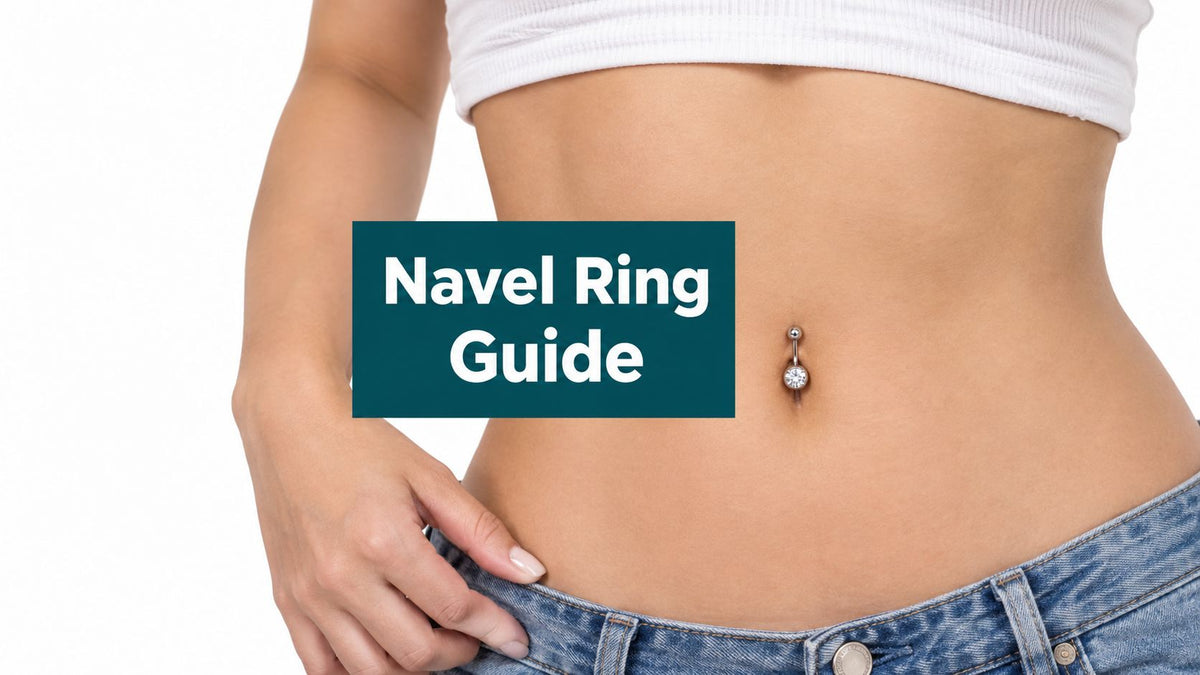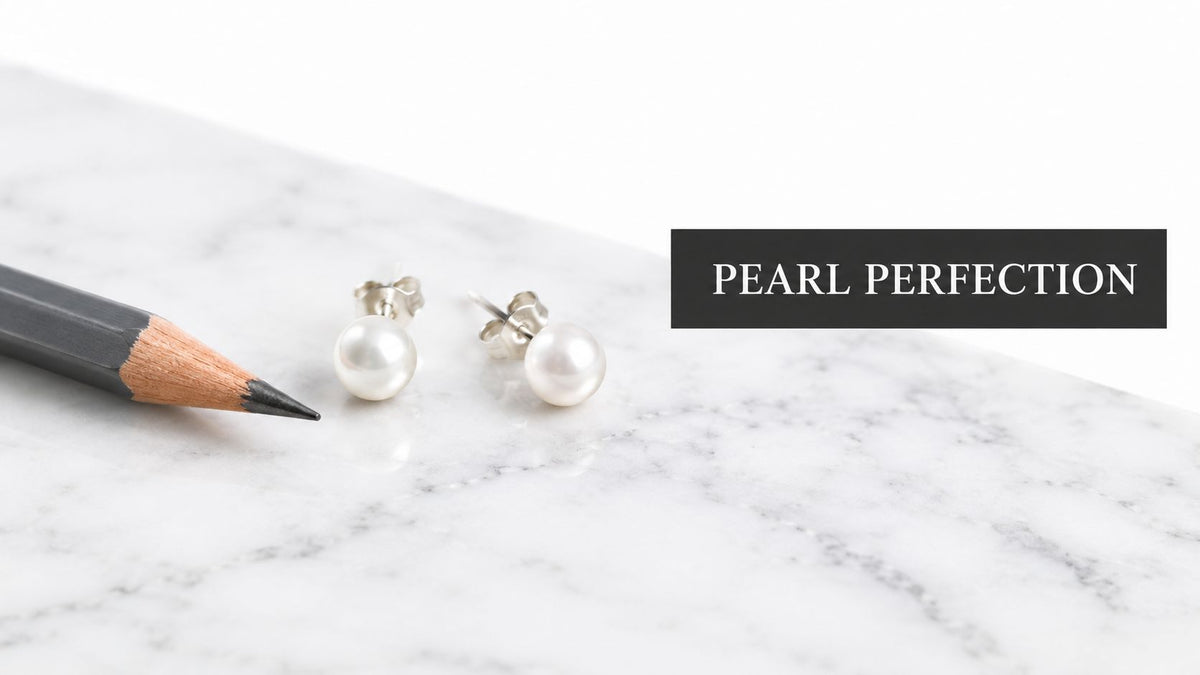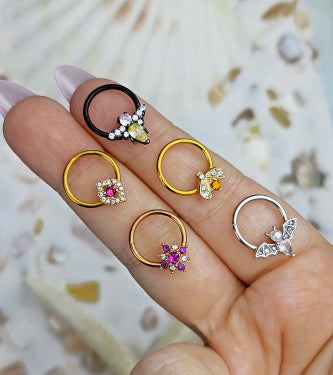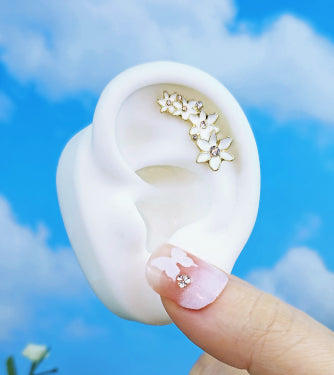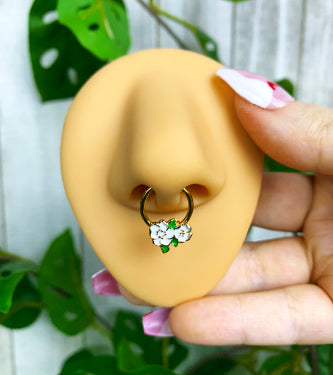


















Is a piece of body jewelry still “high quality” if it looks flawless but the listing can't tell you what metal it's made from? That's the gap between sparkle and safety. A polished hoop might photograph beautifully while hiding a nickel-heavy alloy, rough threading, or a coating that wears away against your skin.
Good body jewelry quality is easier to judge once you know where to look. Material, surface finish, machining, and documentation all matter, especially when jewelry sits inside a fresh piercing or touches sensitive skin for long periods. This guide gives you a practical way to evaluate any listing before you buy it.
Why Body Jewelry Quality Is About More Than Sparkle
A shiny finish is only the surface. Think of body jewelry like a car: glossy paint can catch your eye, but the frame, engine, and safety systems determine whether the vehicle is reliable. A ring can look premium while its alloy, threading, or plating creates problems once it spends hours against your skin.
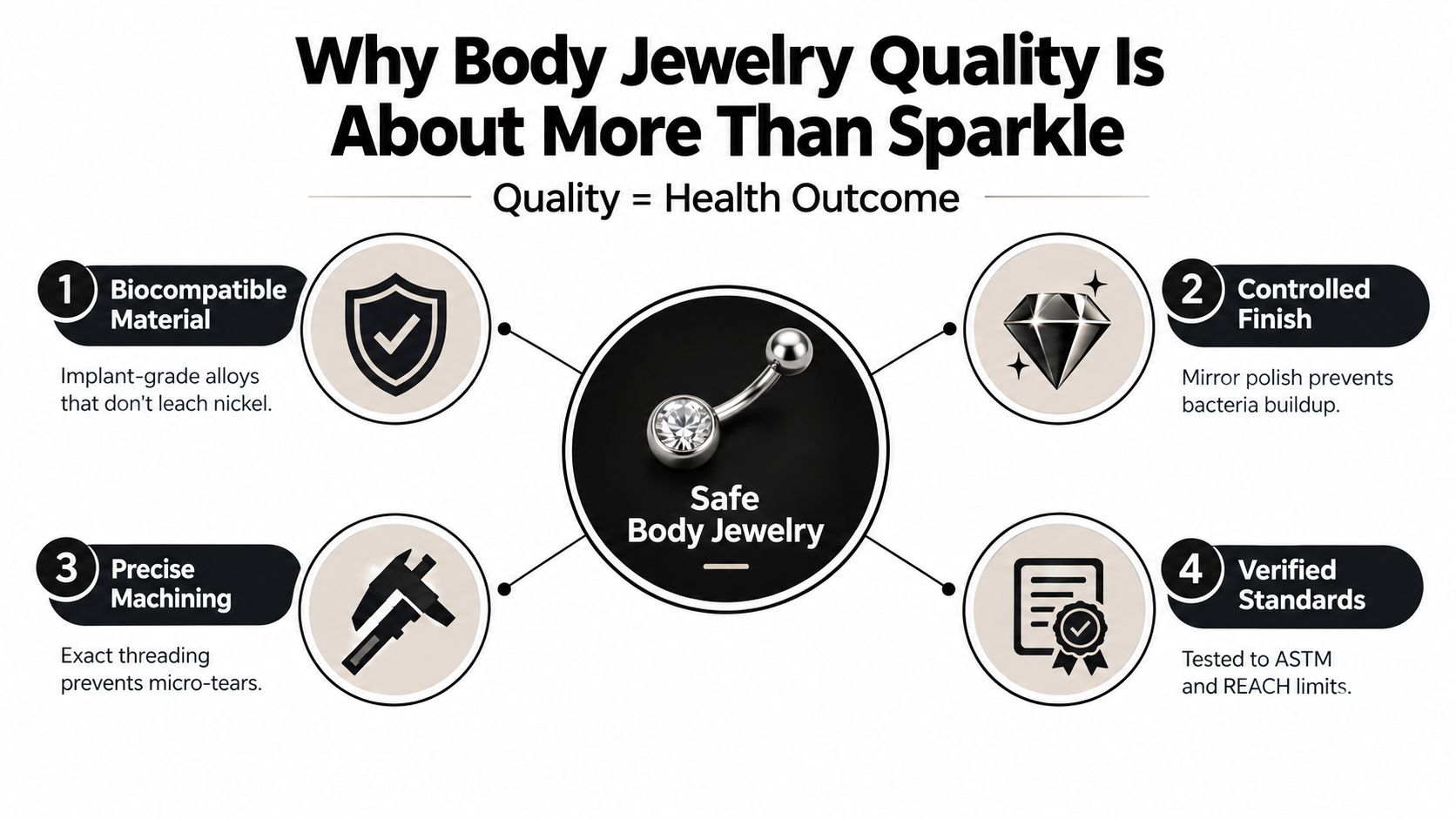
Four pillars do most of the quality work:
- Biocompatible material: The alloy should be suitable for body contact, with clear composition and low allergen risk.
- Controlled finish: Smooth, well-polished surfaces are less likely to scrape tissue or create rough spots where residue collects.
- Precise machining: Clean closures, accurate sizing, and smooth threads make insertion and removal gentler.
- Documented standards: A named alloy and supporting compliance information tell you more than “hypoallergenic” ever can.
Nickel exposure matters because nickel allergy is the most common contact allergy worldwide. A recent systematic review reported 11.4% prevalence in the general population across Europe, North America, and China (systematic review on nickel allergy prevalence). The same source discusses a Mayo Clinic-cited patch-test analysis in which nickel sensitivity averaged 17.5% among tested patients from 1994 through 2014, rising from 14.3% in 1994 to 1996 to more than 20% by 2013 to 2014.
That's why premium jewelry commonly emphasizes nickel-free or very low-nickel materials. It's also why a material label is a quality signal, not decorative marketing copy.
ASTM F136 implant-grade titanium, passivated surfaces, and documented nickel-release testing help separate jewelry made for long-term body contact from pieces designed mainly for occasional fashion wear. You don't need to become a materials engineer. You just need a repeatable habit: identify the alloy, inspect the finish, confirm the fit, and look for evidence behind the claim.
The Materials That Actually Define Premium Body Jewelry
Material choice sets the baseline for body jewelry quality. A beautiful design can't compensate for an undisclosed alloy, and even a named metal may require closer attention to its exact grade and testing.
| Material | Standard | Nickel Content | Best For |
|---|---|---|---|
| Implant-grade titanium | ASTM F136, often specified with ISO 5832-3 | Nickel-free by specification | Fresh piercings, sensitive skin, long-term wear |
| Surgical stainless steel | 316L or 316LVM, with applicable testing | May contain nickel | Healed piercings when nickel release is controlled |
| Niobium | Named niobium material, with reliable maker disclosure | Nickel-free option | Sensitive skin and anodized color |
| Solid gold | Solid 14k to 18k, nickel-free alloy | Depends on alloy | Healed piercings and people who verify the alloy |
| Plated base metal | Varies | Unknown or potentially present | Costume wear only, not fresh or long-term wear |
Implant-grade titanium is the clearest premium benchmark. ASTM F136 refers to the Ti-6Al-4V ELI alloy used in surgical implants, with a tightly controlled composition that includes about 6% aluminum and 4% vanadium (implant-grade titanium jewelry standards). Professional piercing guidance commonly treats this material as effectively nickel-free and appropriate for fresh piercings.
Titanium also supports anodizing, which creates color by changing the oxide layer rather than adding a peelable surface film. That gives you colorful jewelry without relying on a coating that can flake into a piercing.
316L and 316LVM stainless steel can work well for healed piercings, but “surgical steel” alone is too vague. Stainless steel may contain nickel, so the relevant question is whether the finished piece releases nickel within the applicable limit. In the European Union, jewelry inserted into pierced body parts must meet a nickel-release limit of 0.2 µg/cm²/week, while other jewelry in direct and prolonged skin contact must stay below 0.5 µg/cm²/week under EN 1811 testing (European nickel policy and EN 1811 guidance).
Niobium is an underrated option for sensitive wearers. It's nickel-free, can be anodized, and offers color without the same type of plated layer. Solid gold can also be appropriate, but only when the alloy is disclosed and nickel-free. Plated brass and mystery metals belong in the costume category, not in a fresh piercing or a piece you plan to wear continuously.
For more background on common jewelry metals, compare the material descriptions in BodyCandy's body jewelry metal guide. Your decision rule is simple: match the metal to your piercing stage and your skin history.
Plating, Polish, and the Finish Details That Quietly Matter
Two pieces can share the same base metal and still behave very differently because the surface and machining aren't equal. Irritation often begins where your skin meets the jewelry, especially around rough edges, worn coatings, seams, and threads.
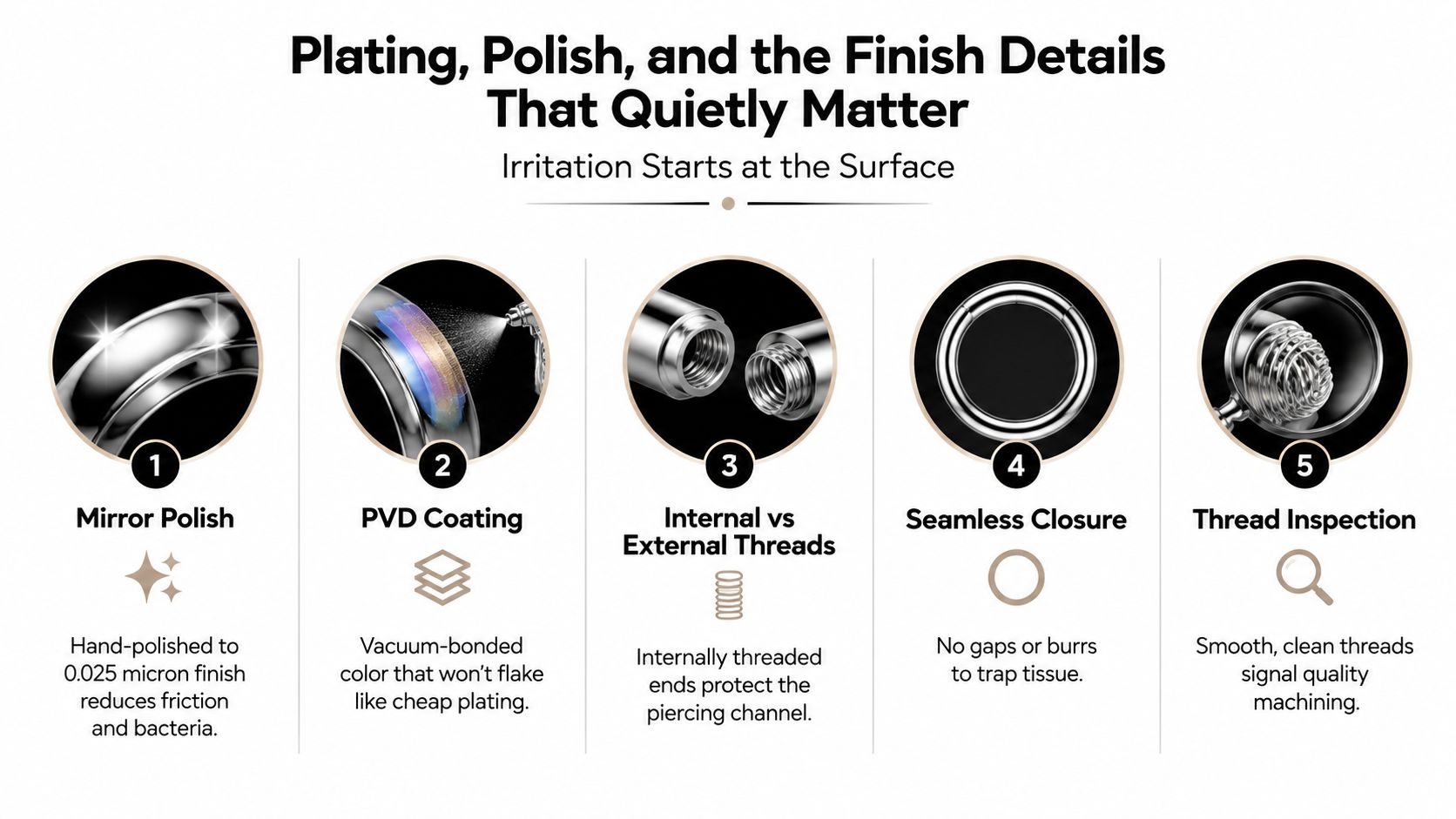
PVD coating uses physical vapor deposition to bond color to the surface under controlled conditions. It's generally more wear-resistant than ordinary electroplating. Electroplating adds a thin layer over a base metal, and once that layer wears through, the underlying alloy becomes the part touching your skin.
Anodizing works differently. On titanium and niobium, it changes the oxide layer to create color. There's no conventional colored film to peel away, although the finish can still fade or change from friction, chemicals, and repeated handling.
The finish is part of the fit
A smooth, high-polish surface reduces friction during wear and insertion. Passivation matters for stainless steel because the process removes free iron from the surface, helping the metal resist corrosion. Look for a piece with an even finish rather than one covered in visible scratches, pits, burrs, or casting seams.
Threading deserves equal attention:
- Internal threading keeps the rough screw portion inside the end rather than dragging across the piercing channel.
- Threadless push-pin systems avoid screw threads altogether and rely on a fitted pin and post.
- External threading can scrape tissue during insertion, especially when the edges aren't carefully finished.
A gold-colored PVD piece may retain its color through extended wear better than ordinary plating, while a thin electroplated barbell can show wear much sooner. The exact lifespan depends on construction, friction, cleaning, and your body chemistry, so treat wear-time promises as product-specific rather than universal.
A product page should explain whether its color comes from PVD, electroplating, or anodizing. It should also tell you how to care for that finish. BodyCandy's guidance on aftercare for coated and plated body jewelry is useful for understanding why surface care affects wear.
Here's a closer look at why threading and finish work together:
Why Hypoallergenic Labels Are Not Enough
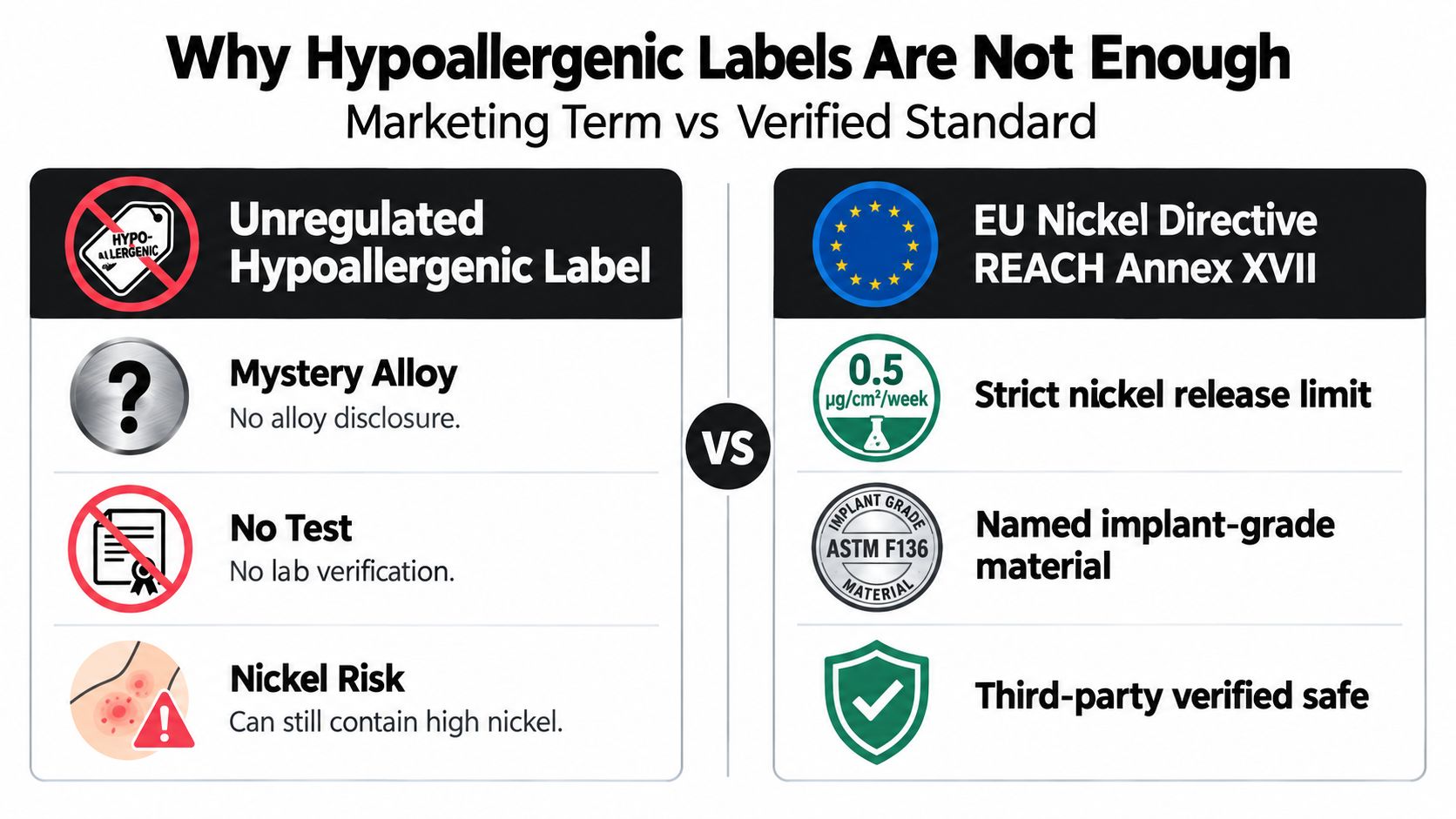
Could a piece labeled “hypoallergenic” still leave important questions unanswered? Yes. The term does not identify the alloy, prove biocompatibility, or confirm a nickel-release result. It may appear on jewelry with no disclosed composition and no accessible test documentation.
Use four questions as your shopping filter:
- What exact alloy is this?
- What standard applies to it?
- Has nickel release been tested?
- Can the seller provide documentation or a compliance statement?
EU requirements provide a useful reference point. Jewelry inserted into pierced body parts must stay at or below 0.2 µg/cm²/week for nickel release. Other jewelry intended for direct, prolonged skin contact must remain below 0.5 µg/cm²/week under EN 1811 testing, as described in the European nickel-release limits and testing context. These limits assess nickel released by the finished item, rather than measuring nickel in the raw alloy.
That difference matters. A stainless-steel piece can contain nickel and still comply when its corrosion behavior keeps release below the applicable threshold. A mystery alloy offers no comparable way to check performance.
What documentation can tell you
An ASTM F136 designation identifies implant-grade titanium. A mill certificate can provide the alloy grade and batch information. A disclosed composition can help you determine whether a gold alloy is nickel-free, but composition alone does not prove how the completed jewelry performs.
Dermatology guidance identifies nickel and cobalt as common causes of jewelry allergy, according to DermNet's guidance on jewelry allergy. People with a previous jewelry-allergy history should treat material verification with extra care. A peer-reviewed 2026 study reported that this history was associated with a 6.11-fold higher risk of metal sensitization after implantation. The study needs its own direct journal or PubMed citation, rather than a general allergy overview, so that claim is best checked against the original research before relying on it.
Practical rule: Treat “hypoallergenic” as an invitation to ask questions, not as the answer.
A low-priced hoop with no material disclosure may cost less at checkout, but price cannot show whether it meets a nickel-release limit. A clearly labeled implant-grade titanium bar gives you a more verifiable starting point. For plain-language context, read BodyCandy's guide to hypoallergenic jewelry for sensitive skin.
How to Spot Quality When You Are Shopping Online
Online shopping removes the most useful advantage you have in a studio: holding the piece, turning it under a light, and checking the threads with your fingertips. You can still make a solid judgment by treating the product page like a materials document, not just a style catalog.
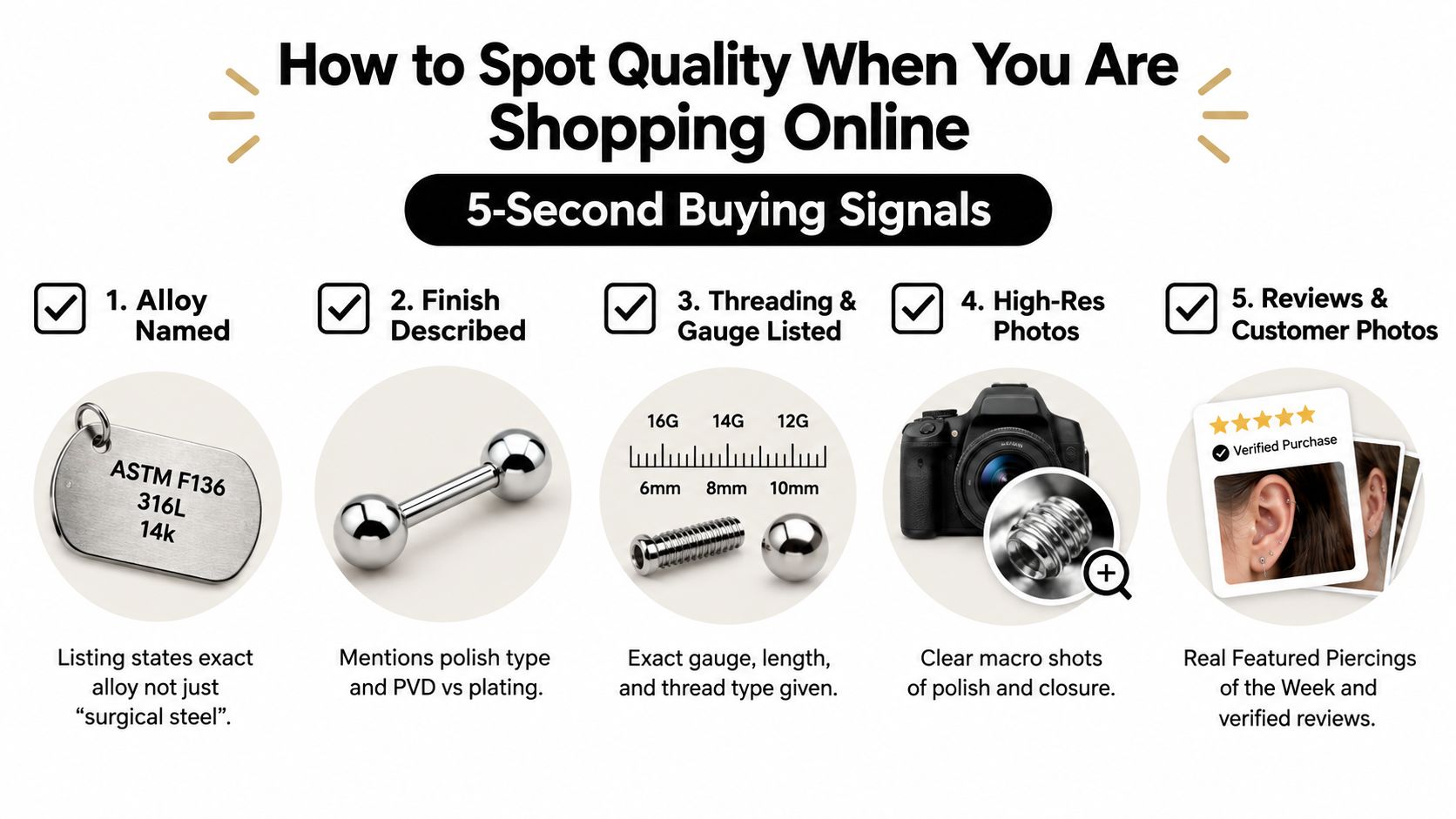
Start with the listing. A reliable page should name the alloy precisely, such as ASTM F136 titanium, 316L stainless steel, 14k solid gold, or niobium. It should also provide gauge, wearable length, closure style, and thread type.
Green flags and red flags
| Green flag | Red flag |
|---|---|
| Exact alloy named | “Surgical steel” with no grade |
| Gauge and length listed | Missing sizing information |
| Internal or threadless closure identified | Threading not shown or described |
| PVD, plating, or anodizing clearly explained | “Gold-tone” with no base metal |
| Macro photos show seams and polish | One stock photo reused for unrelated pieces |
| Compliance or mill documentation available | “Hypoallergenic” with no supporting details |
Photos can reveal more than you might expect. Zoom in for an even polish, clean edges, consistent anodized color, and a closure that meets neatly. Visible casting seams, pitting, uneven color, or a sharp external thread deserve caution.
Weight can also provide clues, but don't use heaviness as a quality score. Titanium is lighter than steel of the same size, and a lightweight piece can be the more suitable option for a healing piercing or stretched lobe.
Use this quick pre-cart check:
- Material: Is the alloy exact and specific?
- Finish: Is the color anodized, PVD, plated, or left natural?
- Machining: Are threads, seams, and closures visible?
- Fit: Are gauge and wearable length stated?
- Evidence: Does the seller provide compliance information or meaningful customer photos?
Gauge, Weight, and Fit as Hidden Quality Signals
A well-made piece can still be wrong for your piercing if the gauge or length doesn't fit. Gauge describes the thickness of the post, and the familiar numbering system works backward, so a smaller gauge number means a thicker piece.
| Gauge | Typical Piercings | What Happens If It's Wrong |
|---|---|---|
| 20g | Some nostril and delicate ear jewelry | A thinner post may feel unstable or place uneven pressure |
| 18g | Nostril, ear, and some lip jewelry | An unsuitable fit can encourage movement or irritation |
| 16g | Septum, lip, labret, eyebrow, and some cartilage | Too large can add pressure, too small may not seat securely |
| 14g | Septum, tongue, navel, and common body piercings | Incorrect sizing can create pressure or excess movement |
| 12g | Nipple and selected larger-gauge piercings | A mismatched post can stress the channel or fail to fit |
Common placement guidance lists nostrils at 18g or 20g, septums at 16g or 14g, lip and labret piercings at 16g, tongues and navels at 14g, and nipples at 14g or 12g (common piercing gauge guidance).
A post that's too short can press into swelling or tissue. One that's too long can catch on clothing and move unnecessarily. A piece that's too thin may place a narrow, concentrated load on tissue, while an oversized bar can add pressure and make movement more irritating.
Weight changes the experience too. Titanium feels lighter than steel at the same dimensions, which can matter for large hoops, stretched lobes, and jewelry worn for long periods. The maker has thought about the wearer when the gauge, length, closure, and metal work together rather than appearing as disconnected product options.
If you're unsure, ask a professional piercer to measure the piercing instead of guessing from a photo or an old piece. Fit is part of quality, not a final detail after material selection.
Real-World Wear Stories That Show Quality in Action
Consider a cartilage ring made from a mystery alloy. It looks fine when it arrives, but after several weeks the wearer notices itching and green-tinted discoloration around the piercing. Those signs point toward a material or surface problem, not a failure of the jewelry's design.
Swapping the ring for clearly identified implant-grade titanium removes the unknown from the equation. The improvement doesn't come from titanium being magically immune to every possible irritation. It comes from choosing a material with a documented composition and a lower nickel concern for sensitive wearers.
A tongue bar shows a different failure pattern. Thin gold-colored plating faces constant contact with saliva, food, and cleaning. After repeated use, the colored layer flakes, exposing the base metal underneath. Swelling and a metallic taste follow because the part touching the body is no longer the surface shown in the product photo.
“The material you bought is not always the material you're wearing months later.”
A third example involves a healed lobe fitted with well-polished niobium. The piece keeps a smooth surface and stable color through extended wear, while a cheaper steel labret creates a different problem. Its rough threads scrape during insertion and removal, producing tiny cuts that keep the channel irritated.
These examples connect symptoms to specific quality factors:
- Itching or discoloration: Investigate the alloy and nickel-release evidence.
- Flaking color: Find out whether the piece is plated, PVD-coated, or anodized.
- Cuts during insertion: Inspect thread type, machining, and polish.
- Persistent pressure: Recheck gauge, length, and jewelry weight.
They aren't substitutes for medical advice, and a worsening piercing should be evaluated by a qualified professional. They do show why the unboxing moment tells only part of the story. Long-term body jewelry quality appears in the surface, the fit, and the documentation that supports the original material claim.
Your Body Jewelry Quality Checklist Before You Buy
What should a quality check answer before you add body jewelry to your cart? Use this list as a filter. If a listing leaves several answers unclear, pause before buying.
- Name the alloy. Look for ASTM F136 titanium, F138 stainless steel, 316L, 316LVM, niobium, or verified nickel-free solid gold. Terms such as “metal,” “silver-colored,” and “surgical steel” do not identify the material precisely enough.
- Check the applicable standard. ASTM F136 and ISO 5832-3 are useful references for implant-grade titanium. Stainless steel needs closer review of both its grade and the finished product's nickel release.
- Look for nickel-release evidence. Jewelry inserted into a piercing must meet the EU benchmark of 0.2 µg/cm²/week. Other jewelry designed for direct, prolonged skin contact has a 0.5 µg/cm²/week limit under EN 1811 testing, as noted earlier. Ask whether the seller can provide testing or compliance documentation. A standard works like a measuring line: it gives you something concrete to verify instead of asking you to trust a label.
- Decode the finish. Identify whether the color comes from anodized titanium or niobium, PVD, or ordinary electroplating. The polished surface should be even, without obvious burrs, pits, or casting seams.
- Inspect the closure. Internally threaded and threadless designs keep rough external threads from dragging across the piercing channel.
- Confirm gauge and length. Compare the measurements with your piercing, or ask a professional to size you. A piece that pinches, catches, or moves constantly is a poor fit, whatever it looks like.
- Check your history. Previous reactions to nickel, cobalt, or other jewelry make full alloy disclosure more useful than a broad “hypoallergenic” label.
BodyCandy groups options by materials, including titanium, surgical-grade stainless steel, 14-karat gold, and bioplast, so you can compare style with the information behind each piece.
Ready to shop with fewer question marks? Review the material and fit details in the BodyCandy collection, then match the alloy, finish, threading, and size to your piercing and skin history. Good documentation lets the sparkle stay fun, instead of making your skin handle the surprise.