



















“Natural means safer” is one of the most popular pieces of jewelry advice, and it's also one of the least reliable. A wood, shell, bone, pearl, or stone piece can look wonderfully earthy while still being porous, unfinished, chemically treated, or paired with a metal component that bothers your skin.
That doesn't make natural materials a bad choice. It means jewelry natural materials belong in the style-and-comfort category, not the automatic-safety category. The right piece can add warmth, texture, color, and personality to a piercing, but smart shopping matters just as much as the aesthetic.
Why Natural Materials Still Belong in Your Collection
Natural materials have been part of personal adornment since prehistoric times. People used shells, bones, pebbles, tusks, claws, wood, amber, coral, pearls, and animal fibers because these materials were available, durable enough for their purpose, meaningful, and workable with drilling, polishing, carving, or stringing techniques. Britannica's history of jewelry materials shows how natural substances are tied to jewelry design and personal expression.
So, if you're choosing a new septum piece and wondering whether a natural-looking finish will be gentler than metal, pause before you click "add to cart." Ask what the material is, whether its surface is smooth and sealed, and what touches your skin besides the decorative element.
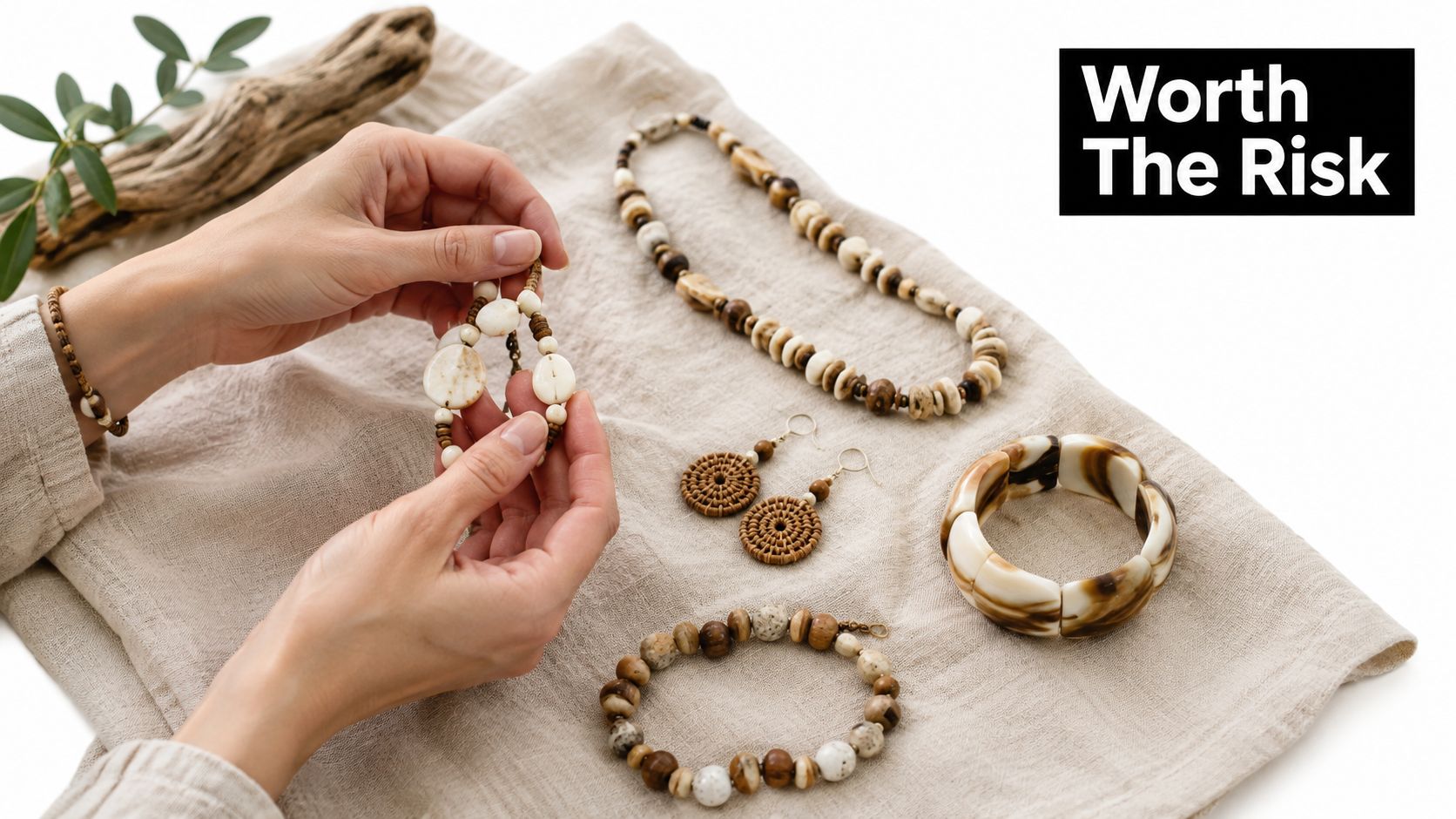
Natural is a look, not a medical label
A natural origin tells you where a material came from. It doesn't tell you whether the piece is porous, whether it contains allergens, whether it has been dyed or coated, or whether it's suitable for prolonged contact with a piercing.
That distinction makes natural pieces exciting rather than off-limits. You can enjoy the grain of wood, the glow of amber, the flash of abalone, or the soft luster of pearl while checking the details that affect comfort and longevity.
The practical rule: Choose natural jewelry for its appearance and feel, then verify its construction and care requirements separately.
The same materials that decorated people for thousands of years still appear in modern body jewelry. Today's version needs a little more information behind the beauty, especially when sweat, friction, cleaning products, and sensitive skin enter the picture.
Meet the Major Natural Materials
Natural jewelry can look wildly different from one material to the next. Use this quick tour to compare appearance, feel, common use, and the main catch.
Stone
Stone brings coolness, visual weight, and natural variation. Depending on the type, it may appear glossy, matte, veined, speckled, or translucent. Natural stone often shows up in plugs, tunnels, beads, pendants, and decorative ends.
Its appeal is individuality. No two pieces have exactly the same pattern, but stone can chip, fracture, or react poorly to treatments and chemicals. Explore the style and symbolism of natural stone jewelry and semiprecious gemstones, then check the seller's care information before wearing a piece regularly.
Shell
Shell feels smooth and light, with colors ranging from creamy neutrals to dramatic iridescent surfaces. Abalone shell is especially recognizable for its shifting blue, green, and purple flashes, making it a favorite for decorative jewelry.
Shell can scratch or crack, and its surface may include a coating that changes how it should be cleaned. Treat it as a material that needs gentle handling, not as an indestructible beach souvenir.
Bone
Bone has a warm, matte appearance and often carries carved details beautifully. In body jewelry, it may appear in plugs, tapers, pendants, or sculptural pieces.
The important question is surface condition. Cracks, rough carving, and unfinished areas can trap moisture or contaminants, so bone is better reserved for fully healed piercings and carefully finished designs.
Wood
Wood offers grain, warmth, and a lightweight feel. Maple and other woods can create a soft, organic look in earrings, plugs, and decorative jewelry.
Porosity is the catch. Wood can absorb moisture, sweat, lotions, and cleaning products, so a smooth, intact, sealed finish matters more than the word “natural” on the product page.
Pearl
Freshwater pearl has a soft glow and smooth tactile quality that works beautifully in understated pieces. Pearl is an organic gemstone, formed when a mollusk deposits nacre around an irritant.
It's also comparatively delicate. Cosmetics, abrasion, harsh cleaners, and careless storage can dull or mark the nacre, so pearl rewards gentle wear and careful storage.
Opal
Opal is one of the materials readers ask about most because its play of color can look almost magical. It may appear as a bright focal point in decorative ends, plugs, or pendants.
Opal's beauty comes with a need for informed care. Ask whether it is natural, treated, or a manufactured lookalike, and follow the specific care guidance supplied for that piece.
Amber
Amber is fossilized tree resin, often from ancient conifers. It can be golden, honey-colored, reddish, or cloudy, and it may preserve insects or other organisms trapped before the resin hardened.
Amber feels warm and lightweight compared with many stones, but it can scratch and may be affected by heat or chemicals. Keep it away from harsh cleaners and store it separately from harder jewelry.
Hardness, Toughness, and How Materials Age
A material's durability has more than one personality. Hardness describes resistance to scratching. Toughness describes how well it resists breaking, chipping, or splitting. Stability describes how it handles heat, light, chemicals, humidity, and repeated mechanical stress.
Those qualities don't always travel together. A piece can resist a light scratch yet still fracture when dropped, soften near heat, fade in sunlight, or react to a cleaning product.
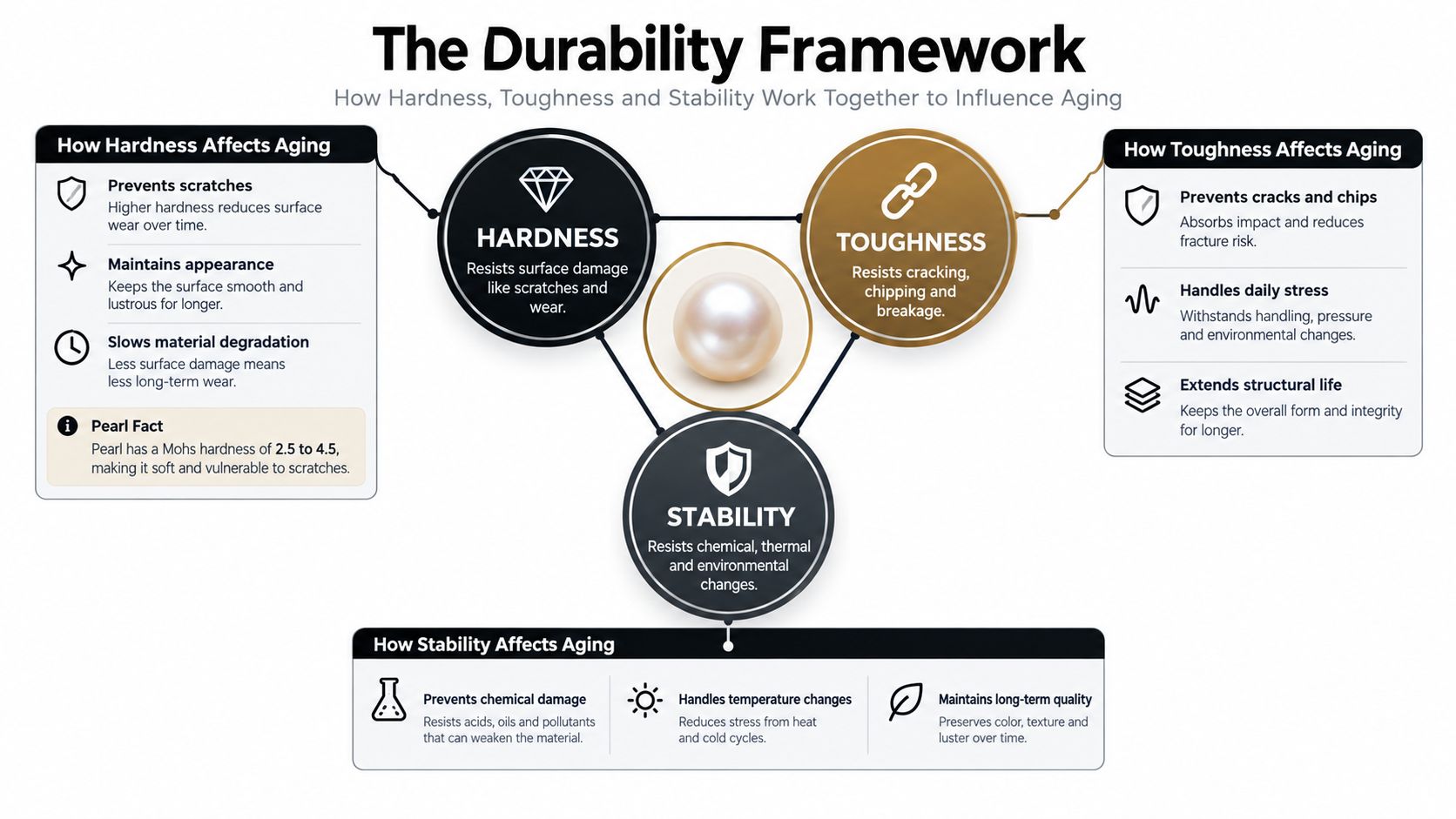
Pearl makes the lesson easy to see
Pearl has a Mohs hardness of approximately 2.5 to 4.5, and its specific gravity is about 2.71, according to the U.S. Geological Survey's guide to organic gems. That makes pearl substantially more vulnerable to scratching and abrasion than many crystalline gemstones.
Suppose you store a pearl piece in the same compartment as a metal chain. The chain can rub against the pearl during ordinary movement, leaving wear marks even though the pearl remains structurally intact. A harder stone or sharp metal edge can create the same problem.
Porosity changes the care conversation
Wood, bone, horn, and shell need different care from nonporous metals because their surfaces can absorb moisture or products when they're cracked, unfinished, or difficult to clean. A lightweight piece may feel comfortable, but low weight doesn't prove that its surface is suitable for a piercing.
Professional gem treatment guidance also warns that durability depends on treatment history. The Gemological Institute of America explains how treatments affect cleaning and stability, including the risks associated with bleaching, dyes, wax or plastic impregnation, and fracture filling.
A good product description should therefore answer three questions:
- Scratch resistance: What can rub against the surface?
- Break resistance: Could the piece chip, split, or fracture?
- Environmental stability: What will heat, light, moisture, cosmetics, or cleaner do to it?
Care and Cleaning That Actually Works
Natural jewelry doesn't need a complicated ritual. It needs the right level of gentleness and a routine you'll follow.
Start with pearl because nacre is sensitive to abrasion and chemicals. After wearing it, wipe the piece with a soft, slightly damp cloth, then let it dry before storing it in a soft pouch. Keep pearl away from cosmetics, perfume, acids, alcohol, and harsh cleaners, and put it on after beauty products have dried.
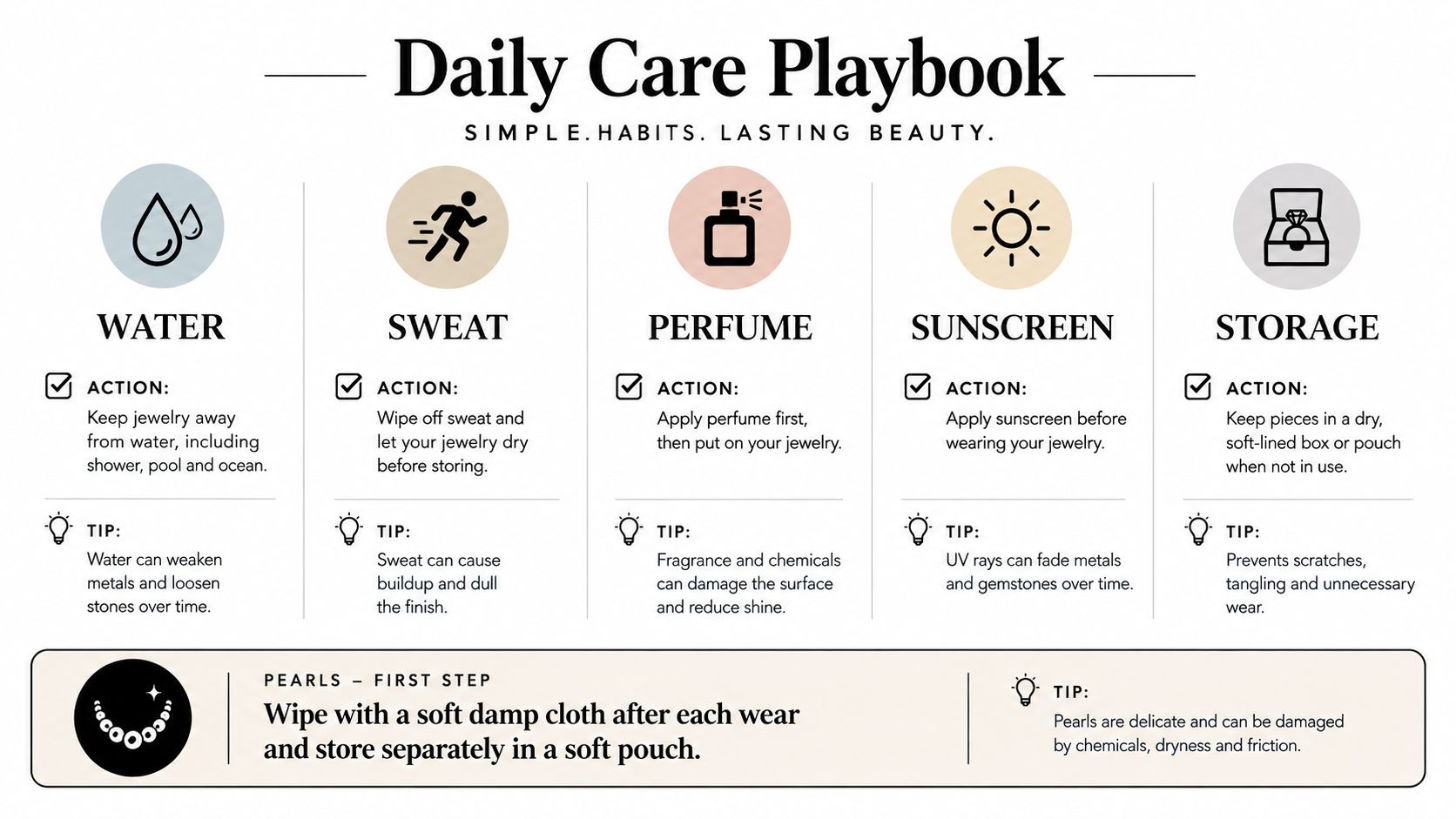
Use the wipe, dry, store rhythm
For amber, shell, wood, and stone, the same simple rhythm helps:
- Wipe: Remove sweat, sunscreen, perfume residue, and skin oils with a soft cloth.
- Dry: Don't leave moisture sitting on porous or treated surfaces.
- Store: Use a separate soft pouch or compartment so pieces don't rub together.
For routine cleaning, use lukewarm water with mild soap only when the material and treatment history allow it. If you don't know whether a piece has been dyed, bleached, wax-impregnated, plastic-impregnated, or fracture-filled, choose a damp cloth instead of experimenting.
Cleaning rule: Unknown treatment history means conservative care.
Avoid acetone, alcohol, prolonged soaking, high temperatures, and harsh household cleaners. Dyes may fade or dissolve, wax and plastic can soften or suffer heat damage, and fracture fillers can change when exposed to chemicals, mild acids, or high temperatures.
Sweat doesn't make a piece unusable, but repeated moisture exposure can be rough on porous materials and finishes. If you wear natural jewelry during a warm day, clean and dry it afterward rather than leaving residue on the surface.
For a broader routine covering different types of body jewelry, use BodyCandy's guide to cleaning your body jewelry.
Sensitive Skin and the Hypoallergenic Question
Natural materials can be beautiful and still cause a reaction. A 2025 dermatology case report documented allergic contact dermatitis caused by Brazilian walnut beads in a rosary necklace, and the authors noted that exotic woods can contain potent quinone allergens with cross-reactivity among woods. You can read the published dermatology case report for the clinical details.
The finding matters for piercing fans because “wood” isn't one uniform substance. Species, porosity, sealant, moisture exposure, surface damage, and metal findings all affect what reaches your skin.
Nickel is the most common jewelry skin sensitizer, according to Baylor College of Medicine's overview of jewelry allergies. Gold and silver can also trigger contact allergy, although less frequently. A natural decorative end may be comfortable while the post, hoop, chain, or connector creates the problem.
Natural Material Sensitivity Snapshot
| Material | Porosity | Best For | Watch For |
|---|---|---|---|
| Wood | Often porous, especially if unfinished or damaged | Fully healed piercings and decorative wear | Species allergens, moisture, sealants, splinters |
| Bone | Porous and dependent on finish | Fully healed piercings with smooth surfaces | Cracks, rough carving, trapped moisture |
| Horn | Porous and finish-sensitive | Carefully finished decorative pieces | Surface wear, moisture, undisclosed treatment |
| Shell | Variable, often layered or coated | Decorative jewelry and healed wear | Cracks, flakes, coatings, metal findings |
| Pearl | Organic and relatively soft | Gentle, low-abrasion wear | Scratches, cosmetics, chemicals, chains |
| Stone | Usually less porous, but varies by type and treatment | Decorative ends and healed wear | Fractures, dyes, fillers, chemical sensitivity |
For a fresh piercing, avoid assuming that a porous natural piece is suitable. Fresh tissue is still vulnerable, and the jewelry must tolerate regular cleaning without degrading. A fully healed piercing gives you more flexibility, but it still doesn't erase the need for a smooth, stable surface.
Check the material description before buying:
- Ask about species: “Wood” alone doesn't identify the tree or possible allergens.
- Ask about finish: Look for smooth, sealed, polished surfaces with no flaking.
- Inspect the findings: The metal may be the actual source of irritation.
- Watch your skin: Redness, itching, swelling, pain, or drainage means remove the jewelry and seek medical advice when symptoms are significant or persistent.
BodyCandy's quick guide to hypoallergenic jewelry for sensitive skin can help you compare safer material questions before choosing a style.
Provenance, Ethics, and What to Ask Before You Buy
“Ethical,” “sustainable,” and “responsibly sourced” sound reassuring, but those labels don't tell you enough by themselves. Material identity and provenance are different questions. Freshwater pearl identifies the type of pearl and its biological origin. It doesn't automatically identify the farm, country, labor conditions, treatments, coatings, or environmental practices.
Pearl history shows why wording matters. Natural pearls were collected for thousands of years, while pearl-culturing techniques developed in the late nineteenth and early twentieth centuries changed access to the material. William Saville-Kent advanced loose-pearl cultivation in the 1890s, Japan established large-scale saltwater Akoya production, freshwater cultured-pearl production began in Japan in 1935 and expanded in China during the 1960s, South Sea cultivation expanded in Australia in 1956, and Tahitian cultivation began in 1961. By 1967, cultured-pearl production reportedly reached a peak of 125 tonnes, according to Jeweller Magazine's pearl-sector history.
Cultured pearl also isn't imitation pearl. It's a human-assisted biological process. The same source reports that more than 98% of pearls produced worldwide are freshwater cultured pearls grown in China, while Japan, French Polynesia, Indonesia, and Australia remain major saltwater-producing regions.
Ask for evidence, not mood words
Use this checklist on a product page or in a shop:
- Country of origin: Where was the raw material collected or grown?
- Species or source: Which wood, shell, mollusk, or stone is it?
- Treatment disclosure: Was it bleached, dyed, stabilized, waxed, filled, or coated?
- Supplier documentation: Can the seller explain what records support the claim?
- Care and durability: Does the finish suit the way you plan to wear it?
Traceability is becoming a real purchasing issue. Reporting on luxury supply chains describes limited visibility back to raw-material production, while Kering reported 97% traceability for key raw materials in 2025, with 88.5% of leather traced to a specific abattoir and no comparable farm-level certainty. The same reporting discusses planned EU digital tracking requirements for diamond imports beginning January 1, 2026. This sustainability reporting from Vogue provides that context.
A renewable or culturally significant material can still have unclear environmental or labor impacts. Good buying means asking for graded evidence instead of accepting a green label as proof.
Picking the Right Natural Piece for Your Style
The easiest way to choose is to match skin needs, daily habits, and visual personality. Style comes first, but comfort and maintenance decide whether the piece becomes a favorite or sits in a drawer.
If your style leans earthy and bohemian
Wood and bone offer warm color, visible texture, and a handmade feel. Choose pieces with clearly identified material and a smooth, intact finish, and keep them for fully healed piercings. This pairing works especially well if you love carved details, natural grain, and lightweight jewelry.
Skip anything with splinters, cracks, sharp edges, flaking, or a mystery coating. Natural origin doesn't cancel out porosity or allergy risk.
If you prefer quiet, polished minimalism
Freshwater pearl gives you a soft glow without demanding a loud outfit. It's a strong choice for gentle, low-abrasion wear when you're willing to wipe it after use and store it away from chains and harder jewelry.
Pearl works beautifully as a small decorative element, especially when the supporting post or finding has a clearly stated composition.
If you collect standout color
Amber and opal bring more visual drama. Amber offers warm honey and golden tones, while opal can shift with flashes of color that become the focus of a look.
Treat both as pieces that need informed handling. Ask whether the material has been treated, follow its care directions, and keep it away from high heat and aggressive cleaners.
If you want beach energy
Abalone shell, other shell designs, and selected stones create a relaxed coastal palette. Shell can deliver iridescence, while stone adds cool color and visual weight.
Look closely at the edges and surface. A smooth, stable finish matters more than the beachy name attached to the design.
If your skin reacts easily, pairing a natural decorative element with a documented metal post, hoop, or finding is often the most sensible compromise. You get the texture and personality of the natural material without asking a porous piece to do every job.
FAQ and Smart Next Steps
Are natural materials safe for fresh piercings?
Don't assume they are. Wood, bone, horn, and shell can be porous, absorb moisture, or become difficult to clean if they're cracked or unfinished. Fresh piercings need jewelry with a smooth, stable surface that tolerates regular cleaning, so natural pieces are generally a better conversation for fully healed piercings unless a qualified professional confirms suitability.
How can I tell whether a piece is real or synthetic?
Start with the product description, not just the appearance. Ask for the exact material, country or source information, treatment disclosure, and care instructions. Opal, amber, shell, and pearl can all be presented in natural, treated, reconstructed, or imitation forms, and color alone can't settle the question.
What should I do if the jewelry irritates my skin?
Remove the piece if you notice itching, redness, swelling, pain, or drainage, especially if symptoms worsen or persist. The culprit may be the natural material, a coating, the finish, or a metal finding such as nickel. Don't keep testing the jewelry against irritated tissue, and seek medical advice for concerning symptoms.
Which natural materials travel best?
A compact, smooth, stable piece with clear care instructions is easier to travel with than a porous or fragile design. Keep it in a separate soft pouch, away from chains and harder stones, and avoid leaving it in heat, direct sunlight, or a damp toiletry bag. Pearl deserves extra caution because its relatively soft nacre can scratch during transit.
Does lightweight mean safer?
No. Wood may feel lighter than metal, and titanium is also known for a lower density than steel, with ASTM F136 titanium described as about 45% lighter than steel at a density of about 4.4 g/cm³ in the cited material summary. This titanium comparison illustrates why weight affects comfort, but weight alone doesn't prove biocompatibility, cleanliness, or structural integrity.
What should I look for in metal findings?
Look for the named alloy and recognized standard rather than vague phrases such as “surgical” or “hypoallergenic.” ASTM F136 specifies Ti-6Al-4V ELI, an implant alloy composed primarily of titanium with approximately 6% aluminum and 4% vanadium. The cited specification identifies maximum oxygen at 0.13% and nitrogen at 0.05%, while nickel isn't an intentional alloy component. This explanation of ASTM F136 titanium shows the value of exact composition details.
The big pitfalls are easy to name: buying “natural” without checking the finish, wearing porous materials in fresh piercings, storing pearl beside chains, cleaning treated pieces with harsh products, and ignoring a reaction because the jewelry looks beautiful. Your style can be playful, earthy, glossy, or delightfully weird. Your material information should be clear.
Browse BodyCandy's body jewelry catalog for pieces that let you compare natural-inspired details, decorative materials, and documented metal options in one place. Save the styles that fit your piercing and routine, then visit BodyCandy to find a look you'll feel good wearing and caring for.