


















A richer gold labret stud is not automatically the safer one. Plenty of shop talk treats a higher karat as the upgrade you should chase, as if more gold means fewer problems on your lip. That advice fails the first time a soft, high-shine piece picks up a scratch and starts rubbing a fresh piercing.
Karat only tells you how much of the metal is gold. The rest is alloy, and that alloy sets hardness, colour, and whether nickel or another reactive metal sits against your skin. A plated or vermeil piece can look like solid gold until the thin layer wears and the base metal meets the piercing channel. Healing status matters too. A stud that is fine in a settled piercing can be a bad choice while the tissue is still open.
If you want a gold labret that you can live in comfortably, start with solid metal in the right karat range, a named alloy, and a design that matches the stage of your piercing. Colour and shine come after that.
Gold Karat Grades That Are Safe for Lip Piercings
A 22K gold stud looks richer than a 14K one, and it is also the grade most likely to scratch and hold debris against your lip. The luxurious pick is often the wrong one.
For a fresh or healed lip piercing, solid 14K to 18K gold that is nickel-free, cadmium-free, and documented is the safe choice. The Association of Professional Piercers initial jewelry guidance puts that range at about 58.3% to 75% gold by mass, with the rest of the alloy controlling hardness, colour, corrosion, and allergen exposure.
Karat is a share of 24 parts. 14K means 14 parts gold and 10 parts other metal. Those other metals are what keep a small post from folding or nicking under daily contact with teeth, food, and a pillow.
| Gold grade | Pure gold content | Typical use | Suitable for a lip piercing? |
|---|---|---|---|
| 10K | 41.7% | Budget solid gold with high alloy content | Use with caution; check the alloy |
| 14K | 58.3% | Most common solid gold for body jewelry | Yes, if nickel-free and documented |
| 18K | 75% | Richer colour, slightly softer than 14K | Yes, if nickel-free and documented |
| 22K | 91.7% | Soft, high-shine pieces | No; prone to scratches and nicks |
| 24K | 100% | Pure gold, very soft | No; prone to scratches and nicks |
| Gold plated | Thin gold layer over base metal | Trend and fashion pieces | No for fresh piercings; the layer wears off |
| Vermeil or gold filled | Thin gold layer bonded to base metal | Lower-cost jewelry | No for fresh piercings; the layer wears off |
Why the middle grades win
Gold above 18K is generally too soft for body jewelry. Repeated contact leaves scratches and small nicks, and those rough spots raise mechanical irritation and are harder to keep clean.
A higher karat is not automatically safer. More gold means less alloy, but it does not name the metals that remain, and it does not make a soft surface kinder to healing tissue.
Gold plated, vermeil, gold filled, and overlay pieces fail a fresh piercing for a different reason. The thin outer layer wears or chips, and an unknown base metal then sits in the healing channel. A listing should name solid-gold karatage plus nickel and cadmium status, not "gold tone" or "gold plated." Mill certificates that show the alloy grade are worth asking for when a studio can supply them.
Practical rule: If the label will not say solid 14K or 18K, nickel-free, and cadmium-free, leave it for a healed piercing or skip it.
Our breakdown of why 14K gold belongs in piercings walks through that middle grade in more detail. The next checks are about the words on the label, not the shine in the photo.
Solid Gold vs Plated Jewelry and Why It Matters
Karat is only half the safety story on a labret. The metals mixed with the gold, how fast a plated layer wears, and whether the lip is still healing decide if that stud belongs in the piercing.
Solid gold runs through the post, the disc, and the ball. Plated and vermeil pieces wear a thin gold coating over a base metal you cannot see until that coating fails. Once it fails, the metal in the channel is whatever sat underneath, and a karat number on the listing no longer describes what touches the tissue. I treat a fresh or irritated lip as a no for any coated piece, and I keep plated fashion studs for piercings that have already settled.
Three checks before you pay
Run these on a product page or at the counter.
- Look for a solid karat stamp. "14K" or "18K" stamped into the metal is a start. Wording like gold tone or gold plated is a different product, even when the photo looks warm and yellow.
- Ask what the alloy is. Karat names the gold share. It does not name nickel, copper, silver, palladium, or anything else in the mix. A useful listing states the composition and whether nickel is present.
- Be suspicious of a price that is far too low for solid gold at that weight. A tiny labret still has to be cast, finished, and polished in solid metal. A bargain that only matches a plated fashion stud is usually plated.
What the allergy numbers actually mean
Metal mix can change how skin tolerates a stud, and clinic figures are easy to overread. A 2024 systematic review found a pooled prevalence of gold contact allergy of 14.1% among dermatitis patients, with a 95% confidence interval of 9.5% to 19.4%, and an I² of 98.3% showing the studies varied a lot, as reported in this Wiley chapter on gold contact allergy.
In that same clinical group, nearly all of the female patients with gold contact allergy had ear piercings, and nearly all had worn gold or gold-plated earrings. That is a strong pattern inside a dermatitis clinic. It does not mean 14.1% of the general public is allergic to gold.
People with a gold allergy can also react to nickel or cobalt. If your skin has already reacted to one jewelry metal, a vague "gold" label tells you nothing about the metal that will touch your lip. Healing status matters here too: a worn plating edge that a settled piercing might tolerate can keep a new channel angry because the base metal is now in daily contact.
A label that says gold without naming the alloy is a colour claim, not a safety claim.
Allergy and Safety Checks for Gold Studs
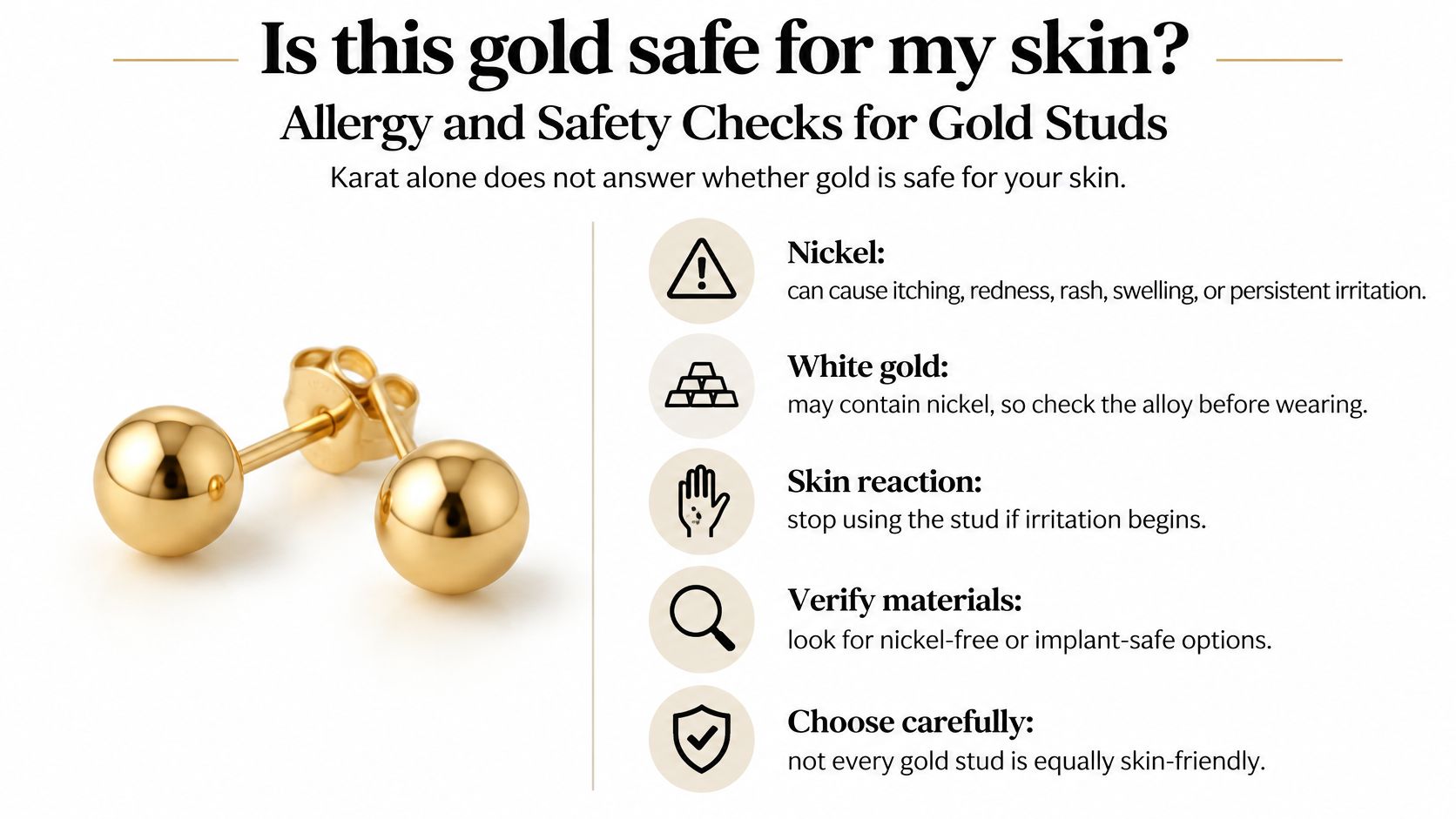
Is this gold safe for your skin? Karat will not answer that. The non-gold chemistry will.
Nickel can trigger allergic contact dermatitis, typically itching, redness, rash, swelling, or persistent irritation at the contact site, according to ColumbiaDoctors guidance on safe piercing jewelry. White gold deserves extra scrutiny because some formulas use nickel to make the white colour. Yellow gold is not automatically innocent either if the maker will not name the alloy.
Choose a verified nickel-free alloy, preferably one that uses palladium or another biocompatible element, and skip unspecified white gold. The piece should also be sterilizable, with a smooth, highly polished wearable surface. Roughness, scratches, and porous finishes raise friction and hold debris while you heal, which can inflame tissue even when the metal itself is acceptable. That matters most on a new piercing. On a healed one, nickel-free construction is still the safer pick if you have reacted before.
What a clinic list actually includes
Mayo Clinic's nickel allergy guidance lists 18-, 22-, and 24-karat yellow gold among jewelry options to consider, along with nickel-free white gold, titanium, nickel-free stainless steel, and sterling silver. It also says to confirm that a piercing studio uses hypoallergenic jewelry and can document the metal content.
Read that list with the softness problem still in mind. 22K and 24K yellow gold can be reasonable for people avoiding nickel, and they are still too soft for an everyday lip post. "Hypoallergenic" on its own is not a precise material claim. You want the metal named.
Before you buy, the short list is simple.
- Documented alloy: the listing names the metals, not just the colour.
- Nickel and cadmium status: both are called out as absent, not implied.
- Sterilizable: the piece can be properly cleaned before it goes into a piercing.
- Polished: the post and disc feel smooth, with no pits or plating edges.
If irritation keeps going, stop wearing the suspect stud and get it assessed. Do not treat a lasting rash as normal healing. More on how reactions show up is in our guide to piercing and material sensitivities.
Threadless, Threaded and Flat Back Designs Compared
The metal can be right and the hardware can still annoy your lip. You will usually see three closures, plus a flat disc on the inside.
Threadless push-in uses a smooth post. The decorative top has a pin that pushes into the post and holds by tension, so there are no threads to drag across tissue. It is the easiest style to change, and it is usually the least irritating while you are healing. If a top feels loose, the pin needs a slight bend for grip. If it will not come off, it has been bent too far.
Internally threaded hides the threads inside the post. The ball screws on and holds firmly once it is seated. You do have to line it up. Cross-threading chews the gold and leaves a gritty edge.
Externally threaded is the older style, with threads on the outside of the post. It is harder to fit, and those exposed threads are the ones most likely to scratch on the way through.
The flat back is the disc that rests inside the mouth, against the gum side, while the labret ball sits on the outside. A smooth disc beats a bulky back that clicks on teeth.
| Design | Fit | Ease of changing | Loosening risk | Best for |
|---|---|---|---|---|
| Threadless push-in | Smooth post with nothing to catch on tissue | Easiest | Low | Healing piercings |
| Internally threaded | Ball screws into a hollow post | Moderate; avoid cross-threading | Low when tightened | Healed piercings |
| Externally threaded | Threads on the outside of the post | Hardest | Higher | Older style, most likely to scratch |
Which one for which stage
For a healing piercing, I would start with a threadless piece and a polished post. Nothing on the shaft has to pass through raw tissue except a smooth surface, and you are not twisting hardware while the piercing is tender.
For a healed piercing, internal threads give a secure fit and open up a wider range of solid gold ends. Check that the ball seats fully. A half-turned ball is how gold labret studs go missing in a napkin.
Solid gold threadless pieces are sometimes limited in thickness options, so confirm the gauge before you fall for the top. A pretty end on the wrong post is still the wrong stud. Style differences across labrets are easier to picture in this look at labret piercing jewelry styles.
Sizing Your Labret Gauge, Length and Ball
Most lip labrets use a 16G (1.2 mm) gauge. Post length and ball size still have to match your tissue, or the right metal will sit wrong.
| Element | Typical value | When to choose it |
|---|---|---|
| Gauge | 16G (1.2 mm) | Standard for most lip piercings |
| Post length | 5/16 in (8 mm) | Common lower lip fit for healed or thin tissue |
| Post length | 3/8 in (9.5 mm) | Thicker tissue or swelling in a fresh piercing |
| Ball diameter | 3 mm to 4 mm | Keeps the stud from sinking into the lip |
| Flat back disc | 4 mm to 5 mm | Sits flat against the gum line |
How to read each number
Gauge runs backward from what people expect. A higher gauge number means a thinner post. 16G is the everyday lip size. Jumping to a thicker or thinner post without a piercer's plan just stresses the channel.
Length is the wearable portion, not the whole piece of jewelry in the bag. Measure lip thickness at the piercing and leave extra room for swelling. A 5/16 inch (8 mm) post is a common lower-lip size once things have settled or if your lip is on the thin side. A 3/8 inch (9.5 mm) post suits thicker tissue, or the puffy first stretch of a fresh piercing. Too short and the disc and ball pinch. Too long and the stud levers against your teeth every time you talk.
The ball is what stops the front from disappearing into the lip. A 3 mm to 4 mm ball is the usual window. Smaller, and soft tissue can grow over the edge. Much larger, and you are clicking it on cups and toothbrushes all day.
The flat back disc, about 4 mm to 5 mm, should lie against the gum line without a raised rim that rubs. If you can feel a sharp edge with your tongue, that finish is not ready for your mouth.
The fit test
Put the stud in and check three things. If it pinches, the post is short. If it slides and taps your teeth, the post is long. If the ball sinks into the lip, the front is too small or the length is off.
Have a piercer measure you rather than guessing, especially on a new piercing. Swelling changes the number you need in the first weeks, and a healed size ordered on day one is a common reason people think gold "doesn't work" for lips.
Daily Care and Warning Signs While Healing
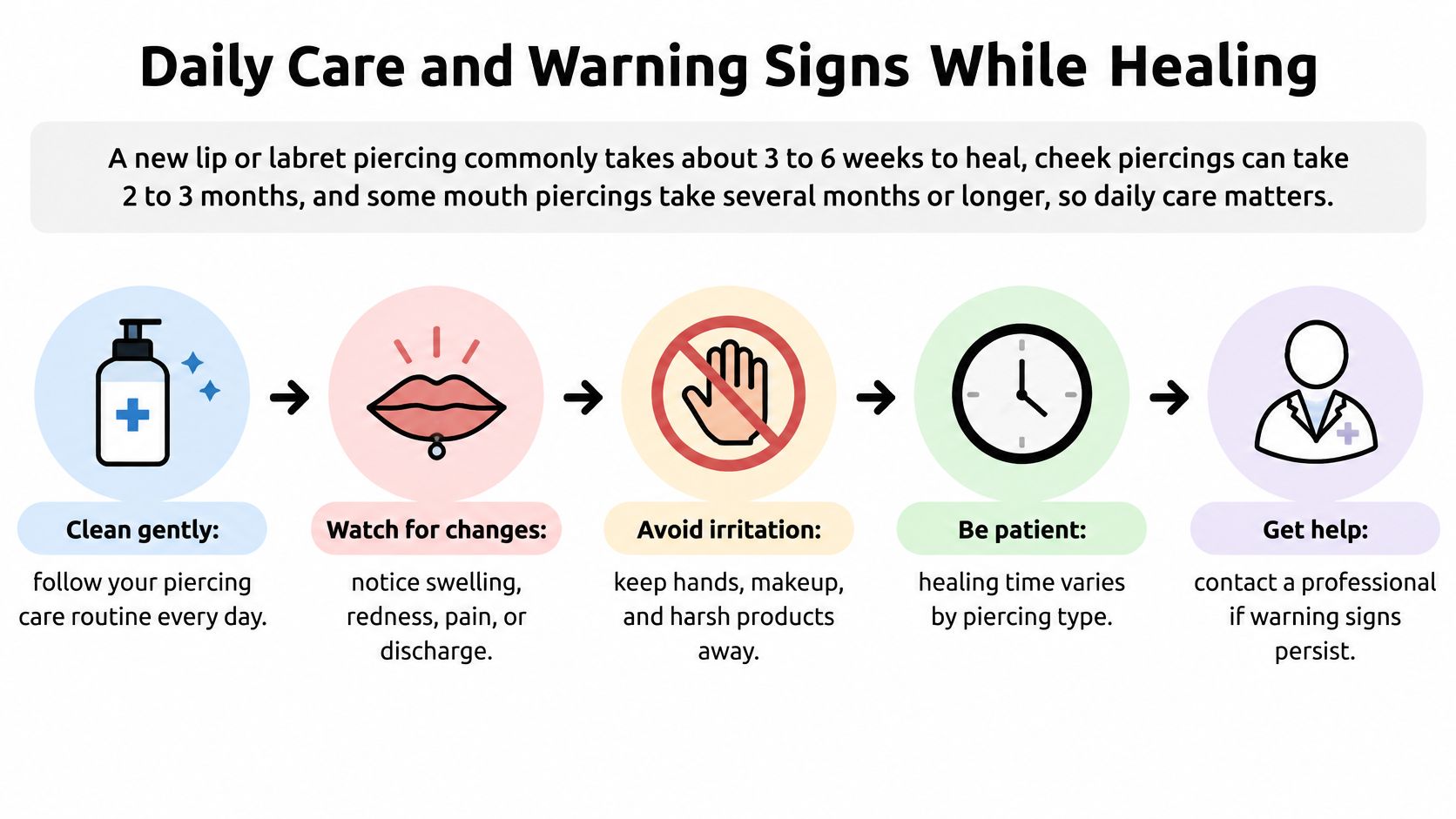
A new lip or labret piercing commonly takes about 3 to 6 weeks to heal, while cheek piercings may take 2 to 3 months, based on Torbay's oral piercing aftercare guide. Some mouth piercings take several months or longer, so the jewelry stays in the whole time. Pulling a stud out early lets the channel close.
Mayo Clinic's piercing aftercare notes treat the inside of the mouth as part of the job, not an afterthought. Plaque and food collect around the post even when the outside looks clean.
A daily routine that actually fits a mouth
- Wash your hands before you touch the stud. Fingers move more bacteria than the jewelry does.
- Rinse with an alcohol-free antiseptic mouthwash after every meal and before bed. Alcohol dries the tissue and stings a healing channel for no benefit.
- Brush daily with a soft-bristled toothbrush around the jewelry and the pierced area so plaque does not sit on the gold.
- Use a warm salt rinse if your piercer wants one: 1/4 level teaspoon of preferably sea salt in an egg cup or shot glass of warm water. That is a small sip, not a mug of salty water.
- Do not twist or turn the stud when the piercing is dry. Dry rotation tears the new tissue instead of "keeping it open."
- Clean twice a day so warm salty water can soften crusting. Picking crust off with a nail reopens the edge.
Skip oral sex until a mouth piercing has healed. That is infection control, not a style rule.
When it is more than irritation
The NHS infected piercings page flags increasing swelling, pain, heat, pronounced redness or darkening, and blood or pus. Pus may look white, green, or yellow. A little tenderness in the first days is expected. Heat, spreading colour, and coloured discharge are not.
See a doctor if those signs show up. Do not swap metals, add ointment, or "wait it out" while pus is present. A good gold labret cannot outrun an infection you ignore.
Confirm the Alloy Before You Buy Your Gold Stud
Confirm the alloy before you buy. Karat and colour do not tell you what touches your lip.
Any listing with no karat, no alloy, and no nickel status is a reason to skip it or ask a piercer before it goes near a fresh or sensitive piercing. A photo of a yellow ball is not a material spec.
We sell lip jewelry that includes labret studs, vertical labrets, hoops, and captives in the 16G lip standard, in surgical steel, titanium, and solid 14K gold, including push-in and threadless styles, plus solid 14K gold body jewelry more broadly. Match the listing to your healing stage and your measured length before you order. If the metal line is fuzzy, your piercer should see it before you do.
Ready to find your gold lip stud? Shop our lip jewelry today. Have questions about aftercare? Drop them in the comments below. Sign up for our newsletter to hear about new arrivals first.
BodyCandy carries lip labrets, vertical labrets, hoops, and captives you can compare by gauge, length, and metal before you commit to a gold stud. If you want a piece that names its alloy instead of just looking gold, start with our lip jewelry and solid 14K gold options. Visit BodyCandy and pick the stud that matches your piercing stage, not just the shine in the photo.