



















You searched for a belly button ring red enough to steal the outfit, but your skin gets a vote too. A red stone can look perfect on day one and miserable by day three if the metal underneath irritates you. Sort the cause of any redness first, then pick the color, finish, and size that let you wear it comfortably.
Red Belly Button Ring Styles at a Glance
In a Brazilian study of 58 medical students with body piercings, 29 participants, or 50%, experienced a local reaction, and 65.5% of the reactions occurred during the first six months after insertion, according to the Brazilian study of pierced medical students. Infections, pain, swelling, inflammation, and hypertrophic scarring showed up often with navel piercings. That's why your choice isn't just cherry versus burgundy. It's also about friction, sanitation, technique, and whether the material suits your skin.
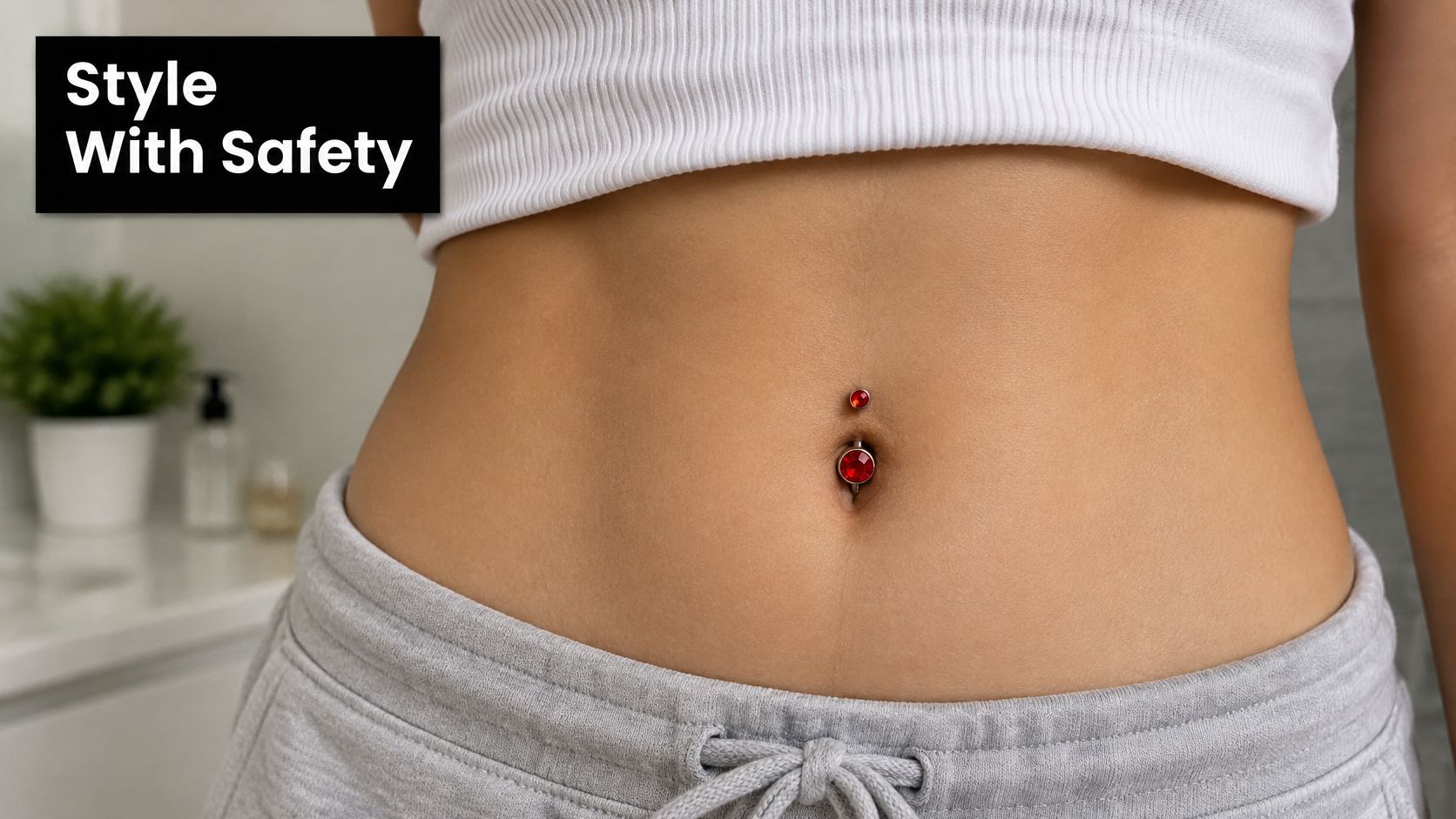
Five Ways Jewelry Gets Its Red Color
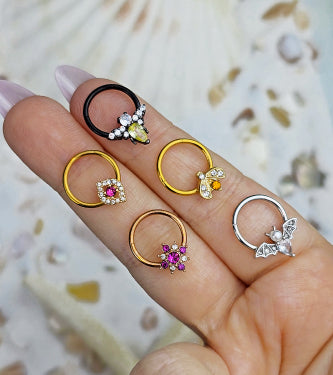
Most red looks come from a red CZ gem set into the top, bottom bead, or both. It gives you sparkle without coloring the whole bar. Red enamel creates a bolder, painted look, while anodized titanium carries color in its surface oxide layer. Acrylic and glass can be molded red throughout, and plated pieces put a thin red coat over another metal.
| Finish | How the red is made | Durability | What to check |
|---|---|---|---|
| Red CZ gem | Cubic zirconia set in a red stone on the top or bead | Stones can loosen if the setting is weak | Secure, threaded setting |
| Red enamel | Colored enamel fired onto the jewelry surface | Chips and wears over time | Enamel is intact, no exposed base metal |
| Anodized titanium | Oxide layer grown electrochemically so the color is part of the surface | Stable, does not flake | Confirm F136 titanium base |
| Molded acrylic or glass | Color molded or blown into the body | Lighter but can crack | Suitable only for short trial wear |
| Plated red over base metal | Color coat applied over a metal core | Peels and wears through | Base metal must be nickel-free |
The Finish Trade-Offs
Gem tops are the easiest everyday choice because the bar itself can stay simple and smooth. Check the prongs or bezel before you wear it, since a loose stone usually means weak threads or a wobbly setting too. Enamel looks cute up close, but a chip changes both the color and the surface against your skin.
Plating is the finish I'd trust least for long wear. Once it rubs through at the curve, you're no longer wearing the surface you bought. You're wearing whatever sits underneath, and that matters if nickel bothers you.
Quick pick: Choose anodized titanium or enamel on a 14G barbell for a longer-term red look, and reserve acrylic for short trial wear.
A smooth, secure red gem top is also a smart starting point if you want color without a dangle swinging into your waistband. Save the dramatic charms for a calm, healed piercing.
Materials That Keep a Red Ring Safe and Durable
A red finish is only as dependable as the metal beneath it. Before you fall for the shade, consider what is touching the piercing channel every hour you wear it.
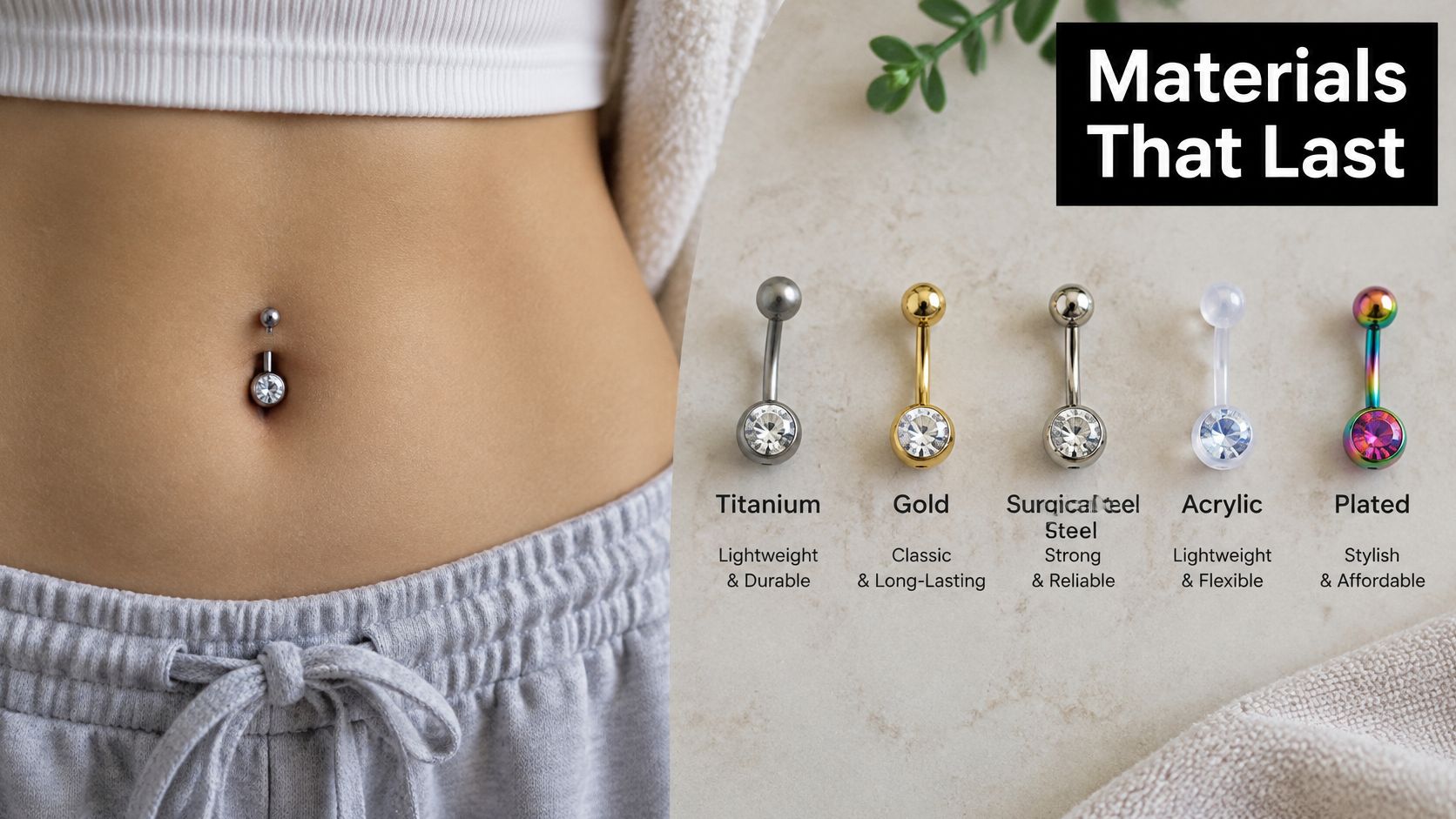
| Base material | Nickel release risk | Red finish options | Best use |
|---|---|---|---|
| F136 titanium | Very low | Anodized red, red gem tops | Sensitive skin and healing piercings |
| Solid 14k gold | Low when solid and verified | Red gem or red enamel | Long-term wear and gifts |
| 316L surgical steel | Contains nickel, moderate release | Plated or enamel red | Budget pieces for non-sensitive skin |
| Medical-grade acrylic | No metal | Molded red | Short trial wear only |
| Plated base metal | High once plating wears | Plated red | Not recommended for new piercings |
Why Hypoallergenic Is Not a Material
Hypoallergenic sounds reassuring, but the label alone doesn't identify the alloy composition, nickel release, coating durability, or whether a piece suits a healing piercing. A 2025 systematic review and meta-analysis on piercing and nickel allergy found a significant association between piercings and nickel allergy and concluded that a large proportion of earrings still release nickel at levels capable of causing allergy or allergic dermatitis. That doesn't prove nickel caused every red navel. It does mean swapping one mystery metal for another can leave the trigger exactly where it was.
Our guide to piercing and material sensitivities is worth reading if the same ring keeps making you itch. Pay attention to timing, too. A reaction may build after repeated wear, and scratches or peeling can increase your exposure as the surface changes.
This short video is a useful pause before you buy, especially if you're comparing finishes side by side.
Your Material Checklist
- Ask for the full specification: Request the exact base material, not just a marketing label.
- Choose documented nickel-safe metals: Prioritize F136 titanium or verified solid gold if your skin reacts easily.
- Inspect the surface: Look for peeling, cracks, scratches, and exposed metal before every wear.
- Skip plated starter jewelry: Don't use plated base metal in a new navel piercing.
If redness comes with intense itching or a rash, stop the suspect piece instead of testing five similar ones. Infection can also exist alongside dermatitis, so discharge, worsening pain, fever, or red streaking needs medical assessment rather than more jewelry experiments.
How Long Redness Is Normal During Healing
Say your piercing is four months old and still looks a little pink after a day in snug jeans. That can be ordinary. Cleveland Clinic reports that navel piercings commonly remain tender, red, or crusty for 12 to 18 months, and complete healing can take a year or longer.
That timeline surprises a lot of people because the outside can look settled while the channel is still fragile. Mild redness that steadily improves is different from redness that suddenly intensifies. The direction matters more than one mirror check.
What the Timeline Often Looks Like
During the first six months, expect the site to complain more easily after pressure, snagging, sweat, or a jewelry change. This is when patience earns its keep. Keep the starter style simple, avoid dangling charms that catch, and don't treat every pink day like a reason to swap jewelry.
In the middle stretch, the piercing may stay faintly pink but feel calmer from week to week. You might notice tenderness only when you bump it. A small amount of clear or whitish crust that cleans away gently can also fit normal healing.
By the final months, the halo should fade and the skin around both holes should look closer to your normal color. Our notes on what is normal for a healing piercing can help you compare today's look with last week's instead of guessing from memory.
Signs You're Still in Normal Territory
- Slight pink halo: The color stays close to the holes and gradually fades.
- Mild tenderness: It protests when touched or snagged, then settles.
- Small crust: Clear or whitish buildup appears without worsening pain or heat.
A red ring is a style upgrade once the site is no longer persistently sore, swollen, or leaking concerning discharge.
Keep the same size until you're sure healing is finished. Changing color, length, and shape at once makes it harder to identify what irritated you if redness returns. One change at a time gives you useful information.
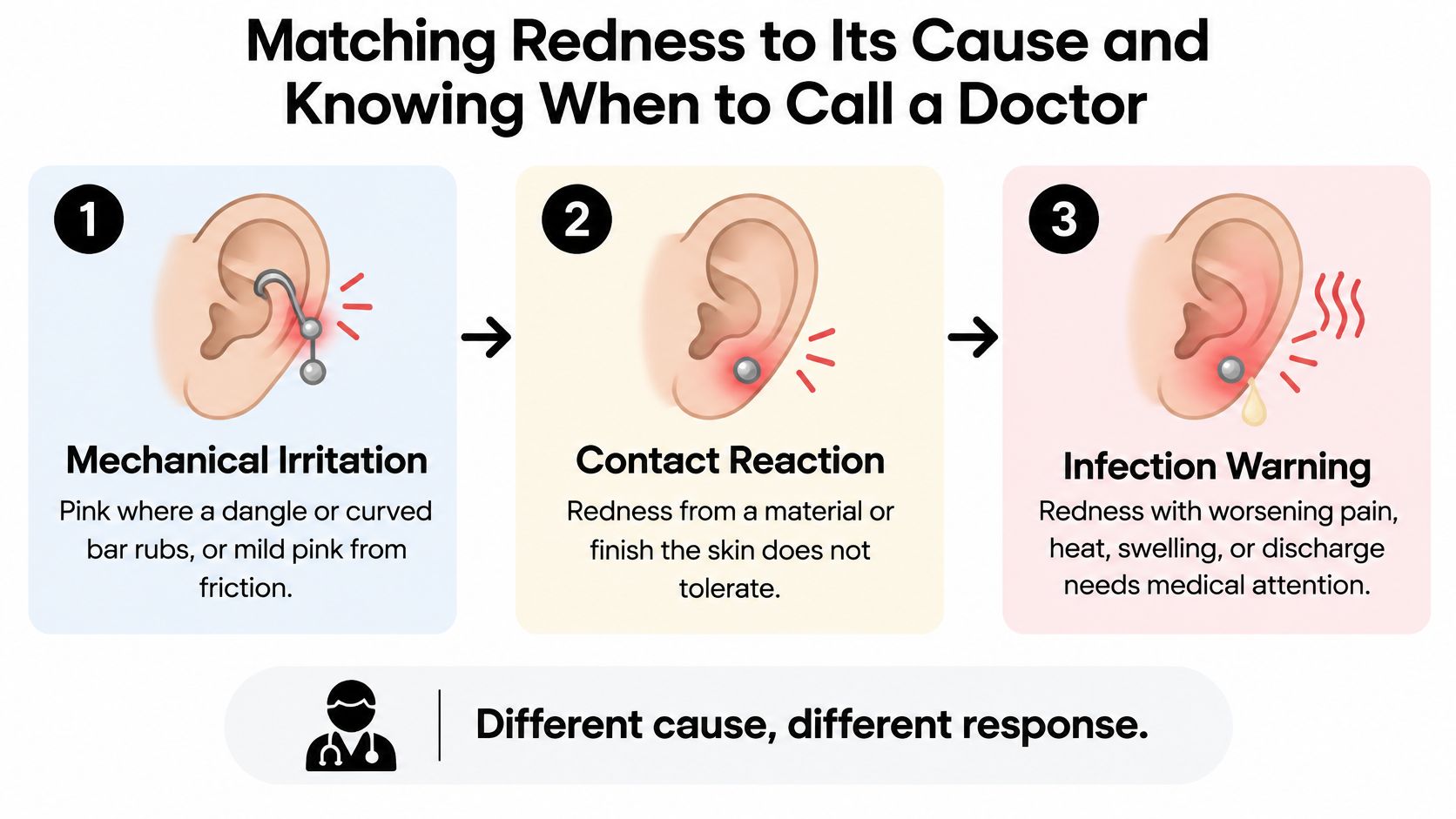
Matching Redness to Its Cause and Knowing When to Call a Doctor
Redness has at least three common causes, and each one asks for a different response. Cleaning harder won't fix a metal reaction. Swapping metals won't treat an infection. Your first job is matching the pattern, not reaching for the strongest product in the cabinet.
| Symptom | Likely cause | First action |
|---|---|---|
| Red, itchy or scaly rash appearing 12 to 72 hours after new jewelry | Nickel or metal allergy | Remove the suspect ring and switch to a nickel-free metal |
| Redness with dry or cracked skin that returns with the same metal | Allergic contact dermatitis | Stop that piece and see a dermatologist if it persists |
| Mild pink or red that improves day by day, no heat | Normal healing irritation | Clean with saline and keep the ring in place |
| Red patch where a dangle or curved bar rubs | Friction or pressure | Switch to a shorter, smoother barbell |
| Redness with warmth, swelling or pus | Possible infection | Seek medical care and do not self-treat |
Mechanical Irritation Usually Has a Map
Friction tends to leave evidence exactly where something rubs. Look for pinkness at one hole, under a large bottom gem, or along the spot where a dangle hits your skin. A waistband, seatbelt, tight workout top, or bar that's too long can keep restarting the irritation.
Remove the pressure first. A smoother, appropriately sized barbell and looser clothing often tell you more than another cleaning product. If the red patch fades when the rubbing stops, you've found a useful clue.
Allergy Often Starts With the Itch
A red, itchy, burning, or scaly rash beneath the jewelry can reflect allergic contact dermatitis, and Cleveland Clinic guidance summarized by the American Academy of Dermatology places nickel-allergy symptoms commonly at 12 to 72 hours after contact. Those symptoms may include itching, burning, rash, dry or cracked skin, and hives. The practical move is to stop the suspected jewelry and choose nickel-free or hypoallergenic materials, including implant-compatible options such as platinum or verified high-karat yellow gold.
Recurrent blistering, oozing, or redness that follows the same metal deserves dermatologic evaluation. Don't keep challenging your skin with the same piece just to be sure. Your piercing doesn't need to fail the same test three times.
Infection Changes the Whole Picture
Infection becomes more likely when redness brings increasing warmth, swelling, pain, or purulent discharge. The NHS guidance on infected piercings identifies white, green, or yellow pus, bleeding, systemic chills, and feeling generally unwell as warning signs. Inflammation can also progress to an abscess, which is a pocket of pus, so escalating symptoms shouldn't be managed by guesswork.
Our overview of common belly piercing problems can help you organize what you're seeing before you call. Still, a clinician needs to assess a suspected infection because treatment may involve topical or oral antibiotics. Avoid hydrogen peroxide and alcohol, and don't assume every red piercing needs antibiotic ointment.
Escalation rule: Redness alone is rarely an emergency, but redness that's spreading, hotter, more painful, or paired with pus or fever needs prompt care.
What to Do While You Decide
- Wash your hands: Do this before you touch the site for any reason.
- Leave the jewelry alone: Don't twist it or remove it without medical advice.
- Clean gently with saline: Skip harsh scrubbing and strong antiseptics.
If symptoms don't improve within 5 to 7 days, book a clinician visit. Go sooner if the area worsens or spreads. Tell the clinician when redness started, what metal you're wearing, whether the ring is new, and whether you've recently been swimming. Seek urgent care at once if you feel very unwell, develop chills, or notice rapidly spreading discoloration.
Sizing Your Red Belly Ring Without Guesswork
Two numbers decide whether your red ring sits pretty or presses all day: gauge and length. Standard belly rings are commonly 14G, but don't order from habit. Confirm your own piercing first, because a mismatch invites pressure, movement, and friction.
A Five Step Sizing Routine
- Confirm your gauge: Ask your piercer to verify the gauge and the jewelry's inner dimensions.
- Leave room early: Choose a barbell length that clears the navel and allows for swelling while the piercing is fresh.
- Downsize only when settled: After healing, choose a snugger length that sits flat without digging into the skin.
- Check the top and bead: Make sure a gem top or bead rests comfortably and doesn't catch on clothing or a waistband.
- Watch for pressure marks: Look for a pale ring, flattened dimple, or redness where the bar meets the skin.
A bar that's too short can pinch swollen tissue and make the holes look angry. A bar that's too long moves more, catches more, and lets a decorative end lever against the piercing. Neither problem is solved by cleaning more often.
Red finishes don't add a special sizing rule. Measure a red CZ piece the same way you'd measure a plain curved barbell. The decorative end still matters, though, because a wide gem or dangle changes how the jewelry moves even when the bar length is correct.
If you see a pressure dimple, size up or swap to a simpler style instead of waiting for your skin to get used to it.
I would start with the least dramatic fix. Remove the dangle, check the length, and wear a smooth barbell for a few calm days. If the red patch follows the pressure point, your sizing was part of the story.
Pairing Red Belly Rings With Outfits and Other Jewelry
Red works best when you let it be the accent, not the entire personality of the outfit. It flashes when you crop, tie, or tuck a top, which makes even a tiny stone feel intentional.

Five Easy Red Ring Looks
- Cropped tank and high-waisted jeans: Let a red stone be the single bright point against a ribbed white or black top.
- Black or denim base: Pair red enamel with dark neutrals and follow the one-bold-color rule.
- Silver layering: Add a chain belt or simple silver accents when you want a playful edge without more red.
- Matching beauty detail: Echo the stone with red nail polish or a similar lip shade.
- Bikini or sarong: Wear a secure red gem top where it can catch the light all day.
With other body jewelry, a red navel ring pairs nicely with one red or silver nose stud. Stack red at every piercing and the effect can flatten into a matching set. One echo is cute. Five echoes start competing with each other.
Keep a plain titanium spare for workouts. Sweat, bending, waistbands, and gym equipment are unkind to dangles and fabric-catching charms. Swap back to your statement piece after you've showered and the area is dry.
Try the jewelry with the exact waistband you'll wear, not just in front of the mirror. Sit down, twist, and check whether the bottom gem flips or digs in. A look that survives sitting through lunch is the one you'll reach for.
What's your favorite red combination? Drop it in the comments, especially if you've found a pairing that looks bold without snagging on everything you own.
Choose Your Red Belly Ring Before You Buy
Don't start with the prettiest product photo. Start with the base metal, then the finish, then the size. That order protects your skin and saves you from buying the same problem in a new shade of red.
We offer belly rings in F136 Titanium, 14k Gold, Rose Gold and Handcrafted options, and belly rings are sold in the standard 14G gauge. Those labels still need checking against the exact piece you choose. A category name isn't a substitute for the specification on the item in your cart.
Your Buyer Checklist
- Confirm the base metal: Choose F136 titanium, verified 14k gold, or another documented nickel-free option, and avoid plated base metal for a new piercing.
- Pick the finish for your skin: Use anodized titanium or gem tops for sensitive skin, and save enamel for a bolder look on a healed piercing.
- Confirm gauge and length: Verify both measurements before you order, especially if your current bar leaves pressure marks.
- Ask for the specification: Request the full material details instead of relying on the word hypoallergenic.
- Inspect it on arrival: Return a piece with scratches, flaking color, loose stones, or exposed metal before it goes near your piercing.
If your piercing is still red, sore, swollen, or leaking, book a check with a professional piercer before swapping jewelry. A new ring can't diagnose the problem. It can only add another variable while you're trying to heal.
Once you're ready to rotate styles more often, our monthly clubs for body jewelry include the Belly Ring Monthly Club and the Septum Monthly Club. Keep your everyday titanium spare in the rotation, though. The best red ring is the one you can wear, remove, clean, and wear again without negotiating with your skin.
Ready to find a red look your skin can live with? Shop titanium and 14k gold belly rings at BodyCandy, check the material specification before you check out, and bring your sizing or sensitivity questions to the comments.