












Between 73% and 90% of participants in a U.S. convenience survey of people with intimate piercings said they still liked their piercing, according to the study indexed by PubMed. That lasting satisfaction offers a better starting point for “why nipple rings?” than assumptions about sex or shock value. For many wearers, the appeal is personal: liking their reflection, expressing themselves, or choosing something that belongs to them.
But loving the look and living with a healing piercing are different things. Your reason matters, and so do your anatomy, jewelry fit, metal choice, and willingness to give healing tissue some peace.
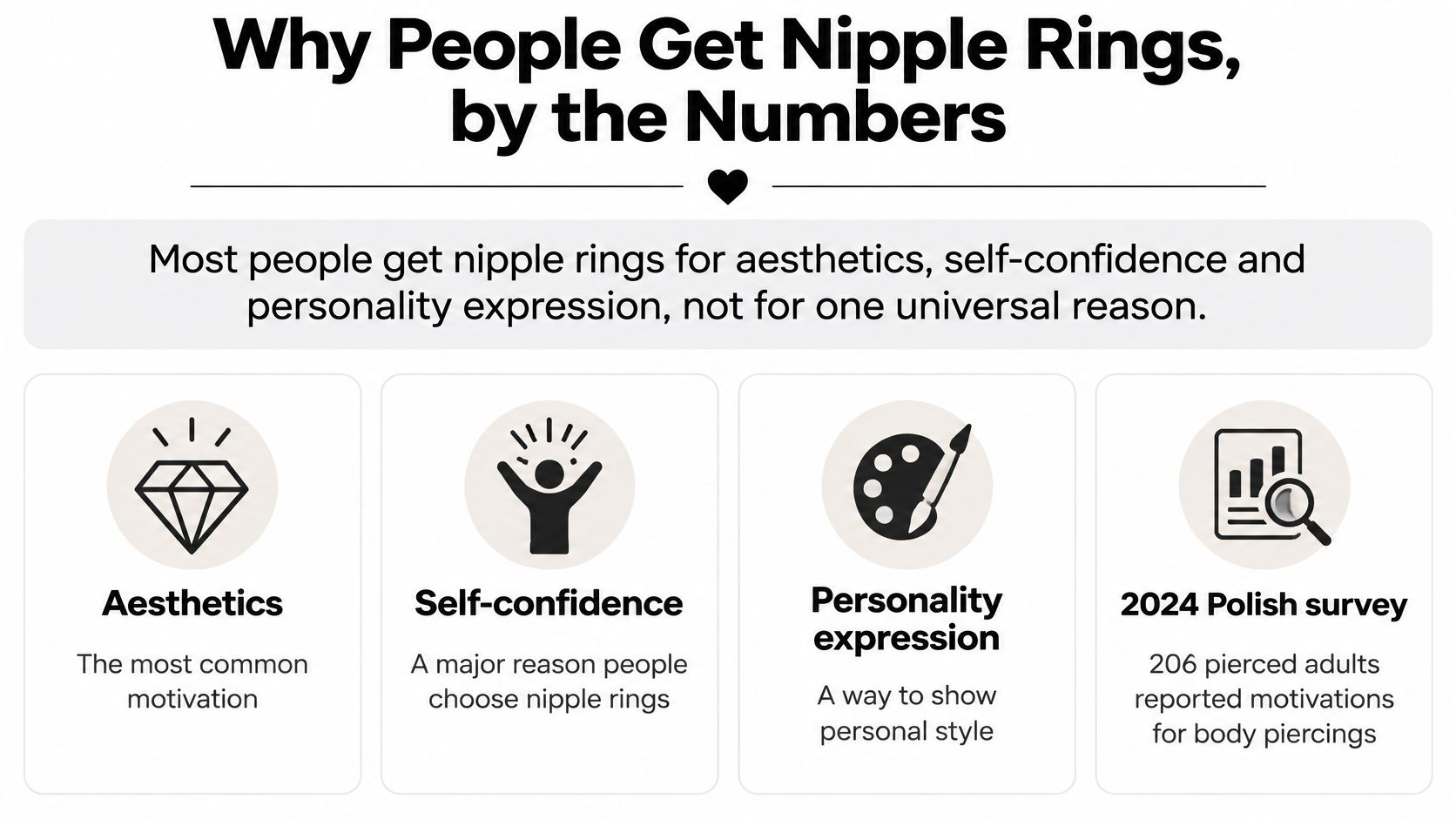
Why People Get Nipple Rings, by the Numbers
80.6% of participants in a 2024 Polish survey of 206 pierced people, published in Cosmetics, named aesthetics as a motivation for their piercing. In that same survey, 56.3% pointed to greater strength or self-confidence, and 54.9% chose personality expression. Looks, confidence, identity: three different doors into the same decision.
Those figures cover body piercing generally, with nipple piercings folded into the mix. Respondents could also select more than one reason, which is why the percentages add up to well over 100. The pattern still tells you something useful: the leading motives center on the wearer, and none of them is sexual.
Motivations reported in two Polish surveys
A 2023 Polish internet survey of 659 people, published in Psychiatria asked a similar question and landed on smaller shares: 32.4% for aesthetics, 22.8% for power or strength, 19.1% for personality expression, and 9.9% for wanting to stand out. The table lays both sets of answers side by side.
| Motivation | Survey figures | What it looks like in practice |
|---|---|---|
| Aesthetics | 80.6% (2024, 206 people); 32.4% (2023, 659 people) | Liking the look and treating jewelry as a visible feature |
| Strength or self-confidence | 56.3% (2024); 22.8% (2023) | Feeling powerful and in control of your own body |
| Personality expression | 54.9% (2024); 19.1% (2023) | Choosing jewelry that reflects who you are |
| Standing out | 9.9% (2023, 659 people) | Being distinct from the people around you |
The two surveys drew different participants and asked their questions differently, so read each figure as a snapshot of that group rather than a trend line. What holds steady across both is the ranking: looking good and feeling like yourself sit at the top, and they work together. A polished barbell can please your eye and reinforce your sense of ownership at the same time.
Knowing which reason is yours pays off later. A wearer chasing a private detail gravitates toward subtle pieces, while someone after a bold statement shops for decoration that demands attention, and an everyday-accessory motive points toward comfort. Each motive leads somewhere different once you reach the jewelry tray, so name yours first, then let anatomically appropriate fit have the final word.
Self-Expression Beyond Sex and Attraction
A nipple piercing isn't an announcement about someone's sex life. It can be sexual, nonsexual, or meaningful in ways that don't fit neatly into either category.
In a study of people with intimate piercings, expressing oneself was the most commonly reported reason for nipple piercings, selected by 77% of male respondents; expressing oneself sexually ranked second among female respondents, at 43%. Those findings leave room for different motivations rather than assigning one meaning to every wearer.
Same placement, different meanings
Consider these hypothetical wearers:
- The graduate: She wants a detail that's just for her when she looks in the mirror. Visibility to other people isn't the point.
- The man choosing his own look: He wants a tangible reminder that he decides how to decorate his body. A simple barbell feels more fitting than an elaborate design.
- The dancer: She likes the confidence of a coordinated look on stage. Her eventual jewelry choices need to account for costumes, movement, and snagging.
None of those reasons requires a partner's approval. None tells a stranger anything reliable about the wearer's availability, orientation, or boundaries.
Aesthetic self-definition means liking how you look. Body autonomy means making the decision yourself. Confidence, gender expression, personal symbolism, and sexual expression may overlap with those ideas, but they're not interchangeable.
A private piercing doesn't need an audience to have meaning.
Make the decision yours
Ask yourself whether you'd still want the piercing if nobody else saw it. There's no required answer, but the question helps separate your preferences from pressure to impress someone.
If a partner suggested it, you can like the idea without owing them the result. Healing also means setting boundaries around touching and sexual contact, so a supportive partner needs to respect more than the finished look.
Our discussion of why people choose to get pierced or modified explores that broader relationship between appearance and identity.
For gift shoppers, this is especially important: don't treat intimate jewelry as a hint that someone should get pierced. Ask about their preferences, and let the wearer decide the placement, visibility, and timing. A thoughtful gift supports their choices rather than making those choices for them.
Choose Hypoallergenic Metal and Fit Before You Book
If you react to nickel, choose your metal before the appointment, not after your skin starts complaining. “Hypoallergenic” is a useful shopping term, but it isn't a substitute for a clearly identified material.
Mayo Clinic's nickel-allergy guidance describes an itchy contact rash that can begin within a few days of exposure and lists titanium, nickel-free stainless steel, surgical-grade stainless steel, and certain yellow-gold options, including 18-, 22-, and 24-karat gold, as alternatives to nickel-containing jewelry.
Talk through both material and fit with your piercer before choosing a decorative finish.
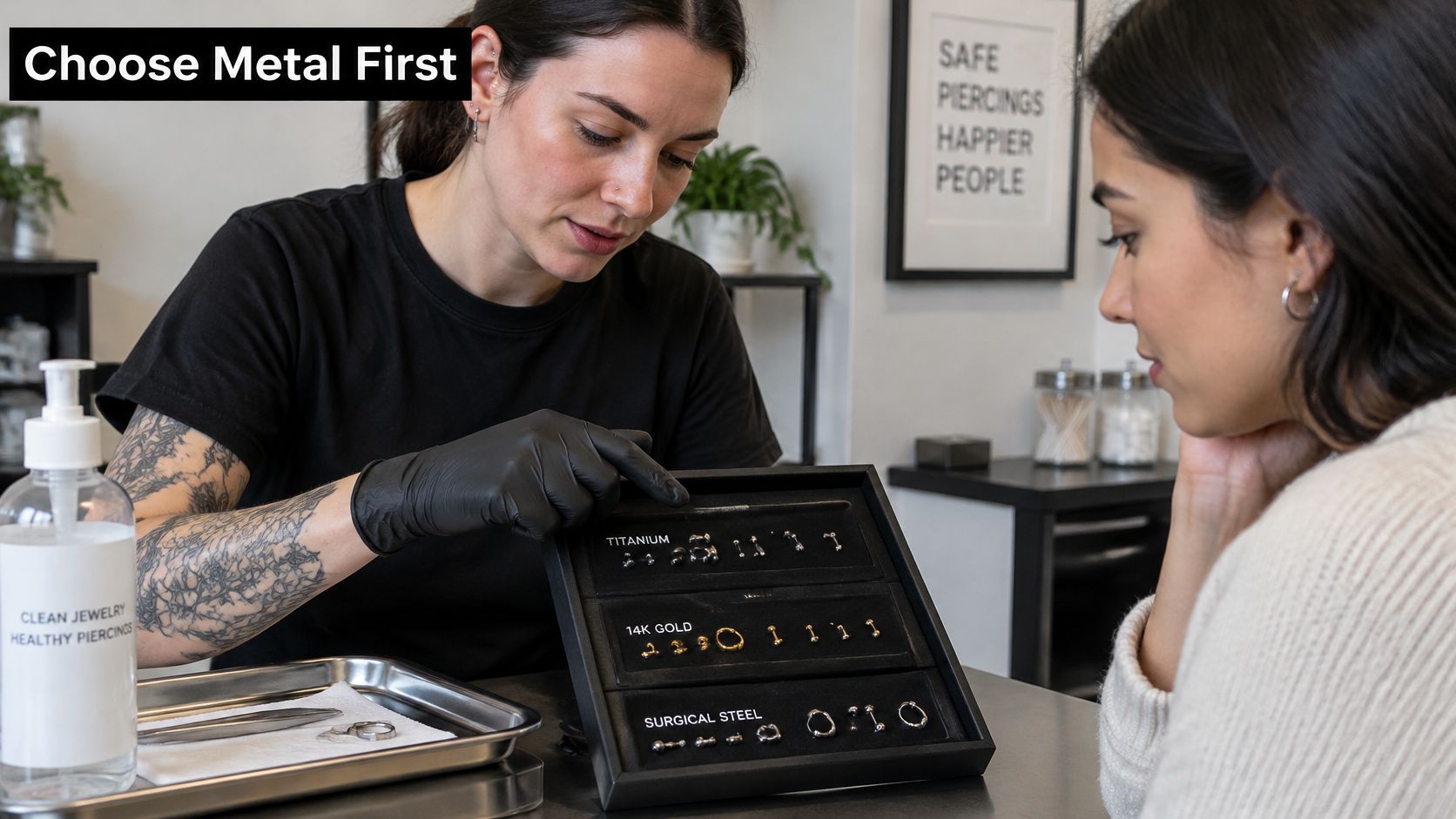
Metals for sensitive skin
| Metal | Nickel-free | What to check |
|---|---|---|
| Titanium (F136) | Yes | Confirm the grade, not just the word titanium |
| Surgical-grade stainless steel | Check label | Don't assume every steel alloy is nickel-free |
| 18 to 24 karat yellow gold | Only with a verified nickel-free alloy | Check karat, alloy, and suitability for the placement |
| Plated or base metals | Only if the underlying alloy is verified nickel-free | Plating can wear through and expose the metal beneath |
Gold color doesn't tell you what a piece is made from. Likewise, a titanium-colored coating isn't the same thing as solid titanium.
Most of our nipple rings are surgical steel, with titanium options available, including F136 Titanium, plus Handcrafted styles; most are sold as matched pairs. A matching appearance is convenient, but each side still needs its own fit assessment.
Your pre-booking checklist
- Confirm sterile equipment. Ask whether needles are sterile, individually sealed, and nickel-free or appropriate surgical-grade stainless steel.
- Get measured in person. Your piercer should choose gauge and wearable length for your tissue, not copy someone else's size.
- Choose a documented material. For nickel sensitivity, verified implant-grade titanium is a straightforward option; steel needs alloy-specific consideration.
- Check both sides separately. A matched pair doesn't guarantee matching anatomy or identical healing.
- Arrange a follow-up. Have the fit reviewed during the early healing period, especially as swelling changes.
Our hypoallergenic jewelry guide for sensitive skin can help you interpret material descriptions. Bring your allergy history to the appointment, and choose the metal before getting attached to a particular design.
Jewelry Styles, Gauges and Sizing Explained
14G is a standard nipple-jewelry size, and 16G options also exist. Gauge describes the thickness of the part that passes through the piercing, not the bar's length.
Those measurements aren't interchangeable. A piece can have the correct gauge and still be too short, too long, or awkwardly shaped for your anatomy.
Also, “nipple ring” is often used as an umbrella term. Plenty of nipple rings aren't rings at all, they're straight barbells.
Jewelry styles and their best uses
| Jewelry type | How it is worn | Best use |
|---|---|---|
| Barbell | Straight bar with a ball or other end on each side | Everyday wear and, with appropriate specifications, healing |
| Captive bead ring | A ring whose opening is secured by a small bead | A rounded look once healed; fitting may require tools |
| Shield | Decorative piece that frames or sits over the nipple, usually secured by a barbell | Decorative coverage for healed piercings |
| Hinged clicker | Hoop that opens at a hinge and clicks shut | A defined hoop look once fully healed |
| Dangle or chain | Hanging decoration attached to the jewelry | Statement wear after full healing |
| Threadless top | Decorative end secured by a tension-fit pin rather than screw threads | Customizing compatible jewelry with a piercer's fit check |
A straight barbell is generally the practical starting choice because it can sit without the curved pressure and movement of a hoop. Start simple, even if your eventual goal is dramatic sparkle.
Captive bead rings have a clean look, but “removable bead” doesn't necessarily mean easy changes. Some require opening pliers or professional handling, so don't force a stubborn ring against your tissue.
Match the style to your actual day
A shield can look compact in a product photo while having edges that catch a lace bra. A chain may look delicate but still get pulled by a towel, costume, or hand.
For everyday wear, think about what crosses your chest: seams, straps, work uniforms, sports equipment, and bedding. Smooth ends and sensible proportions are more useful than choosing jewelry solely by how it looks off the body.
Threadless jewelry describes an attachment system, not a particular silhouette. The pin, post, and end need to be compatible, and the connection needs to hold securely.
Fit check: Measure the wearable bar, not the whole piece including its decorative ends.
Fresh jewelry needs room for swelling, while an unnecessarily long bar can snag after swelling settles. Your piercer should assess when a shorter piece is appropriate, rather than leaving you to downsize it yourself.
Save dangles, chains, shields, and most hoop experiments for a fully healed channel. Don't swap jewelry early just because the outside looks calm, and don't squeeze a thicker piece into a smaller channel.
The right size is the one a piercer checks on your body. A photo can help you choose a mood, not a measurement.
Healing Timeline and Daily Aftercare Routine
Plan for patience: Healthwise's clinical patient guidance lists a typical nipple-piercing healing period of 6 to 12 months, with healing potentially taking up to another year when infection, repeated irritation, trauma, or scar tissue interferes.
That isn't a countdown to change jewelry on a particular date. Tissue thickness, jewelry fit, your healing response, and setbacks all affect when the channel is ready.
Keep the basic routine visible so you're not tempted to improvise when the novelty wears off.
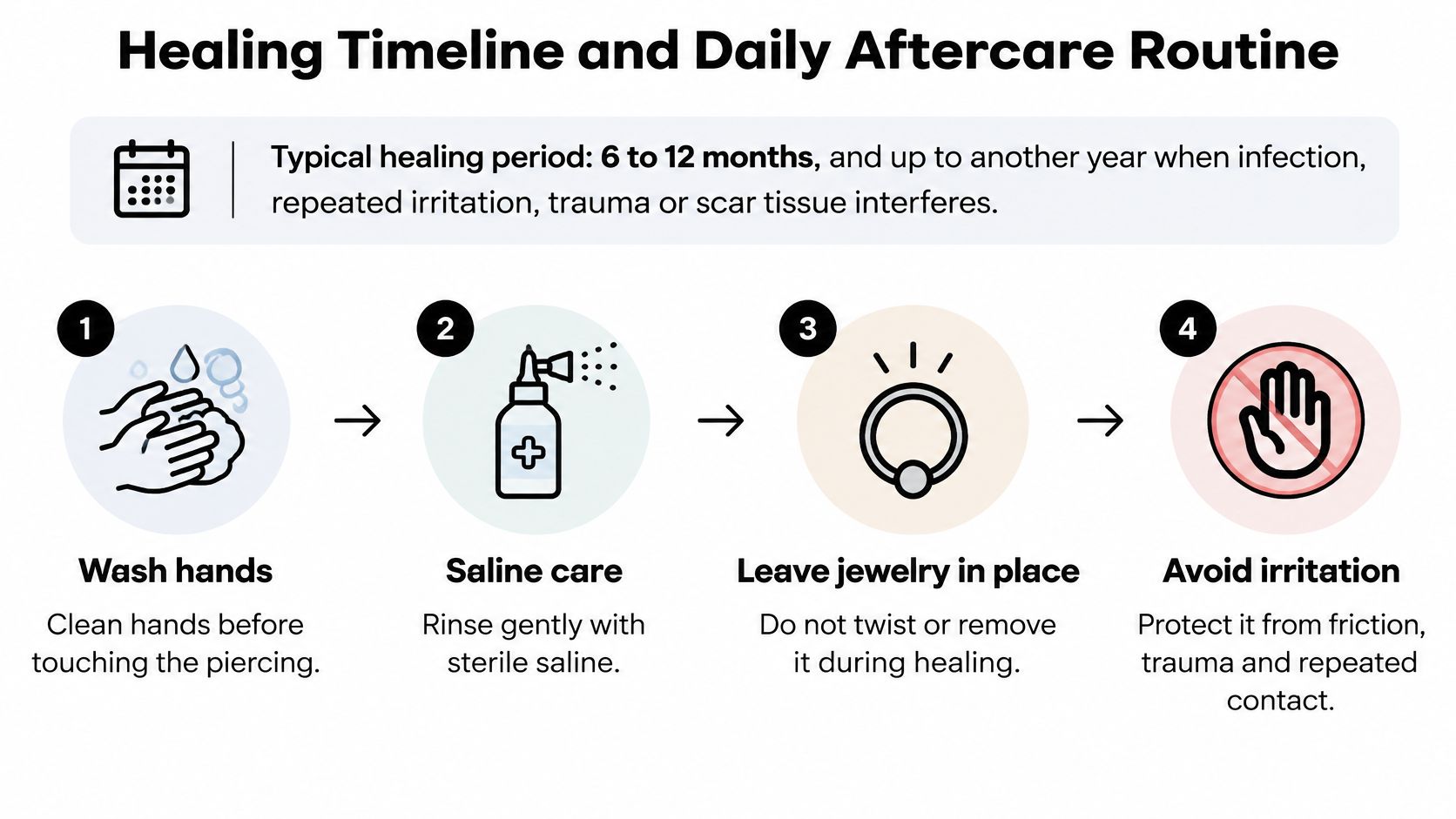
A gentle daily routine
- Wash your hands before contact. Use soap and water before cleaning or inspecting the piercing. Better still, avoid touching it when you don't need to.
- Clean gently with sterile saline. Use packaged sterile wound-wash saline, commonly morning and evening unless your clinician or piercer advises otherwise. Let softened residue rinse away, then gently dry with clean disposable gauze; don't scrub or pick.
- Leave the jewelry in place. Don't twist, rotate, or remove it for cleaning. Moving jewelry through a healing channel can disturb fragile tissue rather than “keep it from sticking.”
- Reduce clothing friction. Choose breathable fabric with no rough seam pressing against the openings. Loose clothing or soft, gentle support can work, but tight straps, dragging fabric, and snag-prone lace need adjusting.
- Skip soaking. Avoid pools, hot tubs, and open-water swimming while the piercing heals. Showering lets you rinse without leaving the area submerged in shared or untreated water.
- Check your sleeping setup. Use clean, soft bedding and avoid sleeping directly on the piercing. If you wake up sore on one side, change your position rather than assuming the jewelry needs more cleaning.
- Notice changes without constantly testing. Watch the direction of swelling, tenderness, redness, and drainage. A worsening pattern needs attention, not extra twisting or stronger cleaning products.
Avoid alcohol, peroxide, and fragranced products on the healing channel unless a treating clinician specifically directs their use. More aggressive cleaning isn't better care.
For a visual companion to your written aftercare instructions, use the video below.
Look for progress, not perfection
Healthy progress means tenderness gradually eases, swelling settles, and drainage diminishes. Once healed, the area should be comfortable during ordinary movement, without persistent discharge or pain.
Don't slide the jewelry back and forth to prove that it moves freely. A comfortable exterior isn't proof that the inside has finished healing, so have your piercer assess readiness before a decorative change.
Keep oral contact and rough handling away from healing tissue. The practical goal is pleasantly boring care: gentle cleaning, minimal disturbance, and clothing that doesn't pick fights with your jewelry.
Risks, Warning Signs and When to See a Doctor
Nipple-piercing complications are real, but published complication counts aren't a personal risk calculator. A 2023 systematic review published by MDedge Dermatology reported 344 nipple-piercing cases, described as 1% of 30,090 documented piercing complications; that doesn't tell us what proportion of all nipple piercings develop problems.
Increased sensitivity isn't guaranteed, either. The StatPearls clinical overview of nipple piercing describes risks including infection, scarring, duct obstruction, and nerve damage, so sensation may change rather than reliably improve.
Pressure, friction, and migration also deserve attention. Jewelry that digs in or shifts toward the surface needs professional assessment, not a tighter end or a DIY replacement.
Breastfeeding needs its own plan
The LactMed evidence summary on nipple piercing explains that breastfeeding generally remains possible, but poor latch, milk leaking from the infant's mouth, discomfort, and reduced production have been described; one cited study of 460 women identified previous nipple piercing as a risk factor for low milk supply.
Remove jewelry before nursing. A loose or dislodged piece can cause choking or injure an infant's mouth or gums, and feeding difficulties deserve help from a clinician or lactation professional.
Warning signs, likely causes and actions
These possibilities aren't diagnoses. Use the symptoms to decide whom to contact, not to label a problem yourself.
| Warning sign | Likely cause | What to do |
|---|---|---|
| Spreading redness, warmth, or swelling | Possible infection | See a doctor promptly |
| Fever or pus with a bad smell | Possible infection | Seek medical care the same day |
| Firm lump or bump that keeps growing | Irritation, scar tissue, or another condition | Have a clinician check it |
| Jewelry looks pushed out or tilted | Possible migration from pressure or unsuitable fit | Visit your piercer promptly; seek medical care if inflamed or painful |
| Numbness or sharp pain | Possible nerve irritation or injury | See a healthcare provider |
| Pain or leaking while breastfeeding | Latch difficulties or jewelry interference | Remove jewelry before nursing and consult a clinician |
Our explanation of piercing infection versus piercing rejection can help you recognize why different problems need different responses.
Get medical help promptly: Spreading redness, fever, and foul-smelling discharge aren't problems to troubleshoot with jewelry shopping.
If you suspect infection, don't remove the jewelry yourself before receiving medical advice. A clinician should decide how to manage the piercing and whether treatment or removal is needed.
Is a Nipple Ring Right for You?
A nipple ring suits you if you want it for yourself, can protect it through a lengthy healing period, and accept that the outcome isn't entirely predictable. Motives generally fall into two camps: nonsexual ones like self-expression, confidence, and a sense of ownership over your body, and sexual ones like sensation or shared attraction. Both are legitimate reasons, and each points to different jewelry and timing decisions, so it helps to be honest about which camp you're in.
“I like the look” counts as a complete answer. What matters is whether you can live with the daily upkeep that follows.
Ask yourself before booking
- What's my main reason? A style-driven motive favors jewelry you genuinely love seeing. A sensation-driven motive calls for measured expectations, since sensitivity responses vary from person to person. If the answer involves someone else's pressure, give yourself more time.
- Can my routine accommodate healing? Consider work clothes, exercise, swimming plans, sleep habits, and whether you can maintain gentle daily care.
- Do I have feeding plans to discuss? If breastfeeding is part of your near future, talk through timing and jewelry removal with a healthcare professional before booking.
Weigh the trade-offs
The appealing parts
- Personal expression: You control whether the look is visible or private.
- A lasting style: Once healed, the piercing can become part of your everyday appearance.
- Creative choice: Simple, decorative, symmetrical, and intentionally mismatched looks offer different ways to make it yours.
The commitments
- Lengthy healing: Patience matters even when the surface looks settled.
- Possible complications: Irritation, infection, migration, and scarring need appropriate attention.
- Uncertain sensation: Sensitivity may increase, decrease, or stay the same, so let style rather than a hoped-for boost drive the decision.
- Practical adjustments: Clothing, intimate contact, and nursing may require changes.
Being undecided is a perfectly good reason to wait. A consultation can help you assess anatomy and ask private questions without committing to the piercing that day. If your motives are mostly private, remember that no one else needs to know unless you choose to share.
Ready to find your new look? Visit BodyCandy to explore nipple jewelry in surgical steel and F136 Titanium, from simple barbells to decorative styles for healed piercings. Have your piercer confirm the gauge and length before you order, and drop your jewelry or aftercare questions in the comments below.