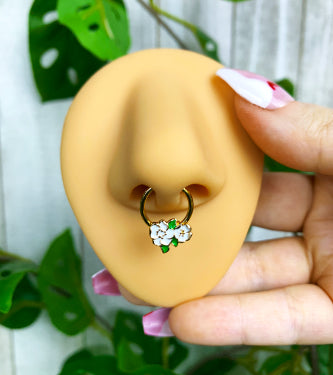




















You've got a tab open with a gorgeous opal septum ring, maybe two, and now you're doing that very normal spiral: is this cute and wearable, or am I about to buy a tiny problem for my face? That's the right question. A lot of people shop septum jewelry opal pieces like they're buying a color, when they should be buying a whole system, stone, metal, setting, fit, and how the thing behaves on a real human nose.
I'm going to be blunt. If the listing tells you everything about the sparkle and almost nothing about the wearable metal, gauge, diameter, or how the opal is set, keep scrolling. A septum piece can look perfect in a product photo and still be annoying, fragile, or flat-out wrong for your piercing. The pretty stone is the bait. The construction is the answer.
Why Opal Septum Jewelry Is Worth the Hype
You spot one white opal clicker and suddenly every plain silver ring you own looks a little too plain. That's the opal effect. It catches light, throws color, and somehow manages to look soft and dramatic at the same time. In septum jewelry, that's rare. Most pieces lean either minimal or loud. Opal can do both.
It has real history, not just trendy-girl energy
Septum adornment isn't some new social media invention. Nose piercing, including septum piercing, has been documented for more than 4,000 years in the Middle East, and later across India, Indonesia, pre-Columbian America, and Australia, with different materials, meanings, and sizes depending on culture and ritual use, according to the historical overview of nose piercing. That same record notes that some groups wore substantial ornaments, not just the tiny polished rings modern shoppers tend to picture.
That matters because opal septum jewelry works so well precisely because septum jewelry has always carried more than one job. It can mark identity. It can read ornamental. It can just make your face look cooler.
Why shoppers keep circling back to opal
Opal has personality. It flashes different colors depending on light, angle, and setting, which means one piece can look clean in daylight and moody at night. That's a neat trick in a small piercing.
Here's my short version of why people love it:
- It feels expressive: Opal doesn't sit there the way a flat metal ring does.
- It plays nice with different aesthetics: Soft, witchy, glam, alt, clean-girl, whatever. It adapts.
- It looks intentional fast: You can wear a simple outfit and your septum still reads styled.
Buy opal because you love the look, not because you assume every opal piece is built to survive your daily chaos.
That's where people get tripped up. The hype is deserved. The blind buying isn't.
What Opal Actually Is and Why It Matters Here
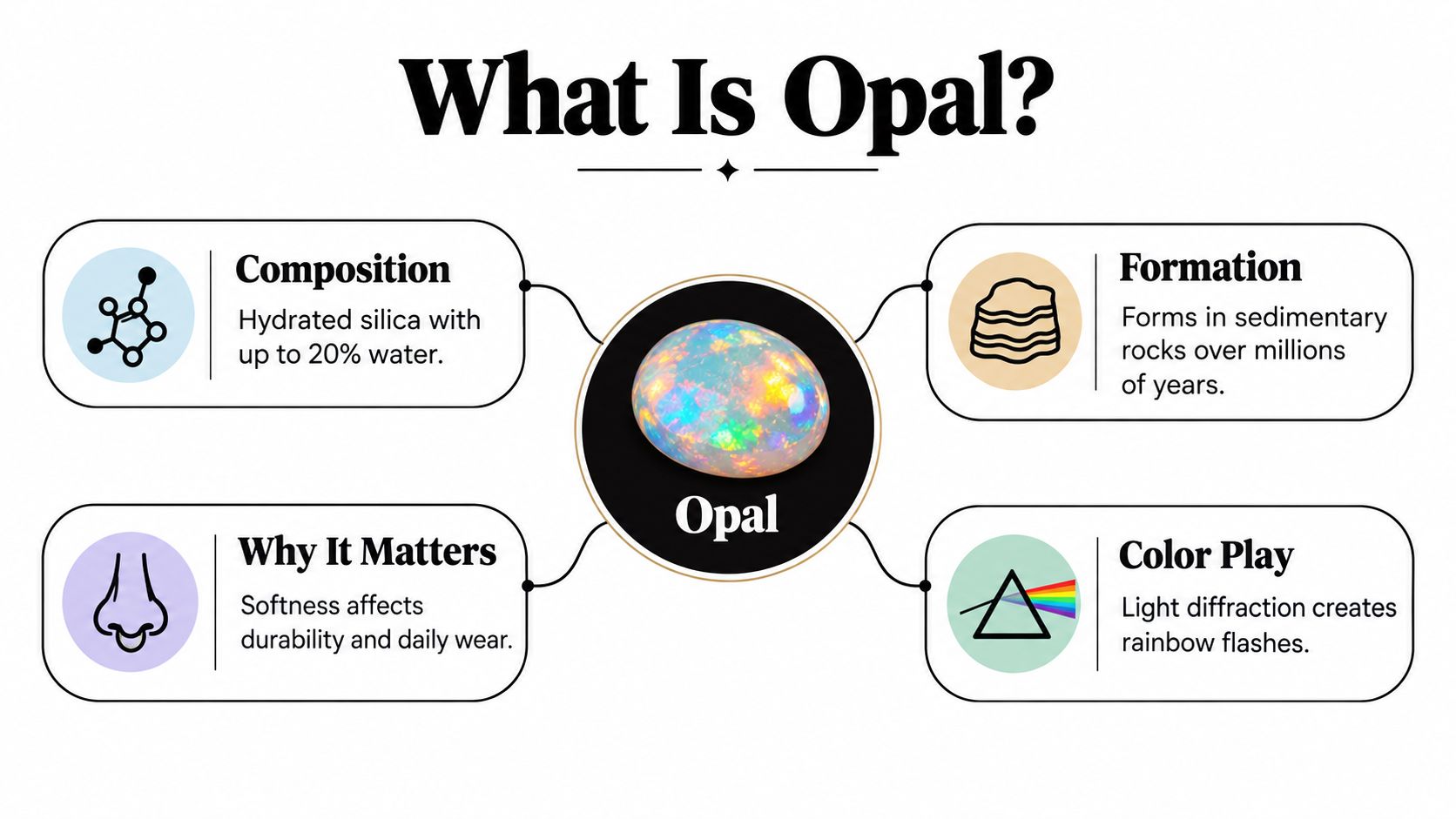
Opal is hydrated silica, with approximate chemistry SiO₂·nH₂O, and it can contain up to 20% water in its structure, according to the Gemological Institute of America's opal guide. That matters because opal is not a hard, shrug-it-off stone. It is a more delicate gem, and septum jewelry gives it very little room to misbehave.
The two numbers you actually need to care about
Mohs hardness matters. Opal sits at about 5 to 6.5 on the Mohs scale, which is why it can scratch, chip, or break more easily than harder gems, as explained by GIA's Mohs hardness reference. On a septum ring, that risk goes up because the piece gets bumped by towels, fingers, shirt necklines, and the occasional rough face wash. You are not buying a display case.
The other issue is water content. The International Gem Society's cleaning guidance for opals notes that opal can contain water and may be sensitive to sudden temperature changes, which can contribute to cracking. A hot shower followed by cold air, or aggressive cleaning, is a real problem for a stone like this.
Not all opal is the same thing
A listing that just says "opal" is doing you no favors. You need to know what kind you are getting, because the material changes how the piece wears, how it costs, and how much babysitting it needs.
- Natural opal: Mined material. Beautiful, often more variable, and not automatically the smartest choice for rough daily wear.
- Synthetic opal: Made to resemble opal structurally or visually. That can be a very practical option.
- Imitation opal: Looks opal-like but isn't the same material category.
- Treated or assembled opal: May involve oils, waxes, plastics, surface treatments, or layered construction.
A good starting point is this plain-English explainer on understanding opals, organic, synthetic, precious, and common.
If you do not know whether the stone is natural, synthetic, imitation, or treated, you do not know enough to judge the price or the care routine.
Opal production has also shifted over time. Australia has historically been cited as producing about 95 to 97% of the world's precious opal supply, with South Australia associated with about 80% of global supply, according to the summary of opal production history and milestones. Nice gem trivia. The shopping lesson is simpler. Iridescent does not mean identical, and not every opal belongs on a septum ring.
Septum Styles That Work Best with Opal
A good opal septum piece starts with the whole setup, not the stone alone. Metal, closure, profile, and how exposed the opal sits all decide whether the jewelry looks smart or turns into a tiny daily annoyance.
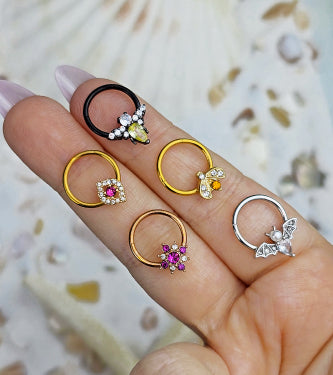
Septum clickers with bezel-set opal cabochons are the cleanest choice. They go in without much drama, close securely, and the bezel gives the stone a bit of armor. Hinged hoops can also work well if the decorative section is built into the ring instead of hanging off it like an afterthought.
Captive bead rings and ultra-minimal styles can still look sharp, but they ask more from you. If the opal is exposed, or if the ring is awkward to handle, you are the one paying for that choice every morning. Threadless setups make sense if you like swapping decorative ends on a wearable post, but only when the fit is right and the connection is solid.
For a look at how closure design changes the experience, the roundup on new septum clickers is a useful reference.
Septum Opal Styles at a Glance
| Style | Opal Protection | Ease of Wear | Best For |
|---|---|---|---|
| Clicker | High when bezel-set | Easy | Everyday wear, quick changes |
| Hinged hoop | Moderate to high | Easy | Classic look with cleaner lines |
| Captive bead ring | Low to moderate | Moderate | People who prioritize a traditional ring look |
| Continuous ring | Low | Fussy | Minimalists who don't mind extra care |
| Threadless setup | Depends on top design | Moderate | People who like swapping decorative ends |
The decision rule I'd actually use
Choose the style that fits your habits, not your moodboard.
- You touch your face a lot: Pick a clicker with a protected stone.
- You want one ring you can leave alone: Go with a low-profile hinged style.
- You like delicate details: Keep the opal from sitting on a vulnerable edge.
- You are new to septum changes: Skip the fiddly option and buy a closure you can manage without cursing at your mirror.
The prettier the exposed stone, the more care it demands. That is the trade, and it is the whole trade.
When opal septum jewelry works, it works because every part pulls its weight. The stone matters, but so does the setting, the closure, and how much of the gem is left out in the open.
Getting the Gauge and Diameter Right
A bad size will ruin a good ring faster than a bad stone will. If your opal septum piece is too tight, it'll sit wrong, feel cranky, and make flipping or cleaning way more annoying than it needs to be.
Gauge first, because that's the non-negotiable
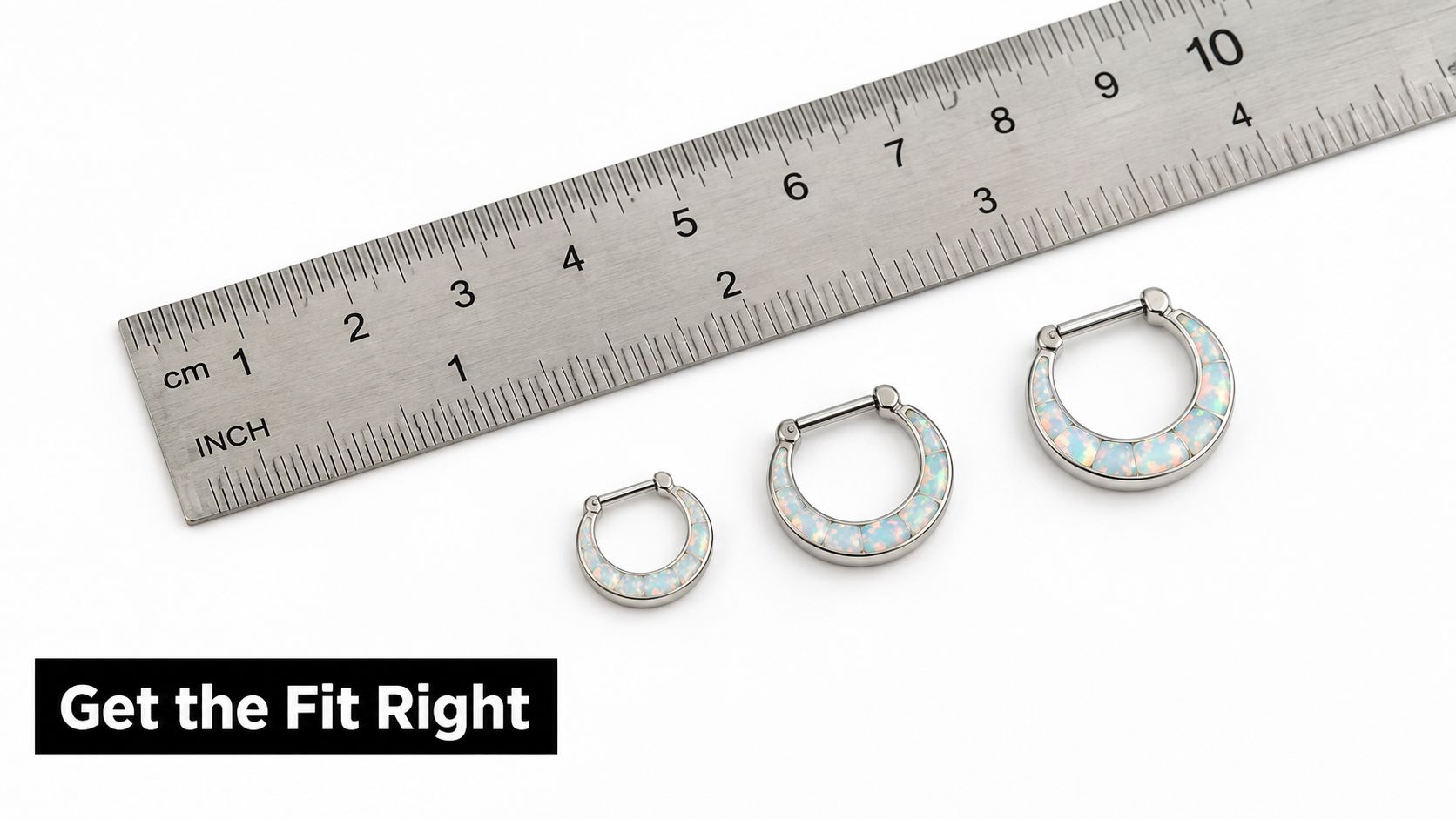
Gauge is the thickness of the jewelry. Most healed septums commonly wear 16G, while some people wear 14G if that's what they were pierced with or stretched to over time. Don't guess. Check what's in your nose now, or ask your piercer to measure it.
If you're shopping product listings, pay attention to the wearable part, not just the decorative face. The opal can make a ring look visually bigger or smaller than it is.
Diameter changes the vibe and the comfort
Diameter is what decides whether the ring hangs neatly, sits close, or presses upward in a way that drives you nuts. Too small and the ring can feel pinched. Too large and it may swing, rotate, or look disconnected from your anatomy.
Use this practical filter:
- Snug fit: Better if you like a neat look or need to flip jewelry up more easily.
- More drape: Better if you want the piece to show clearly below the nostrils.
- Decorative front-heavy styles: Need enough room so the opal detail doesn't crowd the piercing.
If you're still learning how measurements translate on a face, this quick visual helps:
Fresh piercing people, listen up
A septum piercing typically does most of its healing within 2 to 3 months, but complete healing can take 6 to 8 months for some people, according to Healthline's septum piercing aftercare guide. During healing, leave the fashion experiments alone. Don't force new jewelry through an irritated channel just because the opal is cute.
A ring that's technically the right gauge can still be the wrong fit if the diameter creates pressure or constant movement.
That's why I always say size is two numbers, not one.
Hypoallergenic Materials and Sensitive Skin
If your skin gets moody, your septum is still healing, or you've ever reacted to mystery metal, stop obsessing over the opal for a second. The wearable metal is the actual gatekeeper.
The one material label I trust first
Implant-grade titanium conforming to ASTM F136 is the standard I'd look for before anything else. The biomedical description tied to this titanium septum retainer material overview identifies Ti-6Al-4V ELI titanium as corrosion-resistant, biocompatible, and free of nickel in the alloy. It also points out why a smooth, well-polished surface matters. Microscopic roughness can increase friction and give debris more places to hang around.
That's the stuff that matters in a nose. Not a vague “sensitive friendly” sticker.
What I'd choose, and what I'd side-eye
- Implant-grade titanium: My first pick for healing piercings and reactive skin.
- Solid gold in an appropriate quality: Fine for many healed piercings, if the construction is good.
- Niobium: Another option many sensitive wearers do well with.
- Surgical steel: Can work for some people, but it's not my automatic recommendation if you already know nickel is a problem.
- Plated mystery metal: Hard pass for anything irritated, fresh, or fussy.
This article on hypoallergenic jewelry for sensitive skin is worth a skim, but my advice is simpler. Ask for the exact metal spec.
The questions smart buyers ask
Don't ask “Is it hypoallergenic?” Ask these instead:
- What is the wearable metal exactly
- Is it ASTM F136 titanium
- Is there plating or coating on the part that sits in the piercing
- Are the edges rounded and polished
- Is the threading secure and smooth
A decorative opal top can't rescue a badly finished wearable bar or ring.
And no, the opal itself isn't automatically the thing causing irritation. The build quality usually tells the true story.
Styling an Opal Septum Without Overthinking It
The easiest way to style opal is to stop treating it like it needs a whole theatrical production. It doesn't. A good opal septum ring already does enough.
Match the flash, not just the metal
White or clear iridescent opal plays well with almost everything. It looks crisp with silver-tone metals and a little softer with gold-tone pieces. Darker opal looks moodier and can read especially sharp with black, gunmetal, or darker makeup.
A few dead-simple pairings work every time:
- White opal plus silver-tone metal: Clean, bright, easy daily look.
- White opal plus gold-tone metal: Warmer, dressier, less icy.
- Black opal look plus dark liner or a black top: Instantly more alt.
- Pastel or vivid opal with a simple outfit: Lets the jewelry do the talking.
Keep the rest of your jewelry from arguing with it
If your septum has opal, your ear stack doesn't need to scream for attention too. Pick one supporting theme. Maybe tiny studs. Maybe one opal accent elsewhere. Maybe just polished metal.
Here's the cheat code. If the septum ring has a lot of color play, keep the rest sleeker. If the septum piece is minimal, you can stack more in the ears without the whole thing looking busy.
For real-life wear, not just selfies
A snugger fit usually looks tidier and can make flipping the ring up easier when you need it out of sight for work, school, or family stuff. If that's part of your life, choose a style that sits close and doesn't have a giant decorative front.
The best styled piercing is the one you'll actually wear tomorrow morning without changing your whole outfit to suit it.
That's why opal works. It can look intentional with a hoodie, a blazer, or a little black dress and not feel like costume jewelry.
The Honest Truth About Opal and Everyday Wear
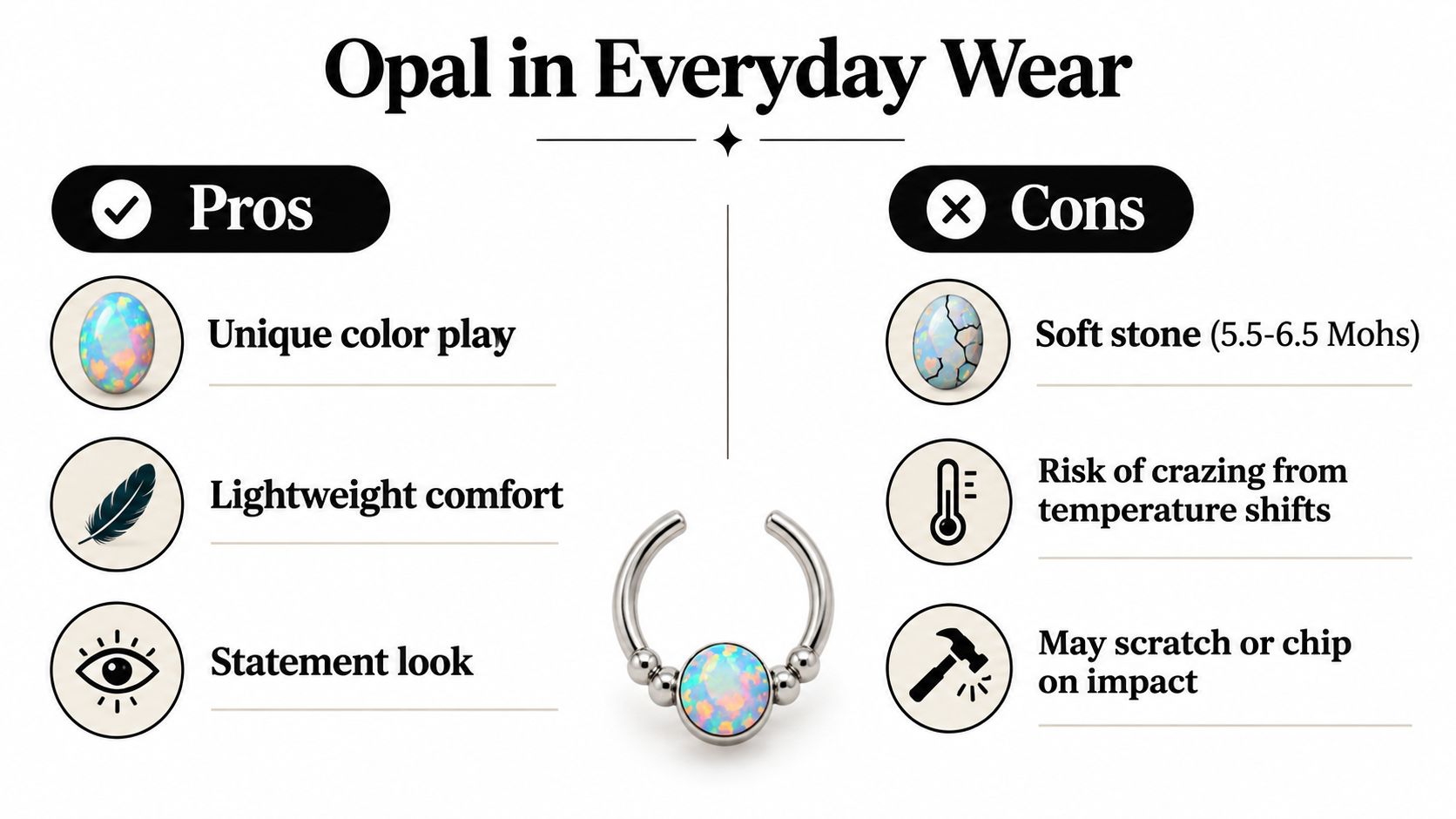
If you want opal in a septum ring, start with the inconvenient truth. Opal is delicate. GIA places it at about 5 to 6.5 on the Mohs hardness scale and describes its toughness as poor to fair, which means scratches, chips, and breakage are real risks in normal wear, according to the GIA opal buyer's guide. That does not make opal a bad choice. It means the whole piece has to earn its keep.
Everyday wear is where the fantasy gets tested
Septum jewelry gets knocked. Towels catch it. Fingers fiddle with it. Sinks exist. So do abrupt weather changes and long hot showers. GIA also warns that heat and sudden temperature changes can cause “crazing,” meaning fracture lines, and that some opals may be treated with oil, wax, plastic, or surface modifications, which changes care needs, as noted in the same GIA buyer guidance.
That is why I push back on the lazy idea that natural opal is always the smartest pick for a septum ring. For daily wear, durability and disclosure matter more than romance.
My opinionated take on the smart buy
If you plan to wear the piece often, a clearly disclosed synthetic or imitation opal is usually the cleaner choice. You get the look without asking a fragile stone to survive every hoodie, towel, and face wipe in your week. If you still want natural opal, keep it protected and accept that it belongs in the careful-wear category.
Use this filter before you buy:
- Protected cabochon or inlay: Better for real life.
- Exposed, protruding stone: Higher risk.
- Clear material disclosure: Good sign.
- Mystery “opal” wording: Bad sign.
- Treatment info missing: Proceed carefully.
The question is not whether opal looks good. It does. The question is whether the metal, the setting, the fit, and the opal type all work together. If one part is weak, the whole septum piece wears like a compromise.
Simple Care Routine and Where to Shop Next
For healed piercings, keep the routine boring. Warm water, mild soap, and a soft cloth are the safe basics. GIA's care guidance says to avoid abrasive products, harsh chemicals, ultrasonic cleaners, steam cleaning, hydrofluoric acid, and caustic alkaline solutions, and to stick with warm, soapy water for opal care in jewelry, as outlined in GIA's opal care and cleaning recommendations. Once a month, check that the setting still feels secure and the ring closes the way it should.
Fresh or irritated septums are a different story. Don't switch jewelry too early, don't over-clean, and don't use alcohol, hydrogen peroxide, or harsh soaps. If you need to move or flip healing jewelry, rinse with warm water first so you're not dragging crust into the channel.
If you're shopping, filter by gauge, diameter, wearable metal, and opal type before you fall for color. One practical option in that search is BodyCandy, which carries opal septum styles including faux and imitation-opal designs in common septum sizes, giving you a cleaner way to compare material labels against the look you want.
Ready to stop guessing and buy the ring that fits your nose and your life? Browse BodyCandy for opal septum styles, then narrow by gauge, diameter, and metal before you hit checkout. If one measurement still feels fuzzy, ask a professional piercer first, then come back and pick the sparkle with confidence.