

















You've just eaten, your lower lip feels tender, and there's a little crust beside your new jewelry. Is that normal, or should you be worried? Labret piercing aftercare gets less confusing when you treat it as both a healing piercing and an oral-health responsibility, not just something to wipe clean.
Start With the Full Picture
A labret asks you to care for two surfaces at once: the skin outside your lip and the tissue inside your mouth. The outer opening needs gentle cleaning. The inner disc or backing needs just as much attention because it can rub against gums, tap enamel, or sit where plaque collects.
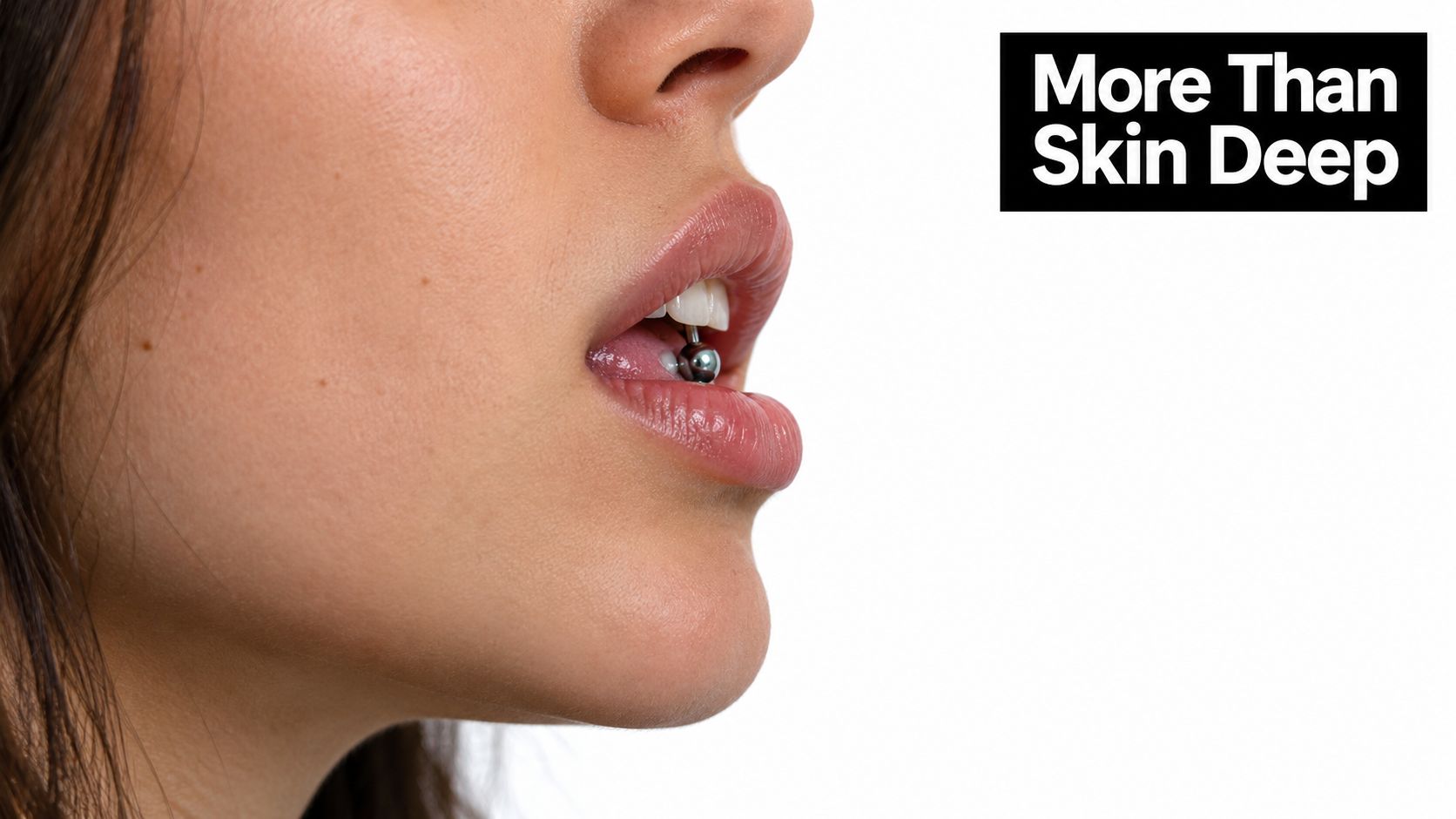
This close-up shows why the jewelry's position deserves attention alongside the surrounding skin.
Set Expectations Without a Countdown
A labret commonly needs 2–4 months to heal, and the same APP procedure guidance lists swelling, tenderness, light bleeding, bruising, and a little clear or white fluid as expected early symptoms during the first 3–5 days (Association of Professional Piercers procedure guidance). Dental guidance often gives oral piercings a wider healing window, and irritation, delayed repair, or complications can stretch recovery further. Treat every timeline as a range, then watch the trend.
Practical rule: Judge healing by the direction your symptoms are moving, not just how long you've had the piercing.
If sensitivity runs in your family, your gums already feel sore when flossing slips, or the jewelry clicks against a tooth when you talk, say so at the piercing appointment or dental visit. Fit and anatomy can change what “normal” feels like.
Your job has three linked parts:
- Keep it clean: Care for the mouth and the external opening separately.
- Reduce friction: Notice catching, clicking, pressure, or a disc that seems to press into tissue.
- Know your limits: Changes that spread, darken, worsen, or stop improving deserve qualified assessment.
Build a Gentle Daily Cleaning Routine
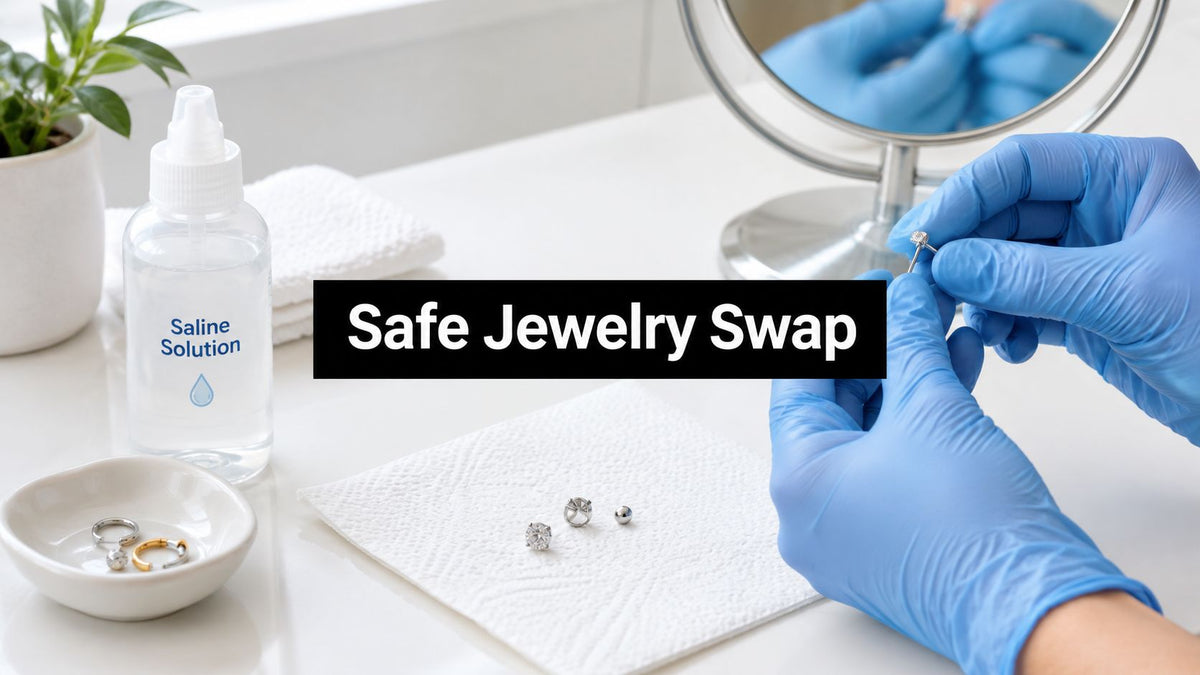
Make the routine repeatable, not elaborate. Keep your rinse, sterile saline, and fresh disposable paper products accessible so you're not improvising with whatever happens to be beside the sink.
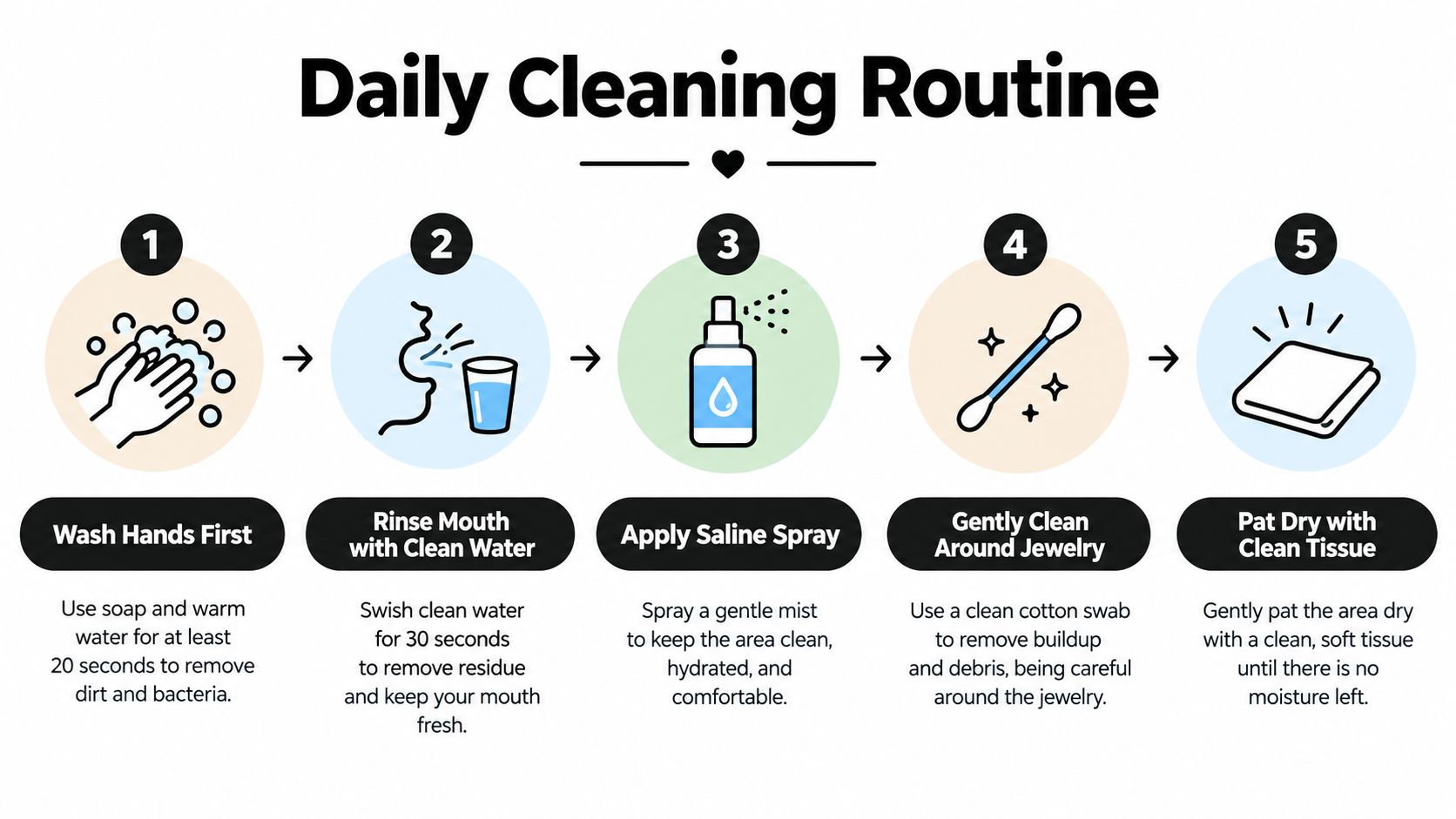
Use this visual as a reminder of the sequence, with gentle handling throughout.
Your Everyday Sequence
- Wash your hands first. Do this before necessary contact with the piercing or jewelry. Checking it with unwashed fingers isn't part of aftercare.
- Rinse inside your mouth. Use clean water or an alcohol-free antimicrobial or antibacterial mouthwash for 30–60 seconds after meals and at bedtime, typically 4–5 times daily; the same guidance recommends external saline soaks for 5–10 minutes once or more daily (APP troubleshooting guidance).
- Care for the outside gently. Let saline soften attached crusting rather than picking or scraping it away.
- Dry without fuss. Use fresh disposable paper products, and leave the jewelry in its resting position.
The point isn't to make every trace of dried fluid disappear immediately. If something remains attached, don't turn a cleaning session into a removal project.
A Practical Daily Care Snapshot
| Care area | What to do | Avoid |
|---|---|---|
| Hands | Wash before necessary contact | Casual touching or checking |
| Inside your mouth | Follow the rinsing routine | Strong, repeated rinses |
| External opening | Apply saline gently | Scrubbing or scraping |
| Drying | Use fresh disposable paper | Reusing a damp towel |
For a video companion to the routine, watch the demonstration below.
After a meal, for example, focus on your oral rinse. You don't need to turn every mouth rinse into another full external cleaning session. Keep the inside and outside routines distinct so consistency doesn't become constant handling.
If your schedule makes the routine difficult, ask your piercer to help you plan it around meals and bedtime. Don't compensate for a missed cleaning with harder scrubbing or a stronger solution.
Keep Cleaning Gentle and Choose Products Carefully
A stronger sting doesn't mean a better clean. With a healing labret, choosing the right formulation matters more than choosing the most intense product on the shelf.
For mouth rinses, look for alcohol-free and hydrogen-peroxide-free options. A suitable oral saline rinse is sterile and isotonic, containing only water and 0.9% sodium chloride, equivalent to 9 mg of salt per milliliter; homemade mixtures are commonly too concentrated and can irritate the piercing (dental aftercare guidance on rinse selection).
Read the Label, Not Just the Front
Don't assume that a product belongs on your labret because its packaging mentions cleanliness or freshness. Check the ingredients and intended use, especially when choosing something that will go inside your mouth.
| Prefer | Skip |
|---|---|
| A clearly labeled, suitable oral rinse | Alcohol- or peroxide-containing mouthwash |
| Sterile isotonic saline | Homemade salt mixtures of uncertain strength |
| A consistent care plan | Extra cleaning whenever you feel anxious |
| Minimal necessary contact | Twisting or rotating the jewelry |
For a useful companion checklist, review five things you should never put on your piercing before adding another product to your routine.
Leave the Jewelry Alone
Twisting, rotating, and repeatedly handling the jewelry can create mechanical trauma and prolong inflammation. The same practical aftercare guidance emphasizes gentle cleaning rather than manipulating the post (oral piercing aftercare toolkit).
That includes absent-minded movement with your tongue. If you catch yourself testing whether the jewelry still moves, stop testing rather than checking again.
Do: Clean consistently and touch gently. Don't: Chase a spotless appearance by scrubbing, rotating, or adding stronger products.
No branded rinse or saline product guarantees healing. If your routine seems to leave the area more uncomfortable, ask for a professional review instead of adding another cleaning step.
Track Healing and Protect Your Teeth and Gums
A lip that looks calmer isn't a reason to stop paying attention to your mouth. Skin symptoms and dental problems aren't the same thing, so your check-in needs to include both.
Use the tracker below as a broad reminder of gradual recovery, not a deadline or permission to ignore worsening symptoms. Its later stages shouldn't be interpreted as proof that a piercing is fully healed.
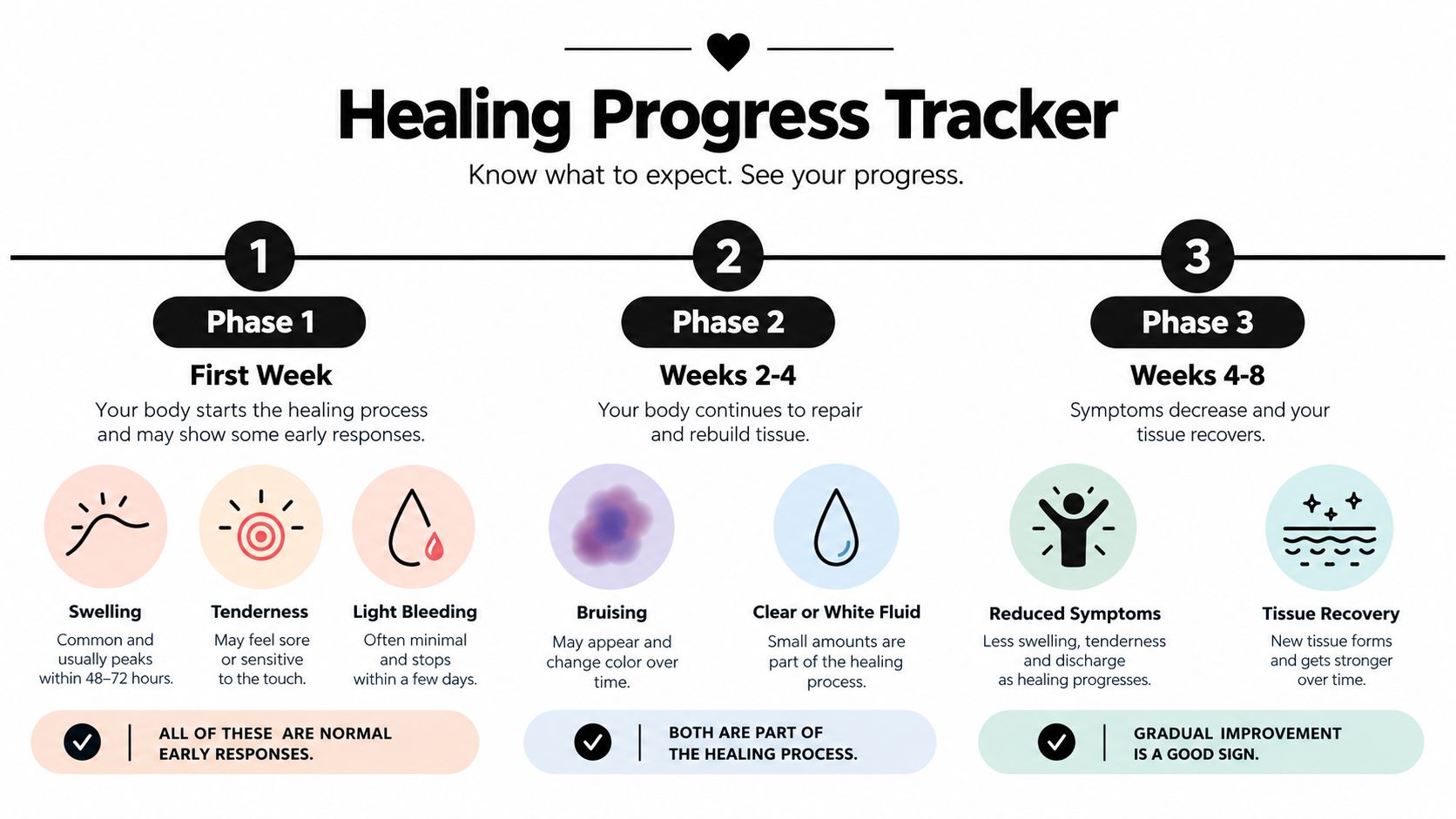
Watch the Trend and Adjust Your Habits
During early recovery, take small bites and avoid hot, spicy, salty, acidic, hard, sticky, or clumpy foods. Cold drinks or ice may ease discomfort, according to the oral aftercare toolkit linked above.
Be gentle when brushing near the jewelry, and notice what happens when you eat or talk. Clicking the post against a tooth isn't a harmless habit to keep practicing.
- While eating: Slow down if you're catching the jewelry.
- While brushing: Clean carefully around it without snagging or pushing it.
- During ordinary movement: Notice repeated rubbing or pressure instead of accepting it as the new normal.
Make Jewelry Fit Part of Aftercare
The initial longer post deserves reassessment after swelling settles. An experienced piercer should decide when downsizing is appropriate, rather than you choosing a shorter post based on appearance alone.
The American Dental Association lists tooth damage, gum recession, embedded jewelry, and other complications among oral-jewelry risks, and explains why professional downsizing after swelling subsides can reduce contact with teeth and soft tissue (ADA guidance on oral piercing jewelry).
Dental risk isn't limited to obvious breakage. A meta-analysis reported 34% prevalence of dental fracture and 33% prevalence of gum recession among oral-piercing participants, although the evidence certainty was low and the findings aren't predictions for every labret wearer (meta-analysis of oral-piercing dental complications).
That's a reason for monitoring, not panic. Explore oral piercing care and tooth protection, and arrange a dental assessment if you notice sensitivity, cracking, gum changes, or persistent irritation.
Know When a Symptom Needs Attention
A little early tenderness and a worsening, hot, throbbing lip shouldn't receive the same response. The expected early symptoms described above should gradually improve, not become something you have to keep explaining away.
An irritated-looking piercing can have several possible causes. A photo alone can't tell you which one applies.
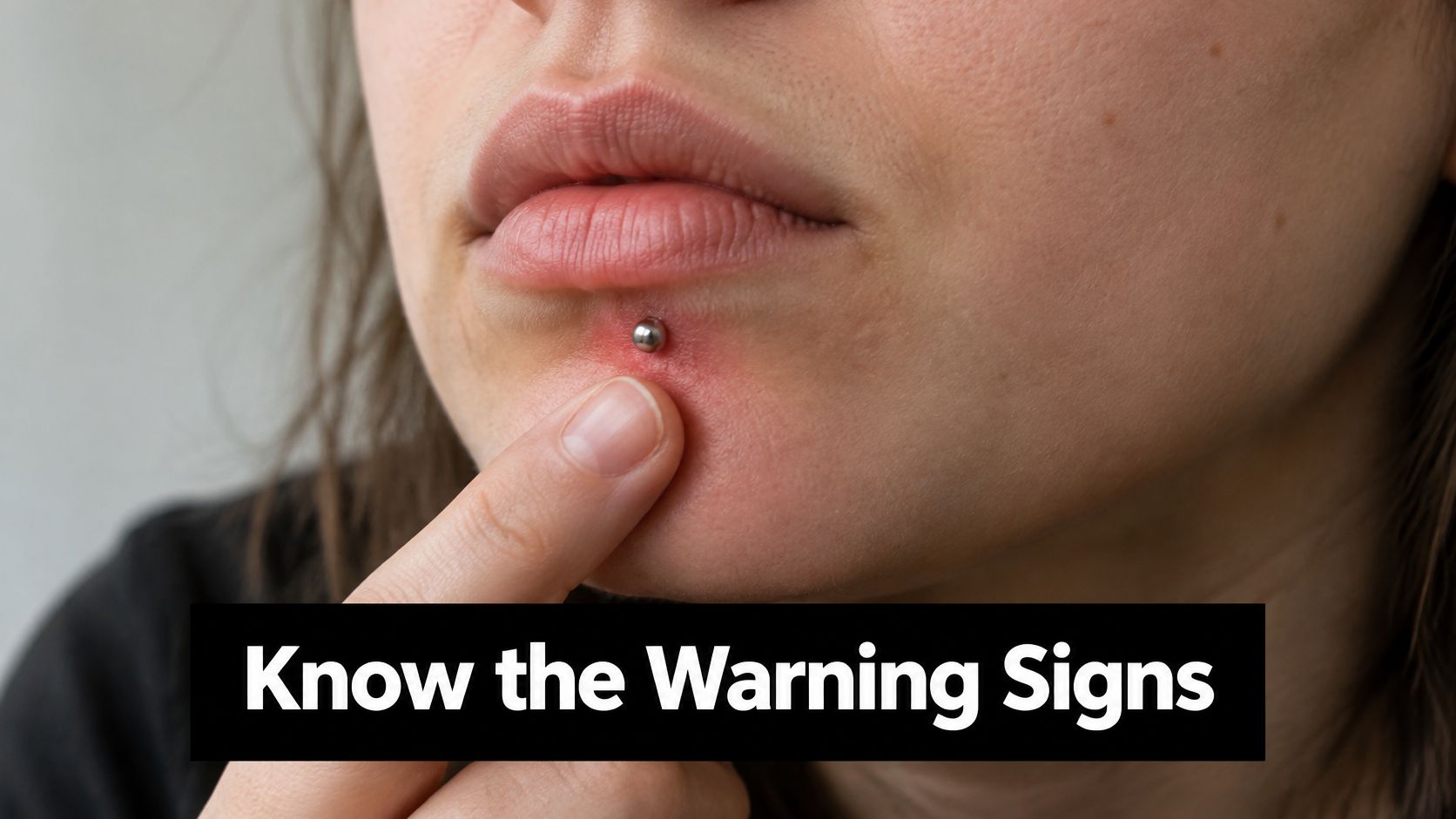
Compare the Pattern, Don't Diagnose Yourself
| Pattern | What to notice | Appropriate next step |
|---|---|---|
| Expected early inflammation | Mild symptoms that steadily settle | Continue gentle care and monitoring |
| Irritation or possible sensitivity | Worsening itch, rash-like redness, recurring discomfort | Request a material, fit, and product review |
| Possible infection | Increasing warmth, throbbing pain, spreading redness, pus-like discharge, fever | Seek prompt clinical assessment |
| Mechanical or dental trouble | Jewelry sinking into tissue, tooth damage, gum changes | Arrange prompt professional evaluation |
Metal ions released from oral jewelry may contribute to hypersensitivity and mucosal changes, so recurring irritation isn't automatically evidence of poor hygiene (systematic review of oral-piercing complications and metal sensitivity). Still, itch or redness alone can't confirm an allergy, and a label such as hypoallergenic doesn't rule out problems with fit, friction, or individual sensitivity.
Prioritize documented, body-safe materials, but don't change jewelry during active swelling without qualified help. A professional needs to assess the situation before deciding whether replacement is appropriate.
Know When Self-Care Stops
Seek prompt medical assessment for worsening pain or swelling, spreading redness, yellow or green discharge, foul odor, persistent bleeding, fever, or feeling generally unwell. Trouble breathing needs emergency care, and trouble swallowing also needs urgent medical assessment.
Don't remove jewelry on your own during a suspected infection. The surface may close and trap infection, potentially contributing to an abscess (medical review of oral and perioral piercing complications).
Don't respond to worsening symptoms by cleaning harder or waiting for the calendar to say you're healed.
Published evidence varies by placement, jewelry, and study design, which is why there isn't a universal complication rate that predicts your outcome (systematic review of oral-piercing complications). Use a straightforward decision rule instead: a piercer for fit and jewelry questions, a dentist for teeth and gums, and a clinician for suspected infection or systemic symptoms. Urgent symptoms shouldn't wait for a studio appointment.
Finish With a Simple Healing Check-in
You don't need to spend the day inspecting your lip. A brief, deliberate check-in is more useful than repeatedly touching the post, taking it out, or trying another product whenever something looks different.
Keep the check-in focused on actions and changes. If you're worried, record what changed and when it started so you can explain it clearly to the professional assessing you.
Your Daily Reminder
- Care completed: Did you follow your oral and external routines without adding unnecessary cleaning?
- Hands and handling: Did you leave the jewelry alone outside essential care?
- Comfort improving: Are symptoms settling, or is something becoming more painful or swollen?
- Mouth protected: Are you noticing tooth contact, gum pressure, sensitivity, or persistent rubbing?
- Follow-up arranged: Have you asked your piercer to reassess fit as swelling changes?
- Help needed: Does today's change belong with a piercer, dentist, or medical professional?
For another way to think through the overall pattern, use this guide to recognizing whether a new piercing is healing. It can help you organize your observations, but it can't replace an examination when symptoms are concerning.
Separate Patience From Putting Up With Problems
Patience means giving tissue time to recover while keeping up gentle care. It doesn't mean tolerating a post that keeps hitting your teeth, a rash that keeps returning, or symptoms that are getting worse.
Before a jewelry appointment, write down anything you've noticed during eating, brushing, or talking. Bring product labels and any available material information so your piercer can review what you're using, rather than guessing.
Ask direct questions: Does the fit need changing? Is this material documented? Does this gum or tooth symptom need a dentist? Those questions are more useful than asking only whether the piercing looks okay.
The aim is a piercing you can enjoy without overlooking your oral health. Keep the cleaning gentle, take fit seriously, and let qualified help take over when home care is no longer enough.
BodyCandy offers body jewelry and piercing-care education to help you explore your style with fit and material questions in mind. Visit BodyCandy to browse jewelry for your next look, and ask your piercer to confirm what's appropriate before changing a healing labret.