



















Your favorite opal ring comes out of the shower looking a little less rainbow and a little more soap-scum chic. You reach for jewelry cleaner, then hesitate. Can you wash opal, or will that make things worse?
How to clean opal jewelry depends on what's inside the setting. Confirmed solid opal can handle brief, gentle cleaning with lukewarm soapy water. Layered pieces and water-absorbing stones need a more cautious approach, and none of them need a scrub-down.
Safe and Unsafe Cleaners for Opal at a Glance
Lukewarm water and a drop of mild soap are the safe default for confirmed solid opal. Keep the water close to room temperature, use a clean soft cloth, and leave the heavy-duty cleaning gear alone. Doublets, triplets, and pieces with unknown construction need the barely damp cloth method instead.
The reason is simple: opal isn't a tough, scrub-friendly gemstone. The Gemological Institute of America's opal care guidance places opal at 5 to 6.5 on the Mohs hardness scale, while ordinary household dust is approximately 7, so rubbing dust across its surface can scratch it; intense heat and sudden temperature changes can also cause crazing, a network of fine fracture lines.
Body jewelry collects skin oils, cosmetics, sweat, and dust rather than sitting untouched in a display case. Exposed stones and thin settings leave less protection between your opal and a cleaning tool, so gentle handling matters just as much as your choice of cleaner.
Cleaners, tools and temperatures for opal
| Item | Verdict | Why |
|---|---|---|
| Lukewarm water | Use | Gentle temperature avoids thermal shock |
| Mild soap | Use | Lifts oils and dust; rinse away residue |
| Tightly woven microfiber cloth | Use | A clean, damp surface lifts dust without abrasive scrubbing |
| Very soft brush | Use with care | Only for settings, with no pressure |
| Hot water or boiling water | Avoid | Sudden heat can cause crazing |
| Steam cleaner | Avoid | Thermal shock and expansion can crack the stone |
| Ultrasonic cleaner | Avoid | Vibration can crack the stone or weaken adhesive |
| Bleach, acids or strong alkaline cleaners | Avoid | Can attack the opal and its assembly |
| Alcohol-based cleaners | Avoid | Unsuitable chemical exposure for a water-sensitive stone |
| Abrasive toothpaste or polishing powder | Avoid | Can scratch a stone softer than household dust |
A cloth labeled for polishing metal isn't automatically suitable for opal. Choose plain microfiber without polishing compounds, and check that it hasn't picked up grit from a countertop or jewelry box.
Practical rule: If the method involves heat, vibration, harsh chemicals, or scrubbing, skip it.
Keep a small bowl, mild soap, and clean cloths with your jewelry-care supplies instead of assuming a bottle of commercial cleaner will suit every piece. The gentlest useful method is the right starting point, not the strongest product available.
Tell Solid Opal From Doublets and Triplets
Your opal body jewelry looks different after a shower, and now you're wondering whether it's a layered piece. That change alone doesn't identify its construction. Don't keep wetting it to test what happens.
Solid opal is a stone; doublets and triplets are bonded assemblies. A doublet has a thin opal layer attached to a backing, while a triplet adds a clear protective cap, sometimes quartz. The GIA opal care guide warns that prolonged water exposure can weaken adhesive in assembled stones, while sudden temperature changes can fracture opal itself.
Check the side, not just the sparkle
Start with the purchase description or certificate. Look for explicit wording such as solid opal, doublet, or triplet rather than relying on a photograph or the word opal alone.
Then examine the side profile under good light. A dark backing, a straight seam, or a clear dome can suggest layers, but an enclosed setting may hide them. Backing color alone isn't proof, and you shouldn't pry the stone out for a better look.
Opal type, how to check it and the method it needs
| Opal type | How to check | Cleaning method |
|---|---|---|
| Solid opal | One continuous stone body with no visible bonded backing layer; confirm with paperwork | Lukewarm soapy water, brief rinse, pat dry |
| Doublet | Thin opal layer on a backing, with a visible seam at the side | Barely damp soft cloth only; no soaking |
| Triplet | Opal bonded to a backing and covered by a clear dome | Barely damp soft cloth only; keep dry |
| Unknown construction | No paperwork and unclear side profile | Treat as a composite: barely damp cloth only |
The seller or original documentation is usually the most direct route to confirmation. If those don't settle it, an opal-experienced jeweler can examine the profile without risking a DIY disassembly.
Hydrophane is a separate property, not another construction type. These opals absorb water and chemicals, which can change their appearance, so the International Gem Society's opal reference advises keeping them dry and avoiding chemical exposure. Don't use a water-drop test at home; use a dry soft cloth while you confirm suitable care.
Our guide to organic, synthetic, precious, and common opals helps untangle the terminology. Water isn't automatically forbidden for every opal, but brief controlled contact and prolonged soaking are different situations.
How to Clean Solid Opal Step by Step
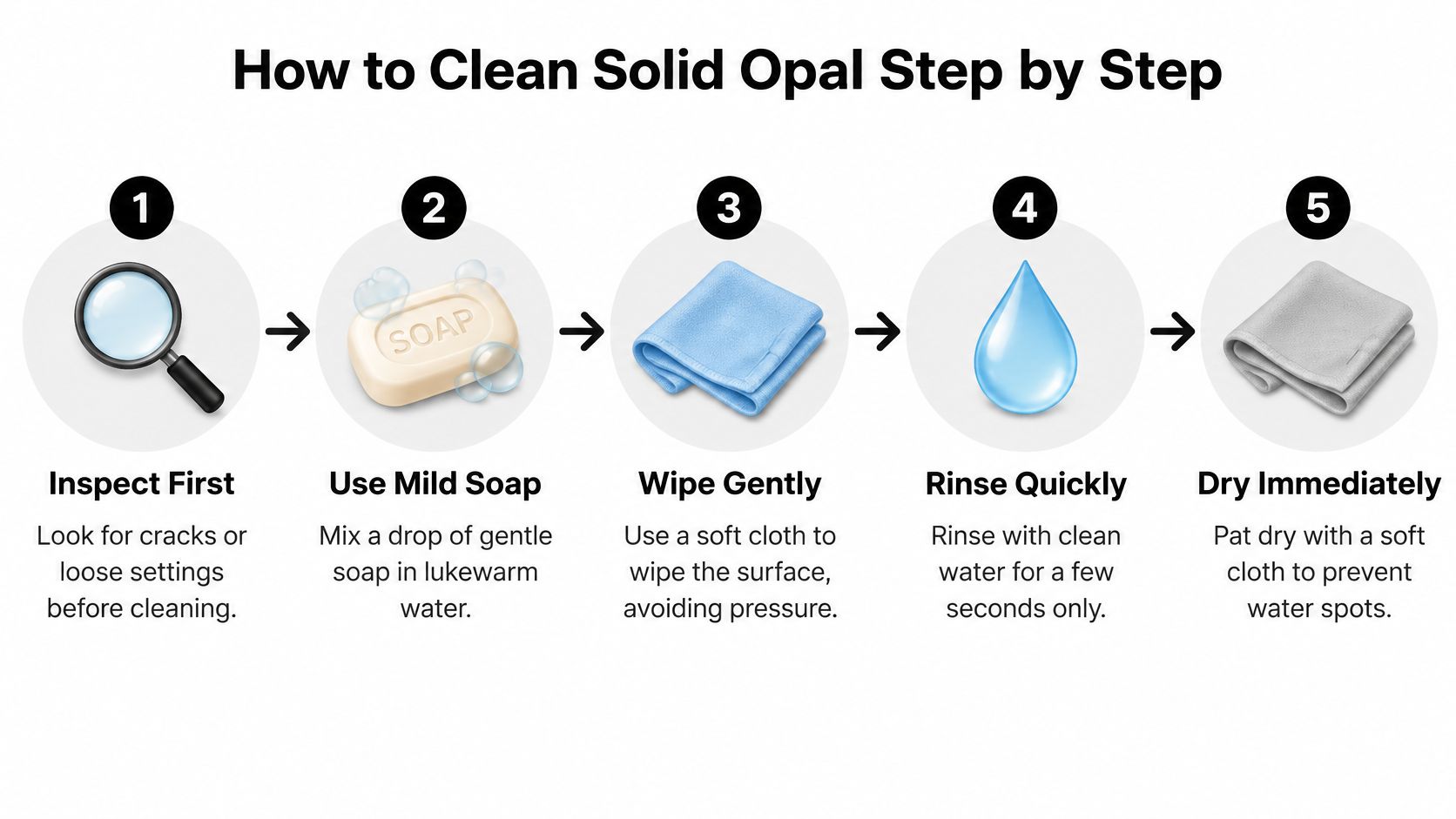
For confirmed solid, non-hydrophane opal, keep the routine short and the pressure light. For doublets, triplets, or uncertain pieces, skip the soapy-water routine: lightly wipe with a barely damp soft cloth and dry immediately.
The GIA cleaning guidance identifies warm, soapy water as the safe cleaning approach for opal and describes its toughness as poor to fair. That means a clean stone still needs careful handling, especially around edges and settings.
Use this visual as a quick reminder of the basic sequence.
Prepare your workspace
Set out a small bowl, mild fragrance-free soap, a tightly woven microfiber cloth, and a separate drying cloth. Work over a soft towel rather than an open sink so a slippery ring or tiny jewelry end has somewhere safe to land.
This is jewelry cleaning, not piercing aftercare. Don't put soap into a healing piercing or remove healing jewelry just to follow a gemstone-cleaning routine; ask your piercer how to handle the piece safely.
Clean with minimal contact
- Inspect before adding water. Look for cracks, loose stones, a lifted setting, or visible separation. If anything moves or looks damaged, stop and have a jeweler assess it rather than trying to clean underneath it.
- Mix a small amount of mild, fragrance-free soap into lukewarm water. Stir gently so you're working with diluted soap, not a thick coating that will need repeated rinsing.
- Dampen and wring out the microfiber cloth. Wipe the opal gently in one direction, changing to a clean area of cloth as it picks up dirt. Don't bear down on a stubborn spot or drag a visibly dirty cloth back over the surface.
- For an awkward setting, use an exceptionally soft brush only where needed around the metal. Let the bristles touch lightly without pressing them against the stone or pushing underneath it.
- Rinse briefly with similarly lukewarm water. Keep a secure hold over a bowl or closed drain, and don't leave the jewelry sitting in the cleaning solution while you do something else.
- Pat dry immediately with the clean drying cloth. Touch the cloth gently around the setting to collect moisture, then let remaining dampness evaporate naturally, away from a radiator or hairdryer.
- Check in daylight. Look for leftover soap film and compare the appearance with how the stone normally looks. A clean setting should feel dry and smooth, without a slippery coating.
The easy mistake is turning up the hot tap to speed things along. Hotter isn't cleaner for opal, and the temperature jump can damage a stone that looked fine before you started.
This video provides another visual reference for handling opal jewelry.
Don't judge success by whether your opal suddenly looks brighter than ever. The goal is its familiar appearance without surface grime, not a dramatic transformation that requires more rubbing.
Daily Habits and Storage That Protect Opal
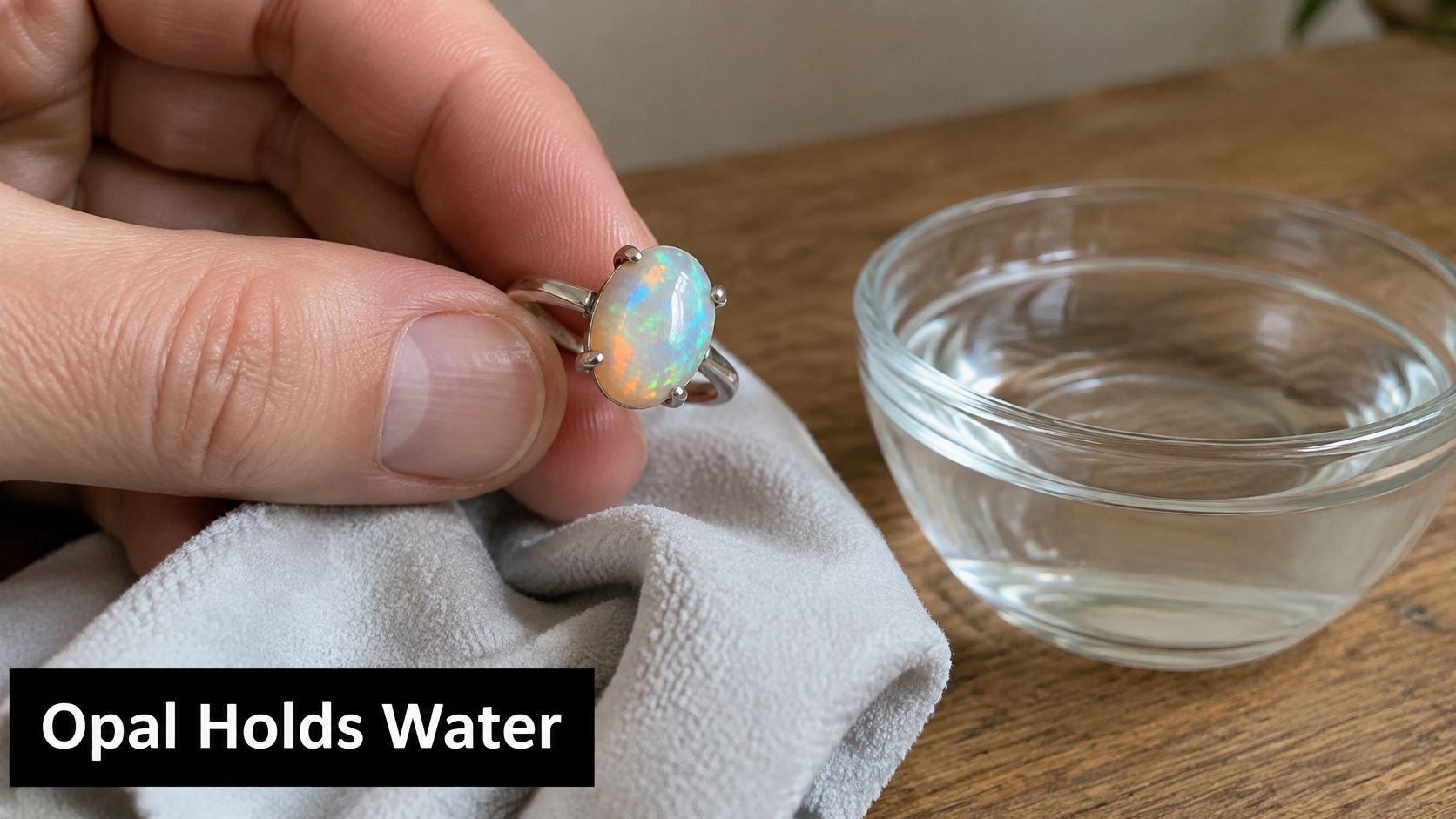
Opal contains water within its structure, not just moisture on its surface. The International Gem Society's opal care guidance describes water content of roughly 3% to 21%, with gem-quality material commonly containing about 6% to 10%, which helps explain its sensitivity to dehydration, heat, and abrupt temperature changes.
That doesn't mean your jewelry needs a bath to stay healthy. Everyday care is about stable conditions and avoiding unnecessary exposure, not keeping the stone wet.
A bowl belongs in a controlled cleaning routine, not in your storage setup.
Make getting ready opal-friendly
For removable jewelry in healed piercings, put your opal pieces on after applying lotion, perfume, and hairspray. Give those products time to settle rather than spraying around jewelry you're already wearing.
Take rings and other easily removable pieces off before dishwashing, swimming, or household cleaning. Gloves don't solve every problem if water and cleaner collect inside them against the jewelry.
Workouts add another trade-off: you might love the look, but sweat, equipment, and accidental knocks aren't ideal companions for a delicate stone. Choose a less vulnerable piece for those activities when changing jewelry is appropriate for your piercing.
Don't make your favorite opal do every job. Saving it from a workout or cleaning session is easier than dealing with damage afterward.
After unexpected sweat or moisture, attend to the jewelry rather than leaving it damp until bedtime. Blot gently, use the cleaning method appropriate to its construction if needed, and let it dry before storage.
Give each piece a protected place
The International Gem Society's gemstone care guide recommends gentle handling and separate padded storage, and notes Jewelers of America's recommendation for professional inspection and cleaning at least twice yearly for fine jewelry. Use those visits to check settings and subtle damage, not just to restore shine.
Storage conditions, risks and fixes for opal
| Condition | Risk | Action |
|---|---|---|
| Tossed loose with metal jewelry | Scratches from harder items | Store in a soft padded pouch or separate compartment |
| Radiator, sunny windowsill or car dashboard | Heat exposure and crazing | Keep at room temperature, away from heat sources |
| Humid bathroom or repeated wet storage | Lingering moisture, especially around bonded layers | Dry completely before storing in a stable location |
| Wet after swimming or washing | Chemical exposure and possible water absorption | For confirmed solid, non-hydrophane opal, rinse briefly and pat dry; blot other types and seek advice |
| Professional inspection | Loose settings or cracks you may overlook | Arrange regular checks with an opal-experienced jeweler |
Choose a pouch that keeps pieces from knocking together rather than putting an entire jewelry stack in the same bag. A padded compartment works too, provided neighboring chains and jewelry ends can't slide into it.
Our DIY jewelry storage ideas can help you organize a setup you'll use. Keep the opal compartment somewhere convenient, not beside the bathroom sink where removing jewelry becomes another chance to splash it.
- Before the gym: Remove an opal ring rather than gripping equipment with it.
- Before a bath: Put your pendant in its pouch, not on the tub edge.
- After sweating: Blot moisture instead of leaving the piece damp.
- At bedtime: Give removable jewelry its own padded spot.
What to Do If Your Opal Looks Dull, Cloudy or Cracked
You've finished cleaning, but the surface still looks hazy. Soap residue is one possibility, not a diagnosis. For confirmed solid, non-hydrophane opal, a brief lukewarm rinse and gentle pat dry may remove a remaining film.
If that doesn't help, stop. More rubbing, longer soaking, or stronger cleaner won't tell you whether the problem is on the surface or inside the stone.
Match the symptom to the next move
- Persistent cloudiness: Leave the piece dry and have an opal-experienced jeweler assess it, especially if you see haze near a layered edge.
- Fine web-like lines: Treat these as possible crazing. Stop home cleaning and arrange professional assessment.
- A moving stone or lifted prong: Stop wearing the piece until its setting is checked. Don't press the stone back into place.
- Visible scratches: Skip toothpaste, polishing powder, and abrasive cloths. Ask whether professional work is appropriate for that particular opal.
Stop sign: A change that remains after gentle surface cleaning calls for assessment, not a stronger home treatment.
For the metal setting, mild soap and a soft cloth can remove ordinary grime, but they won't necessarily remove tarnish. Don't escalate to metal-polishing compounds near the opal; a jeweler can choose a method that suits both materials.
Keep up with professional inspections even when the piece looks fine. Our guide to making jewelry and body jewelry last offers more everyday handling habits, but cracks, loose settings, and layer separation need individual attention.
Confirm Your Opal Type Before Your Next Clean
Pick up the opal piece on your dresser today and check its purchase description before reaching for water. If the side profile is hidden and the paperwork doesn't identify its construction, set aside the bowl and use the conservative cloth-only approach until you can confirm more.
Identify the stone, match the cleaning method, and store the piece dry and separately. That's a better routine than treating every rainbow-colored jewelry end as if it were the same material.
Make your care kit simple
You don't need a crowded shelf of gemstone products. Keep the basics together so you won't substitute a rough towel or grab a cleaner meant for another piece.
- Plain microfiber cloths: Reserve clean cloths for wiping and drying jewelry.
- A small bowl and mild soap: Use them only when the stone is suitable for the solid-opal routine.
- An exceptionally soft brush: Save it for accessible setting details, not scrubbing the opal.
- A padded pouch: Keep it ready before you remove your jewelry.
We publish care guides on properly caring for body jewelry, so you can build habits around the pieces you wear. A delicate opal accent and an everyday metal hoop don't need identical treatment.
Got questions about your particular piece? Leave a comment with the wording from its product description and what you can see around the setting, rather than testing it with water. You can also sign up for our newsletter for new arrivals and care tips that help you keep your jewelry rotation looking good.
At BodyCandy, we offer body jewelry and care guides to help you look after your favorite pieces. Visit us to explore your next look, and check the material description before choosing a cleaning routine for an opal accent.