

















You've found the perfect hoop, barbell, or charm, but the post is too long, the ring sits awkwardly, or the metal leaves your skin angry. That's the moment many shoppers realize stock jewelry isn't the problem. The problem is that your piercing, your material needs, and your style aren't generic.
Ordering custom body jewelry online can solve that. It can also create a frustratingly expensive mistake if you skip alloy details, guess your measurements, or assume “custom” means the same thing at every shop. I've helped plenty of people work through these orders, and the winning approach is simple: treat the purchase like a small design project, not an impulse checkout.
When Stock Jewelry Just Does Not Fit the Bill
You're standing in front of the mirror, holding a new ring against your nostril. The design is right, the color is right, and the photos looked perfect. On your body, though, the curve presses into one side, the opening looks too wide, and the charm hangs at an odd angle. A different customer might have the opposite problem, a barbell that disappears into swelling or a navel ring that catches on clothing because the wearable length is wrong.
Those are practical reasons to go custom. So are unusual anatomy, a settled piercing that needs an uncommon gauge, a sentimental initial or date, and the simple desire to wear something nobody else has. A custom order might involve nothing more dramatic than changing a gemstone or finish. It might also involve a fully bespoke design made from a sketch or digital model.
Online jewelry is no longer a niche retail channel. Industry estimates place global online jewelry revenue at approximately $105.6 billion in 2024, up from $48.1 billion in 2017, while the United States accounted for an estimated $22.5 billion in online jewelry sales in 2024, according to online jewelry market estimates. That scale makes specialized e-commerce practical for customers who need to compare dimensions, materials, finishes, and personalization options from home.
What custom actually covers
The word custom can describe several different services:
- Personalized stock: A standard piece receives initials, text, a date, or a selected image.
- Made to order: The retailer produces an existing design after you select dimensions, stones, or finishes.
- Modified jewelry: A maker changes a post, closure, gemstone, or decorative element.
- Bespoke work: The piece is designed specifically for your anatomy and brief, often with a sketch or CAD mockup.
Each option brings different costs, lead times, approval steps, and return rules. Before you pay, find out exactly which model you're buying.
You'll need to manage more than the visual design. Material documentation, gauge, wearable length, ring diameter, threading, swelling allowance, production updates, shipping insurance, and the retailer's correction policy all matter. That sounds like a lot, but it becomes manageable once you keep one reusable measurement sheet and send the maker a precise brief.
Picking the Right Shop and Sharing Your Design
A serious custom jewelry shop should make its process visible before checkout. Look for clear base-metal disclosures, close-up photos of finished work, sizing guidance, a way to contact a real person, and written information about revisions and corrections. A gallery helps, but it isn't enough by itself. You need to know what the piece is made from and how the shop handles a result that doesn't match the approved design.
Start by deciding whether you want bespoke or made to order. Made-to-order jewelry usually follows an established design with your selected details. Bespoke work starts with your concept and may require more discussion before production. Don't let a product page blur those categories, because they demand different levels of approval.
A useful mood board can be as simple as a phone album containing:
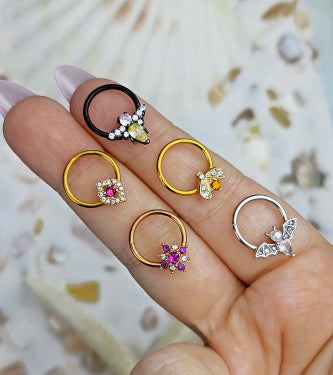
- Shape references: Hoops, spikes, flat discs, claws, hearts, or geometric forms.
- Finish examples: Polished, matte, brushed, blackened, or colored.
- Stone references: Color, cut, size, and setting style.
- Wearability notes: Low profile, snag resistance, visible sparkle, or everyday comfort.
Then turn those images into a written brief. State the piercing site, desired gauge, length or inner diameter, material, finish, decorative details, and budget. Include what you don't want, too. “No high-profile setting” is more useful than a vague request for something comfortable.
Maker conversation: Ask whether you'll receive a sketch, render, or prototype, how many revisions are included, and what happens if the finished piece differs from the approved version.
You can also compare your process with BodyCandy's custom jewelry guidance before contacting a maker. The important move is to ask specific questions early, especially about allergy documentation and the exact alloy. Don't send payment until the shop confirms whether the piece is plated, filled, solid, or made from a named base metal with compliance information.
Choosing Materials That Are Safe and Built to Last
The design is only half the decision. A body jewelry alloy sits against your skin, inside or beside a piercing channel, and the wrong choice can turn a beautiful piece into a constant source of irritation.
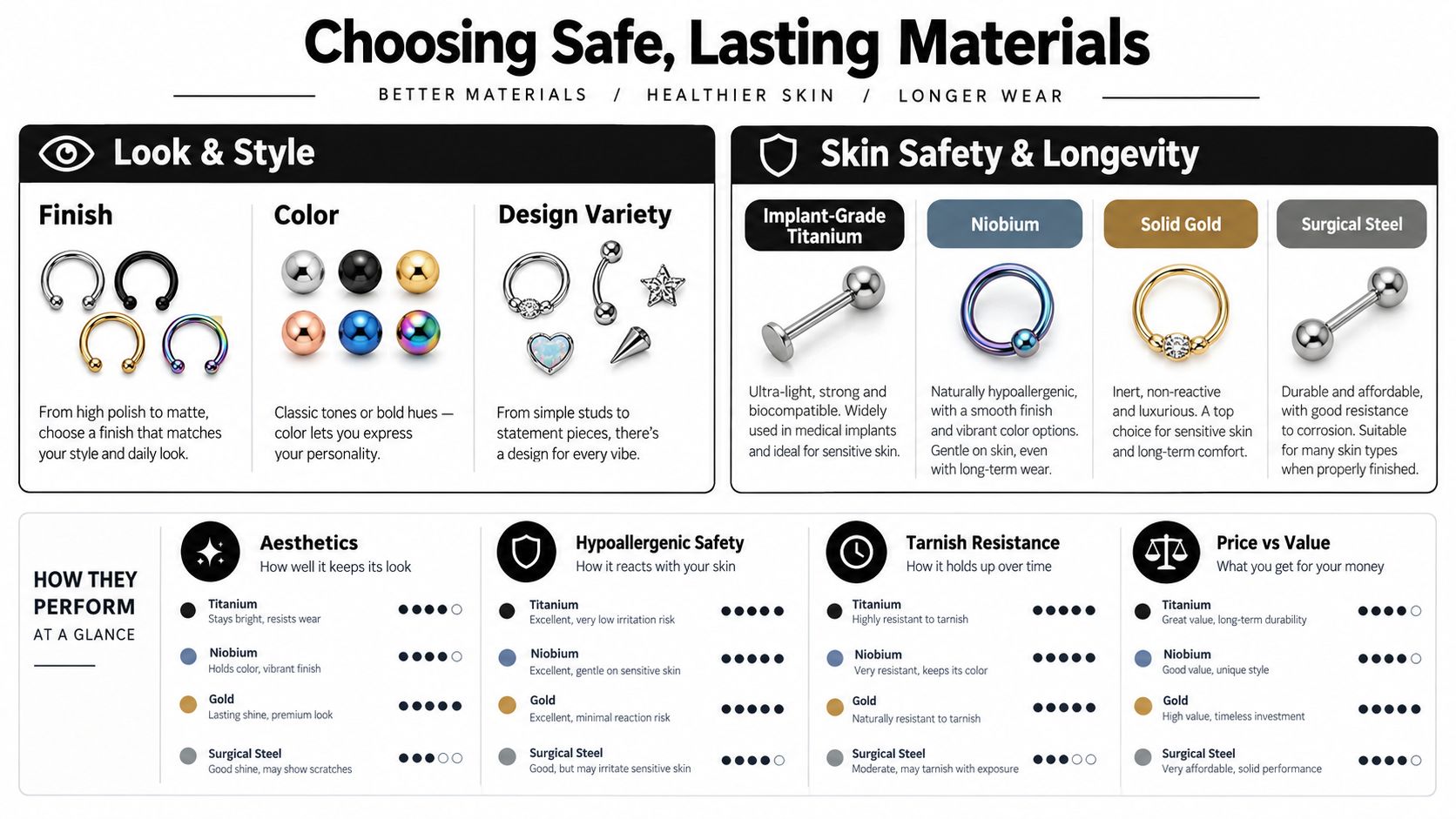
For sensitive skin or a fresh piercing, start with verified implant-suitable titanium or niobium. Generic “surgical steel” isn't enough because stainless steel can contain nickel, and the label doesn't tell you the alloy composition or compliance status. Medical guidance also notes that gold may contain nickel or other alloying metals, so a gold color alone proves nothing. DermNet's body-piercing guidance is clear about checking the material rather than trusting broad marketing language.
Use a practical material filter
Titanium is lightweight and a strong starting point for fresh or sensitive piercings when the retailer verifies that it's suitable for implantation. Niobium is another sensible option for people concerned about reactions. Both are preferable to an unidentified alloy when the jewelry will remain in a healing channel.
Surgical stainless steel can work for some wearers, but insist on composition and documentation. If the shop can't tell you the alloy, treat “surgical” as a sales phrase, not a safety certificate.
Solid gold can be appropriate for long-term wear when its purity and alloy composition are disclosed. DermNet notes that 9-carat gold and white gold can contain nickel, while solid gold of at least 12 carats and hypoallergenic stainless steel are generally safer choices for people concerned about nickel reactions. That doesn't make every higher-carat piece automatically suitable for every fresh piercing. Ask about the complete alloy and use the retailer's guidance alongside advice from a qualified piercer.
For an unhealed piercing, avoid plated, filled, sterling-silver, or mystery-metal options. Coatings can wear through, and uncertain alloys leave you with no reliable way to assess exposure. For a fully healed piercing, your options may be broader, but you still need to stop wearing anything that causes persistent itching, redness, swelling, or pain.
Ask the shop these questions:
- What is the base metal?
- Is the piece plated, filled, or solid?
- Is the alloy suitable for body-piercing wear?
- Can you provide composition or compliance documentation?
- Does the finish contain a coating that can chip or wear?
- What care instructions apply to this material?
This titanium body jewelry guide can help you build the vocabulary for that conversation. The rule is straightforward: fresh piercing means verified material first, style second. Healed piercing gives you more flexibility, but it never makes vague disclosure acceptable.
Getting Your Measurements Right the First Time
Custom jewelry can be beautifully made and still fail if the dimensions are wrong. Most fit problems start with one of four mix-ups: confusing gauge with millimeters, measuring the entire post instead of the wearable section, choosing a ring by appearance alone, or ignoring tissue thickness and swelling.
The Association of Professional Piercers emphasizes that fit, length, material, design, and construction affect healing and tissue safety. Its piercing FAQ and jewelry guidance supports a measurement workflow that begins with the site and current channel, then records the dimensions your anatomy needs.
Build your measurement cheat sheet
Record these details in one note on your phone:
- Piercing site: Nostril, helix, navel, lip, tongue, nipple, or another location.
- Gauge: The thickness of the jewelry passing through the channel.
- Wearable length: The section of a post or barbell that sits inside the tissue.
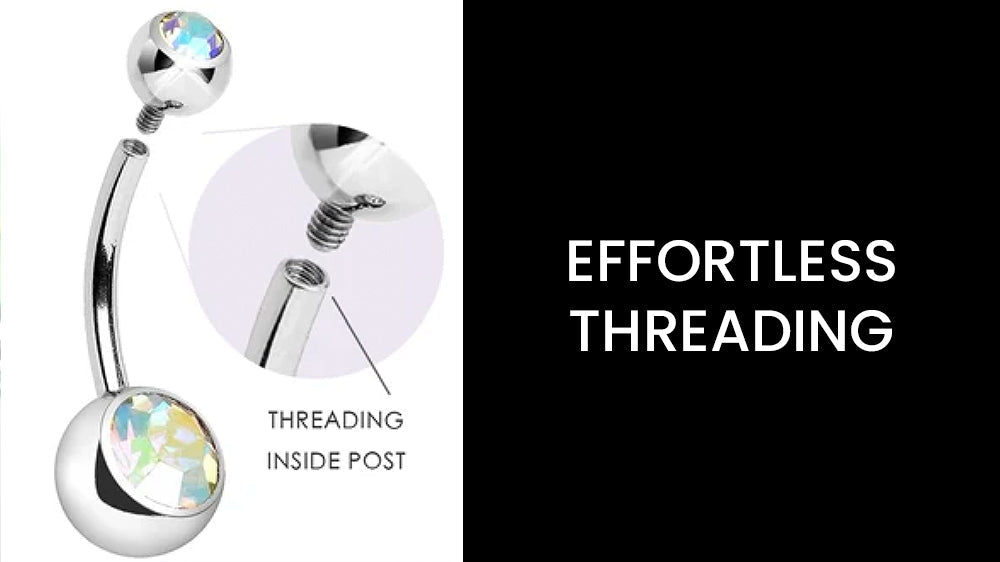
- Post length: The total post measurement according to the maker's stated method. Confirm whether decorative ends are excluded.
- Inner diameter: The usable inside measurement for a ring, not the outside edge.
- Tissue thickness: Measure the area without squeezing it.
- Swelling allowance: Include appropriate clearance for a healing or recently irritated piercing.
Use a caliper if you have one, but don't force it against the skin. A clean ruler, a piece of tape, and a printed gauge reference can help with basic comparisons. Measure a settled piercing twice, ideally at different times, because swelling can make a correct piece seem too short or too tight.
A quick reference should look like this, not a guess based on a product photo:
| Piercing Site | Common Gauge | Length or Diameter to Record | Healing Time Range |
|---|---|---|---|
| Nostril | Confirm your current gauge | Wearable post length or inner ring diameter | Ask a qualified piercer for a site-specific range |
| Helix | Confirm your current gauge | Post wearable length or ring inner diameter | Ask a qualified piercer for a site-specific range |
| Navel | Confirm your current gauge | Barbell wearable length, including swelling needs | Ask a qualified piercer for a site-specific range |
The table is intentionally a recording tool, not a substitute for anatomy assessment. There isn't one universal size for every nostril, helix, or navel.
Avoid the classic sizing traps
A ring that looks delicate online may press into tissue if the inner diameter is too small. A barbell that looks roomy may have a decorative end included in the listed length, leaving less wearable space than expected. Ask the retailer how it measures every dimension before ordering, then send your measurements in the same terminology.
For a refresher on gauge, post length, and diameter, use BodyCandy's body jewelry sizing basics. Confirm unusual anatomy, surface placements, and fresh channels with a qualified local piercer. A maker can produce the requested dimensions, but a piercer should help determine whether those dimensions suit your body.
Submitting the Order and Working with the Maker
A strong custom submission reads like a clear production brief, not a string of hurried messages. Put the design request, measurements, material, finish, reference images, and delivery details in one place. If the piece is complex, attach a sketch with arrows and labels or request a digital render before production begins.
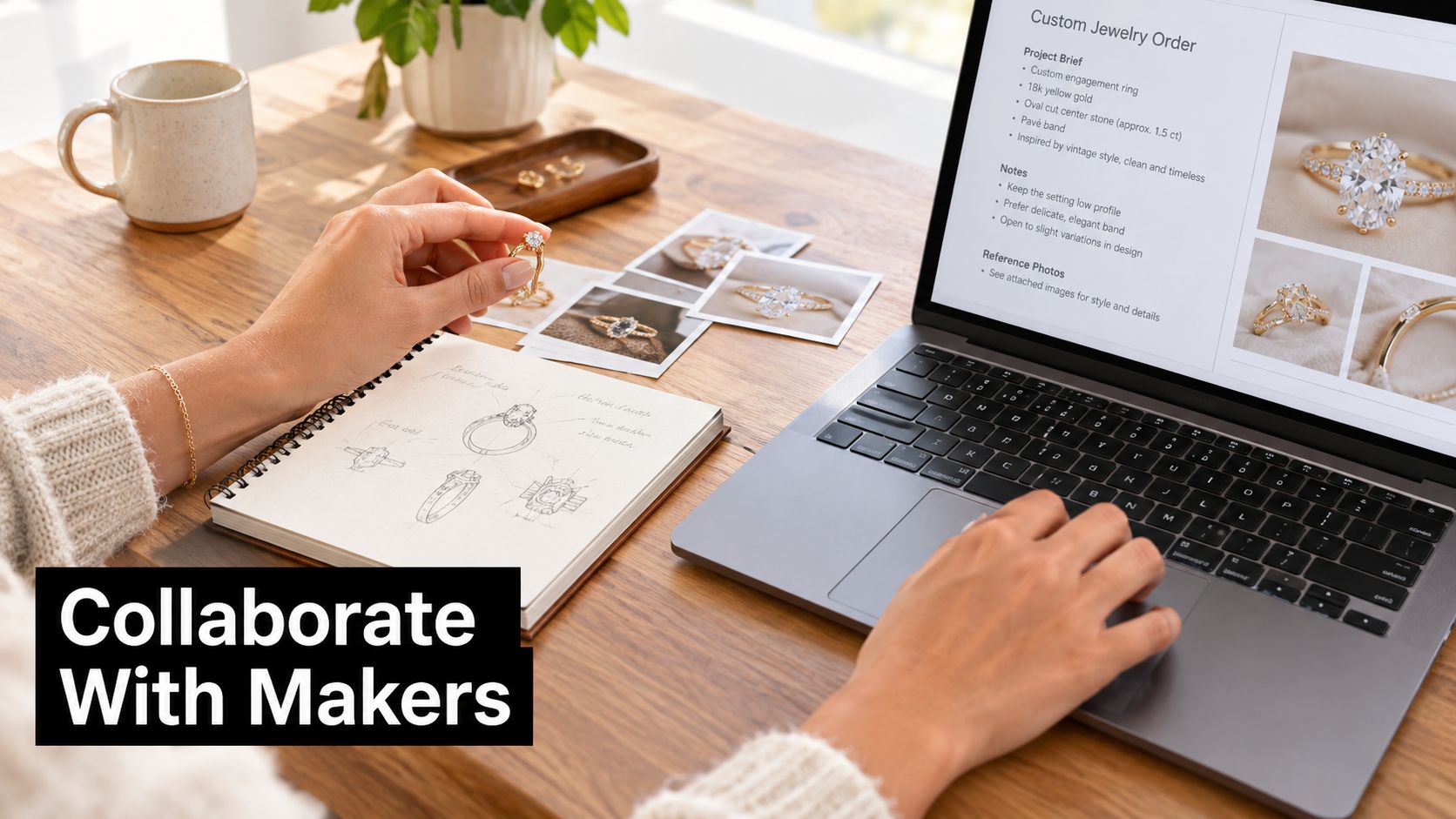
A proof gives both sides something concrete to approve. Check the silhouette, stone placement, proportions, threading, closure, finish, and the dimensions written beside the drawing. Small revisions are normal. Approving a vague concept and hoping the maker interprets it exactly is how avoidable disappointment starts.
Use a simple approval sequence:
- Submit the brief: Include your measurements and reference images.
- Review the proof: Compare the render against your written requirements.
- List revisions together: Number each requested change in one message.
- Approve the final version: Save the approved proof with the invoice.
- Wait for production: Avoid changing the specification after work begins unless the maker confirms the impact.
A stock piece with a personalized detail may move quickly, while a fully machined or hand-fabricated design needs more production time. Ask for a written estimate before paying, and treat it as a planning guide rather than a delivery promise. Repeatedly emailing for updates rarely speeds up a piece already in production. One clear status request is better than several scattered messages.
Watch this short visual reference before you finalize a complicated order:
Shipping deserves its own line in the conversation. Ask whether the parcel is insured, whether a signature is required, and how international packaging protects both privacy and the jewelry. Save the order confirmation, invoice, approved render, revision notes, and tracking details in one folder.
If the piece is for a new piercing, don't plan to install it immediately just because it has arrived. NHS guidance recommends leaving new jewelry in place for at least 6 weeks before attempting to change it, as explained in NHS piercing care guidance. A custom replacement should be ready when the piercing is ready, not used as a reason to switch too early.
Returns, Quality Checks, and Knowing What Is Normal
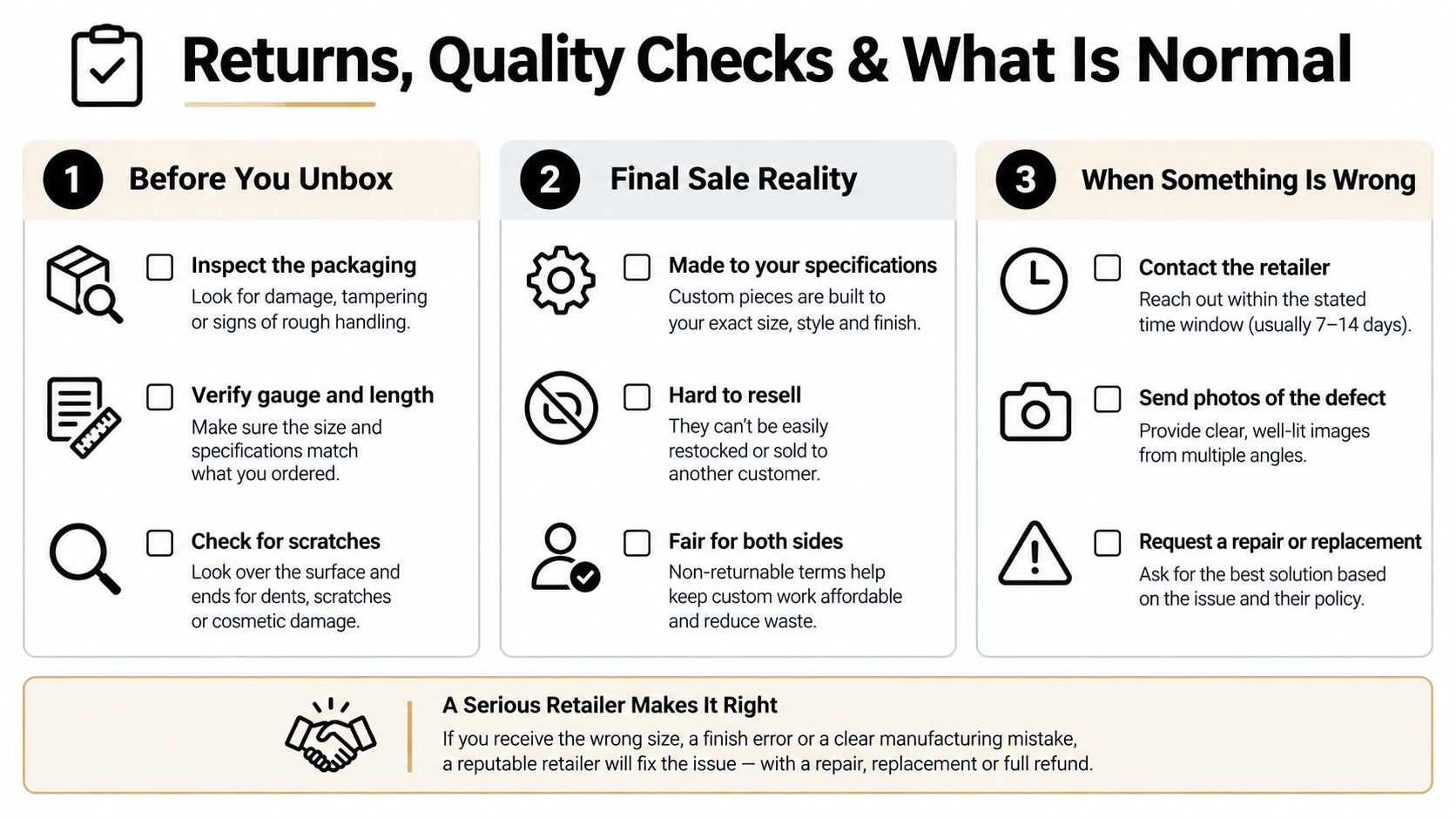
Custom pieces are often final sale because the retailer has made them to your specifications. That policy isn't automatically unreasonable, but it should never excuse poor workmanship or a failure to produce what you approved. A responsible shop should explain how it handles a wrong length, defective finish, damaged threading, missing personalization, or an item that differs from the confirmed design.
Before the jewelry touches your piercing, inspect it with clean hands and strong light. Compare the piece with your order notes, not with your memory of the product page.
Use a calm unboxing routine
- Check the packaging: Look for crushing, punctures, moisture, or signs the parcel was opened.
- Verify the order: Match the gauge, wearable length, inner diameter, material, stone, finish, and personalization.
- Inspect the surface: Look for scratches, chips, rough edges, uneven polish, or flaking.
- Test the hardware: Check that threading and closures engage smoothly without force.
- Photograph everything: Capture the piece, packaging, label, and any defect before wearing it.
Don't perform a fit test on an irritated or healing channel just to see whether the jewelry works. If you do assess fit, wash your hands, avoid forcing the piece, and stop if the dimensions clearly don't match your order. Contact the retailer promptly with clear photographs and the order number.
Medical guidance gives a useful reality check. One cited study found that up to 35% of people with pierced ears experienced one or more complications, with minor infection representing 77% of reported complications and allergic reaction 43%, as summarized by American Family Physician. Those figures describe reported complications in the cited context, not a guaranteed failure rate for your jewelry. Site, hygiene, practitioner experience, material, and aftercare all influence outcomes.
Separate normal healing from warning signs
A new piercing can be tender, itchy, slightly red or darker than usual, and produce pale fluid that dries into a crust during the first few weeks. NHS guidance on infected piercings identifies increasing swelling, pain, heat, redness or darkening, blood or pus, and feeling feverish or generally unwell as signs that need attention.
If those symptoms appear, don't keep wearing a questionable piece while hoping your body adjusts. Document the condition, contact the retailer about the jewelry, and seek medical or professional piercing advice when symptoms suggest infection or a significant reaction.
Your Pre-Order Checklist and Next Move
Your repeatable workflow is short: choose the design, verify the material, record the measurements, submit a precise brief, approve the proof, and inspect the finished piece before wear.
Screenshot this checklist:
- Design: Have I saved references and written what I do and don't want?
- Material: Is the alloy named, documented, and appropriate for my piercing?
- Measurements: Did I record the site, gauge, wearable length, inner diameter, tissue thickness, and swelling needs?
- Maker: Are revisions, production timing, shipping, and corrections explained?
- Quality: Will I photograph the unboxing and compare the piece with my approved order?
- Red flags: Am I being asked to accept mystery metal, vague sizing, rushed approval, or a no-contact policy?
BodyCandy offers online body jewelry categories and personalized pieces where customers can add details such as initials, dates, text, or pictures to selected designs. Browse its sizing and aftercare resources, check any applicable rewards options, and keep your measurement sheet for the next order. Your first custom piece takes the most concentration. After that, the process gets faster because you know exactly what to ask.
Ready to turn your measurements and ideas into a piece that actually fits? Visit BodyCandy to browse body jewelry and personalization options, then use the sizing and aftercare guidance to shop with a sharper eye. Save your final measurements now, and make your next custom order deliberate instead of guesswork.