
















If you've ever winced while changing your piercing jewelry, you're so not alone. The secret to a smooth, totally ouch-free swap often comes down to one tiny, but crucial, detail: the threading. An internally threaded barbell is designed with a completely smooth post. The screw part is tucked away inside the ball end, letting it glide right through your piercing without catching or causing any drama.
Why Your Piercing Deserves an Internally Threaded Barbell
Let's get into why this small design feature is such a huge deal for a happy piercing.
Imagine trying to drag a rough, sharp-edged screw through a delicate, healing piercing. Ouch, right? That’s pretty much what happens with externally threaded jewelry, where those scratchy threads are on the outside of the post. It's a perfect recipe for creating tiny tears, causing irritation, and just having a miserable time, especially if your piercing is new or sensitive.
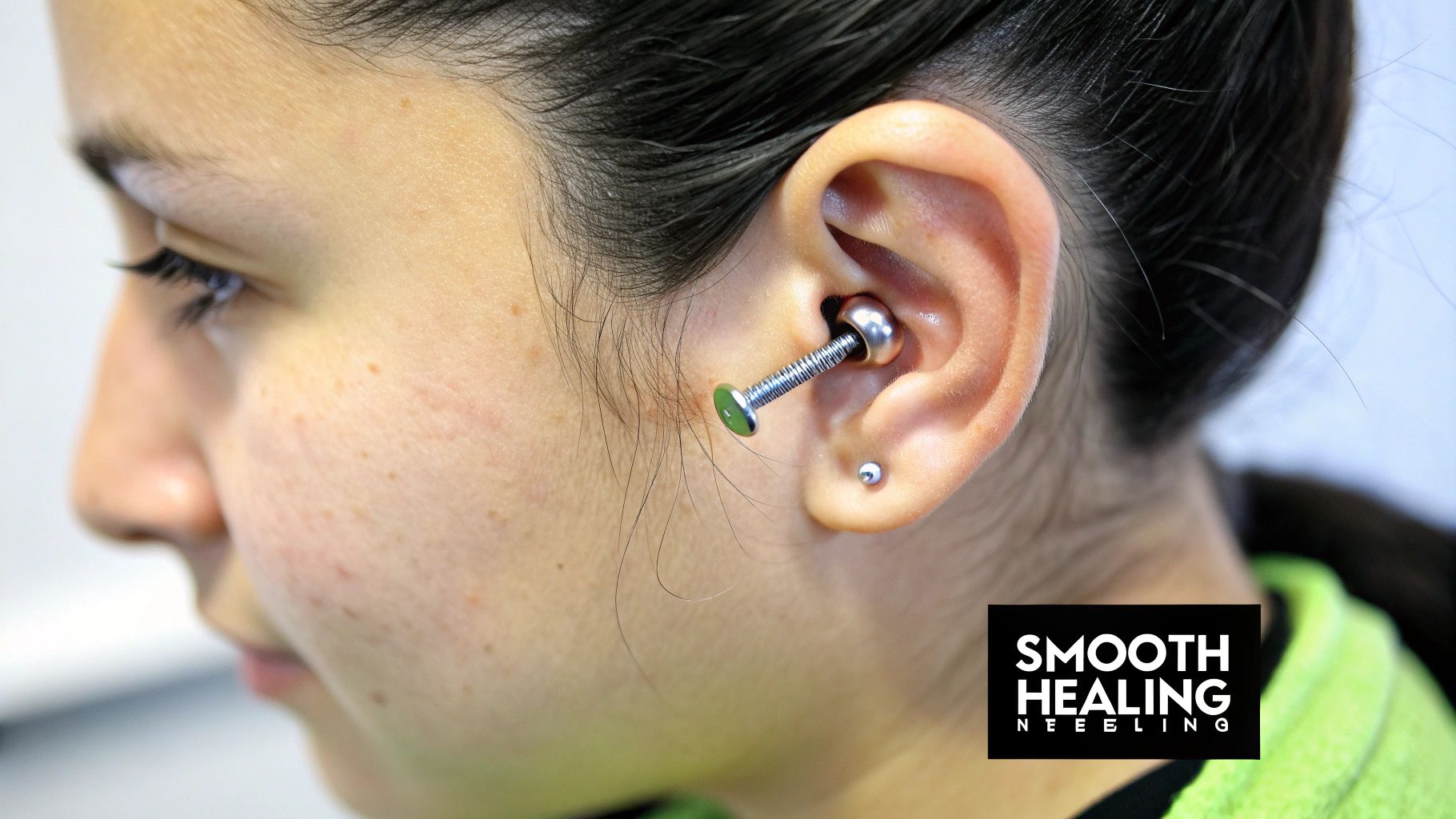
Now, picture a post that’s perfectly smooth from end to end. With an internally threaded barbell, the screw is actually attached to the ball, which then screws into the hollow end of the post. This clever design means only a sleek, polished surface ever touches your skin when you're putting it in or taking it out. For comfort and happy healing, it’s a total game-changer.
Internal vs. External Threading at a Glance
This quick comparison should help you see the key differences between internally and externally threaded barbells.
| Feature | Internally Threaded | Externally Threaded |
|---|---|---|
| Post Surface | Completely smooth and polished. | Has exposed screw threads on the bar itself. |
| Comfort Level | High. Glides through piercings without snagging. | Low. Can scrape or irritate the piercing channel. |
| Best For | New piercings, sensitive skin, and easy changes. | Healed piercings only (if at all). |
| Hygiene | Easier to clean with no crevices for bacteria. | Threads can trap bacteria, increasing infection risk. |
| Material Quality | Typically made from high-quality, body-safe metals. | Often made from lower-quality, mystery metals. |
Once you see them side-by-side, it's pretty clear why one is the superior choice for keeping your piercing healthy and comfortable.
The Professional's Choice for Happy Piercings
There’s a good reason why professional piercers almost exclusively recommend and use internally threaded jewelry. It’s not just about what feels better—it’s about the health and safety of your piercing.
This design was a critical innovation in body jewelry because it massively reduces irritation and the risk of damaging that delicate tissue when you change your jewelry. You can learn more about the rise of safer body jewelry designs and why they matter so much. Plus, since the post is smooth, there are no little nooks and crannies on the bar for bacteria to hide out, which is a major win for preventing nasty infections.
Think of it this way: an externally threaded barbell drags its rough edges through your piercing channel, while an internally threaded barbell offers a VIP entrance—smooth, clean, and irritation-free.
Making the Right Decision for Your Body
Choosing the right jewelry is one of the most important calls you'll make for your piercing, right after picking a reputable piercer. While you might see externally threaded pieces everywhere, they are often made from lower-quality materials that can cause allergic reactions. High-quality, body-safe materials like implant-grade titanium or 316L surgical steel are almost always found in internally threaded designs.
So, when you go for an internally threaded barbell, you’re not just getting jewelry that’s easier to insert. You’re investing in:
- A smoother, pain-free experience: No more snagging or scraping.
- Faster, easier healing: Less irritation means your piercing can heal up without annoying setbacks.
- Better hygiene: A smooth surface is way easier to keep clean and harbors fewer bacteria.
- Higher quality materials: You’re far more likely to get jewelry made from body-safe metals.
It’s a simple switch that makes a world of difference for the long-term health and happiness of any piercing, from a brand-new helix to a well-loved navel piercing.
Choosing the Best Materials for Your Body Jewelry
Alright, so you're sold on why internally threaded barbells are the only way to go. Smart move! But the journey doesn't end there. Now we've got to talk about what your jewelry is actually made of. This is just as critical as the threading, especially if you want a happy, drama-free piercing.
Think about it this way: you wouldn't wear a scratchy wool sweater on a hot day, right? So why would you put your sensitive piercing through the same kind of misery with a low-quality metal? Picking the right material means saying goodbye to irritation and allergic reactions, and hello to a piercing that feels as good as it looks.
Let’s get into the best options out there so you can find the perfect match for your body.
Titanium: The Superhero for Sensitive Skin
If your skin tends to freak out over certain metals, then implant-grade titanium is about to become your new BFF. This isn't just any metal; it's the same stuff doctors use for medical implants. Why? Because it's incredibly biocompatible, which is a fancy way of saying your body will welcome it with open arms. It's also super lightweight and 100% nickel-free, making it the undisputed champion for fresh piercings or anyone with known metal sensitivities.
- Pros: Hypoallergenic, feather-light, won't corrode, and can be anodized into a whole rainbow of awesome colors.
- Cons: It can cost a little more than other options, but trust us, it's an investment in your piercing's long-term health.
316L Surgical Steel: The Reliable Workhorse
You've probably seen 316L surgical steel everywhere, and there's a good reason for that. It hits that sweet spot between quality, durability, and a price that won't make your wallet cry. For a healed piercing, it's a fantastic, reliable choice that delivers that classic, polished silver look that never goes out of style.
One thing to keep in mind: while it's considered body-safe, it does contain a tiny amount of nickel. If you have a serious nickel allergy, you'll want to stick with titanium. For most people, though, it’s a perfectly safe and stylish go-to. If you want to get nerdy about it, check out our deep dive on the most common metals used in body jewelry.
Solid Gold: The Touch of Luxury
Feeling a little fancy? 14k or 18k solid gold (and we mean solid, not plated!) is the ultimate way to spoil your piercing. It’s a timeless choice that's both stunning and body-friendly, provided it's nickel-free. You'll want to stick to 14k or 18k, because pure 24k gold is actually too soft for body jewelry and can get scratched or bent way too easily.
Choosing the right material isn't just about aesthetics—it's an act of self-care for your piercing. High-quality metals work in harmony with your body, preventing irritation and letting your style shine through without any drama.
Finding Your Perfect Barbell Size and Fit
Buying body jewelry online shouldn't feel like a total guessing game. Getting the size right is the absolute key to a comfortable, happy piercing, and we're here to demystify it for you. Don't worry, there's no complicated math involved—just a couple of simple concepts to learn.
The two most important measurements you'll come across are gauge and length.
Understanding Gauge and Length
Think of the gauge as the thickness of the barbell post. Here's the slightly backward part: the smaller the number, the thicker the barbell. So, a 14 gauge (14g) barbell is actually thicker than a 16 gauge (16g) one. It's a little counterintuitive at first, but you'll get the hang of it fast!
Length is much more straightforward. It refers to the wearable part of the barbell post—that's the space between the two decorative ends. This is usually measured in inches or millimeters. A barbell that’s too short can pinch and cause nasty irritation, while one that's too long can snag on everything in sight. Finding that perfect "just right" length is the goal.
How to Measure for the Perfect Fit
The easiest way to find your size is to measure a piece of jewelry you already own that fits perfectly. Just grab a ruler with millimeter markings (they're way more precise!) and measure the thickness for the gauge and the wearable area between the balls for the length.
Don't have any well-fitting jewelry to measure? No problem. The best and safest option is always to pop in and see a professional piercer. They can measure your piercing with specialized tools and give you the exact dimensions you need, taking your unique anatomy into account. For more specific guidance on trickier piercings, our guide on industrial barbell sizing can offer some extra tips.
When you're choosing a high-quality, internally threaded barbell, the material is just as important as the size.
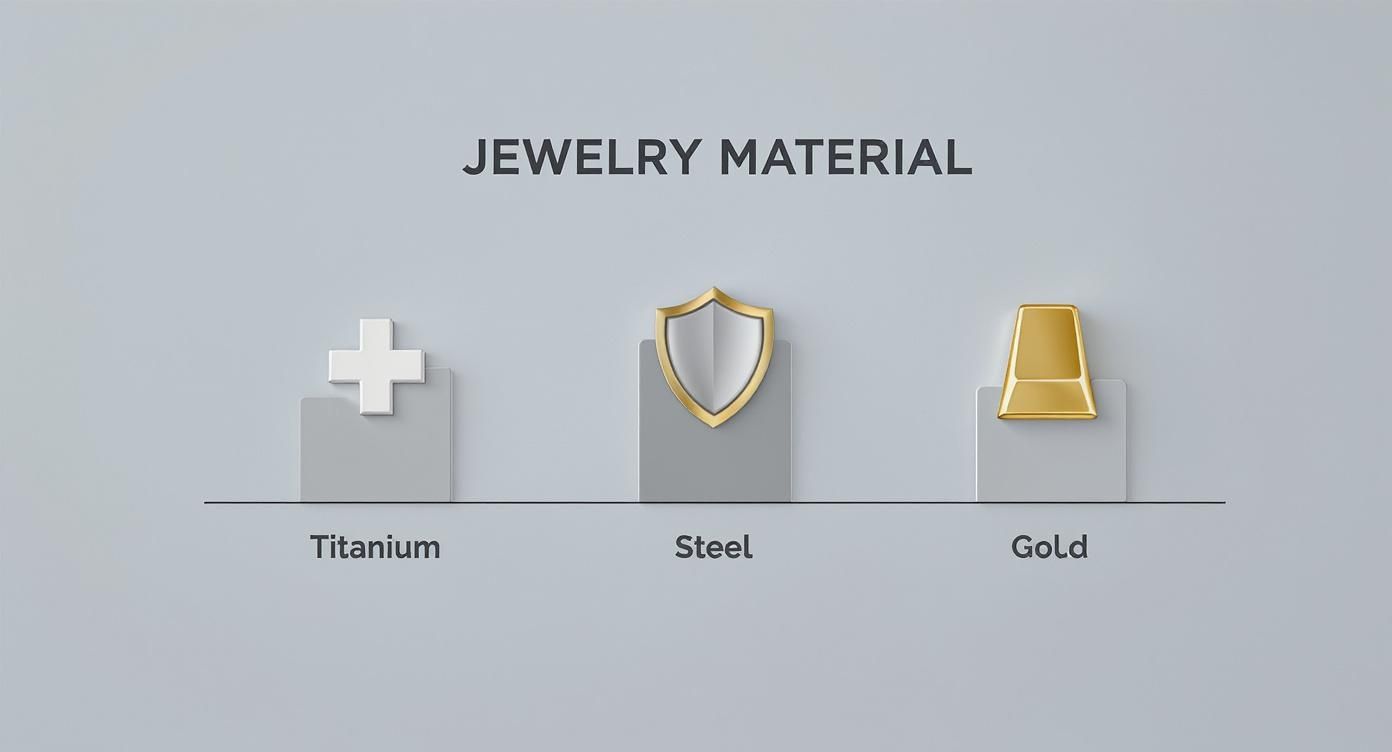
As you can see, titanium and surgical steel are overwhelmingly popular choices, loved for their safety and durability. Of course, gold is always there for a touch of luxury.
Common Piercings and Standard Barbell Sizes
While a custom measurement from your piercer is always the gold standard, many common piercings have "starter" sizes that can give you a great reference point. This table breaks down some of the most popular ones.
| Piercing Type | Standard Gauge | Standard Length |
|---|---|---|
| Nipple Piercings | 14g | 1/2" to 5/8" |
| Tongue Piercings | 14g | 5/8" |
| Eyebrow Piercings | 16g | 5/16" or 3/8" |
| Industrial Piercing | 14g | Varies by Anatomy |
| Bridge Piercing | 14g or 12g | 1/2" to 5/8" |
| Vertical Labret | 16g | 5/16" or 3/8" |
Just remember, these are just guidelines! Your body is unique, and what works for one person might not be the right fit for you. A quick chat with your piercer is the absolute best way to guarantee a perfect, comfortable fit for your piercing.
How to Change Your Barbell Jewelry Like a Pro
Ready for a new look but feeling a bit nervous about swapping out your jewelry? Don't worry, we've all been there. With a few simple tips, changing your barbell can be a quick, painless, and even fun way to refresh your style.
The golden rule, and we can't stress this enough, is to wait until your piercing is 100% fully healed. Trying to change jewelry too soon is a recipe for irritation, healing delays, and even nasty infections. Patience is your best friend for a happy piercing. If you're not totally sure, your piercer is the best person to give you the all-clear.
Your Step-by-Step Guide to a Smooth Swap
Once you've confirmed your piercing is healed and ready for its debut, grab that gorgeous new piece of jewelry and let's get started. These steps will make you feel like you've been doing this for years.
-
Wash Your Hands Thoroughly: This one's non-negotiable. Get in there with warm water and antibacterial soap for at least 20 seconds. Clean hands are your number one defense against introducing any unwanted bacteria to the party.
-
Set Up a Clean Workspace: Lay down a fresh paper towel or a clean, soft cloth on a flat surface. This gives you a sterile spot for your jewelry and—trust me on this—prevents those tiny threaded ends from bouncing into the great unknown. We've all mourned a ball lost to the sink drain!
-
Unscrew the Old Jewelry: Hold your current barbell steady and firmly grip one of the balls, twisting it to the left (remember: righty-tighty, lefty-loosey!). If it's being stubborn, a pair of clean nitrile or latex gloves can give you the extra grip you need. Still stuck? Our guide on replacing body jewelry balls has some clever tricks up its sleeve.
-
Clean and Prep: With the old jewelry out, take a second to gently clean the piercing site with a sterile saline solution. This clears away any gunk and gets the area ready for your new bling.
-
Insert Your New Internally Threaded Barbell: Take your clean new barbell post and gently guide it through the piercing. A tiny bit of water-based lubricant can make this even easier. Since it's an internally threaded barbell, the post itself is completely smooth, so it won't scrape or aggravate the piercing tunnel on its way through.
The smooth post on internally threaded jewelry is a game-changer. It's one of the big reasons professionals love it. This design prevents the threads from catching on your skin, which dramatically cuts down the risk of tearing or irritation, for both fresh and fully healed piercings.
- Secure the End: Now, just take the threaded ball and carefully screw it into the post until it feels snug. Give it one last gentle turn to make sure it's secure, but be careful not to crank it down too hard.
That's it! You've just changed your jewelry like a total pro. Give the ends a quick check every now and then to make sure they're tight, and go show off your awesome new look.
Keeping Your Jewelry Clean and Looking Its Best
So you’ve got your gorgeous new internally threaded barbell, and it looks amazing. Now, let's talk about how to keep it—and your piercing—sparkling clean and happy for the long haul.
A little bit of regular care goes a long way in preventing irritation and making sure your jewelry always looks its best. Trust us, you don't need a complicated routine. Simple is almost always better!
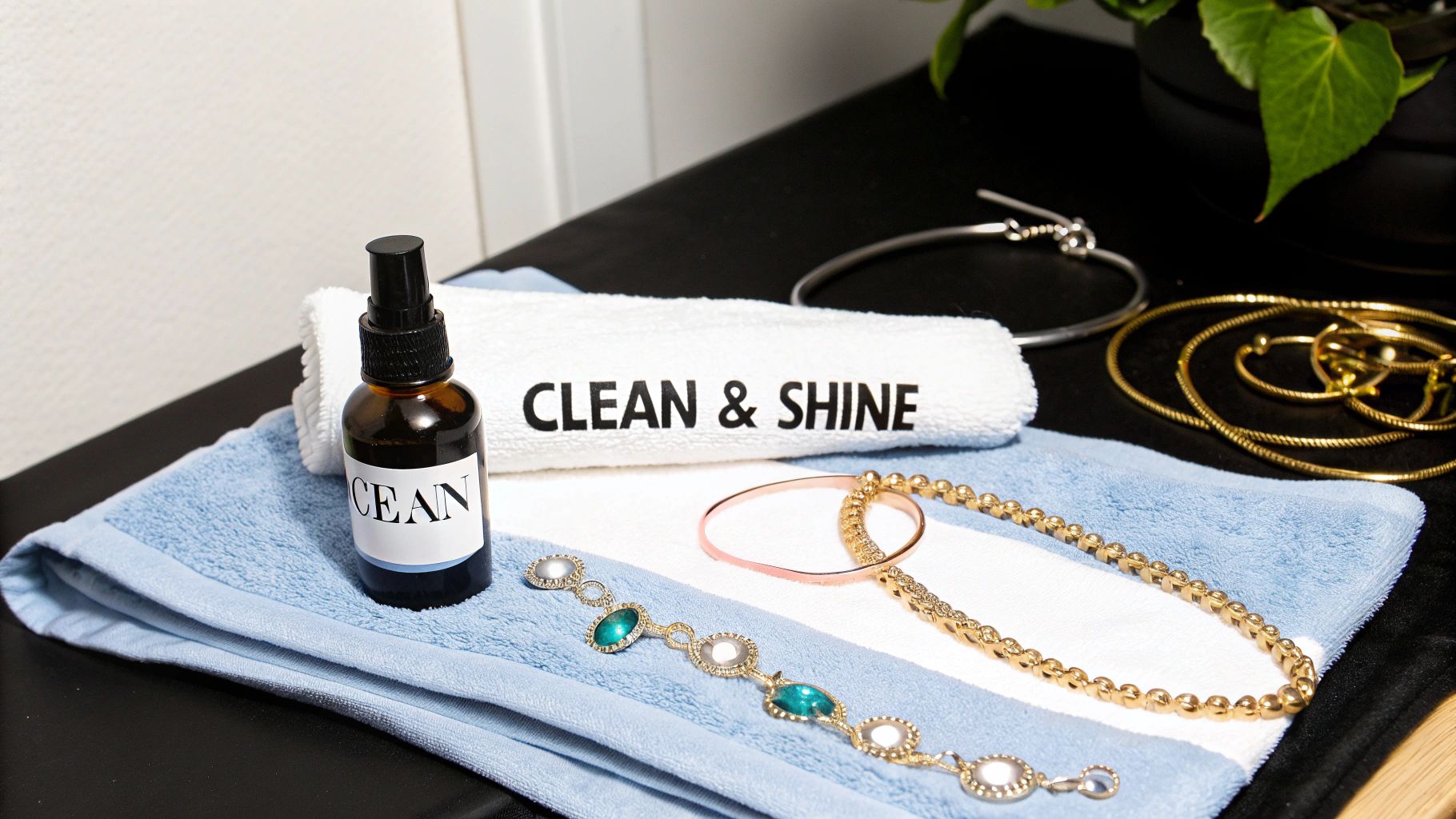
For the piercing itself, a gentle sterile saline solution is your best friend. For the jewelry, a quick wash with mild, fragrance-free soap and warm water is all it takes to remove everyday buildup and keep that baby shining.
Your Simple Cleaning Routine
Keeping things clean is super easy. Just follow these quick steps every so often to maintain that fresh-from-the-studio sparkle and keep your piercing feeling great.
- Wash Your Hands: Seriously, don't skip this. Always start with squeaky-clean hands before touching your piercing or jewelry.
- Remove and Soak: Carefully unscrew your barbell and pop it into a small bowl of warm water with a few drops of mild soap. A few minutes is all it needs.
- Gently Scrub: Grab a very soft-bristled brush (a baby toothbrush is perfect for this) to gently scrub away any residue from the post and ends. Pay special attention to any detailed designs or tiny crevices.
- Rinse and Dry: Rinse the jewelry thoroughly under running water to get all the soap off, then pat it completely dry with a clean paper towel before putting it back in.
One of the biggest myths out there is that you need harsh chemicals to get your jewelry clean. Steer clear of things like alcohol or hydrogen peroxide! They can be way too aggressive, irritating your skin and even damaging the beautiful finish on your internally threaded barbell.
Storing Your Collection Properly
When you're not wearing a piece, don't just toss it in a drawer to fend for itself. Give it a safe home! Keep your barbells in a clean, dry place, like a small fabric-lined jewelry box or even individual plastic baggies.
This simple habit prevents them from getting scratched up, tangled with other pieces, or covered in dust. Proper storage protects your investment and ensures that every piece is pristine and ready to wear the next time you want to switch up your look. A little organization now means your Bodycandy collection will stay flawless for years.
Solving Common Internally Threaded Barbell Issues
Even with the best jewelry in the world, little hiccups can happen. Don't panic! This is your personal troubleshooting guide for those "uh oh" moments. Most issues with an internally threaded barbell are surprisingly easy to fix with a bit of patience and the right touch.
First up, the classic problem: a threaded end that just won’t budge. Before you start wrestling with it, the secret weapon is grip. Try popping on a pair of clean nitrile or latex gloves. This simple trick gives you way more traction than your bare fingers and is usually all you need to get that stubborn ball loose.
If you’re still stuck, it’s time to tap out before you get frustrated. Your professional piercer has specialized tools to remove it safely without damaging your piercing or that beautiful jewelry you love.
Is It Irritated or Infected?
This is a huge question we get all the time, and knowing the difference is key. Most of the time, what you’re dealing with is just a bit of temporary irritation, not a full-blown infection.
- Irritation: This usually looks like some minor redness, a little bit of swelling, or some clearish fluid (that’s just lymph fluid, totally normal!). It might feel tender, but it generally calms down once the source of the annoyance—like snagging it on a shirt or sleeping on it weirdly—is gone.
- Infection: The signs of an actual infection are much more aggressive. Think intense pain, throbbing, bright red or streaky skin, serious swelling, and thick, yellowish, or greenish discharge. You might also feel generally unwell or even run a fever.
If you even think it might be an infection, do not remove the jewelry. That can trap the infection inside. Your first call should be to a doctor or your piercer for professional advice.
When in doubt, always reach out to a professional piercer. They've truly seen it all and can offer you peace of mind and expert guidance, making sure your piercing stays healthy and happy for the long haul.
Your comfort and safety are always the top priorities, which is why the piercing industry never stops evolving. Many jewelry makers are now focusing on improvements like creating more corrosion-resistant materials and better ergonomic designs for internally threaded barbells. You can actually get a peek into these jewelry market trends that are pushing for safer, more comfortable options. When you choose a high-quality internally threaded barbell, you're getting a direct benefit of all that progress.
Your Top Barbell Questions Answered
Let's be real—getting into body jewelry can feel like learning a new language. We see a lot of the same questions pop up, so we've put together the answers to clear things up and help you choose your next barbell like a seasoned pro.
Are Internally Threaded Barbells More Expensive?
Sometimes they are, but there’s a good reason for it. The process to make an internally threaded barbell is just a bit more involved than its externally threaded cousin. Think of that small price difference as an investment in a happy, healthy piercing!
The smooth-post design is a game-changer, sliding into your piercing without scraping or irritating the tissue. This makes it the safest bet, especially if your piercing is still healing or just on the sensitive side. Here at Bodycandy, we've made it our mission to stock a huge range of high-quality, affordable internally threaded barbells so you never have to sacrifice safety for price.
Can I Mix and Match Different Ends on My Barbell?
You bet! This is where the real fun begins and how you build a truly unique jewelry collection. As long as the threading on the end matches the gauge of your barbell post (like a 14g end for a 14g post), you can swap them out to your heart's content.
This is awesome because you can collect a ton of cool, decorative ends without needing to buy a completely new barbell every time you want to switch up your look. Just make sure you read the product descriptions to double-check that the gauges are compatible before you add to your cart.
The love for high-quality, customizable body jewelry is blowing up all over the world. While North America and Europe have been leading the charge, we're seeing markets everywhere embrace body mods as a mainstream form of expression. You can discover more about the expanding global body jewelry market and see how trends are taking shape.
Pro Tip: Got a threaded end that just won't budge? Don't force it! First, wash your hands and make sure they're completely dry. For a much better grip, try putting on a pair of nitrile or latex gloves. If it’s still stuck, it's time for a trip to your professional piercer. They have the right tools to get it loose without damaging your jewelry or your piercing.
Ready to level up your style with the safest, most comfortable jewelry out there? At Bodycandy, we have a stunning collection of internally threaded barbells for every piercing and personality. Shop our full collection today at https://bodycandy.com and give your piercing the love it deserves