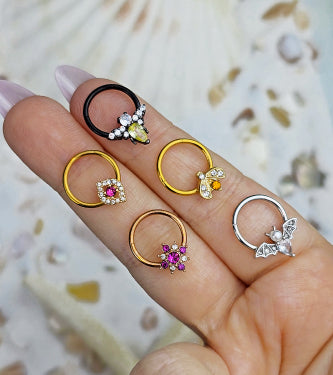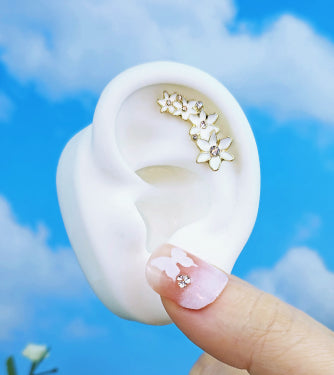















Nose piercing has been used for thousands of years for beautification and social communication, according to a review in the Journal of Education, Health and Sport. That tiny piece of jewelry can carry a surprisingly big message, from “this connects me to my family” to “I just love how it looks.”
If you're wondering why nose piercing appeals to so many people, start with the difference between your reason and someone else's interpretation. You choose the jewelry, but friends, relatives, and colleagues may read it differently. Finding your look means understanding both, without handing other people control of your style.
The Main Reasons People Get a Nose Piercing
People pierce their noses for aesthetics, cultural identity, belonging, spirituality, rebellion, and independence, often for several reasons at once. You don't need an elaborate explanation, either. Liking the way a little sparkle looks on your face is a perfectly complete reason.
Use this comparison to separate what you want from what your jewelry might communicate.
Reasons for nose piercing and what each communicates
| Reason | What It Communicates | Example |
|---|---|---|
| Aesthetic enhancement | Personal style and polish | A small nostril stud matched to an everyday look |
| Cultural heritage and continuity | Roots, family, and identity | A nath-style ring worn in South Asian tradition |
| Group affiliation or rank | Community membership or life stage | Facial ornaments that marked status in several historic societies |
| Spirituality | Devotion or a personal faith practice | A ring worn as a daily reminder of a belief |
| Counterculture and rebellion | Nonconformity with mainstream dress codes | Punk and 1960s to 1970s subculture styles |
| Self-expression and independence | Autonomy and control over your own body | A septum ring chosen because it feels like yours |
Treat these examples as possibilities, not a secret code. A septum ring doesn't automatically mean rebellion, and a traditional-looking ornament doesn't tell you someone's religion, relationship status, or background.
Separate intention from interpretation
Say you choose a delicate hoop because it works with your favorite earrings. Your friend might see a coordinated outfit, while a relative sees a connection to family tradition. Neither reaction changes why you chose it.
The relationship between popular culture and facial piercings adds another layer: people may associate your look with a musician, fashion scene, or community you weren't thinking about.
Cultural meanings belong to specific communities, not to every person wearing similar jewelry. Ask respectfully instead of assuming.
Try this first: Finish the sentence “I want a nose piercing because…” before choosing a placement or shopping for jewelry.
Your answer can be practical, emotional, or delightfully simple. It just needs to sound like you.
Where Nose Piercing Meanings Come From
Say you and a relative both love a gold nose ring. You see an accessory that suits your face; they see wedding jewelry. That difference makes more sense when you follow the history of nose adornment rather than treating it as a recent fashion invention.
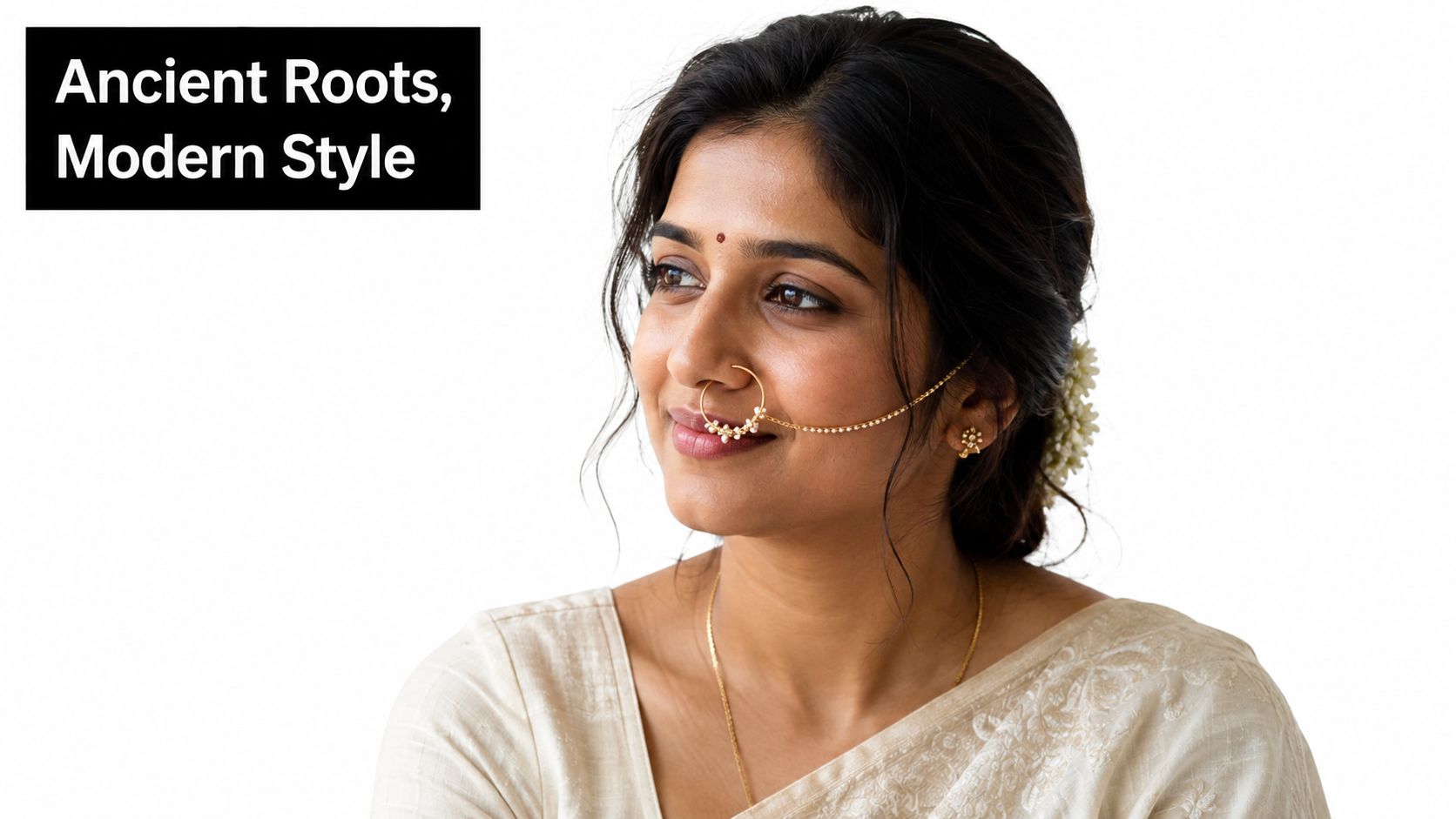
Wikipedia's overview of nose piercing traces documented roots back more than 4,000 years in the Middle East and places the practice in South Asia by at least the 1500s, with its spread commonly associated with Mughal-era routes. In some South Asian regions, the nath became connected with marriage and femininity. Those associations explain why an ornament can feel personal to the wearer and profoundly familial to someone watching.
Traditional jewelry also shows how much meaning can sit in its design.
Ancient adornment wasn't only about beauty
The broader history of body piercing describes a kangaroo-bone nose-septum ornament dated to approximately 44,000 BC, with researchers suggesting similar objects may have helped warriors appear intimidating. That's a striking artifact, but it doesn't establish an uninterrupted or universal piercing tradition.
Historical accounts also describe nose ornaments in the Americas as signs of wealth, virility, leadership, or high standing. Across African and Indigenous communities, facial adornment could communicate belonging and rank. The important lesson isn't that every community shared a meaning, but that people used jewelry to communicate different things.
A ring could identify a social role, mark a transition, or make someone's presence more imposing. Decoration and communication weren't separate jobs.
From inherited meaning to chosen identity
During the 1960s and 1970s, nose piercing gained visibility in Britain and the United States through counterculture and punk movements. In those settings, wearers could use it to challenge conventional appearance rules rather than affirm established expectations.
That shift didn't erase older traditions. It added another set of associations, which helps explain why the same placement can look traditional to one observer and unconventional to another.
Exploring nose piercing traditions in India is a useful starting point if heritage matters to your choice. Ask family members about their own practices, too, rather than expecting a general history to describe every household.
A nose ring can honor something you inherited, express something you chose, or do both at once.
What Surveyed Wearers Say Drives Them
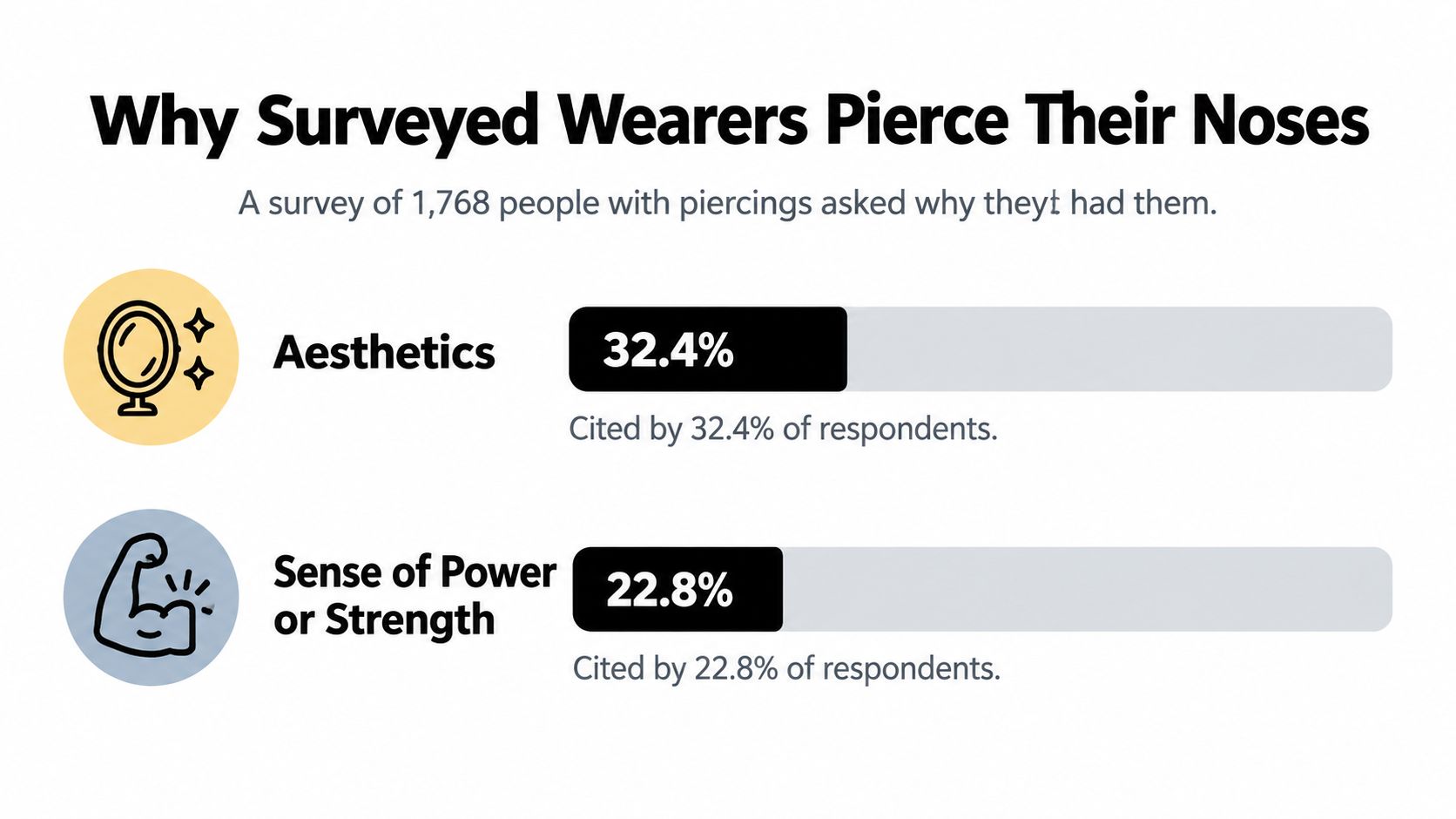
Aesthetic reasons led at 32.4% in a study published in Psychiatria involving 1,768 people with piercings. Other reported motives included a sense of power or strength at 22.8%, expressing personality at 19.1%, and wanting to distinguish themselves at 9.9%; nose piercings accounted for 21.6% of reported piercing locations.
Reported reasons for piercing among surveyed wearers
| Motive Reported | Share of Respondents |
|---|---|
| Aesthetic reasons | 32.4% |
| Sense of power or strength | 22.8% |
| Expressing personality | 19.1% |
| Wanting to distinguish themselves | 9.9% |
The visual below highlights the leading motives. Despite its nose-specific wording, the survey concerned people with piercings generally, not exclusively people explaining a nose piercing.
Turn a motive into a design choice
These figures come from a single study, not a universal ranking of what everyone wants. Respondents could have overlapping motives, so don't treat aesthetics, strength, and personality as mutually exclusive boxes.
Instead, translate your reason into a few concrete preferences:
- For a quiet aesthetic touch: Consider a small, simple nostril end that complements jewelry you already wear.
- For noticeable personality: Explore a distinctive shape, decorative detail, or more prominent ring after healing.
- For a sense of ownership: Choose the look you actually want, whether that's understated or attention-grabbing. Confidence doesn't require oversized jewelry.
Size, placement, finish, and visibility give you different ways to express the same intention. A polished metal stud and a decorative septum piece can both feel powerful to their wearers.
For another visual reference while considering your options, watch the accompanying video.
Before buying, describe your preferred look in plain language: discreet, ornamental, playful, or bold. Then check whether that choice fits your workplace, family expectations, and cultural context without assuming their reactions should decide everything.
Benefits and Trade-Offs to Weigh
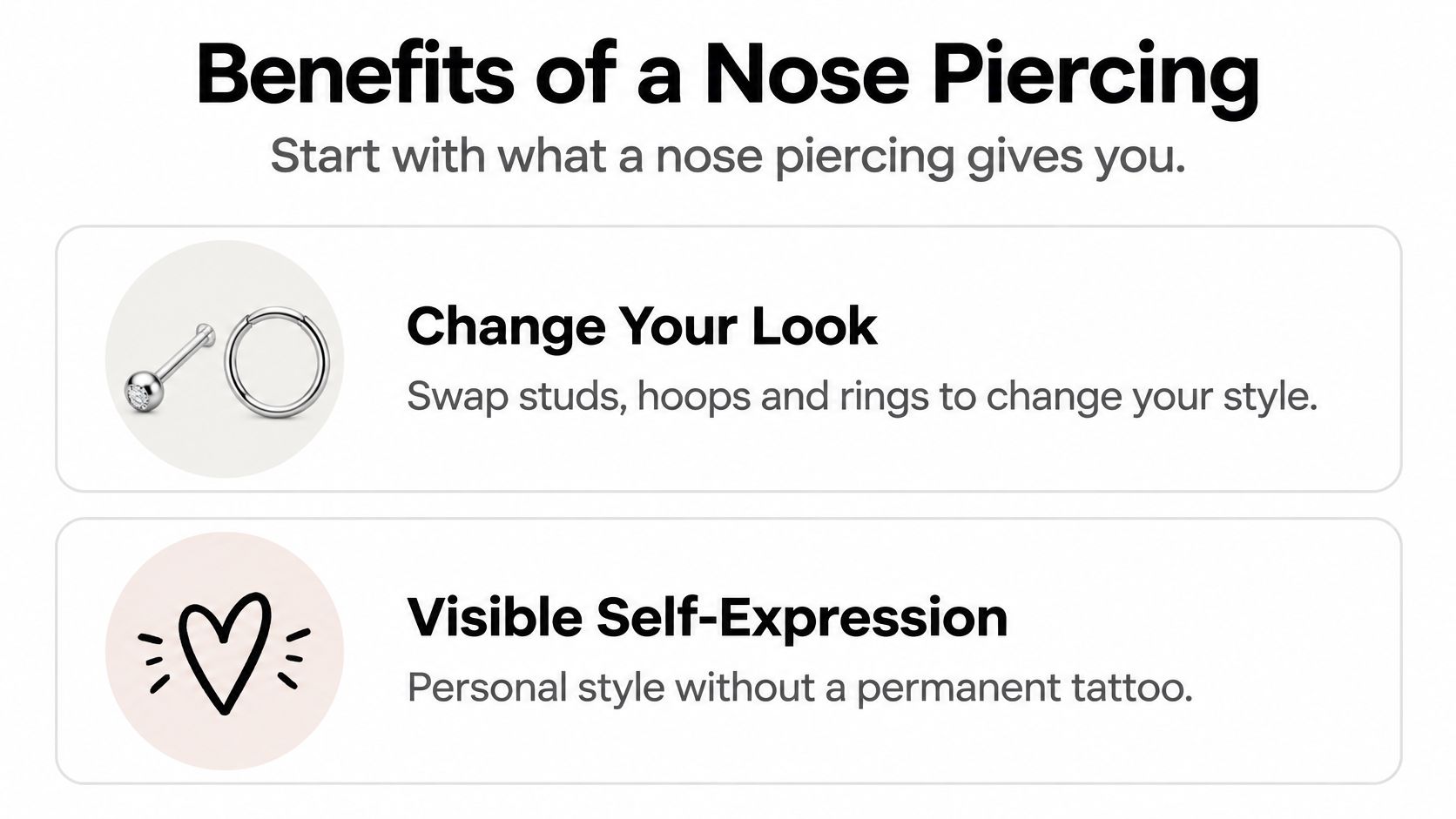
A nose piercing gives you a way to change your look through jewelry rather than committing to a tattoo. Once it's healed and your piercer confirms suitable options, studs, hoops, and rings let you explore different styles within the limits of your placement and anatomy.
It can also offer a tangible connection to heritage or community. But a flexible accessory isn't the same thing as a commitment-free piercing.
These are the appealing parts of the decision, with jewelry changes reserved for an appropriately healed piercing.
Visibility comes with an audience
You may love that your jewelry is noticeable. You may feel differently when a relative makes it the subject of dinner or a colleague asks whether it meets the dress policy.
An older survey of faculty physicians published in the Journal of General Internal Medicine found that 7% considered nose piercings appropriate, while 58% said they would be bothered working with a physician or student who had one. These are dated, profession-specific attitudes, not a current global acceptance rate.
The useful takeaway isn't that workplaces reject piercings. It's that your intention and an observer's judgment can differ, especially in environments with established appearance expectations. Check the actual policy rather than relying on a friend's experience in another profession.
Test the choice against your real week
Healing also limits spontaneity. You'll need to leave suitable jewelry in place, maintain aftercare, and postpone swimming rather than treating the piercing like an earring you can remove whenever convenient.
Make a short list of the settings that matter:
- Work or school: Read the written jewelry policy and ask about anything unclear.
- Family gatherings: Decide whether you want to explain your choice, set a boundary, or acknowledge differing opinions.
- Sports and travel: Check whether equipment, required jewelry removal, or water activities conflict with healing.
- Your own comfort: Consider whether you enjoy visible accessories or would find repeated comments exhausting.
Reality check: Don't book a visible piercing on the assumption that you can remove it every time a setting feels awkward.
You don't need universal approval. You do need a workable plan for the situations you can already predict.
Choosing a Placement by Healing Time and Visibility
Nose piercing placements, healing times and visibility
| Placement | Typical Healing Time | Visibility | Best For |
|---|---|---|---|
| Standard nostril | 2 to 4 months | Low to moderate | Everyday subtle style |
| Septum | 1.5 to 2 months | Moderate, can be hidden by flipping up suitable jewelry | Statement looks and personal expression |
| Bridge | 2 to 2.5 months | High, always visible | Bold, face-framing style |
These approximate healing ranges come from WebMD's nose-piercing safety guidance: 2 to 4 months for a standard nose piercing, 1.5 to 2 months for a septum, and 2 to 2.5 months for a bridge. Treat them as planning estimates, not automatic clearance to change jewelry.
A nostril piercing suits someone who wants a small everyday accent with room to explore other jewelry after healing. A septum piercing suits a centered look, with concealment possible for some anatomy and jewelry combinations. A bridge piercing suits someone who specifically wants a prominent, face-framing placement.
Choose for healing, not just the finished photo
Ask your piercer which placements your anatomy supports and which initial jewelry will fit safely. The ring in your inspiration photo may be a future styling option rather than appropriate starter jewelry.
Keep the original jewelry in place unless your piercer or clinician directs a necessary change. Don't twist it, play with it, or repeatedly check whether it moves freely, because extra handling can irritate healing tissue and delay recovery.
For a septum, discuss concealment before the appointment. If your piercer approves healing it tucked up, agree on that position rather than flipping it back and forth throughout the day.
Match the placement to your calendar
A beach trip, swimming routine, or activity requiring jewelry removal may make this the wrong time to get pierced. Avoid swimming pools, lakes, rivers, and hot tubs until healing is complete, and wash your hands before any necessary contact.
Use gentle cleaning with saline or the soap-and-water approach recommended by your professional. More handling and more aggressive cleaning don't make the process faster.
The guide to healing times for popular piercings can help you think about the broader commitment. Your individual piercing still needs an assessment, particularly if tenderness, swelling, or irritation persists.
Choose the placement whose look and recovery routine both fit your life. A great style match shouldn't require an impossible aftercare schedule.
Normal Healing Reactions and When to See a Doctor
Nose piercing symptoms, likely causes and what to do
| Symptom | Likely Cause | What to Do |
|---|---|---|
| Itching, redness or blistering where the jewelry touches | Contact dermatitis or metal allergy, often nickel | Arrange a professional switch to verified nickel-free jewelry; see a clinician if symptoms persist |
| Painful, warm, spreading redness or thick yellow pus | Infection | Get a medical assessment promptly |
| Firm bump or raised scar that stays after healing | Possible hypertrophic scar, keloid or granuloma | Ask a clinician to identify it; a piercer can also assess jewelry fit |
| Fever, severe pain, embedded jewelry or heavy bleeding | Serious infection or complication | Seek urgent medical care |
| Swelling or pain inside the nose with bleeding | Possible cartilage injury or hematoma | Seek urgent medical care |
Use this as a triage guide, not a diagnosis. Similar-looking symptoms can have different causes, and a photograph alone may not reveal what's happening beneath the skin.
A nose piercing creates a wound exposed to skin bacteria and nasal mucosa. Cleveland Clinic's guidance on infected nose piercings estimates that up to 20% of people may have a nickel allergy and distinguishes itchy, red, swollen, or blistering allergic reactions from concerning infection symptoms such as painful warmth, increasing redness, and thick yellow pus.
Red doesn't automatically mean infected
Mild early swelling, tenderness, or slight bleeding can occur after piercing. What matters is the pattern: symptoms that settle are different from symptoms that intensify, spread, or return repeatedly.
Allergy and infection get confused because both can cause redness and swelling. Itching concentrated where metal touches may suggest contact dermatitis, while worsening heat and pain raise more concern for infection, but neither pattern gives you a reliable home diagnosis.
A dermatology review of body-piercing complications also describes scarring, keloids, granulomas, cysts, and other reactions. Many immediate complications are minor, but a persistent bump shouldn't automatically be labeled a keloid or treated as an infection.
Take the right next step
- Check the material: Ask for the jewelry's documented composition rather than relying only on a label such as sensitive-skin friendly.
- Check the fit: Have a professional assess pressure, snagging, and whether jewelry is becoming embedded.
- Escalate worsening symptoms: Spreading redness, increasing pain, fever, or substantial bleeding needs clinical attention.
Don't assume changing jewelry will solve every reaction. If infection is possible, don't remove the jewelry without clinical advice, because closure can complicate drainage and treatment.
Persistent or worsening symptoms deserve an assessment, not another round of guessing or a stronger home remedy.
Confirm Your Reason Before You Book
Technique matters as much as taste. The American Academy of Family Physicians explains that a septum piercing generally passes through the inferior fleshy portion rather than cartilage. Accidental cartilage injury can cause significant bleeding and a septal hematoma, sometimes with infection. Nasal jewelry can also potentially be swallowed or aspirated.
Choose a trained professional who understands nasal anatomy and uses sterile technique. A do-it-yourself shortcut can put both placement and safety at risk.
A subtle look still sends a signal. Consider how visible jewelry may be read by family, colleagues, or others in your community, then choose a style that fits your reason and comfort.

- Reread your reason. Make sure the choice feels like yours, not a response to pressure.
- Check your calendar. Leave room for the placement's full healing period and possible delays.
- Confirm the material. Ask your piercer about the jewelry's composition, especially if you have sensitive skin.
- Book a consultation. Discuss your anatomy, initial jewelry fit, sterile equipment, and sterilization practices.
- Plan the aftercare. Follow directions for keeping initial jewelry in place and arrange activities around healing.
Your reason does not need to impress anyone. It should help you choose jewelry you feel comfortable wearing and caring for.
Ready to find jewelry that matches your reason? Visit BodyCandy to browse nose rings by style, and check each item's material and sizing with your piercer before you choose.