














Have you fallen for a dramatic nath online, then wondered whether Indian-style nose jewelry is only for a wedding, only for a pierced nose, or somehow both at once? You're not alone. The style carries history, regional vocabulary, and practical choices that a basic nose-piercing guide usually skips.
This guide separates heritage wear, bridal jewelry, and everyday fashion so you can choose with confidence. You'll learn what a nath means, how regional styles differ, which format suits your commitment level, how to choose a size for your piercing and face shape, and how to keep the jewelry comfortable.
Why Indian Style Nose Rings Never Go Out of Style
You spot a grand nath in a wedding photo. It curves around the nostril, catches the light, and connects toward the ear with a delicate chain. It looks polished, ceremonial, and slightly intimidating, especially if your current jewelry experience begins and ends with a tiny nostril stud.
That reaction makes sense. Indian-style nose rings aren't one single product category. A small gem worn every day, a curved Maharashtrian nath, and a large bridal hoop may all appear under the same shopping label, even though they carry different visual weight, cultural associations, and comfort requirements.
The vocabulary helps:
- Nath: A traditional nose ring, often a larger hoop with decorative elements and sometimes a chain attached to the ear or hair.
- Mookuthi: A southern Indian nose ornament, commonly associated with a smaller stud or more compact design.
- Nostril hoop: A simpler circular ring designed for everyday wear.
- Clip-on or magnetic nose ring: A temporary option for trying the look without a nostril piercing.
Your first choice doesn't need to be the most elaborate one. If you're testing the aesthetic, a small stud or lightweight hoop lets you see how the style works with your glasses, makeup, hairstyle, and daily routine. If you're dressing for a ceremony, a chain-linked nath creates a much more distinctive silhouette.
A practical starting point: Choose the occasion first, then the jewelry. Bridal pieces, daily pieces, and temporary fashion pieces solve different problems.
The fun part is that you can move between those categories. You might wear a subtle gold-toned stud on Tuesday, a classic hoop for a night out, and a statement nath for a formal celebration. The style stays recognizable while your level of drama changes.
The Story Behind the Nath and Its Cultural Roots
The story of the nath doesn't begin with a trend cycle. Historical summaries connect Indian-style nose rings with possible Ayurvedic references dating between the 1st and 8th century BCE, while other accounts place the tradition's spread into India during the 16th-century Mughal era. Those timelines aren't identical, so the safest conclusion is that nose adornment has an ancient and layered history, with the bridal form developing over centuries. Natural Diamonds' overview of Indian nose piercing history describes both strands of that story.
One of the most repeated historical associations comes from the Sushruta Samhita, an early medical text. Historical accounts connect a left-nostril piercing with beliefs about relief from menstrual pain and easier childbirth. Whether you approach those ideas as traditional health beliefs rather than modern medical guidance, they show that the ornament wasn't viewed as decoration alone. It could sit inside beliefs about women's bodies, health, marriage, and life stages.
From ritual object to recognizable bridal style
The Mughal period is often credited with influencing the spread and popularization of ornate nose rings in India. Over time, local communities adapted the form, adding their own shapes, chains, stones, and wearing customs. That's why the nath you see today can look radically different from one region to another while still belonging to the same broad family.
The piece became associated with Hindu and Muslim bridal ensembles, and in some southern traditions, nose jewelry also appeared as a coming-of-age marker. These meanings don't apply identically to every person or region, but they explain why a large nath can feel more significant than a decorative hoop.
For a visual introduction to the broader history of nose piercing in India, you can explore this BodyCandy feature on nose piercing traditions around the world.
Today, people wear Indian-inspired nose jewelry for many reasons. Some are honoring family or regional traditions. Some are choosing bridal jewelry. Others love the shape. Understanding the history gives the accessory more context without telling you that every modern wearer has to use it in exactly one way.
Regional Styles Across India
Ask for “an Indian nose ring” and you might receive a very different piece depending on the region, family tradition, or seller. Indian style is a design family, not a single silhouette. The ornament's regional variations are part of what makes shopping for one so interesting.
Maharashtra is known for the Brahmani nath, a curved design that often has a distinctive profile and detailed ornamentation. Its shape can look compact from the front while still feeling richly decorated. If you want a nath that reads as traditional without necessarily reaching across the entire cheek, this is a useful style name to know.
Rajasthan is associated with oversized, chain-linked nose rings. The chain may sweep toward the hair or ear, creating a connected composition rather than a standalone ring. This is the dramatic bridal look many people recognize from formal portraits, celebrations, and social media styling.
Kashmiri bridal ornaments have their own identity, with proportions and decorative details that differ from both Maharashtrian and Rajasthani examples. The variation matters because “traditional” doesn't mean one universal design. It can refer to a local shape, a family custom, or a ceremony-specific piece.
A vocabulary guide for shopping
Use the regional name or design description when you want a more precise search:
- Brahmani nath: Curved, ornate, and strongly associated with Maharashtrian styling.
- Rajasthani-inspired nath: Oversized, often chain-linked, and visually dramatic.
- Kashmiri bridal nose jewelry: A distinct regional family of ceremonial ornaments.
- Mookuthi: A southern style often interpreted as a more compact nose ornament.
- Chain-linked nath: A hoop connected to the ear or hair, usually chosen for formal styling.
Published cultural accounts describe nose adornment traditions across the Middle East and South Asia as roughly 4,000 years old, with the Indian subcontinent adapting those traditions through cultural exchange and Mughal influence between the 13th and 16th centuries. The Asia Media Centre's discussion of the mookuthi and its cultural journey gives useful context for that broad timeline.
The result is a style with several layers. A nose ring can communicate regional identity, bridal status, family tradition, personal taste, or none of those things. When you know the vocabulary, you can shop for the exact mood you want instead of relying on a vague label.
Types of Indian Style Nose Rings Explained
Start by looking at the construction, not just the decoration. A nose ring's stones and color catch your eye first, but the way it anchors and distributes weight determines whether it works as daily jewelry or belongs at a special event.
The grand nath
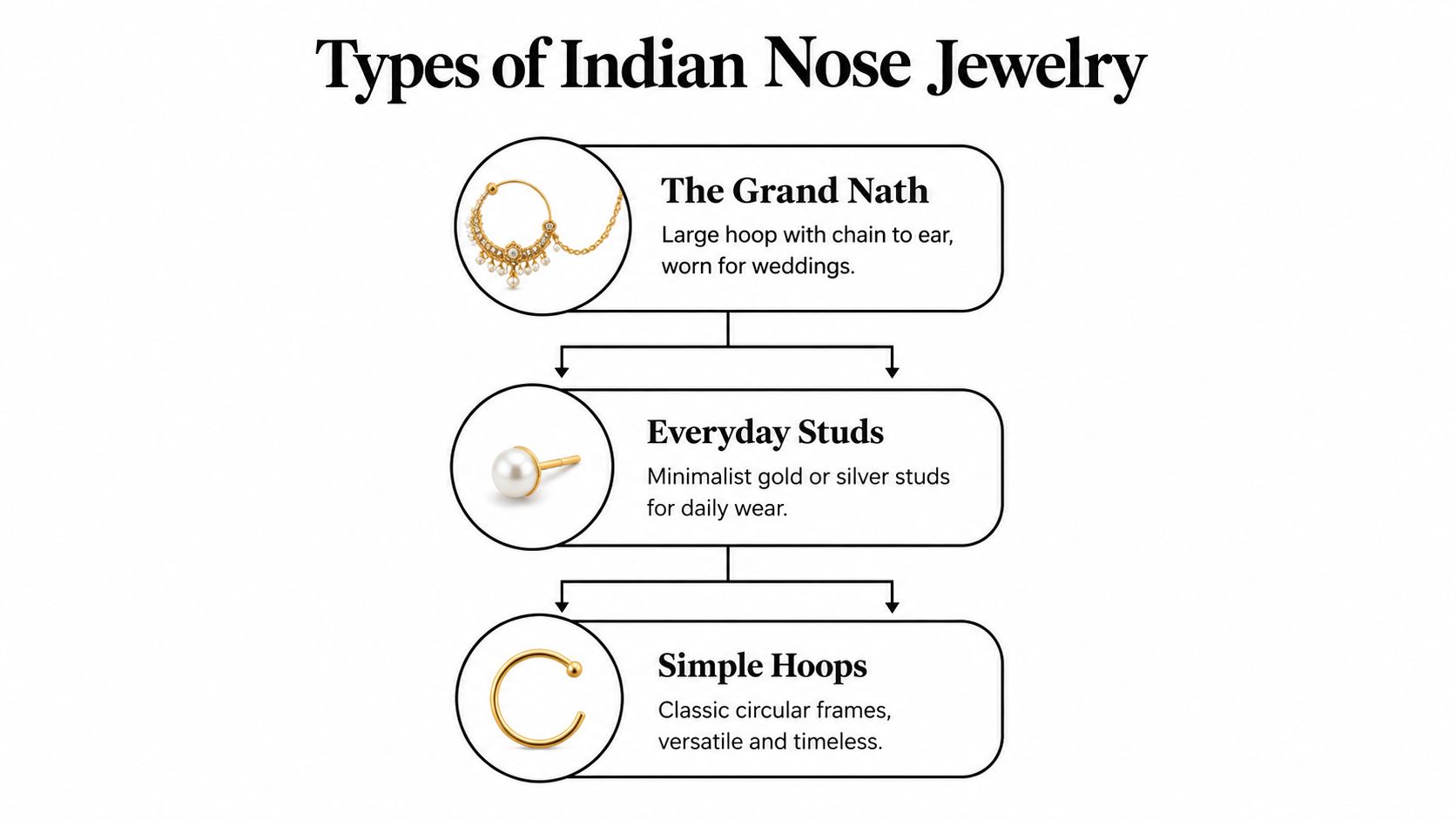
A grand nath is usually a large hoop with decorative beads, pendants, stones, or a chain leading toward the ear or hair. It creates a strong focal point and is most naturally suited to bridal, ceremonial, or formal styling.
Traditional naths can be engineered as weighted, articulated ornaments rather than simple fixed hoops. A museum-documented example at the Victoria and Albert Museum weighs 45 g and uses gold wirework, beaten sheet gold, granulation, and glass stones. The technical discussion of a 45 g traditional nath shows why authentic ceremonial jewelry prioritizes structure and load distribution.
A heavier piece needs a stable nostril anchor. Its larger loop geometry helps spread pressure instead of concentrating it at one tight point, which is why a substantial nath shouldn't be treated like a tiny everyday hoop.
Everyday studs
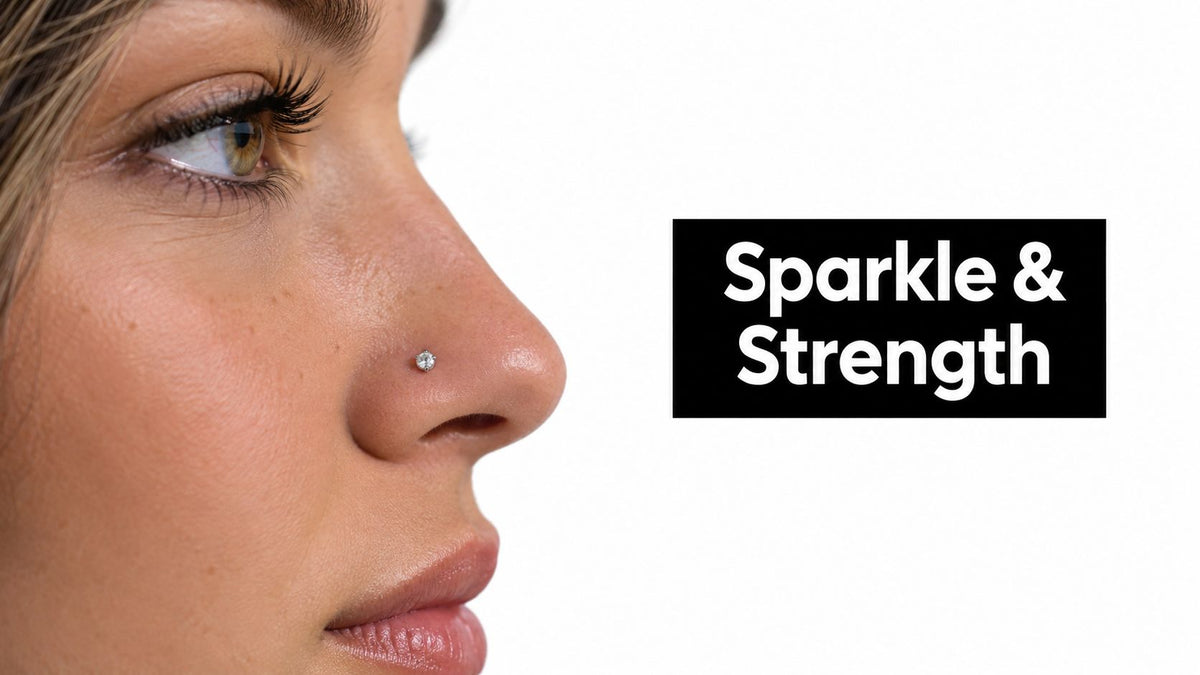
A stud is the easiest place to begin. It sits close to the nostril and usually features a small bead, gem, pearl-like accent, or decorative top. Studs work well with casual clothing, office outfits, and layered facial jewelry because they add detail without dominating your face.
A stud also makes sense if you love the cultural reference but want a quieter interpretation. It can suggest the look without reproducing the full bridal scale.
Simple hoops
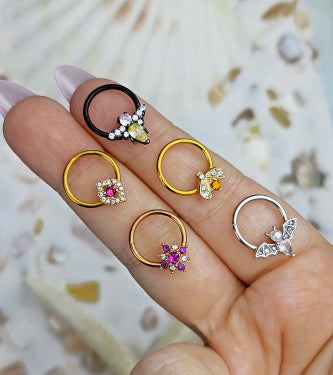
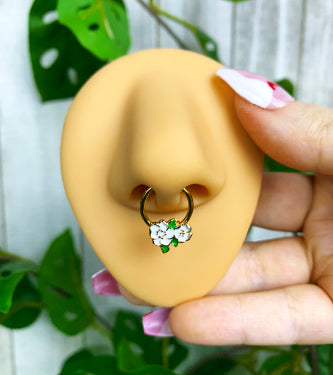
A simple hoop is a circular or C-shaped ring with fewer moving parts. It's versatile, easy to style, and often the closest match for someone who wants an Indian-inspired shape with a more contemporary feel.
Look for a hoop with enough inner diameter to sit comfortably without pressing into the nostril. A ring that appears delicate in a product photo can feel tight once it's on your actual piercing.
Chain-linked and connected pieces
Some designs connect the nostril ring to the ear or hair. The chain creates a graceful line across the side of the face and immediately raises the formality of the look. It also adds another point to secure, so check that the chain isn't pulling the nose ring sideways.
For a closer look at the parts that make up a nose ring, BodyCandy's anatomy guide to nose jewelry can help you identify the post, hoop, backing, and decorative elements before you buy.
Jewelry check: If a piece is heavy, articulated, or attached to a chain, treat it as occasion jewelry unless a professional piercer confirms your piercing can support it comfortably.
Cultural Meaning vs Modern Fashion
The respectful answer to “Can I wear an Indian-style nose ring if it isn't part of my heritage?” depends on which style you're wearing and how you're presenting it. A small contemporary hoop is not communicating the same thing as a traditional bridal nath worn in a ceremonial setting.
It helps to separate three contexts.
Heritage and religious wear
In some families and regions, nose jewelry connects with community identity, religious customs, health beliefs, or life-stage rituals. The meaning can vary by region, generation, and family. Don't assume that a practice associated with one community applies to every Indian wearer.
If you're attending a cultural or religious event, ask someone connected to that tradition about appropriate styling rather than treating a dramatic ornament as a costume accessory. A little context goes a long way.
Bridal wear
A chain-linked nath can signal celebration, marriage, or bridal presentation. Its scale, materials, and placement may carry meaning beyond its appearance. Wearing a bridal-style piece to a wedding as a guest isn't automatically wrong, but copying a specific ceremonial look without understanding its role can feel careless.
Choose a design because you appreciate its craftsmanship and history, and avoid presenting yourself as part of a tradition you don't belong to. That distinction is simple, honest, and useful.
Everyday fashion
Modern wear is more flexible. Nose rings are increasingly treated as mainstream, unisex, and minimalist accessories, with lighter hoops, studs, clip-ons, and designs that work with Western wardrobes. A small ring inspired by Indian forms can be styled with jeans, a blazer, a kurta, or eveningwear without claiming ceremonial meaning.
The thoughtful approach is to learn where the design comes from, name it accurately when discussing it, and avoid flattening every Indian nose ring into “exotic” decoration. Appreciation becomes much easier when you recognize the people, places, and traditions behind the object.
How to Choose the Right Nose Ring for Your Face and Piercing
Your first decision is commitment. If you already have a healed nostril piercing, choose jewelry designed for that channel. If you're curious but not ready for a needle, consider a clip-on, magnetic, or stick-on version. These temporary formats let you test placement, scale, and styling before making a permanent choice.
They don't behave identically. A clip-on grips the nostril from the outside and may feel more secure than a stick-on, while a magnetic piece depends on the strength and placement of its magnets. Temporary jewelry is useful for photographs or occasional events, but it can shift with movement, makeup, or facial contact.
Get the measurements right
Everyday nostril jewelry commonly falls between 20 gauge, or 0.81 mm, and 22 gauge, or 0.64 mm. Some piercing guides describe 18 gauge as a preferred option because the slightly thicker channel can heal more stably. A nostril-piercing sizing guide from Modsbody covers those gauge choices and notes that hoops are commonly about 8 mm across the inside.
Hoop inner diameter often works best around 6 mm to 8 mm, with 8 mm described as the most universal fit in everyday sizing guidance. This Indian nose ring sizing reference explains the basic tradeoff. A smaller ring can pinch the piercing channel, while a slightly larger ring gives more room for movement and reduces pressure for many nose shapes.
Match the shape to your styling goal
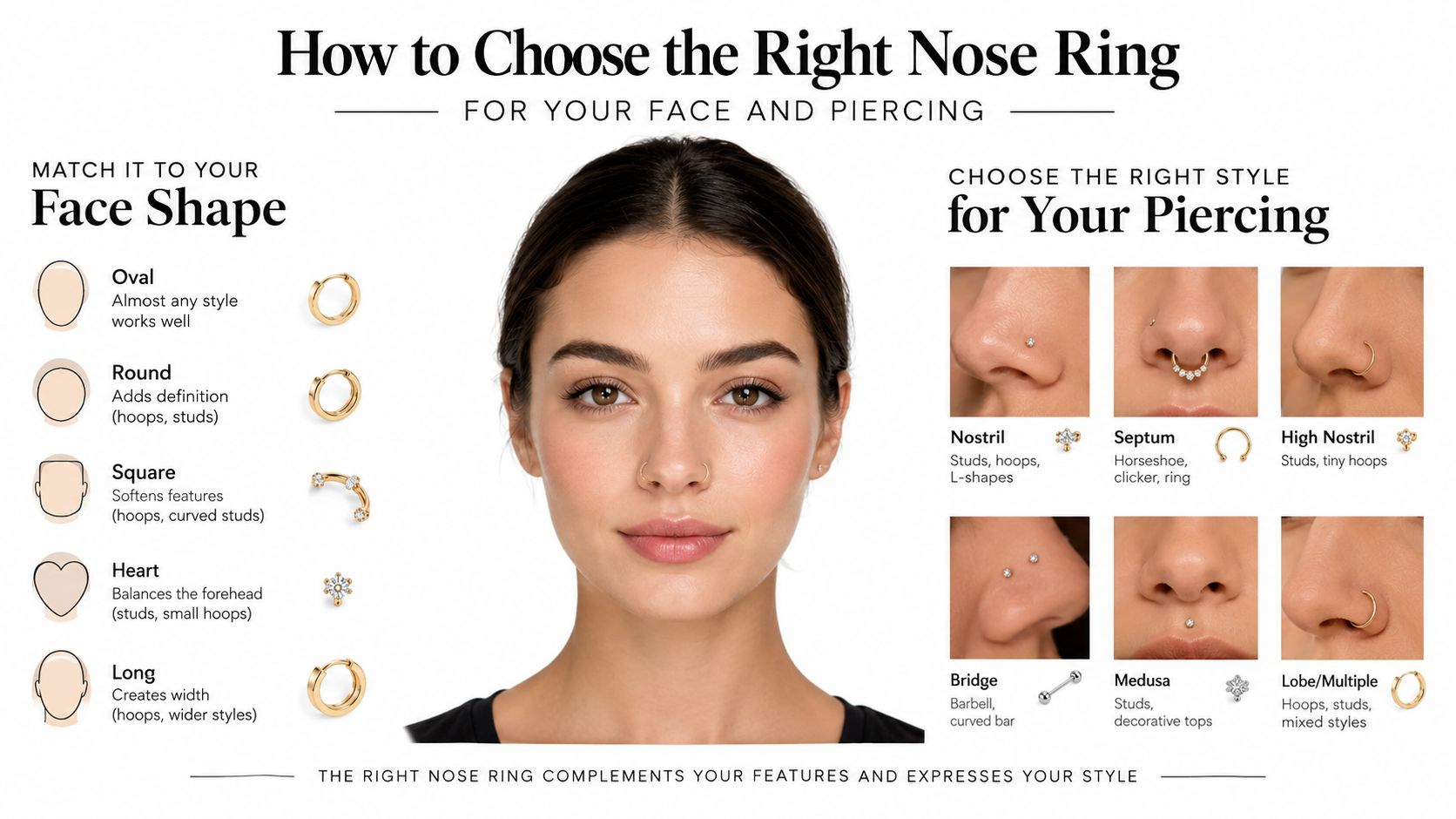
Face-shape advice should guide you, not box you in. A small stud keeps the center of attention close to the nostril. A larger hoop creates a visible curve, while a chain-linked nath draws the eye outward toward the ear or hair.
| Format | Best For | Commitment Level | Styling Note |
|---|---|---|---|
| Pierced stud | Daily wear and subtle detail | Permanent piercing required | Choose a small gem or pearl-like accent for a quiet finish |
| Pierced hoop | Regular wear and modern Indian-inspired styling | Permanent piercing required | An 8 mm inner diameter is a common starting point |
| Grand nath | Weddings, ceremonies, and statement looks | Permanent piercing plus secure anchoring | Check weight, chain tension, and nostril stability |
| Clip-on | Occasional events and testing the look | No piercing | Good for trying scale before committing |
| Magnetic | Temporary fashion styling | No piercing | Check that it stays centered and comfortable |
| Stick-on | Photos and brief wear | No piercing | Best for short sessions rather than active movement |
If your features are delicate, begin with a smaller stud or fine hoop. If you want the jewelry to hold its own against bold makeup, textured hair, or formal clothing, a larger hoop or connected nath can create better visual balance.
Caring for Your Nose Piercing and Jewelry
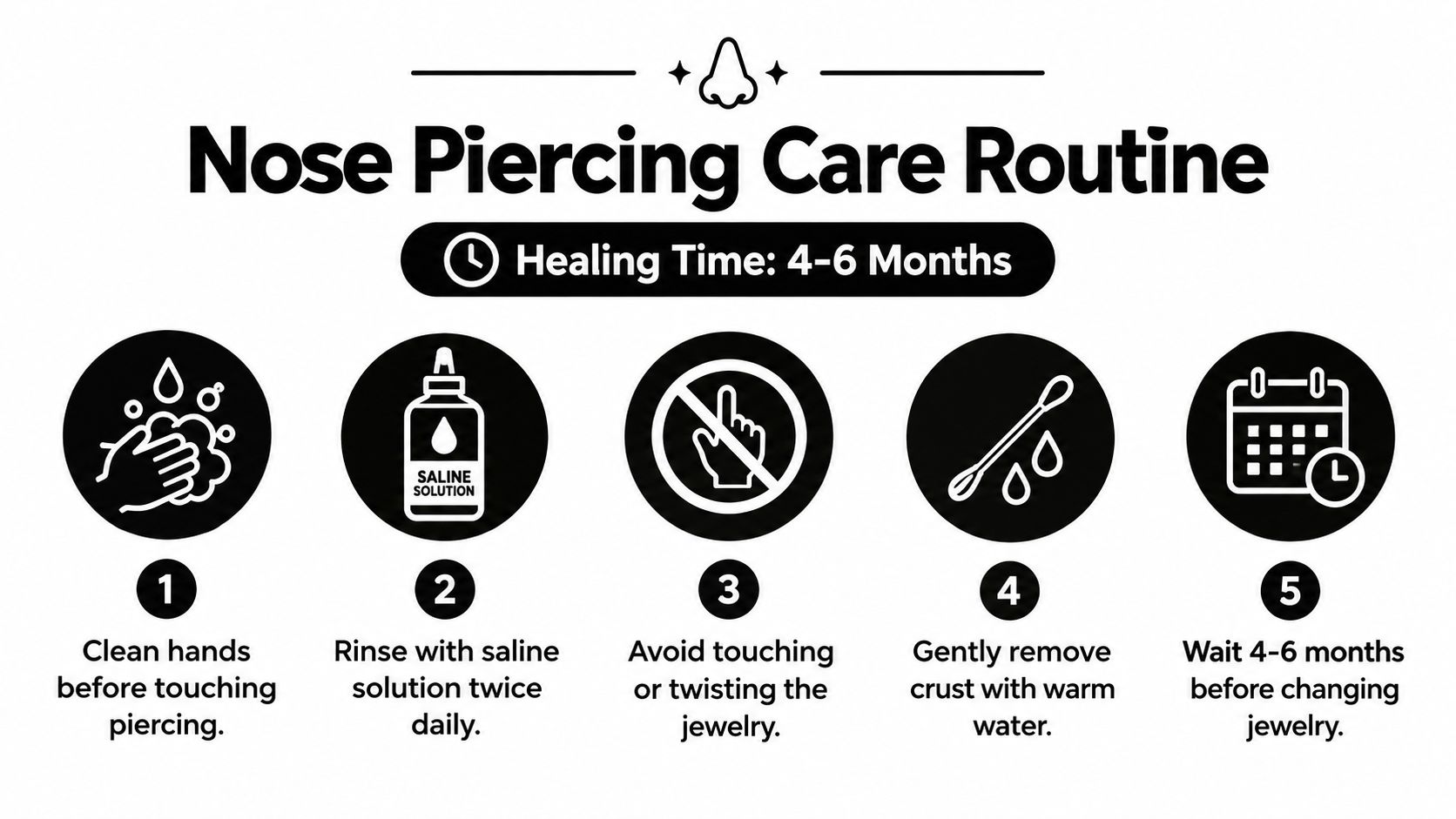
A new nose ring needs patience more than enthusiasm. Nostril piercings generally take about 4 to 6 months to heal, although some medical and jewelry guides give shorter ranges of 2 to 4 months or 2 to 3 months, depending on the jewelry and aftercare. Healthline's guide to nose-piercing healing time explains why healing estimates vary.
Changing jewelry too early can prolong irritation or allow the channel to close, especially when you switch to a thin ring. Wait until the piercing feels settled, then ask a qualified piercer to assess it if you're unsure.
Keep the routine simple
- Wash your hands: Clean them before touching the jewelry or piercing.
- Use saline: Rinse with a sterile saline solution as part of your regular care routine.
- Leave the jewelry alone: Don't twist, spin, or remove it to check the healing.
- Soften crust gently: Warm water can loosen buildup. Don't pick at it.
- Watch for problems: Increasing pain, heat, swelling, unusual discharge, or worsening redness deserves advice from a professional piercer or healthcare provider.
The BodyCandy aftercare guide featuring H2Ocean offers a product-focused reference for keeping a piercing clean while it heals.
Give weighted naths extra attention. Store them in a clean, dry place, check that chains and joints aren't catching on fabric, and clean decorative stones according to the material's care needs. Don't sleep in a heavy ceremonial piece unless a piercer has confirmed that your piercing and jewelry setup can handle it comfortably.
Ready to try the look? Browse BodyCandy for nose rings, studs, and hoops that let you explore Indian-inspired styling at your own pace. Pick a temporary piece for experimentation, choose a simple hoop for everyday wear, or drop your aftercare questions in the comments before you make the switch.