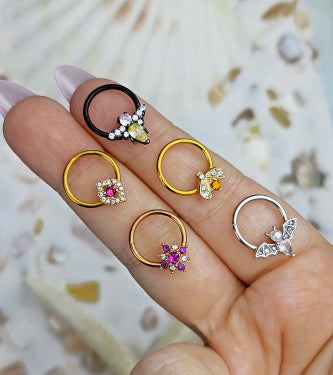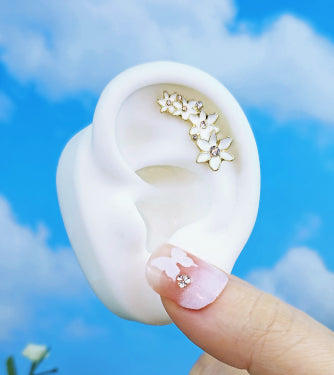











Thinking about adding some new bling to your ear but feeling totally lost in a sea of confusing terms like 'daith,' 'rook,' and 'snug'? You're not alone! The world of ear piercings is huge and exciting, but figuring out where to start can feel overwhelming, especially when you're trying to describe that exact look you want to your piercer.
Whether you're planning your very first piercing or designing a complex and stunning 'curated ear' masterpiece, understanding all ear piercing names is your first step. Getting the lingo right ensures you get the exact placement you're dreaming of and helps you find the perfect jewelry to show off your unique style.
This guide is your new best friend for navigating every option out there. We're about to break down all the different ear piercings, from the classic lobe and helix to the bold industrial and intricate conch. Forget endless searching and confusing diagrams!
For every piercing name on our list, we'll cover the crucial details:
- Placement: A clear description of exactly where it goes on your ear.
- Pain Level: An honest rating of what to expect (on a 1-10 scale).
- Healing Time: The typical timeline for a happy, healthy piercing.
- Jewelry: The best styles, like flat back labrets or cute hoops, that you can rock once you're healed.
Let's dive in and find the perfect piercing to kickstart your new vibe!
1. Lobe Piercing
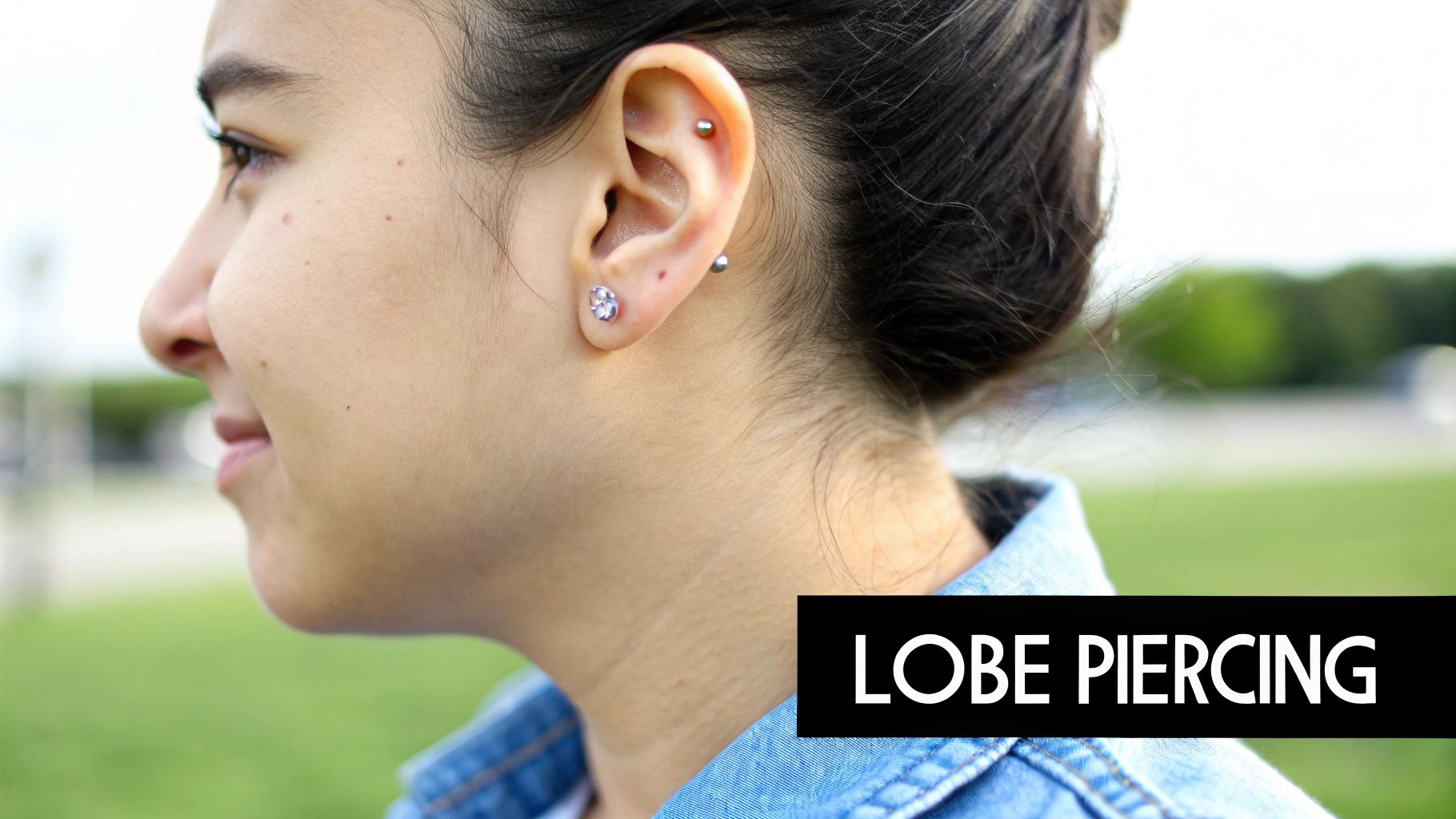
The lobe piercing is the quintessential starting point for pretty much everyone venturing into the world of ear curation. Located on the soft, fleshy lower part of your ear, it's the most common piercing for a reason. Its placement on the earlobe means it's one of the least painful and fastest-healing options available, making it the perfect choice for your first piercing experience.
If you're looking for a list of all ear piercing names, the standard lobe is the perfect foundation to build on. It serves as the anchor for tons of styling combos, from a classic single stud to an elegant "stacked" or "constellation" look with multiple lobe piercings.
Key Facts & Aftercare Tips
- Pain Level: 1-2/10. Most people describe it as a quick, sharp pinch that's over in a flash.
- Healing Time: 6-8 weeks. This is one of the fastest healing times, but it's super important to follow aftercare instructions.
- Best Jewelry: Studs, hoops, and dangles. You'll start with a simple stud, but after you heal, the possibilities are endless!
- Aftercare: Clean the piercing twice daily with a sterile saline solution. Avoid twisting or turning the jewelry—that's old-school advice that can actually irritate it. Wait the full 6-8 weeks before you try to change your jewelry for the first time.
Because the lobe is so versatile, you can create a unique look that's all your own. From minimalist studs for work to bold, dangling hoops for a night out, the lobe piercing adapts to any style. Understanding the basics of ear anatomy and piercing names will help you plan your future ear projects perfectly.
2. Helix Piercing
Moving up from the lobe, the helix piercing is your stylish step into the world of cartilage. Located on the upper, outer rim of your ear, this spot is one of the most popular and versatile cartilage piercings you can get. Its prime position along the ear's curve makes it a fantastic canvas for self-expression, whether you want a single minimalist hoop or a cool row of studs.
The helix is a must-have on any list of all ear piercing names because it offers incredible flexibility. It can be a standalone statement piece or the start of a curated "constellation" ear. Whether you're aiming for a subtle glimmer or a bold arrangement, the helix piercing is a perfect foundation for more complex ear designs.
Key Facts & Aftercare Tips
- Pain Level: 4-6/10. Since it's cartilage, you'll feel more pressure and a longer-lasting ache than a lobe piercing, but the initial sharpness is quick.
- Healing Time: 6-12 months. Cartilage has less blood flow, so healing takes way longer and needs consistent care. Don't rush it!
- Best Jewelry: Studs with flat backs are perfect for initial healing. Once healed, small hoops, barbells, and captive bead rings look amazing.
- Aftercare: Clean the area twice daily with a sterile saline spray. Definitely avoid sleeping on the piercing to prevent irritation. Be careful not to snag it on your hair or clothes, and never twist the jewelry.
The helix piercing is your gateway to a more decorated and personalized ear. Once fully healed, you can explore an endless variety of cartilage earring styles to match your vibe, from elegant gold hoops to sparkling gemstone studs.
3. Forward Helix Piercing
A super stylish and modern take on the classic helix, the forward helix piercing is located on the small, forward-facing rim of cartilage where the top of your ear meets your head. Its unique placement gives you a subtle yet edgy look that perfectly complements other piercings. This spot is perfect for showing off tiny, delicate studs and gems.
If you're building a list of all ear piercing names to consider for your next look, the forward helix is an amazing choice for adding some personality. It draws attention to the front of your ear and can be done as a single, double, or even triple piercing for a dramatic "ladder" effect.
Key Facts & Aftercare Tips
- Pain Level: 5-7/10. As a cartilage piercing, it involves a noticeable, sharp pressure that can be more intense than a lobe piercing.
- Healing Time: 4-12 months. Cartilage takes a long time to heal fully, so patience is key.
- Best Jewelry: Small studs, labrets, or tiny captive bead rings. Your initial jewelry will be a small, flat-back stud to minimize irritation.
- Aftercare: Clean the area twice daily with a sterile saline spray. Avoid sleeping on it, and be careful with hair, headphones, and glasses to prevent snagging. Don't touch or rotate the jewelry!
The forward helix is a fantastic way to level up your ear aesthetic. After it's fully healed, you can explore Bodycandy’s huge range of tiny forward helix studs to find the perfect piece that expresses your unique style.
4. Tragus Piercing
The tragus piercing is a bold and distinctive choice that's become super popular in modern ear styling. It's located on that small, pointed piece of cartilage that sits right in front of your ear canal. This unique placement creates a striking focal point, offering a subtle yet edgy vibe, especially when your hair is pulled back.
As one of the most sought-after cartilage piercings in our list of all ear piercing names, the tragus works beautifully with lobe, helix, and conch piercings. It helps create a balanced and cool composition for your ear. Whether you opt for a tiny stud or a delicate hoop, the tragus piercing is a surefire way to add a touch of personality to your look.
Key Facts & Aftercare Tips
- Pain Level: 4-6/10. Since this is cartilage, expect a firm pressure and a sharp pinch. The pain is brief but more intense than a lobe piercing.
- Healing Time: 6-12 months. Cartilage heals slow, so full healing requires patience and consistent care.
- Best Jewelry: Flat back labret studs or small hoops. A stud is highly recommended for the initial healing period. After healing, a snug hoop can look amazing.
- Aftercare: Clean twice daily with a sterile saline solution. Avoid using earbuds that put pressure on the area during the initial healing months. Don't twist or play with the jewelry, as this can lead to irritation bumps.
The tragus is an awesome way to elevate your ear game. Make sure you see an experienced piercer who knows cartilage anatomy for the best placement. Once healed, you can explore BodyCandy's huge collection of compact and stylish tragus jewelry to find the perfect piece for your vibe.
5. Anti-Tragus Piercing
Looking for something unique? The anti-tragus piercing is a bold statement. It's located on the small, raised ridge of cartilage directly opposite your tragus and just above the earlobe. This placement is a striking counterpoint, and since it’s a less common choice, it's perfect if you want a piercing that stands out.
When you're mapping out all ear piercing names for your dream setup, the anti-tragus is a fantastic anchor for designs that play with symmetry. It pairs beautifully with a tragus or conch piercing, creating an artistic and balanced look. It’s a piercing that definitely draws attention and adds an intricate detail to your overall style.
Key Facts & Aftercare Tips
- Pain Level: 5-6/10. This piercing goes through a thicker piece of cartilage, so you can expect a sharp, noticeable pressure during the procedure.
- Healing Time: 9-12 months. Patience and consistent aftercare are essential for this placement.
- Best Jewelry: Small curved barbells, captive bead rings, or studs are ideal. It’s crucial to start with smaller, lightweight jewelry to minimize irritation.
- Aftercare: Clean the area twice daily with a sterile saline spray. Avoid sleeping on the piercing and be mindful of headphones or earbuds. Don't touch or twist the earring!
6. Conch Piercing
The conch piercing makes a bold and beautiful statement, right in the large, shell-like part of your inner ear. Named for its resemblance to a conch shell, this area gives you a spacious canvas, making it one of the most versatile and eye-catching placements on our list of all ear piercing names. You have so much creative freedom here, from delicate studs to dramatic hoops.
This piercing is a favorite among those looking to create a curated ear, as seen on celebs like Zendaya and Zoë Kravitz. Whether you opt for an inner conch (in the center bowl) or an outer conch (on the flat upper part), you have a prime spot for showing off standout jewelry. Its central location makes it the perfect focal point.
Key Facts & Aftercare Tips
- Pain Level: 6-7/10. Since this piercing goes through a thick piece of cartilage, expect a significant, sharp pressure. The pain is intense but quick.
- Healing Time: 6-12 months. Cartilage piercings require serious patience. The long healing time is necessary for the tissue to fully recover.
- Best Jewelry: Studs, hoops, and barbells. A flat-back labret stud is typically used for initial healing to minimize snagging. After healing, you can switch to a stunning hoop or a decorative cluster stud.
- Aftercare: Clean twice daily with a sterile saline solution. Be very mindful of hair and headphones. Avoid sleeping directly on the piercing by using a travel pillow—it’s a game-changer!
The conch is perfect for anyone wanting a piercing that stands out yet offers endless styling potential. From minimalist studs to ornate hoops, Bodycandy's collection of conch jewelry has the perfect piece to make your ear curation dreams come true.
7. Daith Piercing
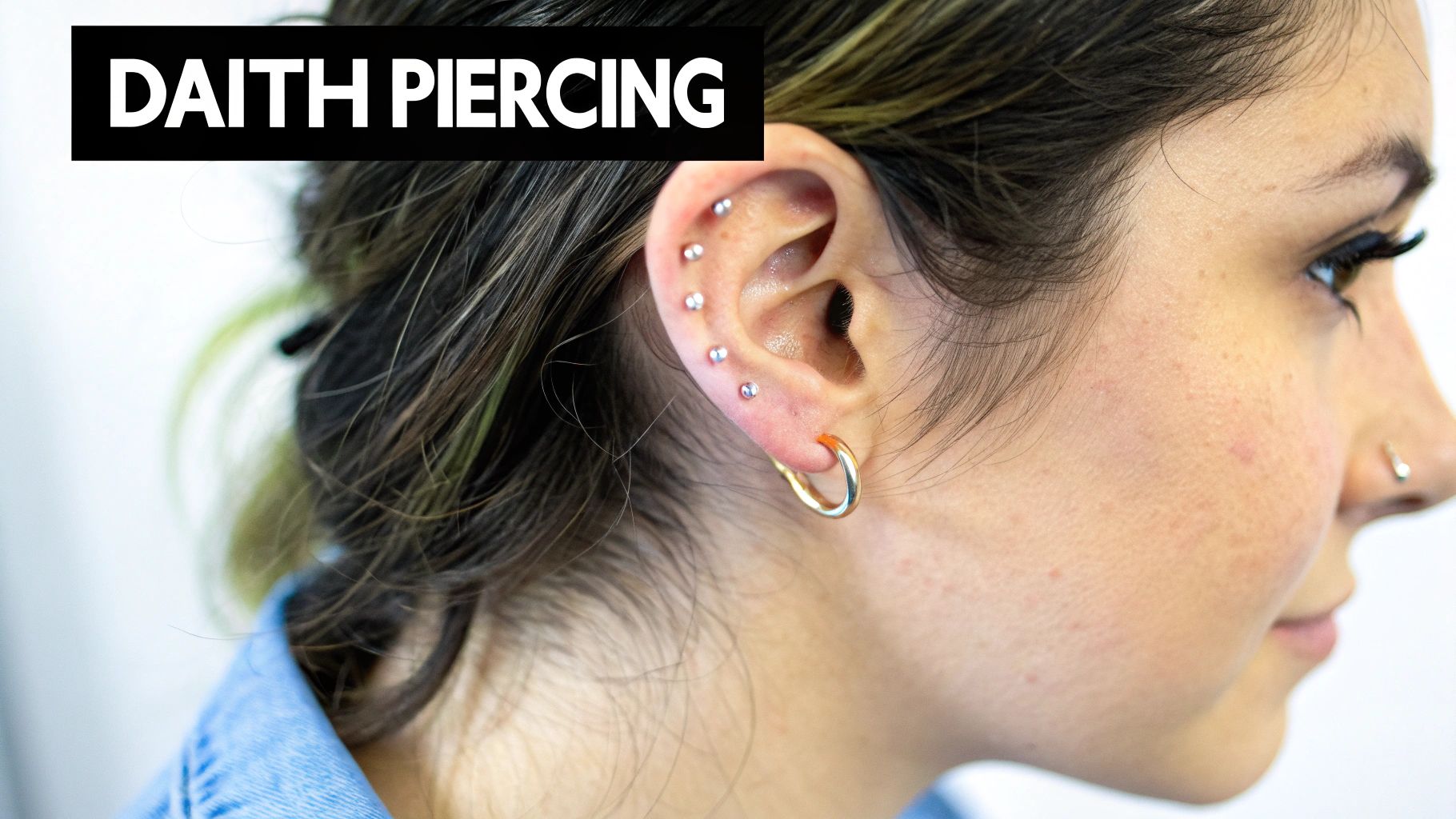
The daith piercing—pronounced "doth" like "goth"—is a distinct and stylish choice nestled in the innermost fold of cartilage right above your ear canal. This unique placement makes it an eye-catching centerpiece for any ear project. Its snug fit is perfect for beautiful, close-fitting jewelry like hoops and curved barbells, adding a touch of sophisticated edge to your look.
While its aesthetic is amazing, the daith has also gotten a lot of buzz for claims of providing migraine relief. This has made it a popular choice for those looking for both fashion and a potential wellness benefit. If you're compiling your personal list of all ear piercing names, the daith is a compelling option that blends beauty with intrigue.
Key Facts & Aftercare Tips
- Pain Level: 6-7/10. The thick cartilage makes this piercing more intense than a lobe, but the sharp pain is very brief.
- Healing Time: 6-12 months. This piercing requires patience and consistent aftercare for proper healing.
- Best Jewelry: Captive bead rings, seamless rings, and curved barbells are ideal. Make sure they are high-quality titanium or solid gold to prevent irritation.
- Aftercare: Clean twice daily with a sterile saline solution. Because of its location, be careful with earbuds and phones. Avoid sleeping on the pierced ear to prevent pressure.
The daith's protected placement can actually make healing easier since it's less likely to be snagged. It's important to know that the link between daith piercings and migraine relief is mostly anecdotal. You can explore the reality behind the daith piercing migraine claims to learn more.
8. Rook Piercing
The rook piercing is a sophisticated and stylish choice if you're looking to add some vertical flair to your ear. Located on the ridge of cartilage between the inner and outer parts of your upper ear (the antihelix), this piercing offers a unique and eye-catching placement. It sits right above the daith and is a fantastic way to draw attention to the unique anatomy of your ear.
If you're making a list of all ear piercing names to plan your next look, the rook is an essential addition. Its distinctive placement allows it to stand out on its own or act as an elegant centerpiece in a more complex constellation project. This versatility makes it a popular choice for those wanting something beyond the standard helix.
Key Facts & Aftercare Tips
- Pain Level: 6-7/10. The rook pierces a thick piece of cartilage, so you can expect a sharp, significant pressure during the procedure.
- Healing Time: 6-12 months. Cartilage piercings take a long time to heal fully, so patience and consistent aftercare are non-negotiable.
- Best Jewelry: Curved barbells and hoops. You'll always start with a curved barbell to accommodate swelling. After it's fully healed, you can switch to a snug hoop.
- Aftercare: Clean the area twice daily using a sterile saline solution. Do not touch, twist, or sleep on the piercing. Be super careful with headphones and hair to avoid snagging it.
Because of its delicate placement, it's crucial to find a highly experienced piercer. Once healed, the rook provides a beautiful canvas for showing off stunning jewelry. You can explore a wide variety of specialized rook piercing jewelry to find the perfect piece to complement your style.
9. Snug Piercing
The snug piercing is a unique and striking choice for anyone looking to add an unconventional touch to their ear. Located on the inner ridge of cartilage between the outer rim (helix) and the inner conch, this horizontal piercing sits just above the anti-tragus. Its distinctive placement makes it one of the more challenging piercings to both get and heal, requiring a very specific ear anatomy to work.
As one of the more advanced options in our list of all ear piercing names, the snug isn't typically recommended for beginners. Its beauty lies in its rarity and the way it hugs the cartilage, creating a sophisticated statement. When healed, it offers a clean line of jewelry that adds depth and interest to your overall look.
Key Facts & Aftercare Tips
- Pain Level: 7-8/10. The snug pierces a thick, sensitive area of cartilage, making it one of the more painful ear piercings.
- Healing Time: 9-12 months, and sometimes longer. This piercing is notoriously difficult to heal.
- Best Jewelry: Curved barbells. A small, high-quality titanium or solid gold curved barbell is essential for the initial healing period.
- Aftercare: Clean the piercing 2-3 times daily with a sterile saline solution. Do not sleep on the pierced ear, as pressure can cause major problems. Avoid moving the jewelry at all costs. Be patient, as this piercing demands a long-term commitment.
Due to its difficult healing process, it's crucial to find a highly experienced professional piercer. They will assess your ear to see if you have a prominent enough ridge to support it. A successful snug is a true testament to dedication!
10. Industrial Piercing
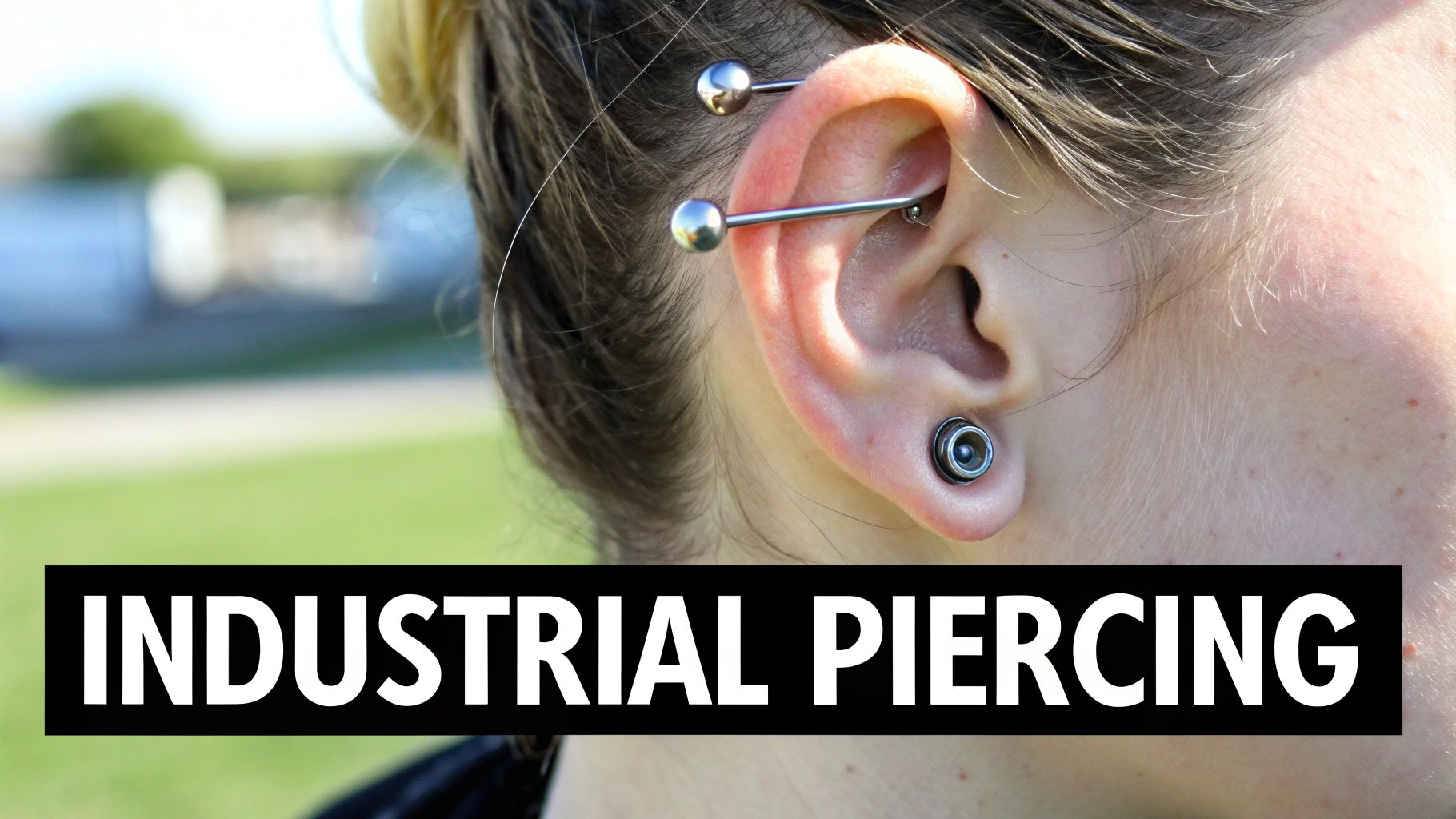
An industrial piercing is a bold statement piece that connects two separate piercings in your upper ear cartilage with a single, straight barbell. Usually, this means piercing both the forward-helix and the outer-helix. The result is a dramatic, eye-catching look that has become iconic in alternative fashion.
If you're compiling a list of all ear piercing names, the industrial is a must-have for its unique, sculptural quality. Its demanding healing process and specific anatomical requirements make it a piercing for the truly dedicated. It’s crucial to find a highly experienced piercer to ensure the angles are perfect for both comfort and healing.
Key Facts & Aftercare Tips
- Pain Level: 7-8/10. Because it's two cartilage piercings in one session, it ranks higher on the pain scale.
- Healing Time: 9-12 months, and sometimes longer. The interconnected nature makes it prone to irritation, so patience is everything.
- Best Jewelry: A straight barbell made from high-quality titanium is essential for initial healing. BodyCandy has a huge range of decorative industrial barbells for when you're fully healed.
- Aftercare: Clean both piercing sites twice daily with a sterile saline solution. Do not rotate or move the barbell. Avoid sleeping on the pierced ear at all costs, as pressure can cause serious irritation.
Proper jewelry fit is critical for a happy industrial piercing. Getting the measurements right is a vital step. Understanding the essentials of industrial barbell sizing will help you choose jewelry that is both comfortable and stylish.
11. Multiple Lobe Piercings
Multiple lobe piercings take the classic single lobe and turn it into a canvas for your creativity. This style involves getting a second, third, or even fourth piercing directly above the first one on your soft earlobe. This lets you create a personalized "stack" or "constellation," turning a simple area into a detailed work of art. And the best part? They have the same low pain and quick healing time as a standard lobe.
This option is a perfect next step if you're exploring all ear piercing names and want to expand your collection without committing to cartilage just yet. The versatility is amazing, letting you mix and match studs and hoops to reflect your unique style.
Key Facts & Aftercare Tips
- Pain Level: 2/10. A little more sensitive than the first one, but still a very quick pinch.
- Healing Time: 6-10 weeks per piercing. It’s often best to get them done separately to ensure each one heals properly without added stress.
- Best Jewelry: Small studs and huggie hoops. Flat-back labret studs are ideal for initial piercings to prevent snagging.
- Aftercare: Clean each piercing twice daily with a sterile saline solution. Avoid sleeping directly on your new piercings until they are fully healed. Plan your spacing carefully with your piercer so all your jewelry can sit comfortably.
12. Orbital Piercing
The orbital piercing is a visually striking mod where two separate piercing holes are connected by a single hoop. Unlike an industrial that uses a straight bar, the orbital uses a ring, creating a captivating "orbiting" effect. This creates a unique, flowing look that beautifully accentuates your ear's natural curves.
When you're looking at all ear piercing names, the orbital stands out for its creative potential. It can be placed in various locations, most commonly in the helix or lobe region. This piercing is a centerpiece, perfect for those who want a bold yet elegant statement in their curated ear project.
Key Facts & Aftercare Tips
- Pain Level: 5-7/10. Since it involves two piercings, often through cartilage, you can expect a higher level of discomfort.
- Healing Time: 6-12 months. Healing two interconnected piercings requires patience and meticulous care.
- Best Jewelry: Captive bead rings (CBRs) and seamless rings are ideal. It's crucial that the jewelry is properly sized to avoid putting pressure on either hole.
- Aftercare: Clean both piercing sites twice daily with a sterile saline solution. Do not twist or rotate the ring. It's essential to avoid sleeping on the piercing to prevent pressure and irritation.
The success of an orbital piercing relies heavily on precise placement, so you need a skilled piercer. The two holes must be perfectly aligned so the ring sits comfortably. Always seek a highly experienced professional for this one!
12 Ear Piercings Comparison
| Piercing | Implementation Complexity (🔄) | Resources & Healing (⚡) | Expected Outcomes (⭐📊) | Ideal Use Cases (📊) | Key Advantages & Tips (💡) |
|---|---|---|---|---|---|
| Lobe Piercing | Low — simple, quick procedure | Heals 4–6 weeks; pain 1–2/10; basic saline care; standard studs/hoops | Versatile, low complication rate, fast recovery | First-time piercings; professional settings; basic ear stacking | Beginner-friendly; use titanium; wait 4–6 wk before changing jewelry |
| Helix Piercing | Moderate — cartilage piercing, needs care | Heals 8–12 weeks; pain 4–5/10; saline soaks; titanium/gold advised | Visible and fashionable; moderate scarring risk | Ear stacking, visible cartilage accents | Avoid sleeping on pierced side; expect longer healing |
| Forward Helix | Moderate–High — precise placement required | Heals 9–13 weeks; pain 5–6/10; small jewelry; hypoallergenic metals | Distinctive, less common; slightly higher rejection risk | Subtle forward-facing accents; starter for ear stacks | Use experienced piercer; avoid rotation; limited jewelry options |
| Tragus Piercing | Moderate — tight, small cartilage area | Heals 8–12 weeks; pain 6–7/10; small gauge; avoid earbuds during healing | Bold inner-ear focal point; higher complication risk near canal | Unique focal accent; ear stacking complement | Seek experienced piercer; clean saline twice daily; avoid headphones |
| Anti‑Tragus | High — angle and placement are critical | Heals 8–12 weeks; pain 6–7/10; precise small jewelry required | Symmetrical counterpoint to tragus; higher rejection risk | Artistic, balanced ear designs with tragus | Expert piercer recommended; keep jewelry small; careful aftercare |
| Conch Piercing | High — deep cartilage, requires precision | Heals 6–9 months; pain 7–8/10; prolonged cleaning; titanium/solid gold | Spacious area for statement pieces; stable when healed | Statement pieces; center of full ear designs; large-gauge options | Plan for long healing; sleep opposite side; professional piercer |
| Daith Piercing | High — very technical placement | Heals 4–6 months; pain 7–8/10; curved/hoop jewelry; diligent care | Unique focal point; anecdotal migraine claims; higher rejection risk | Trend-driven looks; inner-ear focal accent | Only expert piercer; use quality titanium; migraine claims anecdotal |
| Rook Piercing | High — angled inner ridge, needs expertise | Heals 4–6 months; pain 6–7/10; start with curved barbell | Sophisticated, artistic depth; moderate rejection risk | Distinctive ear stacking centerpiece | Start with curved barbell; avoid sleeping on side; choose skilled piercer |
| Snug Piercing | Very High — one of the most difficult placements | Heals 4–6+ months; pain 8–9/10; high rejection/migration risk | Very unique but high complication potential | Advanced modification enthusiasts | Expert piercer essential; expect long healing and discomfort |
| Industrial Piercing | High — two piercings must align perfectly | Heals 8–12 weeks; pain 6–7/10; correct barbell sizing critical | Bold, sculptural statement; alignment-critical; if one side fails both compromised | Iconic statement piece; alternative fashion looks | Ensure precise alignment; choose correct barbell length; cautious sleeping |
| Multiple Lobe Piercings | Low — repeat lobe technique, scalable | Heals 4–6 weeks per hole; pain 1–2/10; low maintenance | Customizable stacking; low complication rate | Beginner-friendly ear stacking; budget-conscious styling | Space 3–4 mm; stagger timing; use hypoallergenic metals |
| Orbital Piercing | Very High — two piercings connected by one ring | Heals 6–9 months; pain 7–8/10; precise spacing and ring size required | Flowing, artistic loop; if one pierce rejects, whole piece fails | Advanced artistic ear modifications | Expert piercer only; continuous ring sizing critical; avoid rotation/sleeping on side |
Ready to Find Your New Look?
You've just navigated the entire landscape of your ear, from the classic lobe to the intricate daith and bold industrial. This journey through all ear piercing names has armed you with the knowledge to design an ear project that is uniquely and authentically you. Now you know the key differences in placement, pain levels, healing times, and the best jewelry for each spot.
Think of your ear as a blank canvas. You're no longer just pointing at a picture and saying, "I want that one." Now, you can confidently walk into a studio and ask for a "rook piercing," knowing exactly what it entails and how to care for it. This knowledge is your most powerful tool for a safe, successful, and stylish piercing experience.
Your Piercing Journey: Key Takeaways
Knowing all the piercing names is about feeling empowered. Here's what you need to remember:
- Placement is Everything: Where you get pierced—soft lobe or firm cartilage—dictates everything from healing time to jewelry choice. Understanding this helps you set realistic expectations.
- Healing is a Marathon, Not a Sprint: Cartilage piercings like the helix, rook, and snug can take a year or more to fully heal. Patience and consistent aftercare are non-negotiable.
- Jewelry Material Matters Most: The most important factor for a happy piercing is quality jewelry. Always opt for implant-grade, body-safe materials like titanium or 316L surgical steel to avoid irritation and healing problems.
- Your Style, Your Rules: The real magic happens when you start combining piercings into a curated ear. Mix and match to create a look that you love!
Turning Inspiration into Reality
So, what's next? Start by saving photos of ear projects that you love. Do you notice a pattern? Maybe you're always drawn to the delicate, snug fit of a daith ring or the edgy statement of an industrial bar.
Once you have a vision, revisit this guide to remind yourself of the healing commitment. Then, the most crucial step is finding a reputable, professional piercer who can bring your vision to life safely. A great piercer won't just perform the piercing but will also offer personalized aftercare advice and help you select the perfect starter jewelry.
Embracing the art of ear piercing is an amazing form of self-expression. Each piece of jewelry you choose tells a part of your story. Now that you're an expert on all ear piercing names, the most exciting part begins: making your mark!
Ready to find the perfect piece for your ear curation journey? BodyCandy is your one-stop shop for the highest quality, most stylish body jewelry for every piercing we've covered. Shop our huge collection of implant-grade titanium and 316L surgical steel jewelry at BodyCandy and turn your dream look into a stunning reality