



















If two bottles both say saline, does that mean they'll treat your fresh piercing the same way? Not necessarily. The formulation and concentration matter more than the word on the front, and a stronger, more antiseptic spray isn't automatically a better choice.
Your new jewelry can bring the attitude. Your aftercare should be gentle, predictable, and easy to repeat without irritating the skin you're trying to heal.
What an Aftercare Spray Is and How It Cleans
You wake up, check your new ear piercing, and find a little crust around the jewelry. It's tender, so scrubbing sounds awful, but leaving everything stuck there doesn't seem right either. Gentle rinsing can help.
A body piercing aftercare spray is a wound-wash product intended to cleanse the surface around a healing piercing. An appropriate sterile saline formula helps rinse away dried lymph, loose debris, and softened crust without making you rub or move the jewelry.
A typical bathroom routine should be simple, not a shelf full of treatments.
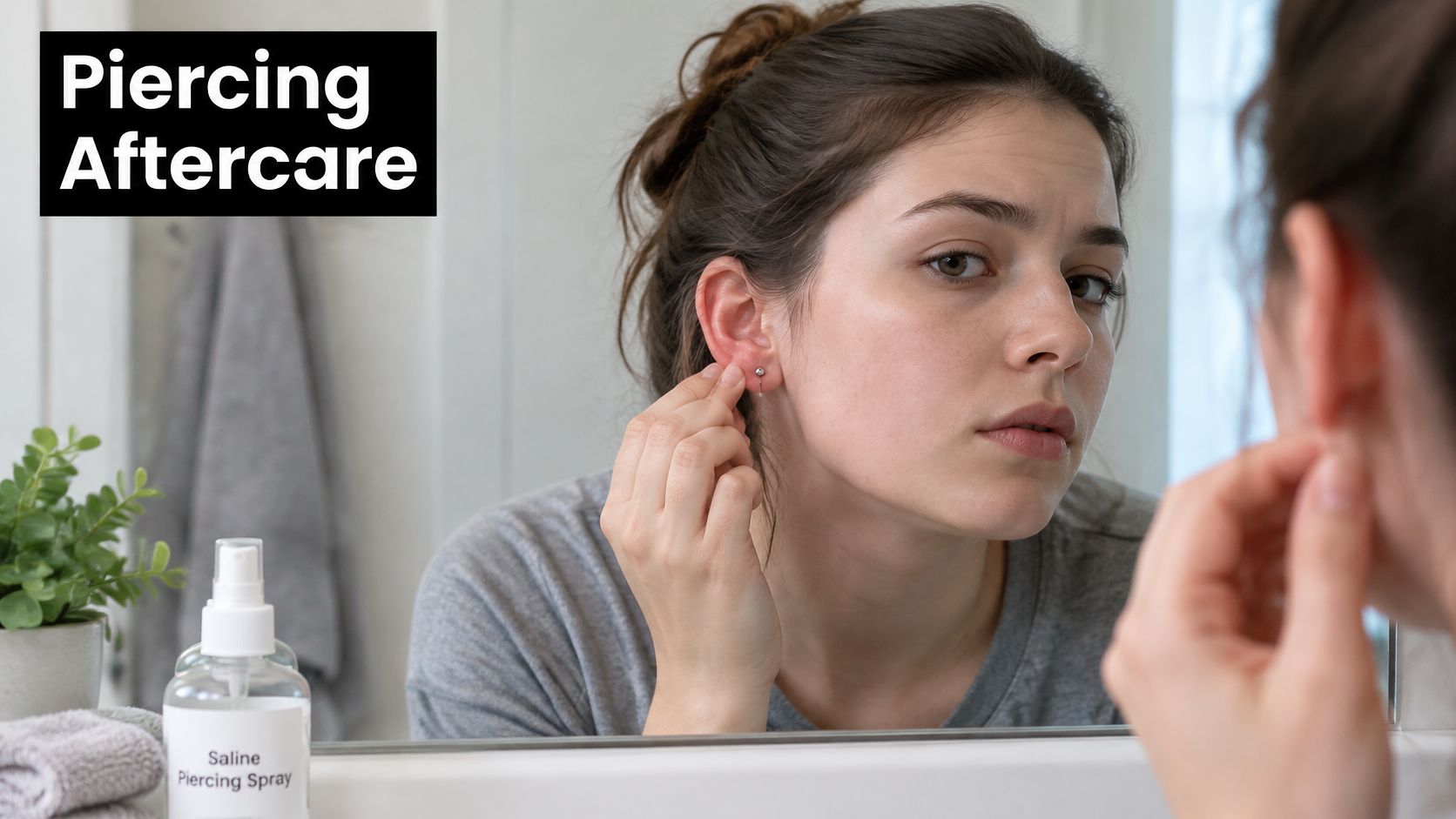
What the rinse actually does
Think of rinsing grit off a beach towel before washing it. The water lifts loose particles so you don't have to grind them into the fabric. Around your piercing, the aim is similarly practical: loosen what's ready to come away without disturbing what's still attached.
The spray has a few useful jobs:
- Lift loose debris: Fluid carries away material sitting around the entry and exit points.
- Soften dried discharge: Brief wetting makes crust less rigid, reducing the temptation to pick.
- Reduce rubbing: A gentle flush lets you clean without dragging a cloth across tender tissue.
Softening crust isn't the same as keeping the piercing wet all day. After cleaning, the surrounding skin should be allowed to dry.
What it can't do
Spray doesn't sterilize the piercing tract, medicate an infection, or eliminate bacteria deep in tissue. Sterile piercing technique helps prevent contamination during the procedure; your immune system handles healing, and a clinician may need to treat an infection.
A clinical review of body-piercing complications identifies piercing location, jewelry material, practitioner experience, hygiene, and the recipient's care as factors affecting outcomes. It also describes complications including infection, contact dermatitis, and abnormal scarring, none of which a bottle alone can reliably prevent.
Practical rule: Use spray to clean gently, not to compensate for poorly fitting jewelry, repeated snags, or worsening symptoms.
When that morning crust softens, let the loose material rinse away. If something remains firmly attached, leave it alone rather than turning cleaning into a removal project. Comfortable, low-trauma cleansing is the benefit, not faster healing on demand.
Reading the Label and Choosing a Safe Spray
Start with 0.9% sodium chloride in a sterile wound-wash formulation, the concentration recommended in the Association of Professional Piercers' body-aftercare guide. This isotonic solution is compatible with body fluids and cleans without the excessive drying associated with overly concentrated homemade mixtures.
The front label might promise natural ingredients, sensitive-skin care, or extra cleansing power. Turn the bottle around anyway. The ingredient panel is more useful than the marketing language, including the word hypoallergenic, which isn't a guarantee that your skin will tolerate a product.
Common spray ingredients and whether to use them
| Ingredient | What it does | Verdict |
|---|---|---|
| 0.9% sodium chloride | Isotonic cleanser that matches body fluid and lifts debris gently | Keep: core active |
| Sterile or purified water | Carries the salt in the finished sterile formulation | Keep: expected base |
| Preservative-free single-use format | Limits contamination associated with storing an opened portion | Prefer |
| Homemade salt mix | Can be too concentrated and overdry healing tissue | Avoid |
| Harsh antibacterial or antiseptic additives | Can irritate healing tissue with routine use | Avoid unless a clinician advises |
| Moisturizers, oils or butters | Can leave residue, trap debris, and slow drying | Avoid |
| Fragrance or essential oils | Can sensitize or irritate vulnerable skin | Avoid |
| Contact-lens saline, nasal spray or eye drops | Similar name, different formulation, not interchangeable with wound wash | Avoid |
Michigan's piercing-aftercare guidance likewise recommends sterile wound wash and warns against look-alike products and additives such as moisturizers and antibacterials. A product designed for your contacts or nose doesn't become suitable for an open piercing because saline appears on its label.
Homemade salt water has another drawback: you control neither sterility nor concentration reliably. Adding extra salt because the piercing looks irritated can make dryness worse rather than improve cleansing.
Decode the packaging before buying
Sterile means the packaged solution is free of living microorganisms. Purified water alone doesn't establish that the finished product is sterile, so look for that claim on the wound wash itself.
Wound wash identifies the intended use on wounds rather than eyes or nasal passages. Preservative-free means there isn't an added preservative to inhibit microbial growth after opening; it doesn't mean an opened container can't become contaminated.
Use this shopping checklist:
- Simple ingredients: Sodium chloride and water, without fragrance, moisturizers, or added antiseptics.
- Intact packaging: A sealed spray system or unopened single-use portion.
- Traceable bottle: A readable expiry date and batch or lot code.
- Practical delivery: A gentle mist or controllable stream you can aim without touching the nozzle to skin.
- Readable directions: Clear instructions for storage, opening, and disposal.
Metal deserves a separate check. A perfectly suitable spray can't stop a reaction to nickel-containing jewelry; if you have a nickel history, ask your piercer about nickel-free implant-grade titanium rather than assuming surgical steel is nickel-free.
Buying rule: if you can't read every ingredient and establish what the product is intended for, don't buy it for your piercing.
Spray Versus Saline Soak and Which Fits Your Piercing
Spray wins on convenience and application control; a soak gives longer contact with stubborn crusting. Neither method makes an unsuitable formula appropriate.
This comparison helps you match the method to the job.
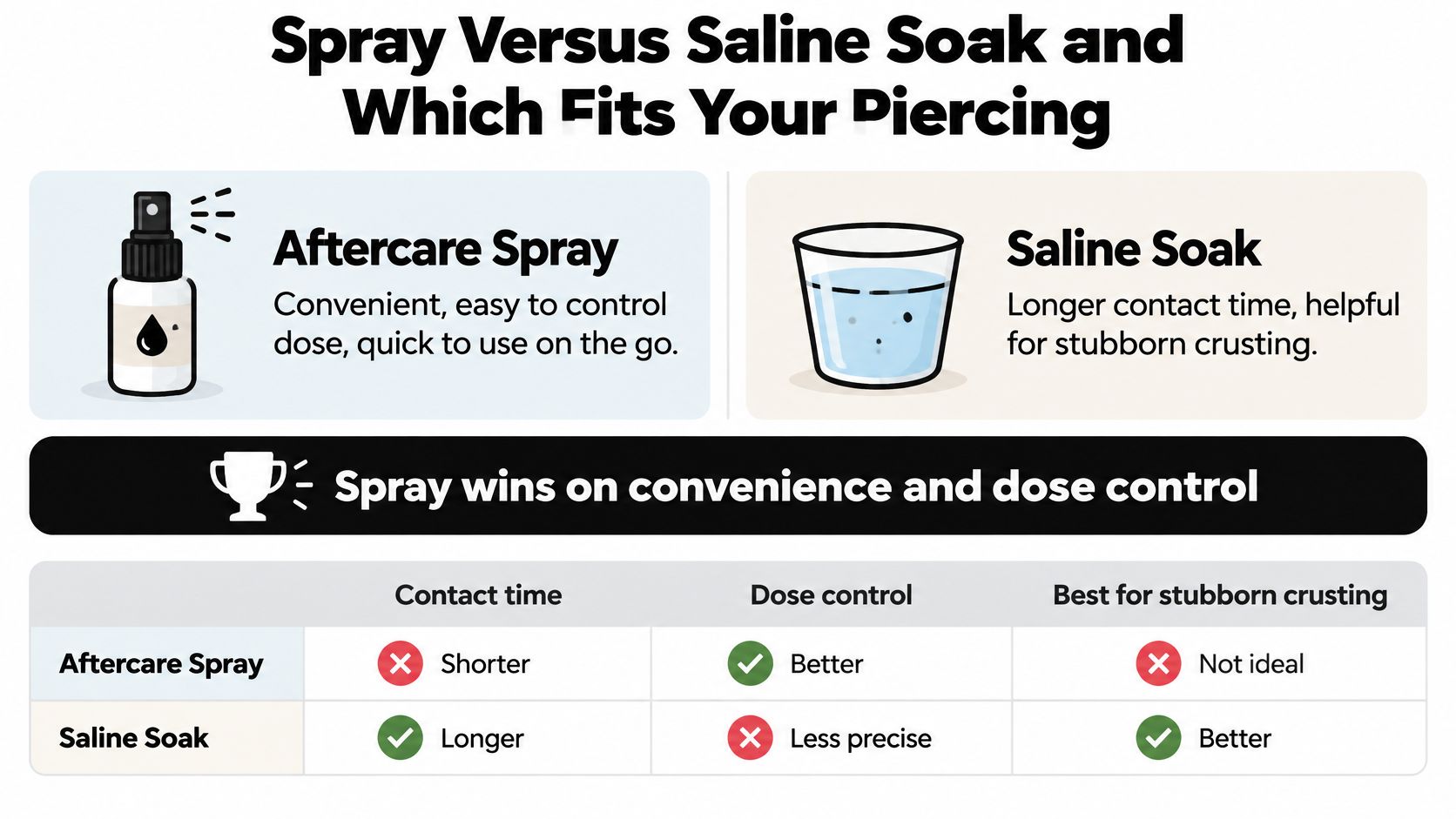
Aftercare spray compared with a saline soak
| Criterion | Aftercare spray | Saline soak |
|---|---|---|
| Contact time | Brief application, then drying | Longer soaking or gentle compression |
| Dose control | Nozzle controls flow; your press controls the amount | You control how much you pour |
| Contamination risk | Lower with intact packaging and a clean nozzle | Lower with fresh sterile saline; higher with reused or dirty cups |
| Mess and setup | Portable and straightforward | Needs a clean cup or sterile gauze and more setup |
| Cost per use | Compare bottle price, volume, and spray output | Bulk sterile saline may reduce solution cost, but leftovers can be wasted |
| Best for | Daily routine, travel, minimal handling | Stubborn crusting when a piercer advises it |
A soak means fresh sterile saline in an appropriately clean vessel or applied with sterile gauze, not a homemade salt mixture left on the bathroom counter. Don't save used solution for later or share the cup.
Spray is easier when you're getting ready for work or cleaning a hard-to-reach site. A soak takes more attention, and extra contact time isn't a reason to keep already-irritated skin wet indefinitely.
For a closer look at formulation choices, read wound wash versus homemade salt soaks. Choose spray for routine care and a soak when your piercer thinks softened crusting needs that approach.
Watch the accompanying piercing-care video for additional context.
How to Use Aftercare Spray Safely, Step by Step
Set out your spray and clean drying material before you begin. This routine is for the external skin around a piercing; oral piercings need site-specific advice rather than spraying wound wash into your mouth.
The basic process should involve very little touching.
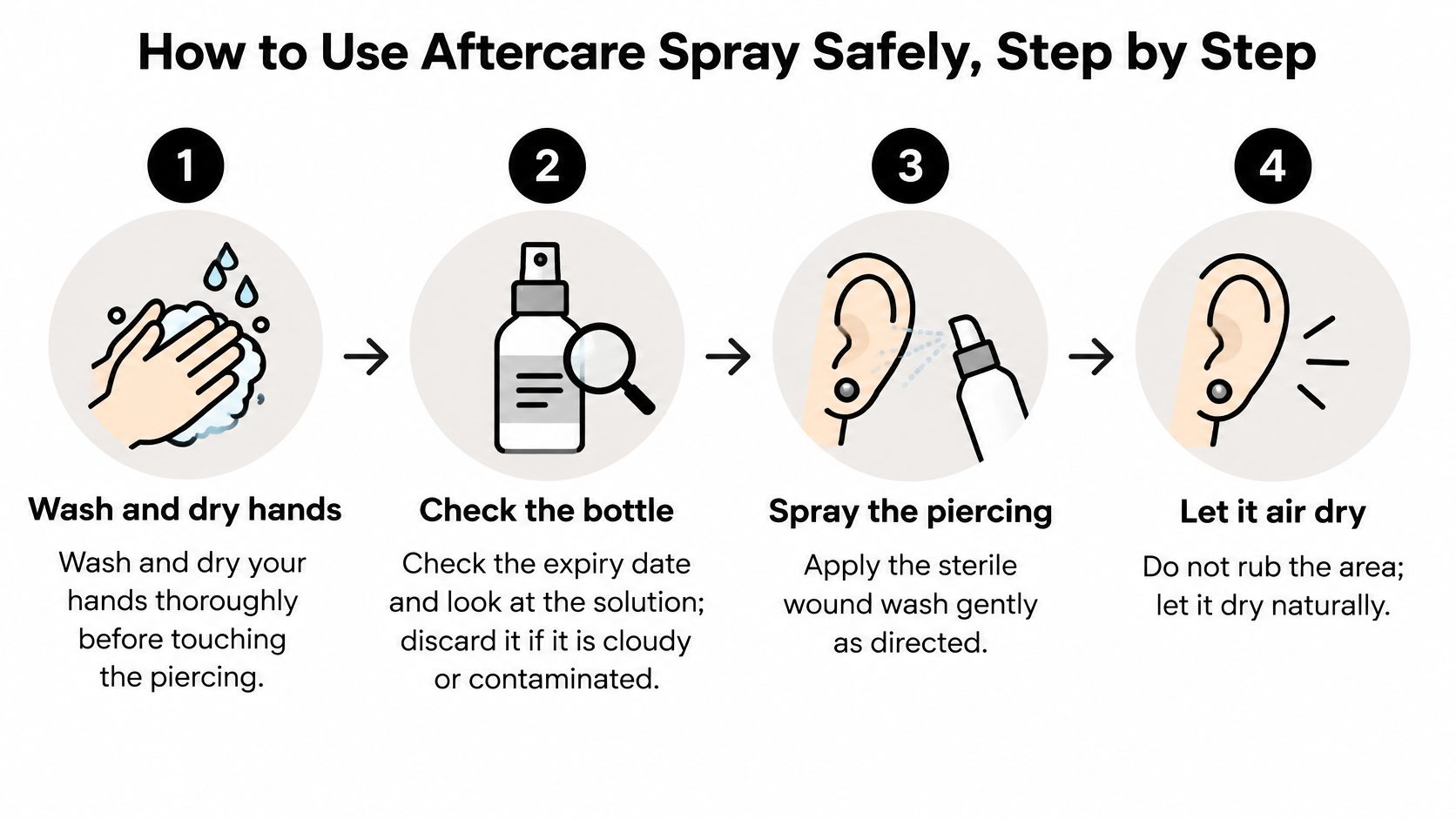
Apply gently and leave the jewelry still
- Wash and dry your hands thoroughly. Do this before handling the bottle or getting near the piercing. A common slip is washing, then touching your phone or a dirty bathroom surface before starting.
- Check the bottle and solution. Read the expiry date and inspect the packaging; discard solution that looks cloudy, has changed appearance, or may be contaminated. Don't assume a clear-looking product is safe if its seal is damaged.
- Aim without touching. Hold the nozzle away from the skin and apply enough to wet the accessible entry and exit points. Don't press the nozzle against the jewelry or use a forceful stream to blast crust away.
- Give dried material a chance to soften. Pause briefly rather than wiping immediately, then let loosened debris rinse away. The mistake is scraping off anything that hasn't released easily.
- Dry without rubbing. Gently blot excess moisture with clean, single-use paper towel or non-woven gauze, keeping fibers away from the jewelry. Air-drying can avoid contact, but don't leave pools of moisture trapped in folds or use a shared fabric towel.
- Leave the jewelry alone. Don't twist, turn, or rotate it to get the solution inside. Moving it can disturb fragile tissue, and cleaning doesn't require you to work the jewelry back and forth.
- Keep the schedule consistent. Follow the frequency your piercer recommends for your site and healing stage. Don't add an extra cleaning session every time you notice the piercing.
How much is enough
You want the surface wet enough to rinse, not saturated for hours. A correct plain saline wound wash generally doesn't need another rinse solely to remove the saline, but clean running water can help remove loosened debris or uncomfortable residue.
A successful cleaning session ends with a clean, dry surrounding area and jewelry you haven't fiddled with.
If cleaning repeatedly leaves the skin tight, flaky, or more tender, reassess the product and frequency instead of increasing both. Continue the agreed routine until your piercer recommends stepping it down.
How Long Healing Takes and When to Stop Spraying
Healing takes months for many piercings, but there isn't one reliable finish date for every site. The clinical review describes a broad healing range, not a countdown you should apply equally to an earlobe, tongue, navel, and cartilage piercing.
Location matters. Movement can repeatedly disturb some sites, while cartilage's relatively limited blood supply can make healing more demanding. Jewelry fit, pressure from sleeping, clothing friction, and snags also affect how smoothly your piercing progresses.
Adjust care to the healing stage
- Early healing: Keep the gentle routine your piercer prescribed while tenderness and dried discharge are active.
- Improving tissue: Ask about reducing routine spray use as irritation and crusting fade.
- Settled piercing: Stop routine wound-wash use when your piercer confirms it's appropriate, while maintaining ordinary hygiene.
A lack of tenderness during normal contact, no recurring morning crust, and no discharge are reassuring signs. They're not permission to tug on the jewelry to test whether the inside has healed.
Don't use an empty bottle as your healing deadline. Use the condition of the piercing and a professional assessment.
If crust keeps returning, ask your piercer to assess jewelry length, material, pressure, and cleaning technique. A targeted change may help more than continuing the same routine indefinitely.
Check healing times for popular piercings for site-specific context, then confirm your own progress in person. Spray doesn't shorten the biological healing process; avoiding repeated injury helps you avoid unnecessary setbacks.
Common Problems and How to Fix Them
A brief, mild sting can happen when saline touches fresh tissue. It should fade rather than build, and a product doesn't need to sting to work.
Persistent burning, itch, discharge, and increasing pain don't all mean the same thing. A pediatric review of ear-piercing complications reports nickel reactions in 31% of Finnish children with ear piercings versus 2% without, illustrating why metal sensitivity deserves attention alongside infection.
Symptoms, likely causes and what to do
| Symptom | Likely cause | What to do |
|---|---|---|
| Mild stinging briefly after spraying | Fresh tissue reacting to application | Keep the routine only if it fades and the area isn't worsening |
| Morning crusting that softens with spray | Dried lymph during healing | Soften and rinse gently; don't pick |
| Tightness, burning or peeling that grows | Product too concentrated, additives, or overuse | Stop the suspect product; choose plain isotonic sterile wound wash and reassess frequency |
| Itchy, eczema-like rash around the jewelry | Possible metal sensitivity or product irritation | Stop the irritant; ask your piercer or doctor about a jewelry change |
| Spreading redness, heat or swelling | Possible infection | Seek medical advice promptly; leave jewelry in pending medical advice |
| Pus, fever, red streaks or feeling unwell | Possible infection needing treatment | Get urgent medical help |
Match the response to the cause
Say the skin becomes flaky after you start spraying whenever you pass the bathroom. The next move isn't a stronger cleanser. Reduce unnecessary handling, check the formula, and ask whether you're cleaning too often.
An itchy rash concentrated where metal contacts skin suggests a different question. Have your piercer assess the jewelry material and fit; don't attempt an early jewelry swap yourself, especially if infection is also possible.
Mechanical irritation can look angry, too. A post that catches on clothing or an ear piercing you sleep on may stay sore despite an appropriate spray, so describe those habits when you ask for help.
More spraying doesn't fix pressure, allergy, or infection. Saline offers supportive cleansing, not a diagnosis or a substitute for treatment.
For additional symptom comparisons, read normal irritation or piercing infection. If symptoms are spreading, intensifying, or making you feel ill, skip the troubleshooting experiment and seek clinical care.
Pick Your Routine and Know When to Call a Doctor
Choose the routine that fits what's happening, not the most complicated one.
- Fresh piercing without problems: Use plain sterile saline wound wash on the schedule your piercer recommends, with minimal handling.
- Sensitive skin or a nickel history: Choose fragrance-free, preservative-free wound wash and discuss nickel-free implant-grade titanium before buying replacement jewelry.
- Persistent crusting: Book a piercer assessment to discuss a saline soak, jewelry fit, or a change in technique rather than adding more spray.
Your next step is straightforward: check your current bottle against the ingredient checklist. Replace it if the formulation, packaging, or intended use doesn't meet the requirements.
When medical care comes first
The NHS guidance on infected piercings advises urgent medical help for suspected infection and says to leave jewelry in unless a doctor tells you to remove it. Increasing heat, pain, marked redness or darkening, pus, shivering, or feeling generally unwell deserve medical attention, not a harder cleaning routine.
A piercer can assess fit and technique. A clinician evaluates suspected infection and decides whether treatment is needed.
BodyCandy offers body jewelry in styles for ears, noses, navels, and more, so you can plan your next look while giving your current piercing time to settle. Visit BodyCandy to explore jewelry options, ask your aftercare questions in the comments, and sign up for the newsletter for new-arrival updates.