

















“Just buy a surgical-steel hoop and switch it in when your nose stops hurting” is advice worth ignoring. A black hoop nose piercing needs more than a cute ring and a quiet afternoon. The metal underneath, the way the black finish is made, and the condition of your piercing matter more than the product photo.
You can absolutely get that sharp, dark outline without treating your nose like a jewelry-testing lab. Start with fit and material, let your piercer handle the healing calls, and save the drama for your outfit.
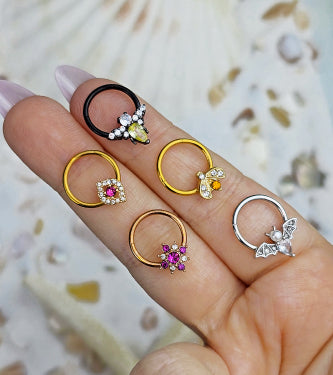
Black Hoop Nose Piercing Styles and Placements
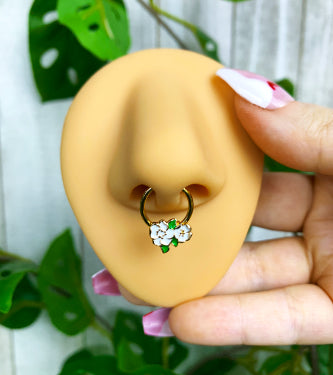
A black hoop nose piercing is a ring worn through the nostril or septum, creating a continuous-looking outline. Black jewelry can use coated metals, specially treated materials, or blackened precious metals, but a dark appearance alone won't tell you how the piece was made.
Nasal adornment belongs to a long history of piercing, with this clinical review discussing ancient body-piercing evidence including Ötzi the Iceman, dated to approximately 3350 BC, although that's not evidence that he wore a black nose hoop or that black carries a universal traditional meaning.
Match the ring to the placement
Say you want a close-fitting ring around your nostril. You're looking for a small segment hoop, not just the smallest ring in the shop. Your piercing's height and angle determine whether that ring can wrap around your nostril comfortably.
A septum ring sits beneath the center of your nose, above your upper lip. A wider hoop can create a bolder outline, but your anatomy still sets the fit.
Black hoop placements, styles and healing windows
| Placement | Hoop style | Healing window | What to expect |
|---|---|---|---|
| Nostril | Small seamless or segment hoop | Roughly 2–4 months is an initial healing estimate, not a guarantee of full healing, according to WebMD's nose-piercing guide; allow longer before assuming it's ready | A quiet-looking piercing may still need time before a jewelry change |
| Septum | Wider hoop that sits above the lip | Get a placement-specific assessment from your piercer | Confirm the jewelry plan before choosing a hoop for a fresh piercing |
Choose a closure you can manage
Rings with a small opening where the ends meet. Segment rings complete the circle with a removable section; some designs use a hinged clicker instead. Captive-bead rings hold a bead under tension, which can make installation fiddly without the right tools.
Those closures change how you install the jewelry, not whether the metal is suitable for your skin. A nearly invisible seam looks sleek, but a rough or poorly aligned join isn't a worthwhile trade-off.
Choose the placement and fit first. The black finish is the styling decision, not the safety specification.
If you want a delicate look, prioritize a proportional ring rather than squeezing into a tight one. For a stronger statement, choose a more visible silhouette without adding so much room that the hoop catches whenever you wash your face.
Materials and Finishes That Keep Sensitive Skin Happy
The base metal matters more than the black finish. A coating can change the color of jewelry without changing what sits underneath it. That's why “black titanium” or “hypoallergenic” shouldn't be the end of your product check.
Zahav Jewelry's safe-metals guide identifies implant-grade titanium meeting ASTM F136 or ISO 5832-3, niobium, and solid, nickel- and cadmium-free gold of at least 14 karat as appropriate material options, while warning that plated, filled, or vermeil finishes can expose the underlying alloy as they wear.
Those titanium standards identify the material specification. They aren't a guarantee that every coating applied afterward is suitable for a healing piercing.
Read the material and finish separately
Common black hoop materials and their nickel risk
| Material | How the black is made | Nickel-free base | Best for |
|---|---|---|---|
| Implant-grade titanium | Verify the treatment; ordinary titanium anodizing doesn't produce true black | Yes, with verified material documentation | Fresh or sensitive piercings only when the complete piece and surface are piercer-approved |
| Niobium | Can be treated to produce a dark finish; confirm the process | Yes | Sensitive skin, with suitable surface quality |
| Solid gold | Blackened surface treatment | Yes, if the alloy is nickel- and cadmium-free | Everyday wear on healed piercings when the finish is suitable |
| Plated or vermeil base | Coating over another metal | Only if the underlying alloy is verified nickel-free | Avoid for fresh piercings; the coating can wear through |
Use this visual checklist to separate the metal from the marketing.
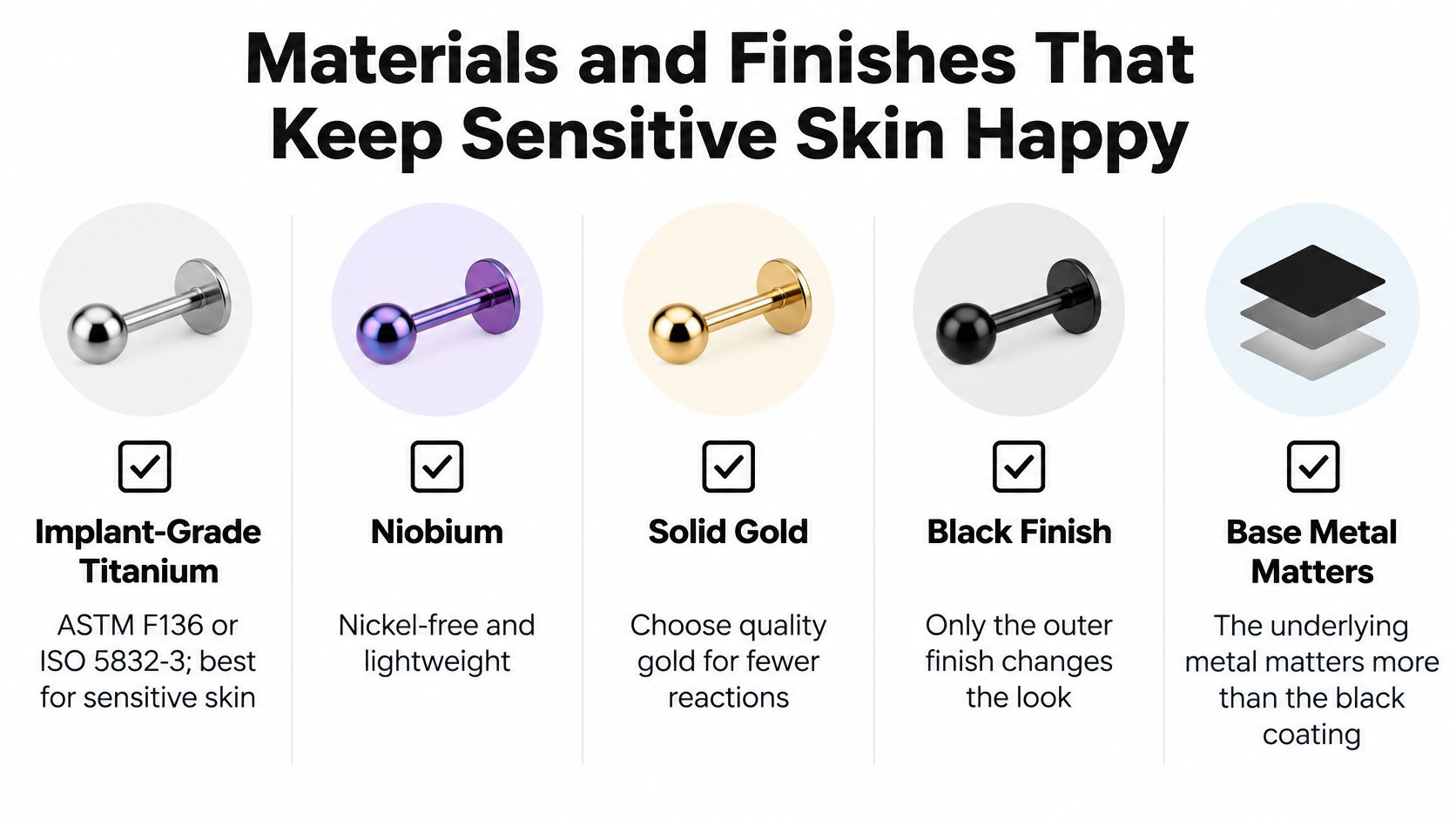
One important correction to shorthand descriptions: anodizing titanium doesn't automatically mean black titanium. Ask what creates the black surface. Likewise, solid gold describes the body of the jewelry, not necessarily the black layer touching your skin.
Nickel deserves its own check
Surgical stainless steel, including 316L, contains nickel. A black PVD finish, a thin surface layer applied through a vapor-deposition process, doesn't turn that steel into a nickel-free alloy.
Cleveland Clinic's nose-piercing guidance notes that nickel allergy affects up to 20% of people. Mayo Clinic's piercing guidance also emphasizes appropriate jewelry materials and nickel-conscious equipment choices.
Body piercing is a major route to nickel sensitization, so take a previous reaction to earrings, watchbands, or belt buckles seriously. Don't buy a coated mystery alloy hoping the coating will keep your skin from noticing.
Verify before you buy
- Base metal stated: Look for the actual alloy, not just the color.
- Material standard named: For implant-grade titanium, ask for documentation rather than trusting the adjective.
- Finish disclosed: Find out whether the surface is coated, treated, or blackened.
- Durability explained: Ask what wear looks like and whether the treatment is appropriate inside a piercing.
- Healing-stage suitability confirmed: Your piercer should approve jewelry intended for a fresh channel.
The nose-jewelry material guide is a useful companion while comparing listings. I'd choose a clearly documented, suitable piece over the cheapest hoop labeled surgical steel, especially for reactive skin.
Sizing Your Black Hoop Without Guesswork
Gauge is the thickness of the wire. Inner diameter is the space inside the ring. They answer different questions, and you need both before ordering.
Don't assume your piercing matches a common retail size. Your piercer can confirm the gauge you're wearing, and that's a better starting point than guessing from a photo or pushing a thicker ring through to see whether it fits.
Black hoop measurements and what each one means
| Measurement | What it measures | Standard or common value | How to check |
|---|---|---|---|
| Gauge | Thickness of the wire | Match your established piercing size | Read the listing or ask your piercer |
| Inner diameter | Open space inside the hoop | Set by placement and fit; no single value applies | Measure across the widest inside point with a ruler or calipers |
| Fit on the nostril | How the hoop sits and moves | Comfortable, smooth, and not catching | Assess a healed piercing or ask a professional piercer |
Measure the opening, not the outside
Lay a comfortable existing hoop flat beside a ruler, or use calipers gently against its inner edges. Measure through the center from inside edge to inside edge. Measuring the outside includes the wire thickness and can lead you toward a ring that fits differently than expected.
A hoop that's too small can pull against the opening or press into your nostril. One that's too large can swing, snag on a towel, or get knocked while you sleep.
Close-fitting doesn't mean clamped against your skin. A healed nostril hoop should follow the contour comfortably without leaving an indentation or tugging the piercing sideways. It shouldn't catch when you gently wash around it.
Fit check: Your nose shouldn't have to change shape to accommodate your jewelry.
The same inner diameter can look roomy on a low nostril piercing and feel tight on a higher one. Wire thickness and closure design also affect the overall feel, so matching a friend's ring size isn't a reliable shortcut.
Use a repeatable ordering routine
- Read the listing. Find both gauge and inner diameter, along with the closure type.
- Measure a comfortable ring. Compare the inside opening, not the outside outline.
- Compare before checkout. If a measurement is missing, ask the seller rather than filling in the gap yourself.
Use the nose-ring sizing guide when you need help interpreting measurements. For a fresh piercing, skip the home fit experiment altogether. A piercer needs to account for swelling and tissue clearance, not just the finished look you want.
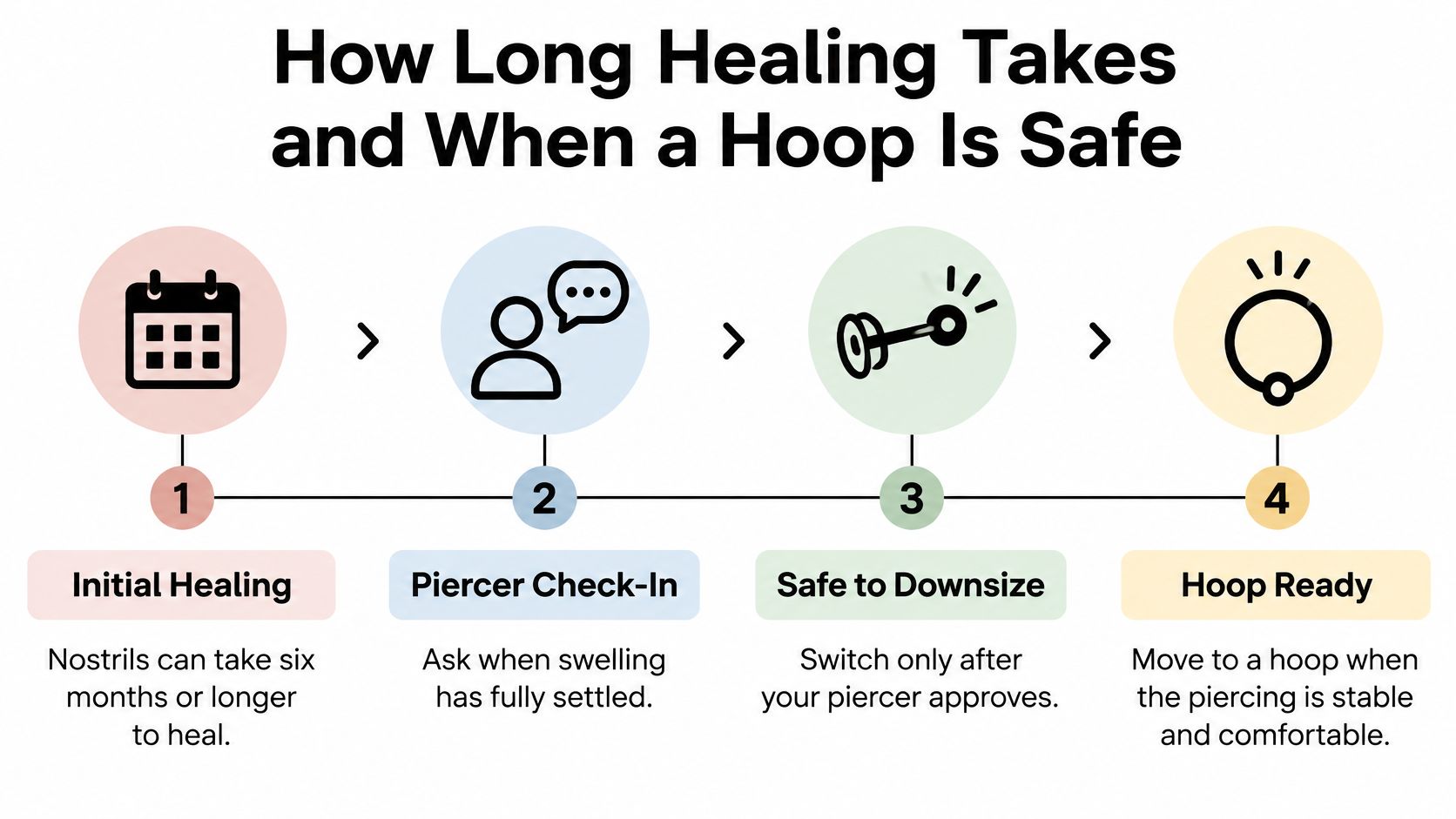
How Long Healing Takes and When a Hoop Is Safe
A black finish tells you nothing about whether a hoop is ready for a healing nostril. Judge the timing by the piercing's condition and your piercer's assessment, not by the ring's colour or by a calm-looking surface.
The Mayo Clinic's general piercing guidance gives about six weeks for many piercings, while noting that some take several months or longer. Nostril piercings often take longer to heal than many other piercings, so that general estimate is not a green light to change jewelry.
Think in stages, not deadlines
- Early healing: Tenderness and swelling can make a snug decorative ring a poor choice. Jewelry needs room for the tissue without swinging around excessively.
- Settling: The piercing may feel fine day to day, but that doesn't mean the channel can handle repeated jewelry changes.
- Fully healed: A piercer can assess the tissue and check that the planned hoop fits without pressure.
Hoops move and rotate through the piercing more than a well-fitted stud. Twisting the ring, checking it repeatedly, or adjusting its seam adds friction when the piercing needs to be left alone.
Downsizing and switching aren't the same job
Downsizing means a piercer replaces jewelry that has become too long as swelling settles. That adjustment does not mean the piercing is fully healed or ready for a fashion hoop.
Changing jewelry too early can scrape the channel, trigger irritation, or make reinsertion difficult as the opening tightens. A pain-free day alone doesn't tell you the piercing is ready.
The guide to healing times for popular piercings can help you prepare questions for your appointment. For a septum piercing, get a placement-specific assessment rather than applying a nostril timeline.
A calendar can help you plan a check-in. It can't inspect your piercing.
If you're considering a hoop as initial jewelry, discuss your anatomy, ring design, and material with your piercer. For a black hoop in an existing nostril piercing, wait until your piercer confirms it is fully healed.
Telling Irritation From Infection
A bump isn't an instruction to scrub harder or pull the ring out. Mild tenderness and pale crust can occur during healing, while increasing heat, swelling, pain, marked redness or darkening, bleeding, or concerning discharge need medical attention.
The NHS infected-piercing guidance advises prompt assessment for infection signs, greater urgency with fever, chills, or feeling unwell, and leaving jewelry in unless a clinician tells you to remove it. Removing jewelry yourself can let the opening close and potentially trap infection.
Piercing symptoms, likely causes and what to do
| Sign | Likely cause | What to do |
|---|---|---|
| Mild tenderness and clear or light crust early in healing | Normal healing may explain it | Clean gently with saline and avoid unnecessary handling |
| Itchy rash or bump after metal contact | Possible metal reaction | Check the material details and seek clinical advice before changing jewelry |
| Increasing heat, swelling, or severe pain | Possible infection | Seek prompt medical evaluation |
| Thick white, green, or yellow discharge | Possible infection | Get prompt medical advice; don't squeeze the area |
| Fever, chills, or feeling unwell with local symptoms | Possible infection with systemic symptoms | Get urgent medical advice |
| Irritation after alcohol or peroxide | Tissue irritation from harsh products | Stop using the harsh product and seek advice if symptoms persist |
Look at the pattern, not just the bump
An itchy rash after introducing new metal leans more toward a contact reaction. Worsening pain, warmth, thick discharge, or symptoms affecting your whole body are more concerning for infection.
Those patterns aren't a home diagnostic test. Allergy, pressure irritation, and infection can overlap, and a photo alone won't reliably separate them.
A tight hoop can also keep irritating an otherwise clean piercing. If the ring is digging in or becoming embedded, get professional help promptly rather than trying to bend it away from your nose.
Keep cleaning gentle
- Use saline appropriately: Follow your clinician's or piercer's cleaning schedule; packaged sterile saline avoids guessing at salt concentration.
- Soften crust first: Let warm saline loosen it rather than picking at attached material.
- Skip harsh agents: Alcohol and hydrogen peroxide aren't fixes for an angry piercing.
- Dry carefully: Gently pat with a clean disposable towel.
- Leave it alone afterward: Repeated cleaning and handling can add irritation instead of solving it.
More cleaning isn't automatically better. When symptoms worsen, escalate to a clinician instead of adding stronger products, squeezing the bump, or swapping jewelry in the bathroom mirror.
Changing to a Black Hoop on a Healed Piercing
Switch only after your piercer confirms the piercing is fully healed. Set out the correct jewelry, a clean disposable towel, saline, and a mirror before removing anything.
Match the opening method to the ring. A ring that twists sideways opens one way; a hinged clicker opens at its hinge. A captive bead or removable segment may need professional tools, so don't treat every black hoop like bendable wire.
Install without forcing the channel
- Wash your hands and prepare the jewelry. Clean the hoop using a finish-compatible method your piercer recommends. Saline rinsing isn't sterilization.
- Check the measurements. Confirm the gauge and inner diameter against your established fit before taking out the current piece.
- Open the closure correctly. For a hoop with no visible closure, gently twist the ends sideways in opposite directions. Don't pull them apart into a wide oval.
- Guide the end through. Follow the angle of the existing channel rather than pushing straight through against resistance.
- Close it evenly. Align the ends or secure the closure so there isn't a sharp edge, protruding seam, or pinch point.
- Assess the fit. The hoop should sit comfortably without pulling, pressing, or catching. Don't repeatedly spin it to prove it moves.
- Finish gently. Rinse away handling residue as advised, pat dry, and avoid unnecessary manipulation afterward.
Know when to hand it over
If the ring won't pass easily, stop. Don't use the jewelry as a needle, push through sharp pain, or keep trying until the tissue swells.
A piercer can check whether you've chosen the wrong gauge, approached the channel at the wrong angle, or discovered a piercing that wasn't ready. An installation appointment is a much better trade than an irritated nose and a damaged hoop.
Never attempt this routine on a fresh or still-healing piercing.
Styling and Caring for Your Black Hoop
A black hoop works with more than an all-black outfit. Pair it with warm gold, a restrained nostril stud, or textured ear jewelry and it can look intentional without making every piercing match.
For a mixed-metal reference, notice how the dark nose ring and gold earrings keep their own space.

Build a look around the silhouette
- Balanced nostrils: Pair your hoop with a small gold or black stud in the other healed nostril.
- All-black detail: Add black threader earrings or ear cuffs without crowding the nose.
- Mixed-metal stack: Use gold hoops in your ears to contrast with the darker facial jewelry.
- Understated focus: Keep surrounding pieces small when you want the nose hoop to stand out.
You don't need to match every finish exactly. A glossy black ring beside matte ear jewelry can work if the shapes feel balanced.
The video below offers another visual reference while you consider your jewelry style.
Protect the finish without overdoing maintenance
- Rinse after exposure: For a healed piercing, rinse away sweat or swimming residue with clean warm water. Don't treat that as permission to swim with an unhealed piercing.
- Store it dry: Keep removed jewelry in a clean, dry case away from direct sunlight and abrasive pieces.
- Apply products elsewhere: Keep perfume, hair products, and harsh chemicals off the hoop.
- Inspect the surface: Check for chips, scratches, roughness, or a different-colored metal showing through.
- Clean gently: Use finish-compatible care, saline when appropriate, and gentle drying rather than alcohol or peroxide.
Don't polish a coated hoop with abrasive jewelry cloths unless the manufacturer specifically permits it. Aggressive polishing can remove the very finish you're trying to maintain.
Replace or professionally assess the piece if the coating flakes, the surface becomes rough, the closure stops aligning, or a new reaction develops. Visible plating loss isn't charming wear inside a piercing. It's a reason to retire that ring, not rotate the damaged section out of sight.
Pick Your Black Hoop and Shop With Confidence
The right black hoop is the one that fits your piercing, suits your skin, and arrives with clear material information. A dramatic product photo is a bonus, not evidence that the ring belongs in your nose.
Choose in this order:
- Confirm placement and readiness. Know whether you're shopping for a healed nostril, healed septum, or a future switch that still needs a piercer's approval.
- Verify construction. Look for the base metal, finish treatment, and meaningful supplier disclosures.
- Match both measurements. Check gauge and inner diameter rather than choosing by appearance.
- Pick your preferred closure and style. Decide how much ring you want visible and whether you can manage the closure safely.
Shop the details, not just the color
Use black or nickel-free filters when available, then open the full listing. A filter helps narrow the selection; it doesn't replace checking the alloy, surface treatment, and measurements.
If your piercing is still healing, bring the listing to your piercer before buying. If you're uncertain about a seller's material description, ask for clarification rather than treating silence as reassurance.
Have an aftercare or sizing question? Leave a comment with the placement and the jewelry details, but take possible infection symptoms to a clinician. For new arrivals and seasonal drops, sign up for the store newsletter once you've worked out the specifications your piercing needs.
BodyCandy offers nose rings and other body jewelry for building a look around your black hoop. Visit BodyCandy, browse the nose-ring options, and check each piece's material, gauge, and inner diameter before choosing your next ring.