

















You've picked a curved barbell because it looks simple, then discovered that “titanium” can mean very different things and that a few millimeters can decide whether your piercing feels comfortable or constantly annoyed. If your navel, eyebrow, or rook piercing is red, tight, snag-prone, or mysteriously unhappy, the problem may not be your cleaning routine. It may be the material, the curve, the threading, or the way the piece was measured.
A titanium curved barbell can be a smart choice for sensitive skin, but only when you know what you're buying. The goal isn't just a shiny piece that fits the product photo. It's jewelry made from a verified material, shaped for your anatomy, and measured by the correct rules.
Why Your Piercing Might Be Irritated
You clean your piercing, avoid sleeping on it, and still find redness or swelling. By evening, one ball may press into the skin while the other sits noticeably farther away. That pattern often points to fit or geometry, not a failed aftercare routine.
A curved barbell follows anatomy that bends, folds, or arches. Navel, eyebrow, and rook piercings are common examples. A straight bar can push against one side of the channel, while the correct curve distributes pressure more naturally. Length matters just as much: too little room creates pressure, and too much lets the jewelry swing, snag, or twist.

Fit and construction can be the missing pieces
Check how the barbell sits at rest, not only how it looks in a product photo. The curve should follow the piercing's path, and the wearable length should leave room for normal swelling without leaving a long, snag-prone gap. Measurements also need context. Gauge describes thickness, while length measures the wearable bar between the ends. Those are separate checks.
Irritation can have several causes at once:
- Poor fit: A short bar can press into tissue, while a long one can catch on clothing or rotate.
- Wrong geometry: A curve that is too shallow or too deep may load one side of the piercing.
- Rough construction: External threads, sharp edges, or an uneven finish can scrape the channel.
- Unknown alloy: A product labeled titanium may not identify a verifiable grade.
Practical rule: Pinching, catching, constant rotation, or one-sided pressure deserves a professional fit check. Ask the piercer to assess the curve, wearable length, gauge, and surface finish together.
If earrings or body jewelry have caused itching before, compare options in this guide to hypoallergenic jewelry for sensitive skin. Titanium may reduce metal-related irritation, but it cannot correct poor placement or careless aftercare. A properly measured curved barbell removes avoidable pressure and movement, giving the piercing a better chance to settle.
Understanding Implant-Grade Titanium Standards
You spot implant-grade titanium on a curved barbell listing and assume the material is settled. The label alone is not enough. A documented standard tells you far more than the word “titanium,” especially when jewelry sits in healing tissue.
The standard commonly specified for body jewelry is ASTM F136, also identified as Ti-6Al-4V ELI, an extra-low-interstitial titanium alloy used for surgical implantation. Its approximate composition is 90% titanium, 6% aluminum, and 4% vanadium, as outlined in this implant-grade titanium body jewelry guide.
“ELI” means extra-low interstitial. The alloy has tighter controls on certain impurities than generic titanium grades. That difference is easy to miss on a product page, but it separates a traceable material specification from a vague sales label.

Why nickel-free still matters
ASTM F136 titanium is described in piercing sourcing guidance as nickel-free and certified for surgical implantation. That matters if unknown jewelry has caused itching, redness, or irritation before. Nickel allergy affects about 10-15% of the global population, according to recognized allergy information.
That figure does not identify the cause of every irritated piercing. As noted earlier, fit, movement, and care still need to be assessed alongside the material.
Generic titanium isn't one guaranteed category
A listing may say “titanium” without naming the grade, leaving the alloy, documentation, finish, and manufacturing quality unclear. Recognized standards can include:
- ASTM F136, Ti-6Al-4V ELI
- ASTM F1295, Ti-6Al-7Nb
- ASTM F67, commercially pure titanium
- ISO 5832 equivalents
Ask for the standard by name. “Hypoallergenic titanium” does not identify a specific alloy or prove that the finished curved barbell matches a recognized specification.
A reputable seller should also be able to discuss mill certificates or other documentation connecting the finished jewelry to its stated material. You do not need to become a metallurgist. You do need to know whether implant-grade describes a verifiable standard or a marketing phrase. For a clearer breakdown of titanium terminology, see this guide to titanium body jewelry.
How to Measure Gauge and Length Accurately
Sizing is where a gorgeous curved barbell can turn into a daily nuisance. Gauge tells you how thick the bar is. Wearable length tells you how much space the bar provides between the two ends. You need both measurements to judge fit.
Start with gauge
Curved barbells are commonly sold in 16G and 14G, which correspond to 1.2 mm and 1.6 mm, respectively, according to this body jewelry size guide.
| Gauge (G) | Thickness (mm) | Common Lengths (in/mm) | Typical Piercing Uses |
|---|---|---|---|
| 16G | 1.2 mm | 5/16 in / 8 mm, 3/8 in / 10 mm, 1/2 in / 12 mm | Eyebrow, rook, and other anatomy-dependent placements |
| 14G | 1.6 mm | 5/16 in / 8 mm, 3/8 in / 10 mm, 1/2 in / 12 mm | Navel and other anatomy-dependent placements |
The chart is a starting point, not a substitute for an in-person measurement. A professional piercer considers the placement angle, tissue depth, swelling, and how the curve sits when your body is relaxed.
Measure the length the right way
A curved barbell is typically measured by the straight-line inner distance between the two balls, not by following the arc of the bar. This rule is easy to miss because the piece itself is curved, but measuring along the curve can make the jewelry seem longer than its actual wearable space. The curved barbell measurement guide illustrates this distinction.
Use these steps when checking an existing piece:
- Remove decorative end sizes from the calculation. Measure the wearable bar, not the full outside-to-outside length.
- Measure straight across the inside. Place your ruler or caliper between the points where the ends meet the bar.
- Record the gauge separately. Thickness and length answer different fit questions.
- Compare the measurement with how the jewelry behaves. Pressure suggests insufficient room. Excess movement suggests too much length.
- Ask a piercer before changing a fresh piercing. Swelling and healing tissue can make self-measurement unreliable.
Avoid the one-size-fits-all trap
A listing can offer several lengths, and the right one depends on your anatomy and healing stage. A navel piercing may need room for early swelling, then a shorter piece later. An eyebrow piercing may need a different curve and length even when the gauge matches.
The right measurement isn't the one that looks smallest. It's the one that gives the tissue room without leaving the jewelry loose and unstable.
For a broader explanation of barbell measurements and standards, use this barbell sizing and measuring overview.
Titanium vs Surgical Steel and Other Metals
Choosing jewelry material is a trade-off between biocompatibility, weight, finish, and intended use. Titanium is popular because it combines a lightweight feel with an implant-grade option, but other materials still have places in a jewelry collection.

Titanium
Verified ASTM F136 titanium is the strongest choice in this comparison for shoppers prioritizing a documented implant-grade material and a nickel-free profile. It's also lightweight, which can make a difference in mobile areas where extra pull or movement is annoying during healing.
Its main limitation is that “titanium” still needs a grade specification. If the seller won't identify the standard, you haven't learned enough from the label alone.
Surgical steel
Surgical steel is common and can work for people who already know they tolerate a particular, properly specified alloy. The catch is that many steel alloys contain nickel, making them less suitable for people with nickel sensitivity. Steel also feels heavier than titanium, which may matter when a piercing is fresh or prone to movement.
Affordable doesn't automatically mean unsafe, and titanium isn't automatically perfect. Documentation and your individual tolerance matter.
Gold
Gold brings a warm, luxury look, but its suitability depends on alloy composition and construction. Pure gold is soft, so body jewelry usually relies on an alloy to improve durability. Those added metals can affect whether the piece works for sensitive skin, especially when the exact composition isn't disclosed.
Gold is best treated as a considered option for a healed piercing, not a shortcut around material verification.
Bioplast
Bioplast is flexible and non-metallic, which can be useful in specific situations. It isn't a direct replacement for every titanium curved barbell, though, and its role is often temporary or placement-specific. Ask a professional whether the material and construction suit your piercing before using it long term.
Material check: A familiar label is less useful than a named standard, a smooth finish, and a fit that doesn't create constant pressure.
Styling with Anodized Titanium Colors
You don't have to choose between body-safe material and personality. Anodized titanium gets its color through electrochemical oxide-layer growth, not paint or plating. The visible shade comes from thin-film interference, so the finish is integral to the metal rather than sitting on top as a separate coating, as explained in this anodized titanium jewelry guide.
That construction changes how the color wears. Because there isn't a painted layer designed to peel away, anodized titanium has a lower risk of wear-related flaking or coating failure. The color can still change or fade under certain conditions, especially with abrasion, but it isn't the same as a decorative coating separating from the base.
Match the color to the placement
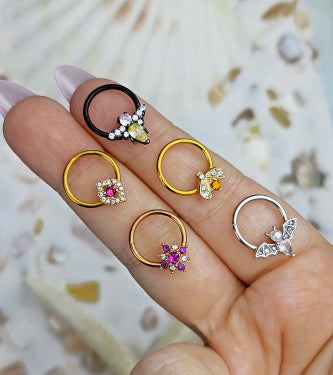
A navel piercing can handle a warmer, more playful look. Try a rose-gold-toned anodized curved barbell with a simple gem end for a soft contrast against summer outfits. Keep the curve and wearable length appropriate first, then let the color do the styling work.
For an eyebrow piercing, black anodized titanium creates a sharper, more understated edge. Pair it with a small ball for a clean look, or choose a pointed end if your daily routine won't make the jewelry catch on clothing or towels.
A rook piercing often looks strongest with a compact finish. A purple, blue, or gold-toned anodized curve can add color without turning the piece into visual clutter.
Keep finish and healing stage separate
Anodized color doesn't make an unsuitable piece safe. A colored barbell still needs a recognized material standard, a polished surface, and dimensions that suit your anatomy. It's also wise to choose simpler ends while a piercing is healing, then switch to more expressive details once the tissue is stable.
Technical knowledge enhances styling choices. You're not limiting your look. You're building it on jewelry that fits, moves predictably, and works with the piercing instead of competing with it.
Cleaning and Aftercare Best Practices
A high-quality titanium curved barbell still needs gentle aftercare. The jewelry can be biocompatible, but the surrounding tissue remains vulnerable to pressure, friction, buildup, and unnecessary handling while it heals.

Keep the routine simple
Use sterile saline as directed by your piercer. Let the solution soften residue around the entry points, then gently pat the area dry with a clean disposable paper towel. Avoid rubbing, picking, or using fabric that can catch on the ends.
- Clean gently: Use sterile saline rather than improvising with harsh household products.
- Dry carefully: Pat around the jewelry instead of dragging a towel across it.
- Wash your hands: Touch the piercing only when necessary, and handle it with clean hands.
- Leave jewelry in place: Don't remove healing jewelry unless a qualified professional tells you to do so.
- Skip harsh chemicals: Alcohol and tea tree oil can damage healing tissue and may affect a polished finish.
- Don't twist it: Moving the barbell unnecessarily creates friction inside the channel.
Give the threads attention
Internally threaded jewelry keeps the rough threads inside the receiving end, away from the tissue during insertion. The threads can still collect residue, though. Once the piercing is healed and the jewelry is removed safely, clean the threaded areas with an appropriate gentle method recommended by your piercer, rinse thoroughly, and dry the piece before reinstalling it.
Don't force a stuck end or cross-thread the barbell. If the jewelry won't open smoothly, a piercer can remove and clean it without turning a simple maintenance issue into fresh trauma.
Aftercare mindset: Clean the piercing, not your way into irritation. More products and more touching won't make healing faster.
Persistent swelling, worsening pain, heat, discharge, or jewelry that appears embedded deserves professional medical or piercing advice. Don't diagnose a serious problem by switching jewelry repeatedly.
Smart Shopping Tips for Premium Body Jewelry
A polished product photo can't confirm a titanium grade. Before buying, look for ASTM F136 or another clearly named implant-certified standard, rather than a listing that only says “titanium” or “surgical titanium.” Ask whether the seller can provide a mill certificate or documentation supporting the stated alloy.
Construction matters too. Internally threaded and threadless designs keep rough external threads from passing through the piercing channel. Check the available gauge, wearable length, curve, and end size instead of choosing by appearance alone. A genuine product description should make those details easy to find.
BodyCandy offers implant-grade titanium curved barbell options, including Grade 23 pieces in gauge and length combinations for placements such as navels and eyebrows. You can also compare designs such as internally threaded, threadless push-in, and hinged styles, while still confirming the fit with your piercer.
Ready to match comfort with your personal style? Explore the titanium curved barbell selection at BodyCandy, compare verified material and sizing details, and choose a piece that suits your piercing instead of forcing your piercing to suit the jewelry.