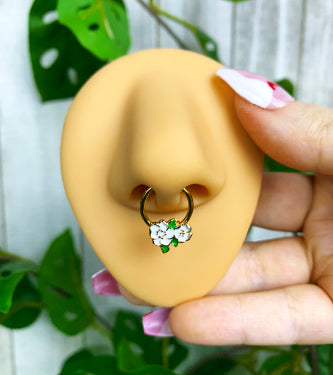




















You slide a new stainless steel ring into your nostril, admire the shine, and then spend the next two days wondering why the area feels hot and itchy. Is the jewelry unsafe, or is something else going on? The honest answer is more useful than a simple yes or no: stainless steel body jewelry can be safe for many wearers, but safety depends on the alloy, the finish, the piercing's healing stage, and your own nickel sensitivity.
The phrase “surgical steel” doesn't settle the question. Some pieces are carefully made and tested, while others offer little more than a shiny surface and a vague product description. By the end of this guide, you'll know how to separate 316L from 316LVM, recognize warning signs, compare steel with titanium and other materials, and choose jewelry that fits your specific piercing instead of trusting a marketing label.
That New Ring Itch and What It Really Means
An itchy piercing doesn't automatically mean stainless steel is the villain. Three common problems can create the same angry-looking symptoms, and they need different fixes.
Start with the fit
A ring that's too tight can press into swelling and trap debris around the channel. A post that's too short can pinch the tissue, while a ring that's too large may move constantly and create friction. Even a well-made piece can cause trouble if its diameter, gauge, or end style doesn't match the piercing.
Check whether the jewelry leaves room for normal movement without dragging through the tissue. If the skin is swallowing the jewelry, the piece is pressing hard, or the piercing is being pulled every time you sleep or change clothes, ask a professional piercer to assess the fit.
Moisture and friction can look like an allergy
Water, sweat, hair products, makeup, and cleanser can collect around the jewelry. That damp environment can irritate the channel, especially if you keep touching or rotating the piece. Friction from headphones, masks, helmets, pillows, and clothing can add another layer of inflammation.
Rinse away residue with sterile saline, then pat the area dry with clean, non-woven gauze. Don't scrape crusts off, twist the jewelry, or keep checking it with unwashed hands.
Metal reaction is still on the list
Nickel can be part of stainless steel, so a reaction is possible even when a listing says “surgical.” The important question isn't only how much nickel the alloy contains. It's how much nickel the finished jewelry releases, and whether your skin is already sensitized.
Practical rule: Treat heat, itching, burning, worsening redness, or a rash as a reason to stop wearing the piece and get professional advice, not as a challenge to tough out.
That's why “Is stainless steel safe?” is the wrong first question. Ask instead: What grade is it, is the piercing fresh or healed, and do I react to nickel? The difference between ordinary 316L and carefully manufactured 316LVM matters, particularly when jewelry sits in a fresh piercing.
What Surgical Steel Actually Is and Why the Grade Matters
"Surgical steel" describes a group of stainless-steel alloys, not one universal, certified material. It tells you the broad category, but it doesn't tell you the exact model, equipment, or build quality.
316L in plain language
316L is a common stainless-steel grade used for body jewelry. Its composition is generally described as roughly 60% to 65% iron, 16% to 18% chromium, 10% to 14% nickel, and 2% to 3% molybdenum, as outlined in this stainless-steel body jewelry guide.
Chromium helps form a thin protective surface layer that resists corrosion. Molybdenum improves resistance in harsher environments, including contact with body fluids. Nickel supports the alloy's structure and helps it remain durable, but it also matters for people with nickel sensitivity.
The L means “low carbon.” Lower carbon content helps reduce corrosion around welded areas and threaded sections. That matters because rough seams, damaged threads, and corroded surfaces can irritate tissue even when the base alloy is appropriate.
316LVM takes manufacturing further
The “VM” in 316LVM refers to vacuum melting. Manufacturers re-melt the alloy in a vacuum to reduce impurities and produce a more consistent structure. That tighter control is one reason implant-grade 316LVM is favored for long-term contact and fresh piercings when a qualified piercer approves it.
Cheaper grades such as 304 and 430 don't offer the same material profile. In particular, they lack molybdenum and may be less resistant to corrosion in body fluids. A shiny finish doesn't erase those differences.
| Grade | Key Alloy Notes | Best For | Watch Out For |
|---|---|---|---|
| 316L | Low-carbon stainless steel with chromium, nickel, and molybdenum | Many healed piercings and quality body jewelry | Contains nickel and isn't universally suitable |
| 316LVM | Vacuum-melted version of 316L with tighter material control | Fresh piercings and long-wear applications when properly verified | “VM” must be supported by trustworthy documentation |
| 304 | Stainless steel without the same molybdenum profile | General consumer goods, not a preferred piercing choice | Greater concern about corrosion and unclear sourcing |
| 430 | Ferritic stainless steel with a different alloy structure | Decorative applications | Not a strong default for body piercing |
For examples of 316L jewelry styles, you can browse BodyCandy's annealed 316L surgical-steel jewelry update. Grade is one of the biggest safety levers you control as a buyer.
Nickel Allergy in Plain English
Nickel allergy is a delayed skin reaction. Your immune system becomes overly sensitive to nickel, and repeated contact can lead to itching, redness, scaling, bumps, or a rash. The reaction may appear where the jewelry touches, but an irritated piercing can also look swollen and sore for other reasons.
Nickel sensitivity is common enough to make material choice important. A clinical review reports prevalence of roughly 8% to 19% in adults and 8% to 10% in children and adolescents in the European general population, with women affected about 4 to 10 times more often than men. A separate multicenter study found nickel hypersensitivity in 176 of 2,400 patients, or 7.3% overall, including 10.5% of women and 2.1% of men. These figures come from a clinical review of nickel allergy.

Release matters more than the label alone
316L stainless steel can contain about 10% to 15% nickel by weight, but nickel doesn't automatically pour out of the alloy. A corrosion-resistant surface layer can limit release when the material is manufactured, polished, and finished correctly. One industry calculator reports approximately 0.05 to 0.12 micrograms per square centimeter per week for 316LVM under EN 1811 test conditions, below the European Union limits described in its nickel-release guidance.
For piercing posts, the European Union maximum release is 0.2 micrograms per square centimeter per week. Jewelry intended for prolonged skin contact, such as earrings, rings, and watch straps, may release up to 0.5 micrograms per square centimeter per week. Those numbers are tiny, but they're not meaningless. In a patch-test study of 267 nickel-allergic people, discs releasing more than 1 microgram per square centimeter per week caused strong reactions, while release below 0.5 micrograms per square centimeter per week produced weak reactivity.
People with a confirmed nickel patch-test reaction, a history of rashes from inexpensive jewelry, eczema, or a fresh and irritated piercing should be especially cautious. This BodyCandy guide to allergic reactions and piercing care offers a useful reminder: stainless steel isn't automatically nickel-free.
Stainless Steel vs Every Other Metal You Will See Online
Choosing body jewelry gets easier when you compare materials using the same questions: How well does the material behave in the body, how much nickel can it release, what does it cost relative to alternatives, and where does it make sense to wear it?
Titanium is usually the safer default for a fresh piercing or a wearer who already knows nickel causes problems. Grade 23 titanium, also called Ti-6Al-4V ELI, is nickel-free and lightweight. BodyCandy's titanium jewelry guide explains why piercers often recommend it when minimizing nickel exposure is the priority.
Niobium is another nickel-free option. It's especially appealing for people with significant metal sensitivity, although the available designs and finishes may differ from the huge stainless-steel market.
Solid 14k or 18k gold can look gorgeous and work well for many wearers, but gold jewelry contains other metals in its alloy. Purity alone doesn't guarantee that every piece will suit sensitive skin, so verify the composition and avoid gold-plated jewelry for a fresh piercing.
Acrylic is light, inexpensive, and useful for certain short-term styling needs. It can be porous, though, and it isn't ideal for repeated sterilization in the same way as implant-grade metal. It's a fashion material, not a universal healing solution.
| Metal | Nickel Release | Avg Cost | Best For | Watch Out For |
|---|---|---|---|---|
| 316L stainless steel | Low release when properly manufactured, but it contains nickel | Lower than premium metals | Healed lobes, septums, and cartilage on a budget | Not nickel-free |
| 316LVM stainless steel | Designed for very low release with appropriate manufacturing | Usually below premium implant materials | Fresh piercings when properly documented and fitted | Still contains nickel |
| Titanium | Nickel-free | Often higher than stainless steel | Fresh piercings and sensitive wearers | Verify the actual grade |
| Niobium | Nickel-free | Varies by design | Severe nickel sensitivity and sensitive skin | Fewer style options may be available |
| Solid gold | Depends on the alloy | Premium | Established piercings and special pieces | Other alloy metals may trigger reactions |
| Acrylic | No nickel in the material itself, but porous | Low | Lightweight, short-term fashion wear | Can hold residue and isn't suited to every piercing |
Healed piercing on a budget? Quality stainless steel is a practical choice. Fresh piercing or known sensitivity? Titanium or niobium gives you a cleaner starting point.
Fresh Piercings Versus Healed Ones and How to Care for Each
A fresh piercing is an open wound, not a finished accessory. That distinction changes the material conversation completely. Jewelry that feels fine in a healed lobe may be a poor choice for a new cartilage, nostril, navel, or other piercing.
Fresh means less experimentation
For the first 6 to 12 months, choose implant-grade titanium, niobium, or properly verified 316LVM from a reputable source, with the final decision made alongside a professional piercer. High-quality stainless steel may work for some people, but nickel irritation during healing can turn a manageable piercing into a stubborn problem.
Sterility matters, too. A studio autoclave cycle is commonly described as 121°C for at least 15 minutes, and jewelry sold as sterile should arrive in a sealed pouch with a lot number and expiration date. Don't confuse “new in a box” with sterile.

Use a simple care routine
Do:
- Rinse gently: Use sterile saline twice daily.
- Dry carefully: Pat with clean, non-woven gauze rather than rubbing.
- Check the fit: Return to a piercer if swelling makes the jewelry feel tight.
- Keep products away: Hair spray, makeup, fragrance, and heavy creams can irritate the channel.
Don't:
- Touch casually: Wash your hands before any contact.
- Rotate the jewelry: Twisting can damage delicate healing tissue.
- Pick crusting: Let softened buildup rinse away naturally.
- Sleep on it: Pressure and friction can prolong irritation.
A healed piercing gives you more freedom. Once the channel is stable, many wearers can rotate through fashion-grade pieces, plated rings, and stainless steel for events. “Healed” doesn't mean invincible, so stop if a piece causes burning, itching, swelling, or discoloration.
Remove jewelry before an MRI unless the piece is explicitly rated as MRI-safe and the imaging team approves it. Never guess based on the metal's appearance.
How to Buy Stainless Steel Body Jewelry Without Getting Burned
A product page should answer more than “What color is it?” Before checkout, look for material details that let you evaluate the actual piece.
Your checkout checklist
- Confirm the grade. Look for 316L or 316LVM on the post, packaging, or product specifications. A listing that only says “surgical steel” hasn't given you enough information.
- Check the seller. Piercing studios and established body-jewelry specialists are more useful sources than anonymous listings with no material documentation.
- Ask about standards. If a seller uses the phrase “implant grade,” look for mill test certificates or references to ASTM F138 or ISO 5832-1 compliance. A label without supporting details is just a label.
- Measure the jewelry. Match the gauge and length to your actual piercing. Use a caliper or ask a piercer to measure it instead of guessing from a photo.
- Inspect the threading. Internally threaded or threadless ends help keep rough external threads from scraping tissue during insertion.
- Study the finish. A smooth mirror polish can suit a healed piercing. Visible weld lines, sharp seams, pits, or rough edges should make you pause.
- Verify sterile packaging. Jewelry for a fresh piercing should be individually packaged, sealed, and labeled sterile, with traceable lot information and an expiration date.

BodyCandy's 316L stainless steel collection gives shoppers a place to start when they want to compare steel styles while checking product specifications. You should still match any piece to the piercing's age, fit, and sensitivity history.
Shop smart: A low price isn't automatically suspicious, and a high price isn't automatically safe. Material documentation, a smooth finish, and a trustworthy seller tell you more.
Myths About Stainless Steel Worth Forgetting
Myth one, surgical steel means nickel-free
Reality: Stainless steel used in jewelry isn't necessarily nickel-free. 316L stainless steel typically contains about 10% to 15% nickel by weight, according to technical guidance on stainless steel and nickel release. Its protective surface can keep release low, but a highly sensitive wearer may still react.
A person with a confirmed nickel allergy shouldn't assume “surgical” settles the issue. Nickel-free titanium or niobium may be a more comfortable starting point.
Myth two, every stainless-steel piece behaves the same
Reality: Grade, manufacturing, polishing, welding, threading, and sourcing all affect how jewelry performs. A well-finished 316LVM piece and an unidentified stainless-steel ring may look identical in a product photo while offering very different confidence levels.
Myth three, shiny means high quality
Reality: A bright finish only tells you that the surface looks bright. Plating can hide an inferior base metal, and visible seams or rough edges can create mechanical irritation. Your skin can't read a product photo, so inspect the specifications and finish instead.
Myth four, steel heals piercings faster than titanium
Reality: There's no verified basis here for promising faster healing from stainless steel. Healing depends on placement, fit, care, friction, individual skin response, and the jewelry material's suitability for that wearer.
Myth five, “implant certified” is a complete guarantee
Reality: “Implant grade” can be used loosely in body-jewelry marketing. Ask what standard applies, whether the seller can provide documentation, and whether the piece is intended for a fresh piercing.

The useful habit is simple: ask better questions than “Is this surgical steel?” Ask for the exact grade, release testing where relevant, finish quality, packaging, and recommended use.
Your Stainless Steel Game Plan and What to Do Next
Use this three-question filter before wearing any stainless-steel body jewelry:
- Is it 316L or 316LVM from a trusted maker?
- Does the wearer have a known nickel sensitivity?
- Is the piercing fresh or healed?
If the piercing is fresh, choose implant-grade titanium, niobium, or properly documented 316LVM with professional guidance. If the piercing is healed and you don't have a known nickel reaction, high-quality 316L can be a sensible, durable option. If you're unsure about the alloy, ask the seller for material documentation or request a mill certificate.
Stop wearing a piece that itches, burns, causes a rash, creates increasing swelling, or leaves unexpected discoloration. A professional piercer can assess fit and irritation, while a healthcare professional can help evaluate a suspected allergic reaction. Don't keep swapping jewelry through an angry piercing without guidance, because repeated changes can add more trauma.
A practical action checklist
- Verify: Read the exact grade, finish, threading style, and size.
- Match: Use jewelry designed for your piercing's current stage.
- Clean: Follow a gentle saline routine and dry without rubbing.
- Monitor: Pay attention to heat, itching, burning, swelling, and rash.
- Replace wisely: Move to titanium or niobium if steel repeatedly causes problems.
- Ask questions: Request testing or certification details when a listing is vague.
Stainless steel isn't a villain, and it isn't a magic shield. It's a material category with excellent options and questionable ones, so your safest choice comes from matching the grade and timing to your body.
Ready to compare styles with safety in mind? Explore BodyCandy for stainless-steel body jewelry, check the material details, and choose a piece that fits your piercing stage and personal sensitivity. If your piercing is fresh or reactive, bring the product information to your piercer before you wear it.