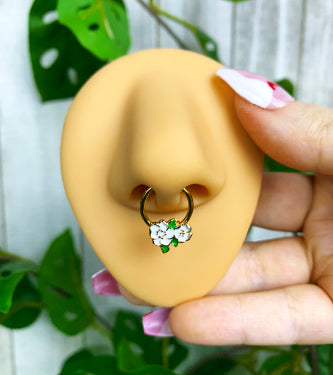




















You're comparing two captive bead rings that look nearly identical. One has a smooth, verified surface and clearly documented metal. The other just says “handmade,” but the seller can't explain what it's made from. That small difference matters far more than the artisan label.
What Handcrafted Body Jewelry Actually Means
Handcrafted body jewelry describes jewelry shaped, finished, or assembled through hands-on work rather than produced entirely by an automated manufacturing line. The phrase covers a wide range, from a one-off piece made for a specific customer to a small-batch collection produced in a studio with repeatable tools and techniques.
That range creates confusion. A piece doesn't become higher quality just because a maker touched it. A factory can apply “handmade” language to mass-produced inventory, while a small studio may use machines for cutting or threading and still perform the important shaping, polishing, setting, and inspection by hand.
Look for control, not just a story
A genuine artisan process usually gives one maker or a small team control over several stages:
- Shaping: Wire, sheet, or other stock is formed into the final silhouette.
- Finishing: Edges are smoothed, surfaces are polished, and textures are refined.
- Assembly: Components, closures, chains, and decorative elements are fitted together.
- Quality checks: The maker inspects the result for rough seams, poor alignment, loose settings, or defective threading.
That control can create subtle variation. Two pieces from the same small batch may have nearly identical dimensions while showing tiny differences in texture or stone placement. Those differences can be signs of individual attention, but they're not proof of safe or durable jewelry by themselves.
The useful question isn't “Was this touched by hand?” It's “Who controlled the material, finishing, and final inspection?”
For a piercing, craft quality has to work alongside body-safe design. The strongest signals are material disclosure, certification, surface finishing, accurate sizing, secure construction, and maker transparency. The rest of this guide uses those signals to separate meaningful craftsmanship from attractive marketing language.
Materials Used in Handcrafted Body Jewelry
Start with the material before you fall for the silhouette. A beautifully carved end or unusual hammered finish won't compensate for an undisclosed alloy, a rough surface, or a coating that can wear against your skin.

Start with implant-grade options
For fresh or sensitive piercings, implant-grade titanium certified to ASTM F136 or ISO 5832-3 is a strong technical benchmark. Those standards describe Ti-6Al-4V ELI titanium used in medical implants. Industry piercing standards accept this titanium for initial piercings because it's lightweight, highly corrosion resistant, and protected by a stable passive oxide layer that reforms quickly after abrasion, helping reduce ion release during wear. (Association of Professional Piercers jewelry standards)
Niobium is another material commonly chosen for body jewelry, especially when a maker can identify its grade and finishing method. With either metal, specific composition beats a vague “hypoallergenic” label.
EU-market jewelry also has strict nickel-release limits. Inserted posts for pierced ears and other pierced body parts must release less than 0.2 µg/cm²/week, while items in prolonged skin contact must remain below 0.5 µg/cm²/week. Implant-grade titanium is preferred partly because its specification is nickel-free, rather than depending on a surface coating that could wear. (European Chemicals Agency nickel restriction document)
Understand gold, silver, and natural materials
Solid 14k or 18k gold can suit healed piercings when the alloy is disclosed and appropriate for body wear. Gold plating is different. As the plating thins, the underlying metal reaches the skin, so plated jewelry needs more caution, particularly in a fresh or reactive piercing.
Sterling silver, marked 925, is popular with artisan makers and works well for decorative, healed-piercing jewelry for many wearers. It isn't the automatic choice for an unhealed piercing, where alloy composition, copper content, surface condition, and professional guidance matter.
Natural materials such as hand-cut horn, bone, responsibly sourced wood, glass, and stone are often used for stretched lobes and decorative ends. Their suitability depends on the specific piercing, the material's porosity, its finish, and how it's maintained.
Before comparing price or artistry, ask for material names, grades, alloy details, and any applicable certification. Craftsmanship begins with a material the maker can identify.
For a broader overview of common metals, see BodyCandy's body jewelry material guide.
Techniques That Define Artisan Craftsmanship
A handcrafted piece often reveals its process through details you can inspect. You don't need to be a jeweler. Bright light, a close look, and a few direct questions can tell you plenty.
Shaping leaves visible decisions
A maker may bend wire or sheet over mandrels, then forge it with controlled hammering to create a curve, taper, or texture. Hand-forged work can show gentle variation in a hammered surface or a curve that feels shaped rather than stamped. Variation should look intentional, not like a defect.
Stone setting uses equally practical techniques. A flush setting seats a stone level with the metal. Prongs hold a stone with small claws, while a bezel surrounds it with a metal rim. In each case, inspect whether the stone sits securely, whether the surrounding metal is even, and whether gaps or sharp edges catch on fabric or skin.
Finishing determines comfort
Hand-polishing can produce a reflective surface, while brushed finishing creates a controlled satin texture. A maker may also use patina on silver or copper for an antiqued appearance. Patina is a decorative surface treatment, not a substitute for a well-finished area that passes through a piercing.
Threading deserves special attention. Internally threaded jewelry keeps the rough thread inside the bar or component, allowing the smoother portion to pass through the piercing. Check that the thread starts cleanly, turns without catching, and meets the decorative end without a visible gap.

A close-up video can also help you recognize how jewelry moves from concept to finished form:
When you inspect a piece, focus on seam lines, symmetry, polish consistency, bead seats, and thread quality. For more design context, BodyCandy's guide to modern jewelry design offers a useful look at how ideas become wearable pieces.
Why Handcrafted Pieces Stand Out From Mass-Made
Put an artisan nose ring beside a mass-made version with a similar shape. The differences may be subtle at first, but they become clearer when you examine what touches your piercing, how the closure works, and what the seller can document.
Handcrafted production can offer more attention to finishing, customization, and small-batch details. Mass-made jewelry can offer consistency and accessibility. Neither label answers the safety question alone, and a higher price doesn't automatically prove better wearability.
| Dimension | Handcrafted | Mass-Made |
|---|---|---|
| Material information | Often presents a specific metal grade, alloy, or sourcing detail | May provide limited composition information |
| Surface finish | Can receive individual polishing and inspection | May rely on standardized finishing across large runs |
| Uniqueness | Small batches, custom details, and maker-specific textures | Repeated designs made for broad distribution |
| Fit options | May allow more choice in dimensions or decorative elements | Usually follows fixed inventory sizes |
| Quality verification | Maker can explain process and construction | Details may depend on the retailer or factory documentation |
The wider category also has substantial commercial momentum. The global body piercing jewelry market is estimated at US$2.0 billion in 2026 and projected to reach US$3.5 billion by 2033, implying an 8.5% CAGR over that period. That growth creates room for premium and design-led products, but it also means shoppers need sharper criteria because more products are competing for attention. (Persistence Market Research body piercing jewelry market overview)
The premium makes sense when it reflects identifiable labor, verified materials, careful finishing, and a useful fit or customization. It doesn't make sense when it only pays for romantic wording around an otherwise ordinary alloy.
How to Verify Real Craftsmanship Before You Buy
Treat “handcrafted” as a starting point, not a conclusion. A seller who knows the work should be able to answer practical questions without hiding behind broad terms such as artisan, premium, or hypoallergenic.
Use a buyer's checklist
- Check material certification. Look for ASTM F136 or ISO 5832-3 titanium, a clearly identified niobium grade, or documented solid-gold alloy information. For EU-market jewelry, ask how the product addresses nickel-release requirements.
- Study the finish. Under bright light, look for smooth surfaces, clean transitions, and consistent polish. Rough threading, pits, sharp edges, and uneven bead seats deserve caution.
- Inspect the setting. Stones and decorative elements should sit securely, with no visible gaps or movement. A pretty stone is still a problem if it catches, loosens, or presses unevenly against the piercing.
- Find the maker. A transparent studio can usually identify who made the piece, where it was made, and which steps happen in-house. Process photos can help, but they don't replace material details.
- Read the documentation. Care instructions, specifications, and batch or maker information show that the seller has thought beyond the product photograph.

Notice the red flags
Be wary of identical inventory appearing across many unrelated resellers, vague “hypoallergenic” claims with no alloy disclosure, and pricing that seems disconnected from the stated material. Ask which mill supplied the metal. A maker who knows the supply chain should be able to explain the answer or clearly state what information isn't available.
Nickel deserves extra attention because sensitivity is strongly associated with piercing. A systematic review reported an odds ratio of 5.9 in the general population and 3.6 in dermatitis patients, while older survey data found nickel release above regulatory thresholds in 16.2% of piercing posts and 24.7% of European earrings intended for piercing. (Nickel allergy statistics and source discussion)
For a concrete example of material and maker detail, explore BodyCandy's handcrafted 14kt gold nose ring information.
Caring for Handcrafted Body Jewelry
Artisan finishes need care that matches the material. A mirror-polished surface can show scratches quickly, while patina, porous stone, and natural materials may react badly to harsh cleaners.
For titanium, niobium, and suitable gold jewelry, use a gentle saline routine. For a new piercing, the Association of Professional Piercers recommends sterile saline only and gives a mix of 0.75 to 1.42 grams of non-iodized, fine-grain sea salt per 8 ounces of water, about 1/8 to 1/4 teaspoon per cup. (Association of Professional Piercers aftercare guidance)

Keep cleaning gentle
For healed jewelry, rinse away residue and pat dry with a clean, lint-free cloth. Avoid alcohol, hydrogen peroxide, bleach, and strong antibacterial products, especially around porous stones, patinated surfaces, and natural materials. Perfume and cosmetics should also stay off jewelry when possible.
Fresh piercings need a stricter routine:
- Wash your hands: Clean your hands before touching the area.
- Use sterile saline: Apply it without twisting or rotating the jewelry.
- Let the piece dry naturally: Pat surrounding skin gently if needed.
- Follow professional advice: A piercer can assess swelling, fit, and irritation.
Store each piece in a soft pouch or lined case so metal surfaces don't rub together. Inspect threaded ends and closures regularly, and pay attention to any new roughness, looseness, or change in fit. Good maintenance protects both the jewelry and the piercing it serves.
Styling and Occasion Ideas for Artisan Pieces
Style handcrafted jewelry by coordinating material, texture, and visual weight, not by matching every detail perfectly. A polished titanium or niobium piece can disappear neatly into everyday workwear, while a hammered ring, carved plug, gemstone end, or patinated element can carry an evening look.
Think about contrast. Warm gold works naturally with earthy colors and soft textures. Cool silver tones, blackened details, and polished titanium can sharpen monochrome layers. If one piece has a strong texture or a large decorative element, keep nearby jewelry simpler so the arrangement feels intentional rather than crowded.
Match the piece to the activity
Your favorite design still needs to suit the day. Low-profile jewelry makes more sense for sports, manual work, travel, or sleep. Secure threaded or threadless designs can be practical for long events, while fragile stones, porous materials, and delicate patinas deserve protection from impact, heavy moisture, and abrasive surfaces.
For a navel piercing, a common standard is 14G, with typical lengths of 3/8 inch or 7/16 inch. Nostril jewelry commonly uses 20G or 18G, while septum jewelry commonly uses 14G or 16G. These are reference points, not substitutes for measuring your anatomy or asking a qualified piercer to check the fit. (Body jewelry size help chart)
Gauge refers to the thickness passing through the piercing. Common sizes include 20G at 0.81 mm, 18G at 1.0 mm, 16G at 1.2 mm, 14G at 1.6 mm, 12G at 2.0 mm, and 10G at 2.4 mm. (BodyCandy gauge and size guide)
Make the story personal
A handcrafted piece can make a thoughtful gift for a birthday, piercing anniversary, milestone, or style change. Personalization works best when it improves the connection between the jewelry and the wearer, such as a meaningful stone, a preferred finish, or a fit selected for a specific placement.
Before gifting, confirm the intended location, gauge, length, closure, and material. A gorgeous piece that doesn't fit or isn't appropriate for a healing piercing becomes a decoration instead of wearable jewelry.
Your Next Move Into Handcrafted Jewelry
Decide what matters most before you browse. You may want everyday comfort, an unusual silhouette, precious-metal value, a specific finish, or a material that suits sensitive skin. That priority gives you a useful filter when every product photo looks tempting.
Then judge the piece by evidence rather than the word “handmade.” Look for:
- Published material details: The seller should name the metal or natural material and provide relevant grade information.
- Accurate dimensions: Confirm gauge, length, diameter, and the size of decorative elements.
- Clear construction: Check whether the closure is threadless, internally threaded, hinged, captive, or another design.
- Visible finishing: Product photos should show smooth surfaces, clean edges, and secure settings.
- Care guidance: The maker should explain how to clean and store the piece.
- A traceable maker: You should be able to learn who made it, where it was made, and what the studio does.
Handmade pricing needs the same clear-eyed approach. A higher price can reflect small-batch labor, precious materials, customization, and careful finishing, but it doesn't automatically prove comfort or safety. A distinctive design still needs suitable construction, verified metal, and a fit that works with your anatomy.
For healing or sensitive piercings, choose appropriate implant-grade materials and follow your piercer's advice. If a listing leaves out the alloy, measurements, closure, or care instructions, ask before buying. Sellers who make technical details easy to find give you more confidence than sellers who rely on vague artisan language.
BodyCandy offers a broad selection of body jewelry styles, including handcrafted and customizable options, so you can compare designs while checking the details that matter. Filter your search by style, gauge, length, closure, and material, then choose the piece that earns its place in your collection.
Explore the handcrafted and customizable body jewelry options at BodyCandy, and compare each piece by material, fit, finish, and design. Find your next artisan-inspired look, then share your questions with a piercer before wearing anything in a fresh or sensitive piercing.