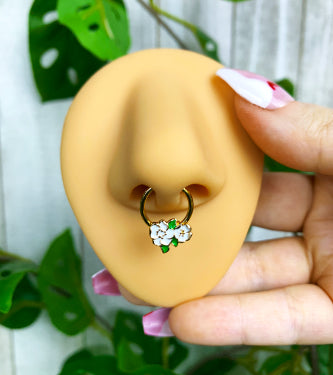

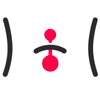


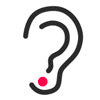





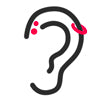







A clear nose ring spacer is a see-through retainer, not a healing tool, and its safety depends on material and fit rather than transparency. For qualifying plastic jewelry, California's lead restriction is below 0.02% by weight, equivalent to 200 parts per million, but meeting that limit alone doesn't establish suitability for a healing piercing.
Maybe you've got an interview coming up, your school has a jewelry rule, or you'd like your nostril piercing to attract less attention at a family event. A discreet retainer can sound like the perfect compromise. Before you buy the least visible option, check whether it's the right material, shape, and size for your nose.
What a Clear Nose Ring Spacer Actually Is
You need your piercing to be less noticeable, but you don't want to leave the channel empty. That's the basic job of a clear nose ring spacer, often called a nose retainer. It occupies the piercing channel while making the jewelry less prominent.
The word spacer can be confusing. It doesn't mean the piece is designed to stretch your piercing, treat inflammation, or speed up healing. Think of it as jewelry with a discreet appearance, not an aftercare product.
The jobs people ask a retainer to do
People usually reach for transparent jewelry for different reasons, and those reasons shouldn't all lead to the same purchase.
- Concealment: You want less noticeable jewelry for work, school, or an event. This is the most straightforward reason to consider a retainer.
- Placement during a necessary swap: You need an alternative to your regular jewelry. If the piercing is healing or irritated, a professional should assess whether changing it makes sense.
- A lower-metal option: You're concerned about material sensitivity. That calls for documented composition, not a product that looks like plastic.
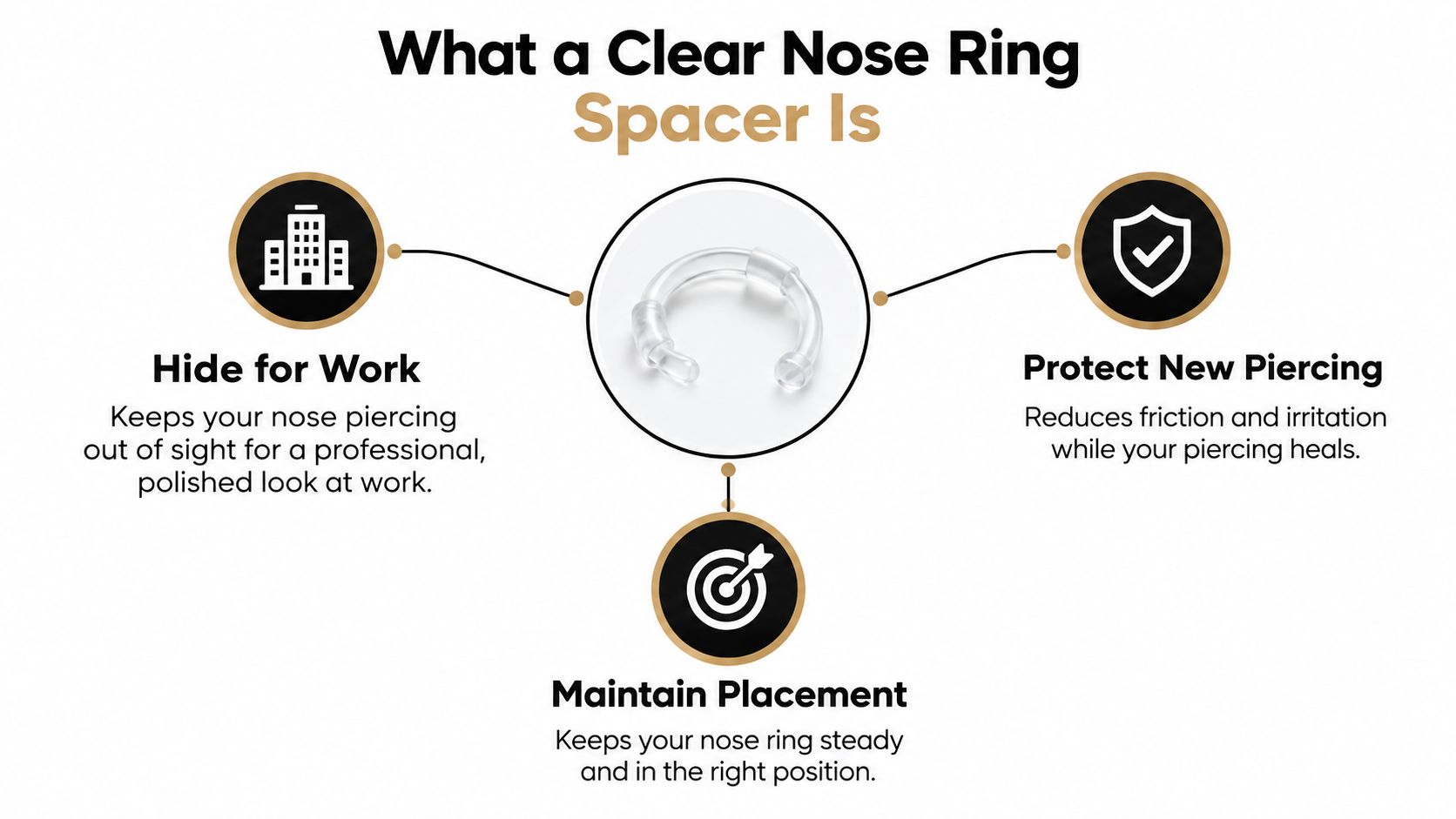
The concept map below shows the roles commonly associated with retainers. Its protection branch means considering an appropriate substitute when necessary, not treating a new piercing yourself.
Decide what problem you're solving
For a healed nostril piercing before a job interview, temporary concealment may be a reasonable goal. For a tender new piercing, however, the priority is keeping the healing process stable, not making the jewelry disappear.
A retainer also isn't a guarantee that an empty piercing will remain open after you remove it. Its placement function depends on wearing an appropriate piece, not merely owning one.
Start with your actual need: Less visible jewelry, a necessary replacement, and suspected material sensitivity are different problems.
If you'd rather wear a tiny decorative stud than hide the piercing altogether, a standard jewelry style may suit you better. Your purchase should follow your purpose, healing stage, and fit requirements, in that order.
Materials That Matter for a Clear Nose Ring Spacer
A listing that says only clear plastic hasn't told you enough. Transparency describes appearance; it doesn't identify the polymer, its additives, or the finished surface.
The California jewelry-law fact sheet documents the lead restriction described above and recognizes dense, low-porosity plastics within its body-piercing framework. Legal composition requirements are useful screening criteria, but they aren't a blanket endorsement of every transparent retainer.
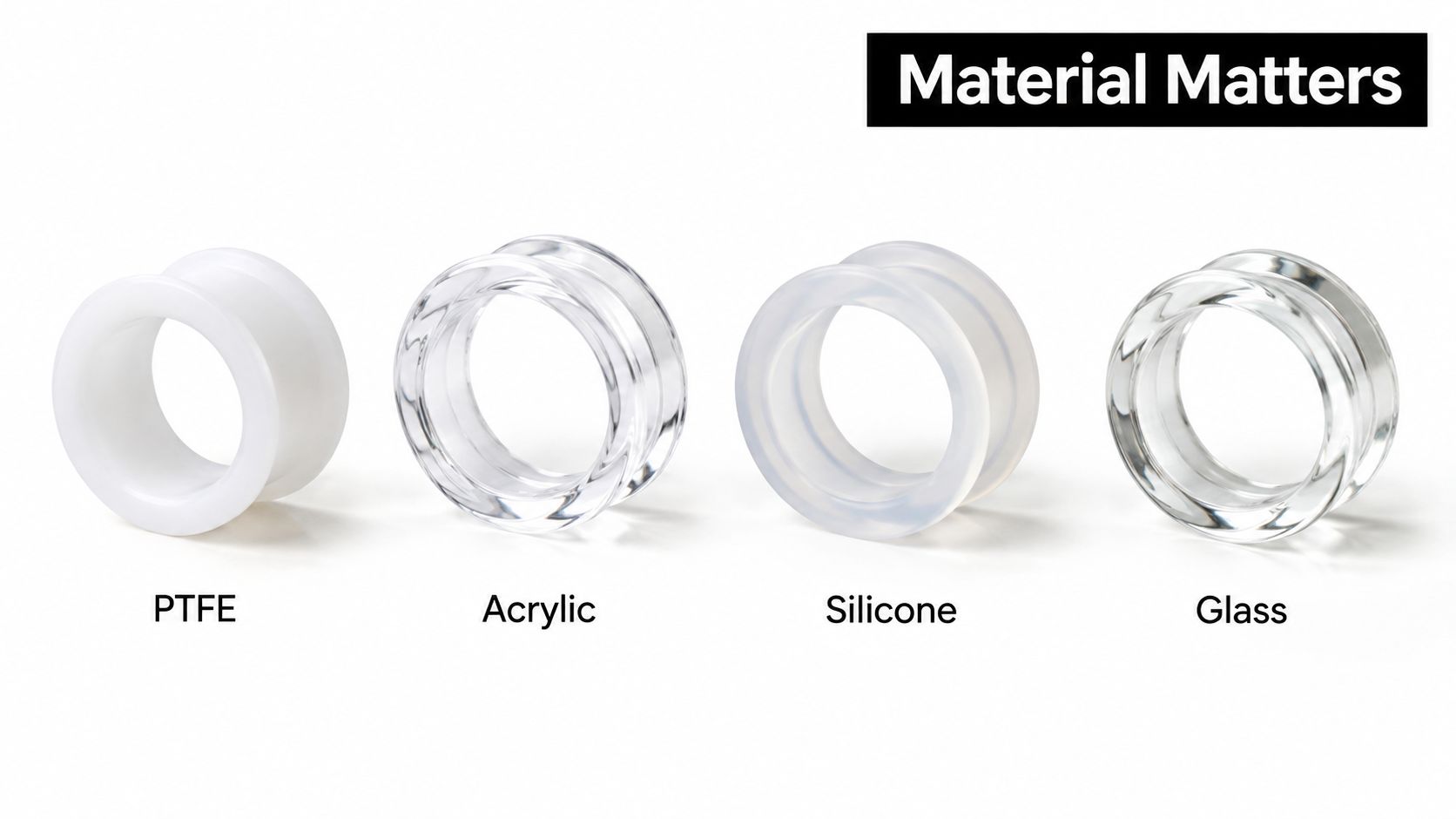
These material examples are shown as plugs, not nostril-fitting recommendations. Use the image to distinguish categories, not to choose a nose-jewelry shape.
What the material names actually tell you
PTFE, or polytetrafluoroethylene, is a specified polymer rather than a generic marketing label. Utah's body-piercing material rules specifically permit ASTM F754-compliant PTFE and high-density, low-porosity nontoxic plastics.
The ASTM F754 polymer specification includes cytotoxicity evaluation and a USP sterility requirement after sterilization. That's more meaningful than medical-grade without documentation, although raw-material compliance doesn't automatically validate a finished jewelry design.
Acrylic needs the same scrutiny. Even a listing describing biocompatible acrylic or medical-grade PMMA should explain its intended use and supporting documentation; those words aren't permission to install it in a healing nostril.
Silicone shouldn't receive automatic approval because it's soft. Ask for the exact formulation and relevant biological-testing documentation, such as USP Class VI or ISO 10993 testing where applicable to the polymer.
Glass isn't a polymer, so PTFE's standard doesn't apply to it. Have a piercer evaluate the specified glass jewelry and finished design rather than borrowing a plastic classification.
Read the listing like a checklist
- Material identity: Look for an exact name, not mystery plastic.
- Documentation: Ask which standard or biological testing supports the intended use.
- Dimensions: Both gauge and wearable length should be available.
- Finished-item preparation: Establish whether the actual jewelry is sterilized and packaged, not just whether the resin can tolerate sterilization.
- Missing information: An unexplained bargain price isn't proof of danger, but it shouldn't persuade you to overlook absent specifications.
Don't purchase first and investigate later. If the seller can't answer basic material questions, choose another option.
Clear Spacer Versus Standard Nose Jewelry
A retainer and a decorative nose ring can occupy the same piercing, but they serve different purposes. Your everyday jewelry might be chosen to show off a gem or hoop. A clear spacer is chosen primarily to reduce that visual emphasis.
Don't assume transparency means invisibility. Clear jewelry can reflect light, remain visible inside the nostril, or show from certain angles, as noted in WebMD's nose-piercing safety guidance.
Clear Spacer vs Standard Nose Jewelry at a Glance
| Jewelry type | Best for | Visibility | Healing suitability | Swap ease |
|---|---|---|---|---|
| Clear retainer | Temporary concealment when appropriate | Less prominent, not invisible | Requires professional material and fit assessment | Depends on shape and retention system |
| Metal nostril stud | A compact decorative look | A visible end or ornament | Suitable initial designs should remain under professional guidance | Depends on its attachment |
| Nostril screw | A stud with a curved retention shape | Primarily the outer end | Shape alone doesn't establish suitability | Curved insertion path needs care |
| L-bend | A stud with an angled post | Primarily the outer end | Must match anatomy and healing stage | The bend affects insertion and removal |
| Seamless hoop | A visible ring look | The ring remains noticeable | Don't make an elective healing-stage swap | Closure design affects handling |
The table is a decision aid, not a ranking. An L-bend isn't automatically safer than a screw, and a flexible retainer isn't automatically easier to install than your current stud.
Match the style to the situation
During healing, keep the original jewelry unless a qualified professional recommends a change. A smaller-looking replacement doesn't necessarily accommodate tissue in the same way as your initial piece.
For long-term healed wear, choose a style you enjoy and can wear comfortably. If you want the jewelry itself to be part of your look, a suitable metal stud or hoop is a more direct choice than a concealment retainer.
For short-term discretion, consider a clear spacer after checking its specifications. Choose a construction you understand rather than experimenting with an unfamiliar bend or closure just before you need it.
A retainer is an alternative piece of jewelry, not a universal upgrade from a stud or hoop.
Removal should never become a test of how long your piercing can stay empty. Have the replacement ready and ask for help if you're unsure about the insertion path.
Also, don't substitute a straight-back ear stud. Its backing is unsuitable for the nose and can trap bacteria, a concern identified in the safety guidance linked above.
How to Size a Clear Nose Ring Spacer the Right Way
Start with the jewelry that already fits, not a product photo. A retainer can look tiny on-screen and still be wrong for your piercing.
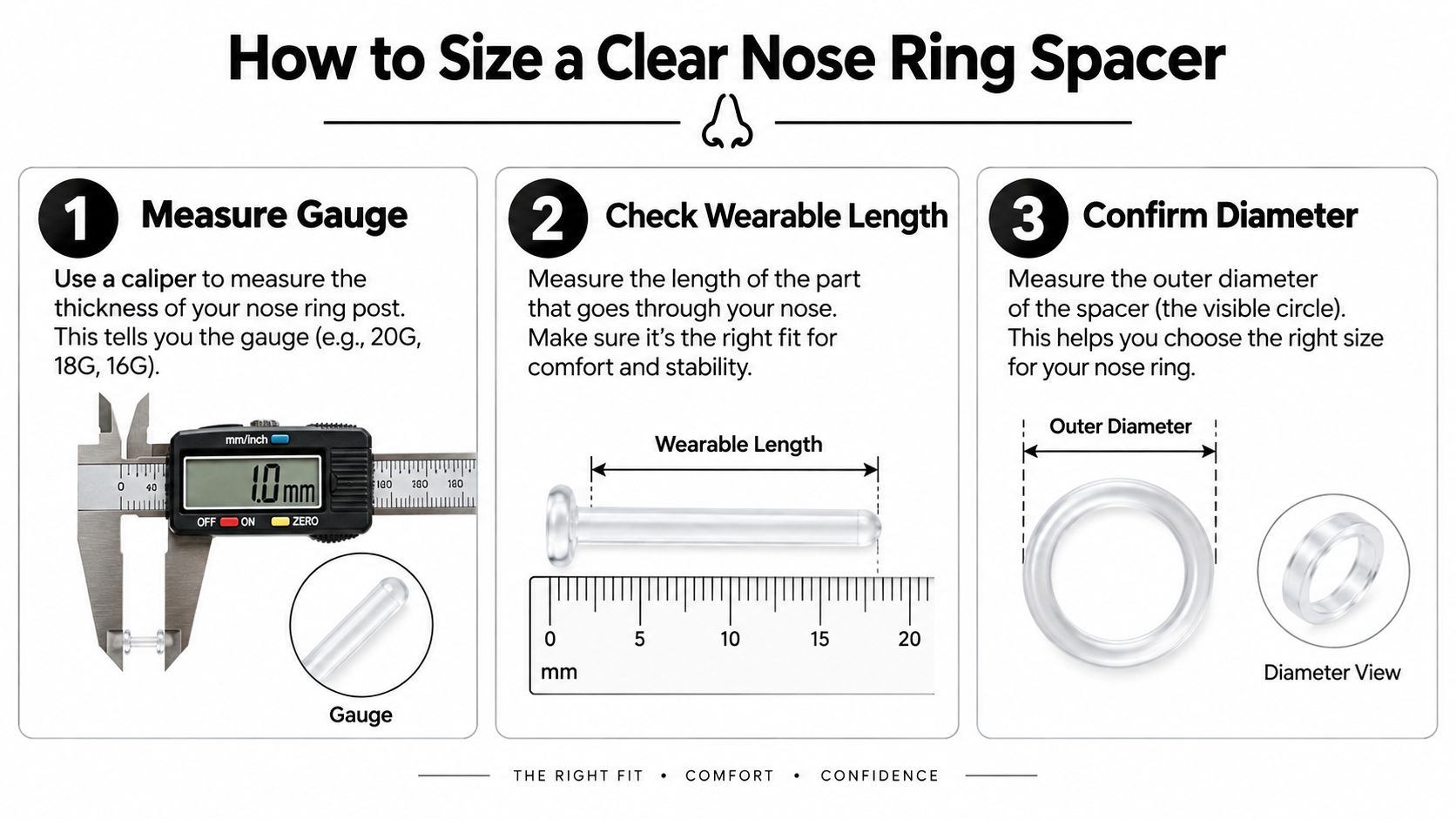
Gauge means the thickness of the part passing through the channel. Wearable length means the usable portion that accommodates your tissue, not the jewelry's total tip-to-tip measurement. Diameter describes a circular piece and matters when the design is ring-shaped.
Measure the relevant parts
Use the original order details, packaging, or your piercer's records to confirm gauge. Check any marking on the jewelry, but don't assume every post is stamped or that every marking identifies thickness.
For a spare stud, lay it flat and measure the usable post with a suitable ruler or calipers. Exclude decorative ends and retention features that don't sit within the tissue.
For a ring, establish whether the listing describes inner or outer diameter. A coin might help you visualize scale, but it isn't a reliable measuring tool for fit.
Use this graphic alongside your measurements, rather than estimating from the illustration.
Check pressure, movement, and finish
A post that's too short can compress tissue; an overly long one can move and snag. This piercing-jewelry discussion of sizing and surface quality also emphasizes avoiding scratches, burrs, rough ends, and manufacturing defects.
PTFE's flexibility can accommodate movement, but it doesn't rescue incorrect dimensions. Don't deliberately size down because a piece can bend, and don't force a thicker post through the channel.
Save this checklist beside your jewelry box:
- Gauge confirmed: Match the established piercing size.
- Wearable length checked: Measure usable space, not the decorative head.
- Diameter clarified: Confirm the seller's measurement convention.
- Insertion end inspected: Use bright light to check for seams or damage.
- Fit assessed: The jewelry shouldn't dig in or slip out.
For help separating measurements from construction styles, use the nose ring guide to length, gauge, and style. If your current jewelry feels wrong, have a piercer measure your anatomy instead of copying its size.
When People Actually Reach for a Clear Spacer
The same retainer can be a sensible purchase for one person and a poor choice for another. The difference is often the situation, not how discreet the product looks.
A professional outfit is a common reason to want less prominent jewelry, but the decision starts before you get dressed.

A new piercing and an interview tomorrow
Your nostril piercing is new, and you've suddenly been invited to an interview. Swapping to a retainer at home might feel like the quickest fix, but appearance shouldn't override the healing-stage decision described earlier.
Call your piercer and explain the deadline. Ask whether any change is appropriate and whether they can handle it, rather than treating a transparent replacement as harmless.
Your next step: Get professional advice before touching the jewelry. You can also ask the interviewer about their jewelry policy instead of assuming concealment is required.
A dress code and a healed piercing
Your piercing is settled, but school or work doesn't allow noticeable jewelry. First establish what the rule says: a ban on visible metal isn't necessarily permission to wear a clear retainer.
Sports rules deserve the same check. Don't assume nonmetal jewelry is exempt from a requirement to remove all jewelry.
Your next step: Confirm that retainers are allowed, then select a documented, properly fitted piece. The guide to retainers for making modifications less visible offers additional concealment context.
For another look at the topic, watch the video below.
Sensitive skin and a break from metal jewelry
You've had reactions to certain jewelry and want another option. That doesn't automatically mean a transparent polymer is your only route.
Mayo Clinic's piercing guidance identifies titanium, niobium, surgical stainless steel, and 14–18-karat gold as lower-allergy-risk options. Material composition still matters, especially with a known sensitivity.
Your next step: Bring your sensitivity history and the proposed retainer's specifications to a professional. There isn't a universal polymer-wear deadline that applies to every product, so ask about that item's intended duration and care requirements.
Allergy, Irritation, and When to Stop Switching
Making jewelry less visible doesn't make a tissue reaction disappear. A clear spacer can satisfy an appearance preference while leaving the underlying problem unresolved.
Nickel is the most common allergen associated with body piercing, and allergic contact dermatitis is the most frequent non-infectious complication described by DermNet's body-piercing overview. A surgical stainless steel label also doesn't automatically establish that a product is nickel-free, so sensitive wearers need composition details.
Symptoms aren't a home diagnosis
Itching after wearing a particular material may raise concern about allergy. Tenderness after snagging jewelry may suggest mechanical irritation. Neither observation reliably rules out another problem.
Persistent redness, swelling, increasing pain, warmth, bleeding, or discharge deserves professional assessment. You shouldn't decide that a symptom is harmless because the retainer is described as hypoallergenic.
- Possible material reaction: Stop experimenting with products and seek advice about a documented alternative.
- Pressure or snagging: Ask a piercer to evaluate fit and surface condition.
- Persistent or worsening symptoms: Contact a healthcare professional rather than making another cosmetic swap.
- Tissue growing over jewelry: Get professional help instead of trying to pull the piece through.
The guide to allergic reactions, piercing care, and irritation can help you organize your concerns before that conversation. It isn't a substitute for examining a troublesome piercing.
Know what to tell the professional
Describe when symptoms began, which jewelry you were wearing, and whether anything changed beforehand. Useful details include a recent swap, a snag, a new cleaning product, or a known metal sensitivity.
Bring the retainer's packaging or listing information if you have it. Exact material and dimensions give a piercer or clinician more useful information than saying the piece is clear.
Stop the swapping cycle: Repeated changes aren't a reliable way to diagnose allergy, irritation, or infection.
For mild discomfort that's improving, follow your established aftercare advice and monitor it. If you're unsure whether symptoms are improving, or they persist or worsen, seek help rather than repeatedly testing different jewelry.
Care, Cleaning, and When to Replace a Clear Spacer
A clear retainer still needs an appropriate care routine. Keep piercing aftercare separate from cleaning removable jewelry, especially while the channel is healing.
Complete healing commonly takes about 2–4 months, although placement, individual healing, and irritation affect the timeline; during that period, avoid twisting, rotating, or playing with the spacer, and keep it in while sleeping unless a qualified piercer or healthcare professional advises otherwise, according to Medical News Today's nose-piercing care guidance.
Keep the routine gentle and material-specific
Follow your piercer's instructions for saline use around the piercing. For removable jewelry from a healed piercing, ask whether mild soap and warm water are compatible with that particular product.
Don't use alcohol, hydrogen peroxide, or harsh makeup remover as a default cleaning method. Have the manufacturer or piercer confirm suitable products rather than experimenting on an unspecified polymer.
- Ultimately: Check for pressure, accumulated residue, or a change in how the retainer sits.
- During regular inspection: Look under bright light for cloudiness, cracks, warping, or rough areas.
- Before reuse: Confirm the piece is clean according to its material-specific instructions and hasn't been damaged.
A weekly inspection can be useful, but don't turn it into an automatic deep-cleaning swap schedule for a healing piercing. Home cleaning also isn't the same as professional sterilization.
Sleeping, swimming, and medical imaging
Sleeping: Follow the healing-stage guidance above. For healed wear, ask whether the retainer's construction and intended use suit overnight wear.
Swimming: A clear spacer isn't protection from water exposure. Ask your piercer about swimming based on your healing stage rather than assuming the material changes your aftercare requirements.
MRI: PTFE is non-magnetic and radiolucent, but that doesn't authorize every retainer for every appointment. Tell the imaging team exactly what you're wearing and follow their instructions.
Replace a spacer that becomes cloudy, cracked, rough, or permanently deformed, as described in the surface-quality guidance earlier. If you can't identify the material or care requirements, don't keep guessing.
Explore nose rings and discreet retainer options at BodyCandy when you're ready to choose your next piece. Check the material, gauge, and wearable length before buying, and let your anatomy, healing stage, and skin needs guide the choice, not just how well it disappears in a selfie.