


















Have you noticed how nearly every guide to body piercing jewelry types reads like a flat catalog, listing names without explaining when each piece works? A ring, stud, or barbell isn't just a look. Its closure, shape, thickness, weight, and fit all need to cooperate with your anatomy and your daily routine.
That's why the right jewelry for a healed septum may be completely wrong for a fresh cartilage piercing. Let's walk through the case together, piece by piece, so you can choose jewelry with more confidence and fewer painful surprises.
Why Knowing Your Jewelry Types Matters
Why does the same piece feel comfortable in one piercing and cause problems in another? Each jewelry type solves a different practical need. A straight barbell connects two ends across a defined path, a labret stud places a flat disc against the back of the tissue, and a ring relies on its diameter and closure to move comfortably. The name identifies the piece, while its construction helps determine where it belongs.
Fit errors can cause specific problems. A barbell that is too short for a fresh nostril piercing can press into swollen tissue and become embedded within days. A loose ring may catch on hair or clothing, while decorative gaps can hold buildup that is difficult to clean. Jewelry that shifts repeatedly can irritate the channel and contribute to migration.
Practical rule: Choose jewelry by placement first, then anatomy, material, size, closure, and style.
A fresh helix shows why placement comes first. A continuous ring may look simple, but its movement can rub healing cartilage. A properly fitted flat-back labret usually presents a lower-profile surface against the ear, making it a practical choice for that stage. For a navel piercing, a curved barbell follows the tissue's shape more naturally than a straight post.
The same reasoning applies across placements. Gauge describes thickness, while post length or ring diameter determines the space available for tissue. Closure style affects cleaning, removal, and the chance of snagging. For an initial piercing, implant-grade titanium is a common material sweet spot when the jewelry meets recognized standards. The Association of Professional Piercers outlines suitable metals and alloys, including implant-grade titanium and biocompatible grades such as ASTM F-138 stainless steel or ISO 5832-1 steel, in its Association of Professional Piercers jewelry standards.
Use this guide like a conversation at the jewelry counter. Each section connects a jewelry type with its best-use piercing, a sensible material choice, and the everyday conditions that affect comfort and healing.
The Main Body Piercing Jewelry Types Explained

Straight barbells
A straight barbell is a straight post with a closure at both ends, usually threaded balls, discs, or decorative ends. It's commonly associated with tongue piercings and industrial piercings, where the bar needs to span a defined path.
Its advantage is stability. The straight shape stays aligned with a straight piercing channel. The drawback is that it can press against nearby tissue if the length doesn't match your anatomy. Internally threaded ends keep the exterior of the post smooth, while threadless ends use a pin-and-post tension system for interchangeable styling.
Labret studs
A labret stud has a flat disc on one side and a decorative end on the other. The disc rests inside the lip or behind the ear, so there's no rounded ball pressing into nearby tissue.
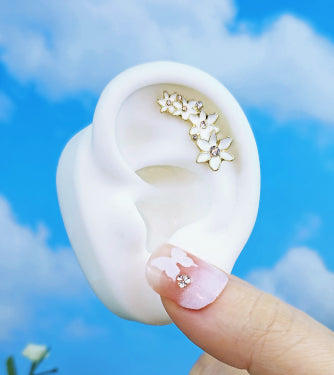
Labrets are especially useful for lip piercings and cartilage placements such as the helix, conch, and tragus. Their low profile can make sleeping and headphone use easier, but the post still needs enough room for swelling during initial healing.
Captive bead rings and horseshoes
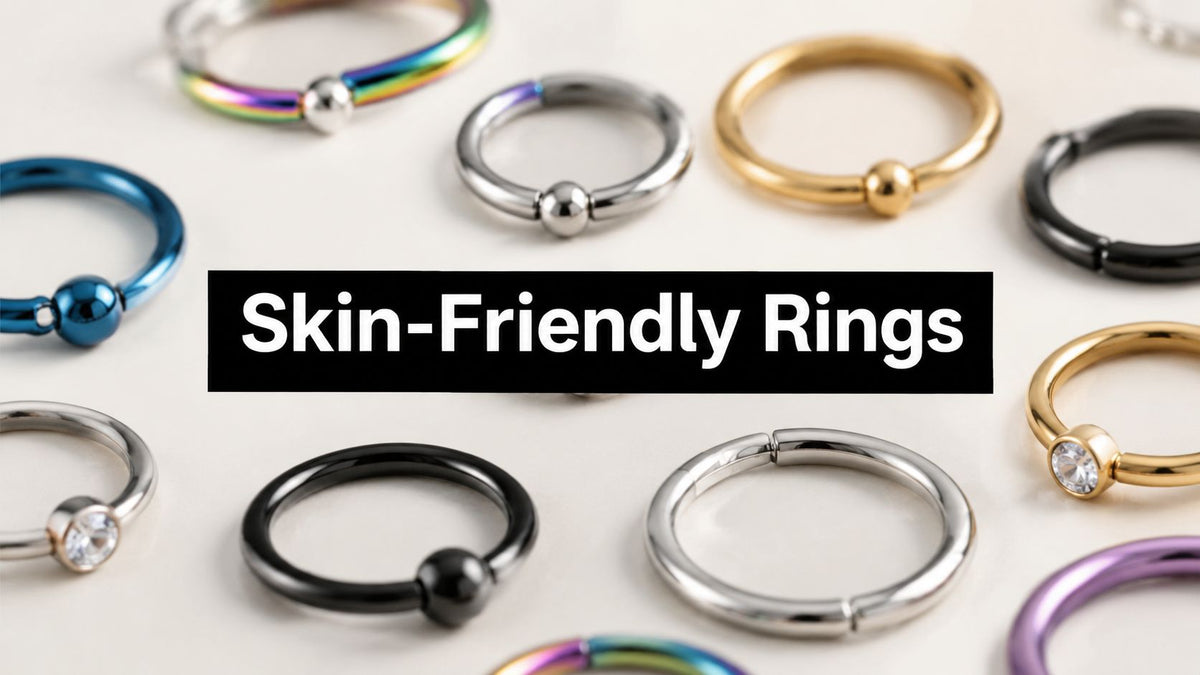
A captive bead ring forms a circle closed by a removable bead or segment held under tension. The bead can be small and discreet or replaced with a decorative option. These rings suit healed septum and ear piercings, although the closure can be fiddly to handle without the right fit.
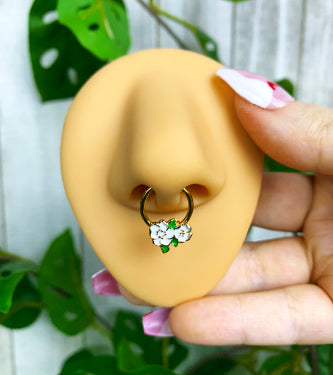
A horseshoe barbell is a circular piece with two ends, commonly balls or charms. It works well in septum, cartilage, and other ring-style placements where you want a visible opening and symmetrical ends. Its open shape offers personality, but exposed ends can snag more easily than a smooth hinged ring.
Hoops and clickers
Hoops come in several constructions:
- Hoops have a continuous-looking circle with an opening that must be aligned carefully.
- Segment rings use a removable section to complete the circle.
- Hinged hoops open on a built-in hinge and close at a defined latch.
- Clickers use a hinged segment that snaps shut with a distinct click.
Clickers are popular for septum and daith placements because the hinge simplifies opening and closing. Their moving parts need careful cleaning, and the ring must be fitted to the placement rather than chosen only for its visual diameter.
Plugs, tunnels, and specialty pieces
Plugs fill a stretched lobe, while tunnels leave an open center so you can see through the jewelry. Both are intended for stretched piercings, and the material and finish matter because a rough edge can irritate the lobe.
Specialty options add even more personality. Threadless pins let you swap decorative ends without screwing them on. Bananabells, also called curved barbells, follow curved placements such as the navel. Spiral tapers create a dramatic stretched-lobe look, but they shouldn't be treated as permanent jewelry unless a professional confirms the design and fit are appropriate.
For a quick category reference, BodyCandy's guide to basic body jewelry types covers forms such as captive bead rings and horseshoe barbells.
Comparing Popular Jewelry Materials
Which material should sit against your skin all day? Start with the piercing's needs, then consider color and style. Implant-grade titanium is often the safest default for a fresh piercing because it is lightweight, biocompatible, nickel-free, and suitable for sensitive skin. ASTM F136 specifies Ti-6Al-4V ELI, a titanium alloy containing about 6% aluminum and 4% vanadium. This grade is widely used for surgical implants, as outlined in the body jewelry materials reference.
Surgical stainless steel is durable and often more budget-friendly, but it may contain trace nickel. People with nickel sensitivity may find it less comfortable, even when the piece is marketed as “surgical.” Solid gold can suit fresh or healed piercings when it is nickel-free and made with body-safe alloys. Higher-karat gold is softer, so the alloy and surface finish still affect how well it wears.
Niobium is another hypoallergenic option. It can be anodized into vivid colors without relying on plating. Acrylic feels light and offers plenty of color, though it is better reserved for healed piercings and shorter wear rather than fresh tissue.
| Material | Fresh Piercing Safe | Nickel Content | Best For | Price Tier |
|---|---|---|---|---|
| Implant-grade titanium | Yes, when properly certified and fitted | Nickel-free | Fresh piercings, sensitive skin, daily wear | Higher |
| Surgical stainless steel | Placement and individual sensitivity matter | May contain trace nickel | Durable healed jewelry and budget-conscious wear | Budget to mid-range |
| Solid gold | Yes, when nickel-free and body-safe | Depends on alloy | Healed style and selected fresh piercings | Higher |
| Niobium | Suitable option when properly made | Nickel-free | Sensitive skin and colorful jewelry | Mid-range to higher |
| Acrylic | Best for healed piercings | Usually not the main concern | Lightweight color and short-term styling | Budget |
Match the material to the job: titanium works like a dependable daily base, gold adds polished style once the fit and alloy are appropriate, and acrylic is better for temporary color on healed tissue. For practical details about common metals and finishes, read BodyCandy's body jewelry material guide.
Treat “hypoallergenic” as a starting label, not a guarantee. A 2025 systematic review reported critical nickel release in 11.3% of European earrings, 31.1% in North America, and 34.5% in Asia. Certification and clear material information therefore matter more than a vague product description, according to the 2026 body jewelry trend and materials discussion.
How Gauge and Size Affect Comfort and Healing
Here's the sizing shorthand that saves the most confusion: gauge is thickness, length is the straight wearable portion, and diameter is the distance across a ring. They aren't interchangeable. A ring can have the right gauge but still be too small in diameter, while a barbell can have the right thickness but be too short for swelling.
Common industry references place many cartilage piercings at 16G, or 1.2 mm, with tragus jewelry often measuring 6 to 8 mm in diameter. Navel starters are commonly 14G with 10 mm curved barbells, while nipple jewelry often uses 14G with 14 to 16 mm barbells, as summarized in this implant-grade titanium sizing guide.
A piercer may begin with a longer post to allow for swelling and cleaning access, then assess whether downsizing is appropriate once swelling settles. Don't downsize by guesswork. Tissue thickness, angle, placement, and swelling all change the measurement.
| Piercing | Typical Gauge | Starting Length/Diameter | Healed Size |
|---|---|---|---|
| Navel | 14G | 10 mm curved barbell | Fit depends on anatomy |
| Nostril | 20G or 18G | 1/4 in or 5/16 in length | Placement-dependent |
| Lip or labret | 14G or 16G | 1/4 in, 5/16 in, or 3/8 in length | Placement-dependent |
| Cartilage | 16G, or 1.2 mm | Tragus rings often 6 to 8 mm diameter | Anatomy-dependent |
| Nipple | 14G | 14 to 16 mm barbell | Anatomy-dependent |
The BodyCandy gauge sizing guide can help you recognize the terminology before you shop. For a professional fitting, bring the jewelry or ask your piercer to measure the current piece rather than relying on memory.
Too-short jewelry can compress swollen tissue. Too-small ring diameter can increase friction and pressure, while excess length can catch on clothing. Correct sizing is comfort, healing support, and appearance all at once.
Fresh Piercing Jewelry vs Healed Piercing Style
A fresh piercing needs jewelry that supports healing, not jewelry that wins the most compliments on day one. The safest starting point is usually simple, smooth, lightweight, and made from a verified biocompatible material. Implant-grade titanium is the practical default, with solid nickel-free gold or niobium as alternatives when properly selected.
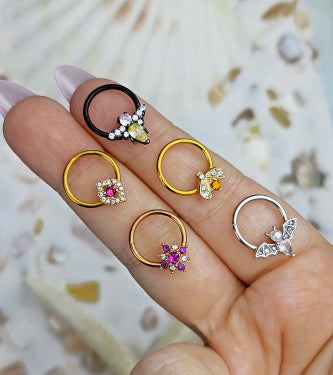
Trend pieces such as seam rings, dangles, gemstone clusters, and ornate decorative ends can look fantastic in a healed piercing. They may also add movement, weight, edges, or cleaning challenges that a fresh piercing can't tolerate. The distinction isn't about boring versus exciting. It's about matching the jewelry to the tissue's current condition.
Check the construction before the sparkle
For starter jewelry, choose a closure that stays secure and presents a smooth surface. Threadless and internally threaded pieces can both work when made and fitted correctly. Push-pin systems, another name for threadless construction, use tension instead of screw threads and allow decorative ends to be changed later.
Healed-piercing style gives you more freedom:
- Seam rings: Sleek, but the seam must close cleanly and stay aligned.
- Clickers: Convenient for septums and other ring placements, with a hinge that needs regular cleaning.
- Dangle pieces: Expressive, but more likely to move, snag, or add weight.
- Gemstone clusters: Visually rich, but their settings need careful cleaning.
- Decorative ends: Easy to personalize when the base post is already correctly fitted.
A trendy piece may not be ready for a fresh piercing if it's plated, coated, heavy, rough, difficult to sterilize, or designed to move constantly. “Hypoallergenic” alone doesn't confirm the metal grade.
Fresh-piercing test: If the piece adds friction, pressure, weight, or hard-to-clean detail, save it for later and ask a professional piercer when it's appropriate.
Matching Jewelry Types to Real Life
A dangling septum clicker catches on a gym towel during burpees. Jewelry needs to suit both the piercing and the routine around it, because placement changes which shapes stay comfortable and secure.
Sleeping
Flat-back labrets suit ear cartilage and lobe piercings when you sleep on your side. Their low profile keeps less hardware against the pillow, while titanium works well when the piece must stay light and smooth. A navel barbell creates a different problem: its curved bar and decorative ends can press into bedding when you sleep on your stomach. Choose a fitted, low-profile barbell and avoid putting direct pressure on the navel.
A post that is too long can snag on fabric. One that is too short can press into swelling or tissue, so fit matters as much as the design.
Working and exercising
Office wear pairs well with small decorative ends on flat-back labrets, especially for ear or nostril piercings. Secure threadless or internally threaded ends keep the profile tidy without dangling movement. A curved barbell can suit a healed eyebrow or navel piercing, but its exposed ends may catch on uniforms or equipment.
For workouts, pick low-profile jewelry for placements near straps, towels, and helmets. Hinged segment hoops and clickers work best in healed piercings when their closures sit flush. Contact sports can still pull on ear, nose, or lip jewelry. Remove a piece only after a professional confirms the piercing can safely remain empty.
Social plans and special occasions
Healed lobes, septums, and navels can carry more expressive styles. Dangle barbells add movement, statement rings frame a septum, and gemstone clusters bring detail to a healed helix or lobe. Wear them when you can watch for snags, then remove pieces before sleeping or doing activities that pull on the jewelry.
Travel calls for a smooth titanium stud or well-fitted labret, especially for nostrils and ears. Saltwater swimming can still irritate or contaminate a piercing, so travel jewelry does not replace appropriate healing care.
Lifestyle shortcut: Match the placement to the routine. Choose low profile for sleep, secure closures for movement, and expressive pieces for occasions when you can keep an eye on them.
Aftercare Tips That Change With Each Jewelry Type
The basic routine stays gentle, but the jewelry's shape tells you where to pay attention. Wash your hands before touching the area, use sterile saline as directed by your piercer, and avoid unnecessary twisting or turning. Don't use alcohol, hydrogen peroxide, or harsh ointments on a healing piercing.

Match cleaning to the construction
- Threaded barbells and labrets: Let saline reach the entry points and threaded ends, then dry gently with a clean disposable product. Avoid spinning the post.
- Captive bead rings: Clean around the bead and the areas where the ring meets the piercing. A soft, clean brush can help remove buildup without forcing the bead.
- Seam rings and clickers: Don't twist the jewelry through the channel. Check that the seam or hinged closure is fully closed and free of residue.
- Dangle pieces: Keep movement to a minimum during healing. Clean the decorative portion separately and watch for snags.
- Plugs and tunnels: Leave them alone during healing and follow a piercer's instructions for stretched tissue. Rough surfaces and forced insertion can damage the lobe.
Coated or plated jewelry needs extra attention because worn finishes can expose a different underlying material. Review BodyCandy's care guidance for coated and plated body jewelry before using those finishes.
Know when the fit needs professional attention
A labret or barbell may need a fit check when pressure bumps appear beneath the flat back, crust persists around threaded ends, or the post begins pressing into tissue. A ring may need assessment if it pulls, rotates constantly, or leaves a pressure mark.
Downsizing should happen only after swelling has settled and a piercer confirms the new length. Healed piercings still benefit from occasional removal and gentle cleaning. Store spare pieces clean and protected, and never force jewelry through resistance.
Picking Your Next Piece and Caring for It Long Term
Which piece suits your piercing today, and will it still work as your routine changes? Use the guide as a decision map. A fresh cartilage piercing pairs with a correctly fitted implant-grade titanium labret. For a healed septum, choose a clicker or horseshoe when you want more personality. A healed stretched lobe calls for comparing plugs and tunnels by finish, comfort, and visual openness.
Long-term care is simple but regular. Store spare pieces in clean bags or containers, check threaded connections, and replace worn o-rings before they lose grip. Retire jewelry that becomes rough, discolored, loose, or difficult to close rather than asking the piercing to tolerate it.
If sizing or healing concerns remain, ask a professional piercer. Share your question in the comments for more conversation.
Ready to match your next piece to your piercing and real life? Browse the BodyCandy collection for labrets, rings, barbells, belly jewelry, and colorful style options. Choose the material and fit before focusing on sparkle. Have a sizing or closure question? Leave it in the comments and start the conversation.