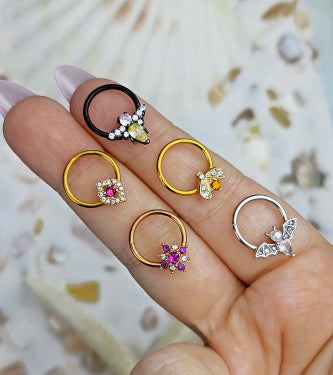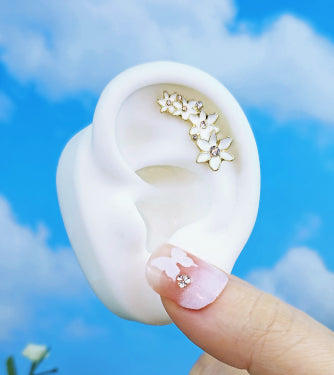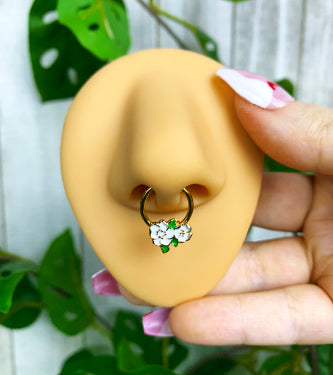

















Have you ever looked at a captive bead ring and wondered how a bead can stay in place without a screw, hinge, or clasp? The answer is simpler, and more mechanical, than it looks. A captive bead ring uses the spring tension of the hoop and two tiny dimples in the bead to keep the jewelry closed.
That simple setup explains both the appeal and the common frustrations. A properly fitted ring can feel secure and look clean, but the wrong gauge, worn bead, unsuitable metal, or rough handling can make the bead wobble or pop out. Let's break down how captive bead rings work, how to handle them safely, and when another style may suit your piercing better.
What a Captive Bead Ring Actually Is
A captive bead ring, often shortened to CBR, is a nearly continuous metal hoop with a small opening. A ball or decorative bead sits in that opening, held there by pressure from the two ends of the ring.
The bead isn't glued to the hoop. It isn't threaded onto it, either. It's “captive” because the ring traps it between its ends. From across the room, the jewelry may look like one complete circle with a bead attached. Up close, you can find a tiny gap and the two points where the ring rests in the bead.

The three parts you need to recognize
Think of the ring as a small spring-loaded frame:
- The circular hoop passes through your piercing and provides the tension.
- The two ring ends sit on opposite sides of the bead.
- The bead fills the gap and gives the ring its finished look.
Each side of the bead has a small dimple, or indentation. The ring ends sit in those dimples, so the bead can't slide sideways while you're wearing it.
This design works across many placements because the hoop can be made in different gauges and diameters. You'll see captive bead rings used for healed earlobes, cartilage, nostrils, septums, daiths, nipples, and other placements. The format was already appearing in specialized body-jewelry distribution by the mid-1970s. A Gauntlet jewelry catalogue dated August 15, 1976 included captive bead and fixed bead styles, according to Point 73's historical timeline of American initial piercing jewelry.
The important idea is this: the bead doesn't do all the work. The bead provides the seat, while the hoop's spring force keeps both sides pressed into position.
The Mechanics Behind the Spring-Tension Closure
A traditional captive bead ring has three working components, and each one has a specific job.
The hoop creates the pressure
The circular wire is made with a small gap rather than a fully closed circle. When the ring is opened correctly, the ends move apart. When released, the metal tries to return to its original shape.
That returning force is the spring tension. It pushes the ring ends inward against the bead, which keeps the closure secure during normal wear.
The dimples stop sideways movement
The bead has two small dimples, one for each end of the ring. Those indentations give the ends somewhere to sit. Without them, the bead could drift along the hoop or fall through the opening.
To close the ring, one dimple lines up with one ring end. The opposite side is pressed into position until the second end seats in the other dimple. The bead should sit centered, flush, and stable rather than leaning away from the hoop. A traditional tension-style ring typically uses a gap that's about 1mm smaller than the bead size, helping the bead remain captured, as explained in this guide to opening and closing captive bead rings.

The design's staying power comes from its lack of moving hardware. There's no hinge to loosen and no threaded part to cross-thread. Captive bead rings became a standard form of piercing jewelry in the modern body-modification industry by the mid-1970s, and the same basic physics still makes sense today.
Mechanical rule: A secure bead needs both a correctly shaped seat and enough spring tension to hold it there.
Problems usually begin when one of those elements changes. A very thin ring may not hold its shape well after repeated bending. Flattened dimples can give the bead less grip. A low-quality alloy may lose its spring memory, meaning it no longer returns firmly to its original position. That's why understanding the closure matters more than knowing that “the bead snaps in.”
How to Open and Close a Captive Bead Ring Safely
Treat a captive bead ring like a small piece of precision hardware, not like a key ring you can yank open. The goal is to widen the gap only enough to release the bead, then return the hoop to its original shape.
Start by washing your hands. Place the ring on a clean towel in a bright, uncluttered area. A towel gives the bead somewhere soft to land and reduces the chance that it'll roll under furniture.

Release the bead without warping the hoop
Use ring-opening pliers or two pairs of smooth-jaw pliers. Hold the ring on either side of the gap, then twist the ends in opposite directions. One end moves slightly forward while the other moves slightly back.
That twisting motion opens the ring without pulling the ends straight apart. A side-to-side wiggle can weaken the circular shape, leaving you with a hoop that doesn't close evenly. You only need enough space for the bead to slip free.
Once the bead is out, guide the ring through the piercing by following the existing angle of the channel. Don't drag it sideways or force it through a spot that feels tight. If the jewelry resists, stop rather than turning a minor fit problem into irritation.
Reseat the bead carefully
After the ring is through, bring the ends back toward each other using the same controlled twisting motion. Place the bead between them and align one dimple with one end. Press the opposite side into place until the second end seats in the other dimple.
Check the closure from several angles. The bead should feel snug, sit flush with the ring, and resist light movement. If it wobbles, the ends may not be aligned, or the ring may have lost its tension.
For additional guidance on handling the bead, you can review this body-piercing ball removal tool guide.
Know when the ring needs professional help
A dropped bead is annoying but usually replaceable. A ring that has been over-bent is a different issue. If the hoop no longer springs closed, don't keep forcing the bead into place. The metal may need professional adjustment, or the jewelry may be ready for retirement.
Never pry a CBR open with fingernails, teeth, or craft pliers. Those methods can scratch the finish, distort the hoop, or create rough edges that irritate the piercing.
Sizing Your CBR by Gauge and Diameter
A captive bead ring has two separate size measurements, and they solve two separate fit problems.
Gauge measures the thickness of the metal that passes through your piercing. Diameter measures the inside distance from one edge of the hoop to the opposite inside edge. A ring can have the right diameter but the wrong gauge, or the right gauge but a diameter that pinches.
The available range is broad. Captive bead rings may start around 22g, or 0.60mm, and extend to 00g, or 10.00mm, for stretched piercings, according to this captive bead ring size reference. Other sizing references list common diameters such as 6mm, 8mm, 10mm, 12mm, and 19mm, with gauges commonly ranging from 18g through 00g in body jewelry.
Compare the measurements by placement
| Piercing | Typical Gauge | Typical Diameter | Notes |
|---|---|---|---|
| Cartilage-related placements | 18g to 16g | 6mm to 8mm | A smaller inside diameter can hug the ear without pressing into the cartilage. |
| Earlobe | Varies by existing piercing | 8mm to 10mm | Choose a diameter that clears the lobe without hanging excessively. |
| Nostril | Varies by existing piercing | 8mm to 10mm | The ring should follow the nostril without pulling the piercing channel. |
| Septum | 14g to 10g is common for larger placements | 10mm to 14mm | Fit depends on anatomy and the desired amount of drop. |
| Daith | Match the established piercing gauge | Placement-dependent | The ring needs enough room for the bead without compressing the fold. |
These ranges are examples, not a substitute for measuring your existing jewelry. Body Candy's captive ring sizing guide explains the difference between gauge and diameter in more detail.
Choose gauge first, then diameter. Increasing the diameter won't compensate for a ring that's too thin. A thin hoop can press into tissue differently from a properly matched gauge, while an oversized diameter may snag on hair or clothing.
Fit check: The ring should sit without pinching, pulling, or protruding awkwardly. If the bead presses into tissue, the inside diameter is probably too small.
Picking the Right Metal for Sensitive Skin
Could the metal in a captive bead ring be causing irritation? The ring and bead sit close to the piercing channel, so material choice affects comfort, not just color or finish.
Nickel deserves careful attention. Reviews connect pierced-ear inflammation with metal allergy, and one 2025 study reported positive metal-allergy testing in 81.3% of patients with a history of inflammation from pierced earrings, as documented in this published review of pierced-ear inflammation and metal allergy. If a ring repeatedly causes itching or redness, changing the alloy may matter more than changing the style.
For a broader explanation of material choices, read this guide to allergic reactions and piercing care.
Titanium and niobium
Certified implant-style titanium is often a sensible starting point for someone concerned about nickel. It is lightweight, stable, and can have colored finishes created through anodizing. Look for certification and traceable material information, since a product label that says “titanium” does not explain the alloy or its quality.
Niobium offers another option for sensitive wearers. It is used for body jewelry and can also be colored, although it is softer and less available in some ring designs.
Stainless steel needs a closer look
Implant-grade stainless steel remains common in body jewelry. Oregon's administrative code lists ASTM F138-compliant steel and ISO 5832-1 steel among acceptable initial-jewelry materials for standard body piercing, as shown in the Oregon administrative code for piercing jewelry materials.
That approval does not make every steel ring comfortable for every wearer. 316L stainless steel is commonly described as containing about 10% to 15% nickel by weight, so anyone with known nickel sensitivity should discuss the material with a professional instead of judging it by its finish.

Plated brass and unidentified alloys create another risk. Friction can wear through plating and expose the base metal to the piercing. Persistent itching, burning, rash, swelling, or unusual tenderness calls for help from a piercer or medical professional. Fresh piercings also need extra caution, because irritation from a poorly tolerated alloy can complicate healing.
Which Piercings Work Best With a Captive Bead Ring
Captive bead rings make the most sense when a piercing is healed, the tissue has room for a closed hoop, and the jewelry won't receive constant tugging. Their smooth circular profile can look clean and classic, while the bead adds a small focal detail without a dangling component.
Strong matches
Healed earlobes are an easy place to start. A small CBR can give a sleeper-style look while remaining visually simple. A healed helix can also work well when the diameter leaves enough clearance around the ear's shape.
A daith is another popular match because the bead can sit neatly in the inner fold when the ring has been fitted correctly. Septum piercings can carry a CBR with a centered bead and a bold, uncomplicated profile. Common applications vary by placement. Size references list cartilage-related placements around 18g to 16g, while larger or stretched placements such as septum or nipple piercings may use 14g to 10g, as outlined in this body-jewelry sizing reference by piercing type.
Placements that need more caution
Fresh piercings usually aren't the place to experiment with a tension-style hoop. A ring can move, rotate, and catch more easily than jewelry designed to remain stable during healing. A snug placement may also leave the bead pressing into tissue, while a tongue placement creates a risk of the bead contacting teeth.
If your piercing is fully healed, the ring sits comfortably, and you want a clean hoop with a visible bead, a CBR is a strong choice. If the area is still healing, frequently snagged, or too tight for the bead to clear comfortably, consider a seam ring or a clicker instead. Those alternatives use different closure designs and may be easier to manage for your particular placement.
Care Tips and When to Retire Your Jewelry
Keep care simple. Rinse the piercing with sterile saline once a day, then pat it dry with non-woven gauze. Don't twist the bead to “clean” underneath it. Repeated movement can irritate the channel and gradually disturb the tension that keeps the closure seated.
During healing, pay attention to changes rather than trying to adjust the jewelry constantly. Redness that spreads, jewelry that sits crooked, or a bead that no longer snaps flush all deserve attention. If you notice increasing pain, swelling, heat, or unusual discharge, leave the jewelry decision to a professional piercer or medical provider.
Retire the ring when the hardware changes
A CBR has reached the end of its useful life when you can no longer trust the closure or the surface. Replace it if you see:
- Scratches on the wire: Rough spots can drag against the piercing channel.
- A weak bead grip: Flattened dimples can stop the ring ends from seating securely.
- Worn plating: Exposed base metal can create a material problem for sensitive skin.
- A distorted hoop: An over-bent ring may never recover its original tension.
- A style change: Once the fistula is fully mature, you can switch to a different look if the current ring no longer suits you.
Let a professional handle changes in a fresh or irritated piercing. For fully healed piercings, choose the correct gauge, inside diameter, and documented material before you make the swap. BodyCandy offers captive bead ring options, including titanium and niobium styles, so you can compare replacement jewelry with both comfort and closure security in mind.
Ready to replace a worn bead ring or find a better-fitting hoop? Browse the captive bead ring selection at BodyCandy, compare materials and sizes, and choose jewelry that matches your healed piercing and everyday style.