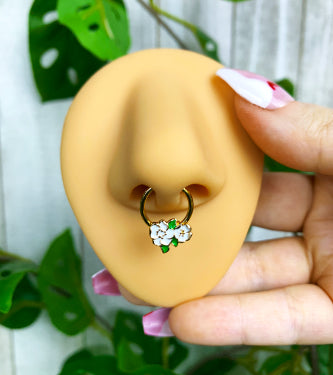




















The advice you hear most often is simple. Spend more, chase the shine, and trust the word hypoallergenic. That advice falls apart the first time a fresh piercing meets a plated stud, or a beautiful bar that is the wrong length.
High end body piercing jewelry earns the name when the metal is documented, the fit matches your anatomy, and the piercing is ready for a change. A mirror polish on mystery metal is still mystery metal. A high price with no alloy name is a costume with a bigger tag.
I would ignore the sparkle until three questions have answers. What alloy is this, and to which standard? What gauge and wearable length did your piercer record? Has the piercing finished the stage it is in, or are you shopping off a calendar date?
Those three questions sort a piece faster than any brand story.
Materials That Qualify as High End
High end body piercing jewelry is defined first by its metal, not its shine. The test a professional uses is blunt. Is this material accepted for a fresh piercing?
If the answer is no, the piece waits until the channel is healed, no matter how pretty the product photo looks.
| Material | Fresh piercing | What to verify | Best fit |
|---|---|---|---|
| ASTM F136 titanium | Yes | Exact alloy and standard on a certificate | Sensitive skin, large or ornate pieces |
| Implant-grade stainless steel | Yes | Implant-grade designation, not generic surgical steel | Bars and everyday wear |
| Niobium | Yes | Documented grade and finish | Sensitive skin, alternative to titanium |
| Solid 14k or 18k gold | Yes | Solid composition, not plated or filled | Visible pieces meant to last |
| Platinum | Yes | Purity stamp and alloy details | Premium pieces and heirloom wear |
| PTFE-like plastic | Yes, for initial wear | Dense, low-porosity monofilament | Flexible initial jewelry for certain sites |
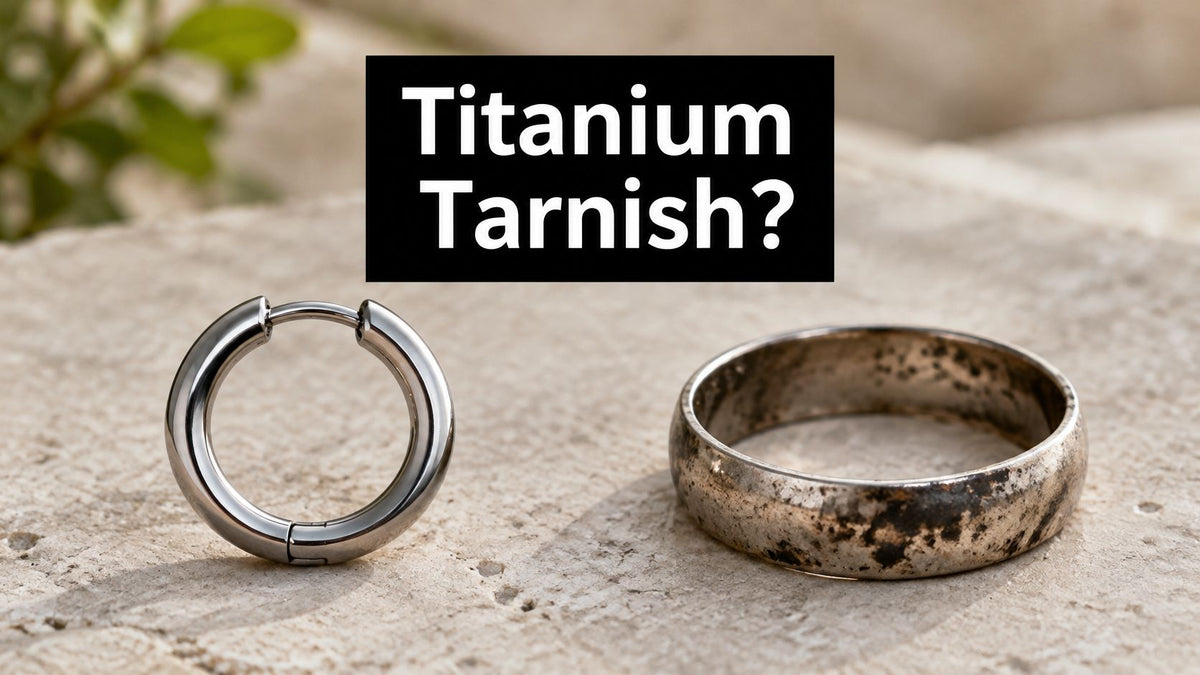
| Gold-plated or gold-filled | No | Plating can wear through | Healed piercings only, with caution |
| Sterling silver | No | Not suitable for new or unhealed piercings | Healed piercings only, if at all |
What the top rows actually mean
ASTM F136 titanium is the clearest yes on that table. The Association of Professional Piercers identifies it as wrought titanium-6 aluminum-4 vanadium ELI, an implant-grade material, in its jewelry standards note. Outside materials certified to relevant ASTM or ISO surgical-implant standards, that same note says safety evidence for commonly used piercing substances may be only anecdotal.
Ask for a certificate that names the exact alloy and the standard, not a title that just says titanium. Commercially available grades and surface finishes differ. Titanium is also less dense than steel, so a large-gauge or ornate piece puts less mechanical load on the tissue.
Implant-grade stainless steel stays in the yes column only when the listing says implant-grade. The phrase surgical steel is not that designation. Niobium is the practical swap when you want a documented grade and finish for sensitive skin and titanium is not the look you want.
Solid 14k or 18k gold can go in a fresh piercing, but the karat stamp is not the proof. Alloying metals and plating change how the piece behaves on skin. Solid, documented composition beats a thin coating that can wear through. If gold is the look you want, the basics of buying and wearing gold jewelry spell out what solid means before you pay for a color.
Platinum needs a purity stamp plus alloy details before it counts as heirloom wear. PTFE-like plastic is for initial wear when you need a dense, low-porosity monofilament that flexes at certain sites. It is a healing tool, not a forever fashion piece.
What never goes in a new piercing
The Association of Professional Piercers says gold-plated, gold-filled, and sterling-silver jewelry are never appropriate for new or unhealed piercings, in its initial jewelry guidance. Those two rows sit at the bottom of the table on purpose.
A plating can look like solid gold for months, then open onto the base metal. Sterling silver is a healed-piercing question at best. I would skip it entirely if your skin has ever reacted to costume metal.
Practical rule: For a fresh piercing, choose from the top rows. For a healed piercing, the rest of the table opens up, and plated or silver pieces still need caution.
Words like surgical, premium, and hypoallergenic are marketing. They are not a standard, and they do not move a piece up the table.
Verify the Documentation Behind Any Label
A label is a claim. Documentation is the proof. The seller question that exposes most fake claims is simple. Can they name the exact alloy and the standard?
If the answer is a vibe, a color name, or "it's hypoallergenic," you do not have a high-end piece yet. You have a story. Walk this list in order, and stop at the first trap you hit.
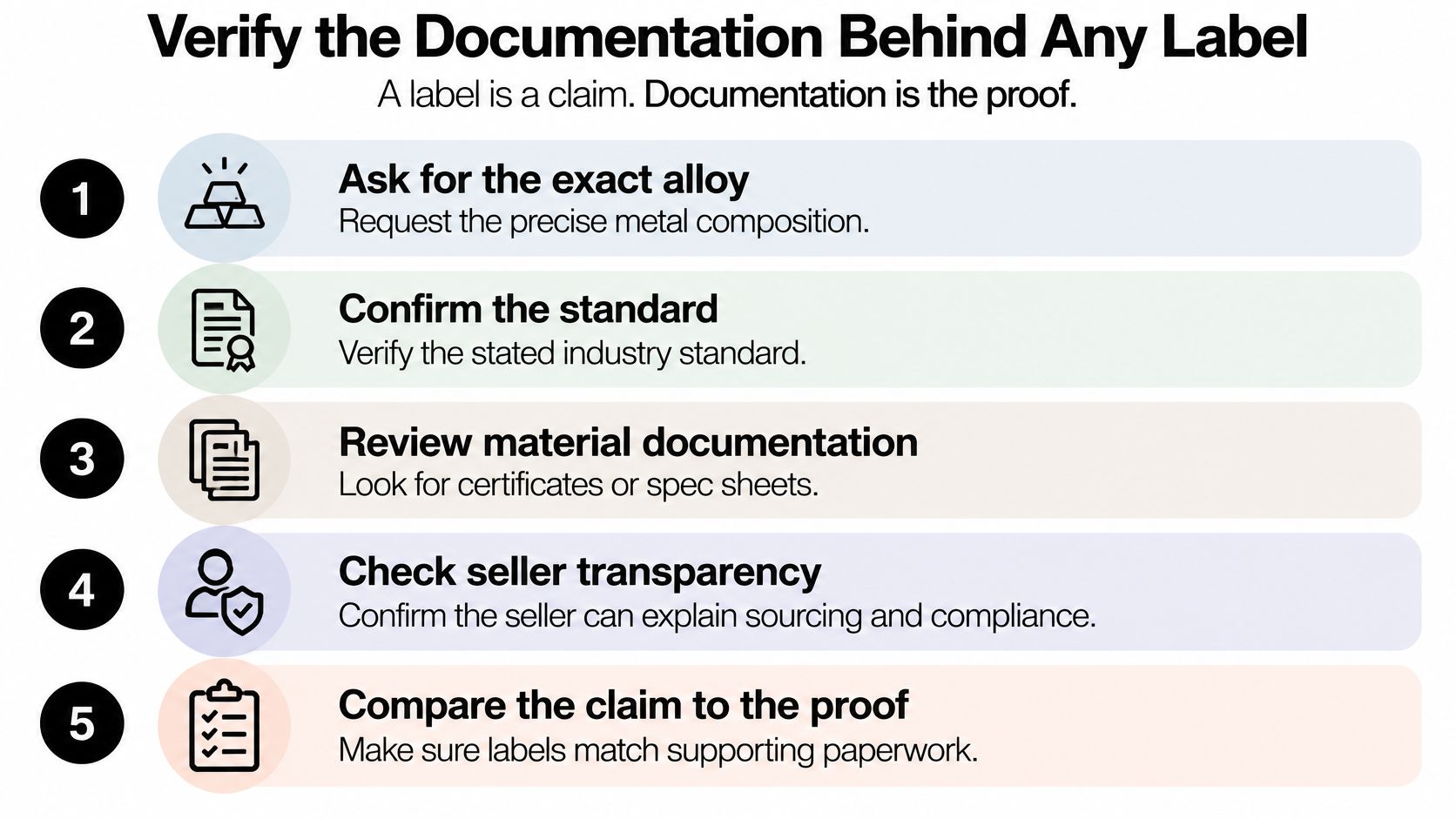
Six checks, one trap each
- Exact alloy and standard. You want ASTM F136, or an equivalent ISO designation, written on a material certificate. The trap is treating every titanium the same. Grades and surface finishes can differ, and a mill sheet that only says titanium does not close the gap.
- Solid or plated. If it is plated, ask what the base metal is. The trap is a coating that looks fine in the box and wears through after months of cleaning, sweat, and friction.
- Finish. You want a smooth, mirror-polished surface with no pitting and no seams you can catch with a fingernail. The trap is a rough spot that snags tissue every time the piece shifts.
- Nickel status. The page should say nickel-free, low-nickel, or coated, and it should point to EN 1811 test evidence wherever a nickel-containing alloy is sold. The trap is a hypoallergenic tag with no test behind it.
- Thread style. Internally threaded or threadless, and you should be able to see how the ends connect. The trap is a loose or cross-threaded end that backs off in your sleep.
- Size and length. A chart should exist before you order, with gauge and wearable length, not just a pretty style name. The trap is guessing the wearable length from a photo.
What the nickel numbers actually limit
European restrictions set a maximum release of 0.2 micrograms per square centimeter per week for post assemblies inserted into pierced body parts, and 0.5 micrograms per square centimeter per week for other jewelry in prolonged skin contact, with EN 1811 as the test method, according to this SGS safeguards note on the nickel rules. A coating is not automatically protective. Coated products must still hold that 0.5 limit for at least two years of normal use.
Friction, sweat, and cleaning chemicals can break a coating and expose the alloy underneath. For sensitive skin, I would rather see uncoated, fully documented implant-grade titanium than a coated piece with a soft claim. If a piece is already making you itch, a dermatologist and patch testing beat swapping to another luxury-looking alloy.
If the seller cannot name the alloy, the piece is not high end, whatever the price.
Craftsmanship That Separates Premium Pieces
A well-cut stone and a cheap cast copy can look identical in a product photo. The difference shows up in your hand, in the fit, and in the finish. Pick up one stud or one end and check it the way you would check a ring before you propose with it.
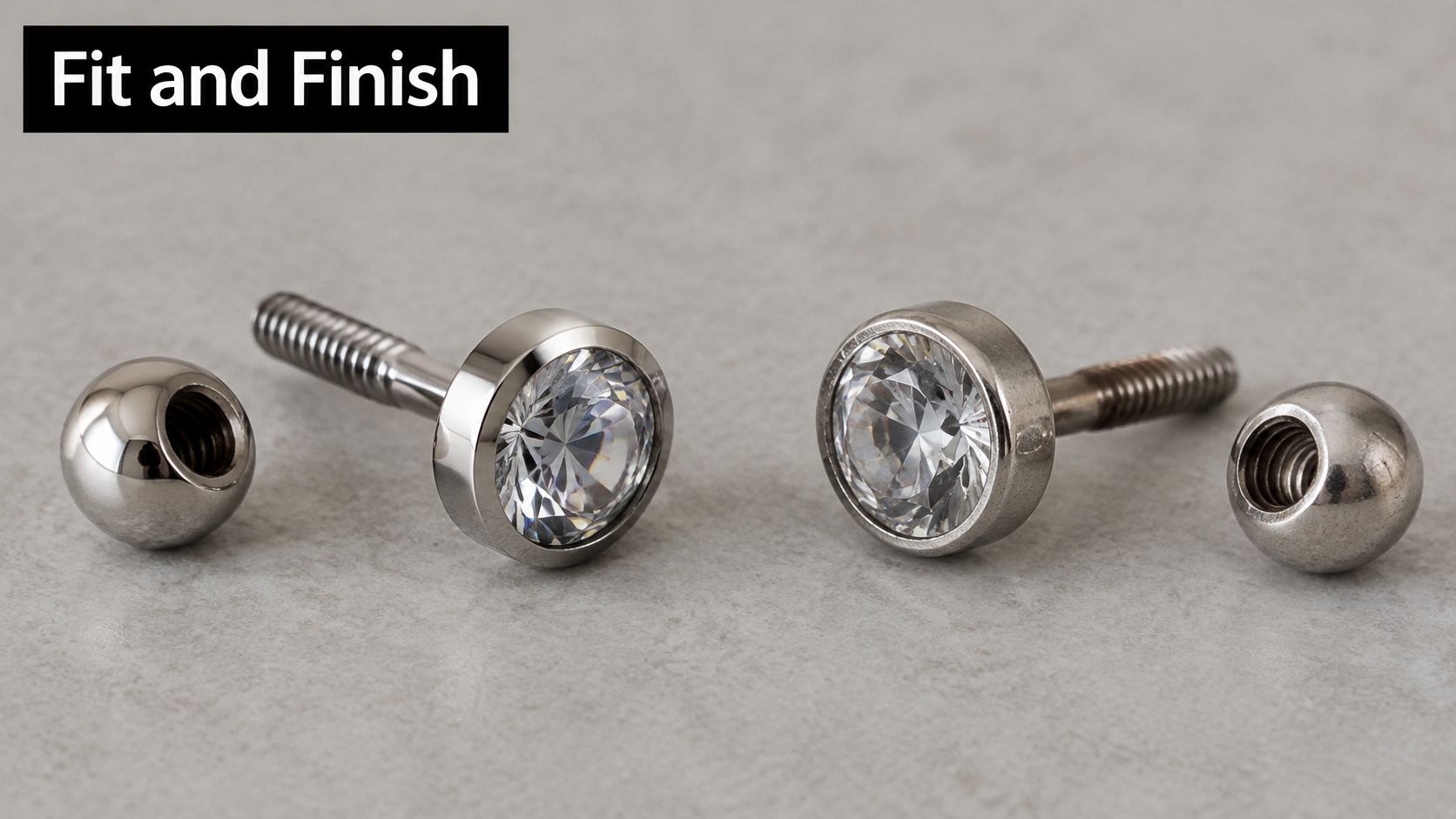
What you should see in your hand
Hand finishing comes first. Polished surfaces should have no seam burrs. Run a clean fingertip along the post and the back of the end. If it snags skin on the outside, it will snag the channel.
Threading is next. Precise internally threaded or threadless ends should sit flush, so the piece does not catch on a collar, a mask strap, or a pillowcase. A gap at the joint is not a style choice. It is a place for crust and a place for the end to loosen.
The setting is where costume pieces usually fail. A bezel, or a secure prong setting, holds the stone. Glue does not. Hold the stud under a bright light and look for flash, a milky glue line, or a seam around the setting and the back. If you can see adhesive, the stone is not locked in.
Solid construction is the wall of the piece, not the color on top. You want uniform, solid metal rather than a thin plated shell that feels light in a bad way. Traceable making closes the check. The seller should be able to say who made the piece and where, and show the paperwork behind it. Josh hand-makes every 14k gold diamond piece that BodyCandy sells, which is the kind of named maker you can ask about. What makes handcrafted body jewelry exclusive is that trail, not a velvet box.
The gem piece worth keeping
A high-end gem piece has a stone held by a visible, secure setting, no glue, and a maker or workshop you can name. Lab-grown or mined does not change that test. The setting does.
If you want a closer look at how a clean thread and a set stone should sit together, this short walk-through is worth the two minutes before you buy.
Getting the Fit Right With Gauge and Length
A perfect alloy still fails if the gauge or the length is wrong. Gauge is the thickness of the post. Length is the wearable distance between the ends. Both have to match the piercing you already have, not the piercing in a size chart photo.
Initial jewelry generally needs extra room for early swelling. After that swelling subsides, the jewelry is often replaced with a shorter post. That swap is called downsizing. The Association of Professional Piercers explains the sequence, and why the wrong length causes trouble, in its piercing FAQ. Correct downsizing helps keep jewelry from embedding in the skin. Changing too early, or using the wrong length, can create irritation and trauma. Many piercings need that shorter post before they are fully healed, and a qualified piercer should do the change.
A routine you can actually follow
- Record the first piece. Write down the gauge and the length your piercer installed, plus the style, before you lose the bag or the receipt.
- Wait for the swelling to settle. That window is not the same for an earlobe and a navel. Location sets the pace, not your weekend plans.
- Let a qualified piercer downsize it. Doing it yourself on a half-healed channel is how people tear the fistula they just paid to heal.
- Check the new fit. Ends should rest against the skin without pressure, and without a long bar swinging free.
- Re-check if tenderness shows up. A piece that felt fine on day one can sit wrong once you sleep on it or go back to a tight collar.
The two mistakes that ruin a good piece
Changing too early causes irritation because the tissue is still swollen and fragile. Leaving a length that is too long lets the piece move, tilt, and snag. Too short is the other failure, and it can press the ends into the skin.
A beautifully made flat back, labret, or barbell is unsuitable if its wearable length is wrong. One standard length does not fit every anatomy. Keep the piercer's measurements with the order, and use a standardized body jewelry sizing reference so the numbers you send match the numbers on the product page.
Healing Times and Aftercare That Protect Your Piece
Replace jewelry when the piercing is healed, not when a calendar date arrives. An outside that looks calm can still be tender inside.
| Piercing | Typical healing time | Upgrade signal |
|---|---|---|
| Many piercings in general | About 6 weeks (Mayo Clinic) | Swelling gone, no tenderness |
| Surface, navel or nipple | Up to 6 months to 1 year (Braintree Council) | Fully settled, no discharge or crusting |
| Cartilage | Several months or longer (Mayo Clinic) | Downsized by a piercer, no discharge |
Why the rows are not interchangeable
Mayo Clinic states that many piercings heal in about six weeks, while others take several months or longer. That is why an earlobe piece can be ready for a considered change long before a cartilage piece is. Cartilage sits in the "several months or longer" range, so the upgrade signal is a piercer-done downsize plus no discharge, not a calm-looking front.
A public-health aftercare guide from Braintree Council warns that surface, navel, and nipple piercings can take as long as six months to one year. Planning a premium navel or nipple barbell on a six-week clock is how people buy a piece they cannot wear yet. During healing, Mayo advises keeping jewelry in place, including at night. Jewelry should generally stay installed unless its size, style, or material is causing a problem.
Aftercare that does not abuse the piece
Aftercare is a mechanical habit, not a reason to fuss with an expensive end all day.
- Wash your hands before you touch the piercing at all.
- Leave it alone except during cleaning. Do not twist, spin, or rotate the jewelry. Movement irritates healing tissue, and clothing friction can slow recovery the same way.
- Check the ends on threaded and threadless pieces for tightness, using clean hands or a paper product, not a constant spin through the channel.
- Swap the piece if it causes persistent swelling, redness, bleeding, itching, or irritation. The APP aftercare sheet is the practical version of that rule.
A three-point readiness check
You are closer to an upgrade when all three are true.
- No tenderness when you press gently around the piercing.
- No discharge or crusting that keeps returning after a normal clean.
- A completed downsize already done by a qualified piercer, where that piercing needed one.
A piercing is not healed just because the outside looks calm. Tenderness, redness, or irritation that lasts beyond a few days needs a healthcare professional, not a new end from your cart.
Pricing, Custom Work and Long-Term Care
Price is a receipt for metal, labor, and design time. It is not a safety certificate.
What the number is actually buying
Metal content is the first driver on a solid piece. More documented gold, platinum, or implant-grade titanium costs more because the metal is the piece, not a film on top. Labor in the setting is the second. A secure bezel or prong setting takes time that a drop of glue does not. Design time is the third, and it shows up hardest on custom work, where someone is building to your anatomy instead of a stock length.
A higher price with no documentation is not evidence of quality. A low price on a plated piece reflects a thin coating, not a cheaper version of the same solid metal. You are paying for less metal and a finish that will not last the same way.
How to order custom without guessing
Send your piercer's measurements with the design, not a screenshot and a hope. Request the material certificate before you pay. Confirm that the threading, or the threadless design, still lets you downsize later. Expect a longer lead time than a stock bar. Custom is slower because someone is making it, not because the shop is being dramatic.
Investment value follows the metal. Solid, documented gold or titanium keeps its worth and can be resized or worn again in another healed piercing. Plated pieces lose that value once the coating wears through. You cannot polish a worn plate back into solid metal.
Care that keeps the finish
- Wipe with a soft cloth and mild soap, then rinse and dry fully.
- Skip harsh chemicals and abrasive cleaners. They dull a mirror polish and can haze a stone.
- Store pieces separately so they do not scratch each other.
- Do not put a brand-new fashion piece into a piercing that is still healing.
- Recheck threaded ends for tightness, and retire a piece once its coating shows wear.
Solid, documented metal is the investment. The coating is a rental.
Choose a Verified High End Piece Next
Buy a verified high-end piece only when the material passes the fresh-piercing table, the documentation is available on request, and the piercing has reached its healing stage.
That is one last pass, not a new shopping personality. Material first. Paperwork second. Finish and fit third. Healing stage fourth. A qualified piercer confirms the size before any upgrade goes in. Skip a step and you are back to buying shine.
Where those checks meet a real cart
BodyCandy sells body jewelry in F136 titanium, 14k gold, and 316L surgical steel, along with solid 14k gold body jewelry and titanium hoops. Nose jewelry is offered in F136 titanium, 14k gold, and platinum, including diamond options, and that includes a 14k solid white gold micro nose ring with a genuine 1.5mm diamond. Read each product page for the base alloy, the surface treatment, and the standard before you order. If those three lines are missing, the piece is not ready for you, even if the photo is.
Shop the high-end collection when your piercing is ready, drop questions about materials or aftercare in the comments, and sign up for the newsletter if you want alerts when new arrivals land.
BodyCandy carries documented options in implant-grade titanium, solid 14k gold, and platinum so you can match the metal to the piercing you have. Start with the alloy and the size your piercer wrote down, then look for the piece that meets that note instead of the one that only looks expensive. Visit BodyCandy when you are ready to choose a verified piece for a healed piercing, or to plan the upgrade you will make once healing is done.