














Have you ever wondered why a higher needle gauge means a smaller needle, while a larger-looking piece of jewelry can carry a lower number? That backwards logic trips up almost everyone at first. Matching a gauge number alone won't guarantee a safe or comfortable piercing, because anatomy, swelling, jewelry dimensions, materials, and sterile technique all matter too.
The good news is that body piercing needle sizes become much easier once you separate needle gauge from jewelry gauge. This guide translates common gauges into millimeters, explains why nostrils and septums may use different sizes, and shows why a qualified piercer should make the final call.
Understanding the Counterintuitive World of Gauge
A piercing chart can look like it was designed to test your patience. You might see 18g, 16g, and 14g and reasonably assume that 18g is the largest. In the gauge system, the opposite is true. A lower gauge number means a thicker needle or piece of jewelry, while a higher gauge number means a thinner one. Hamilton Company's needle gauge reference explains this inverse relationship and distinguishes outside diameter from other needle dimensions.
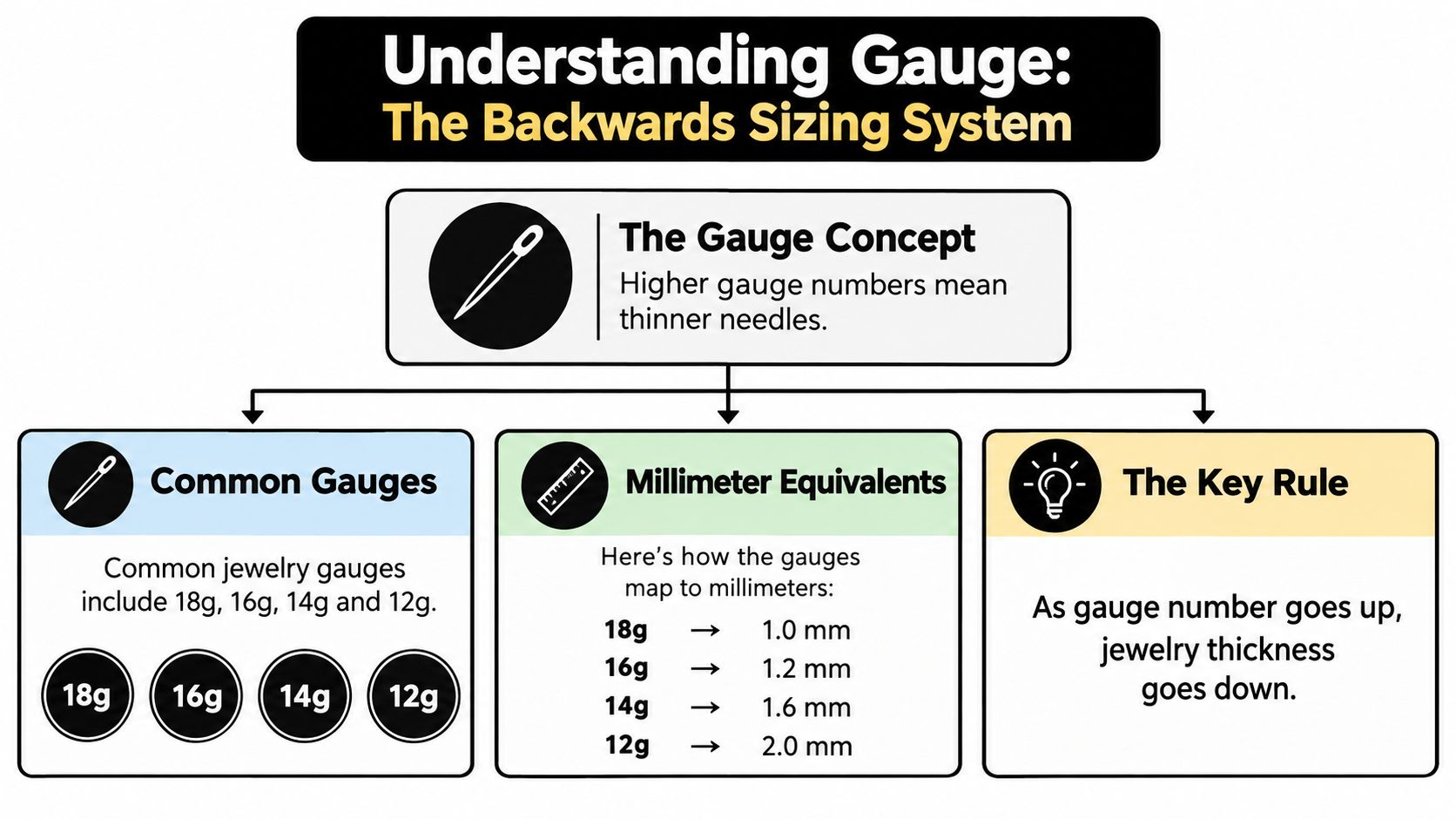
A quick example makes the pattern easier to remember. A 14g needle is approximately 1.6 mm, a 16g needle is about 1.3 mm, and an 18g needle is about 1.0 mm in outside diameter. Move upward to 34g and the diameter becomes much smaller. In the same reference, a 10g needle measures approximately 3.4 mm, while a 34g needle measures approximately 0.16 mm.
The memory trick: Lower gauge equals thicker jewelry. Higher gauge equals thinner jewelry.
Gauge describes approximate outside thickness, not the entire construction of a needle. Wall thickness can change the internal opening even when two needles share the same outside diameter. That distinction matters for technical applications, but for shopping and piercing conversations, the most useful starting point is simple: compare gauge and millimeters together.
You can also browse BodyCandy's guide to gauge sizing standards for another explanation of this unusual scale. Once the inverse pattern clicks, size charts stop feeling backwards and start giving you useful context.
Converting Gauge to Millimeters Made Simple
Millimeters make piercing sizes easier to picture. Gauge is the label you'll see on needles and jewelry. Reading both together helps you compare what a piercer recommends with what an online listing is selling.
Here's a practical conversion chart for common piercing sizes:
| Gauge | Approximate outside diameter |
|---|---|
| 20g | 0.81 mm |
| 18g | 1.0 mm |
| 16g | 1.2 mm |
| 14g | 1.6 mm |
| 12g | 2.0 mm |
The Association of Professional Piercers procedure manual lists these standard conversions. The change from one gauge to the next can look small on paper, but in a fresh piercing that difference affects how much room the tissue has, how jewelry sits, and whether a replacement piece is likely to fit.
A simple habit helps. Check the gauge first, then confirm the millimeters. If a product page says only “small” or “standard,” it leaves out the information that matters. A listing that says 16g, 1.2 mm is much more useful because you can compare it directly with your current jewelry or your piercer's recommendation.
The scale works inversely. As the gauge number goes up, the diameter goes down.
- 20g to 18g: the jewelry gets thicker.
- 18g to 16g: the diameter increases again.
- 16g to 14g: the channel becomes more substantial.
- 14g to 12g: thickness increases further.
That backwards pattern confuses people because it doesn't behave like a ruler. Lower number, thicker piece. Higher number, thinner piece. Once that clicks, charts become easier to read.
Gauge is only one part of fit. It does not tell you a barbell's wearable length or a hoop's internal diameter, and it does not tell you whether your anatomy or expected swelling calls for more room. For a clear jewelry-focused reference, see BodyCandy's standardized jewelry sizing guide.
Needle Size Versus Jewelry Fit Explained
Why can two pieces marked with the same gauge still fit so differently? Because the needle size used during the piercing is only part of the story. The jewelry has to suit the actual channel, the tissue around it, and the room that tissue needs while it settles.
A professional piercer uses a sterile, single-use hollow needle to create the opening, then chooses jewelry that can pass through that opening without grinding or squeezing the tissue. In practice, the needle and jewelry are selected together, but they are not the same decision. The right match depends on anatomy, placement, tissue density, technique, and expected swelling, as described in public-health piercing guidance from Vermont.
That distinction matters later. If you are shopping for a replacement, the number recorded from the procedure is less useful than the gauge of the jewelry currently in the piercing, plus the wearable length of a post or the internal diameter of a ring. A channel can heal around jewelry in a way that reflects your body, not a generic chart.
Why swelling changes the decision
Fresh piercings often need breathing room. A post that looks fine at the moment of insertion can become too tight once the area puffs up, and pressure from jewelry that is too short can irritate tissue or even press into it. Ontario public-health guidance explains that initial jewelry dimensions vary by body site and by the person's anatomy, which is why one-size-fits-all charts fall short.
People get tripped up. Gauge describes thickness. Wearable length describes the room a straight piece has inside the piercing. Internal diameter describes the space inside a hoop. A piercer may recommend downsizing to a shorter post after swelling calms down, while keeping the same gauge.
Forcing a mismatch causes problems fast. Thicker jewelry can tear or stress a smaller healed channel, while jewelry that is too thin may leave the piercing feeling unstable or sitting differently than expected. Before you buy a replacement, compare the gauge, length or ring diameter, material, and the current condition of the piercing. If you want to check the measurements yourself, BodyCandy's caliper measurement guide shows the process clearly. If the piercing is fresh, sore, swollen, stretched, or unusual in shape, let a qualified piercer confirm the fit.
Common Piercing Types and Their Ideal Sizes
There isn't one universal piercing needle size. A nostril, septum, earlobe, cartilage placement, lip, and navel each present different tissue and jewelry requirements. The ranges below are useful conversation starters, not promises that the same gauge will suit every person.
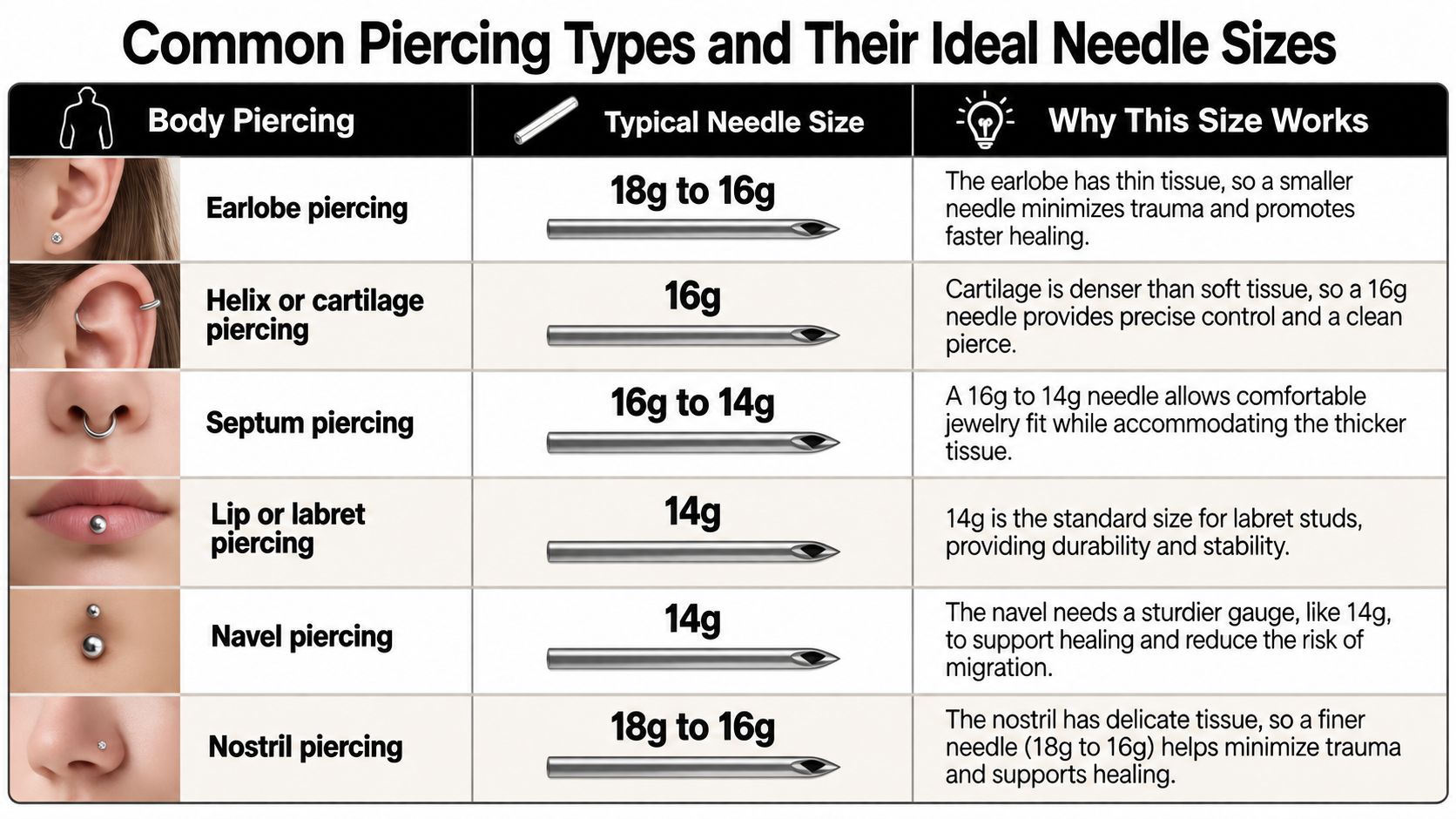
| Piercing location | Common needle or jewelry range | Why the choice varies |
|---|---|---|
| Earlobe | Often 18g to 16g | Soft tissue and jewelry style both influence the choice |
| Helix or other cartilage | Often 16g | Cartilage needs controlled placement and suitable jewelry |
| Nostril | Often 20g to 18g, with 18g to 16g also used | Nostril anatomy and future jewelry plans differ |
| Septum | Commonly 16g or 14g | A thicker channel may suit the planned jewelry |
| Lip or labret | Often 14g | The post and swelling need careful sizing |
| Navel | Often 14g, with other gauges possible | Anatomy and jewelry shape affect stability |
| Nipple | Often 14g | Tissue, placement, and jewelry dimensions require individual assessment |
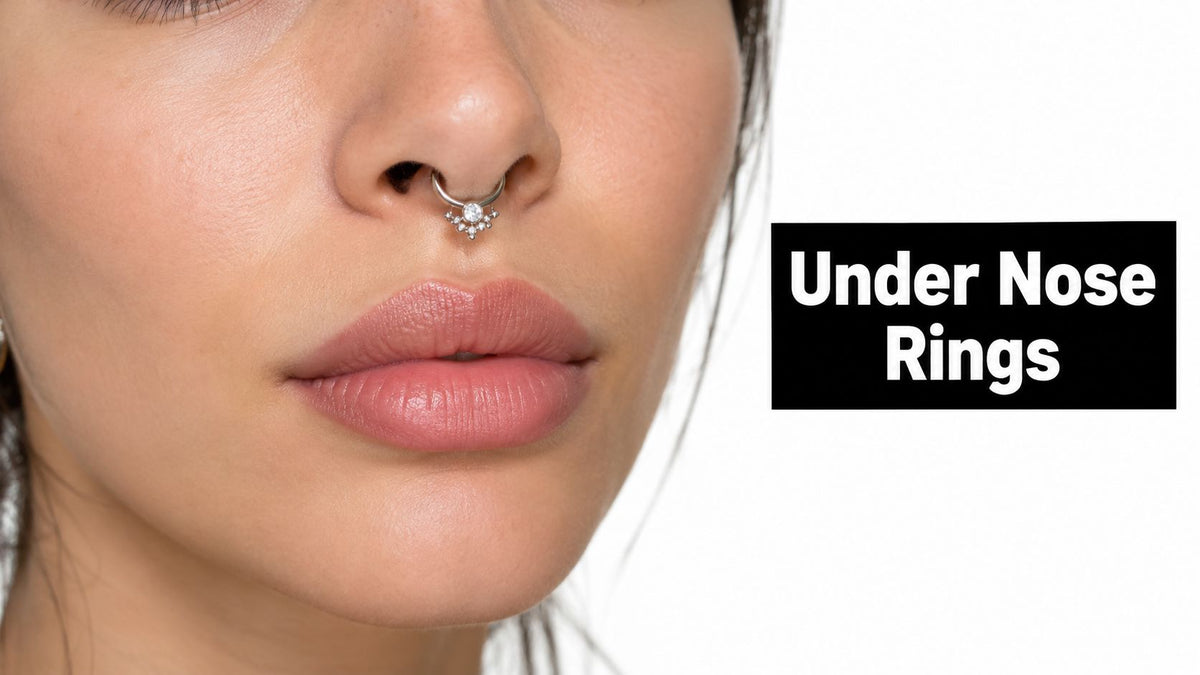
The nostril and septum comparison is especially useful. Professional piercing size guidance identifies 20g, approximately 0.8 mm, and 18g, approximately 1.0 mm, as common nostril dimensions, while septums are commonly performed at 16g, approximately 1.2 mm, or 14g, approximately 1.6 mm. That doesn't mean every nostril must be delicate or every septum must be thick. It means the anatomy and intended jewelry differ.
Use the chart as a starting point
A chart can help you prepare questions, but it can't see the thickness of your tissue, the angle of the planned piercing, or the room needed for swelling. A qualified piercer may recommend a different size from the one you expected, and that isn't automatically a problem.
For example, a nostril intended for a particular flat-back stud may use a different gauge from one planned for future stretching or a larger ring. A septum's comfortable placement also depends on finding the correct tissue area, not selecting a number from a list.
How Anatomy Influences Needle Selection
Your body isn't a chart. The same gauge can work beautifully for one person and create a poor fit for another, even at the same piercing location.
A piercer considers tissue thickness, elasticity, placement angle, planned jewelry, and expected swelling. A thin nostril and a substantial septum don't present the same challenge. Neither do a shallow navel and a deeper fold. Needle selection should follow that assessment rather than a one-size-fits-all rule.
Tissue and jewelry work together
Thinner jewelry can look delicate, but it may not provide the structural feel someone wants for a particular placement. Thicker jewelry can offer more stability, but it requires enough tissue and accurate placement. Neither option is automatically safer just because it's smaller or larger.
Medical literature has described piercing needles commonly ranging from 12g to 18g, while also emphasizing that jewelry width and length must accommodate swelling. A clinical review of piercing complications reports redness and swelling in 30%, drainage in 26%, and infection in 24% of one patient sample. Those figures don't tell you which gauge to choose, but they do show why sizing belongs in a broader tissue-health conversation.
The practical questions are more useful than asking for a universal standard:
- Will the initial jewelry leave enough room for swelling?
- Does the jewelry's thickness suit the tissue and placement?
- Is the intended angle compatible with the anatomy?
- Could the piece press, migrate, tear, or become embedded?
- Does the material suit your skin?
A nostril is not a septum
Nostril tissue is usually approached differently from septum tissue. A septum piercing may use 16g or 14g, while a nostril may use 20g or 18g, with some professional choices falling outside those common ranges. The difference reflects anatomy and the jewelry channel you're creating, not a ranking of which piercing is more advanced.
Forcing jewelry into a channel created by a substantially different needle size can damage tissue. Your piercer should select the needle and initial jewelry as a coordinated pair, then account for swelling and later changes.
The safest size is the one that fits your anatomy and planned jewelry, not the one that appears smallest on a chart.
The Importance of Professional Consultation
Guessing your piercing size from a product photo is risky because photos can't show your anatomy, swelling potential, or the condition of your existing channel. A professional piercer can inspect the area, discuss your preferred jewelry, and decide whether the planned gauge and wearable dimensions make sense together.
Safety starts before the needle appears. Professional and public-health guidance requires a sterile, single-use needle for every client and procedure, immediate disposal in an approved sharps container, sterile jewelry, and cleaning and sterilization of reusable tools between clients. Queensland infection-control guidance also says sterile packaging should remain intact until use and recommends showing the package opening to the client.
Questions worth asking
A good consultation doesn't need to feel intimidating. Ask direct questions and listen for clear answers:
- What gauge are you recommending, and what is the millimeter equivalent?
- What gauge and wearable length will the initial jewelry have?
- How much room are you allowing for swelling?
- What material standard does the jewelry meet?
- How will you confirm the needle and jewelry are sterile?
- When should I return for an assessment or possible downsizing?
Florida regulations provide a concrete example of how detailed sterilization controls can be. They require instruments to be cleaned and sterilized after each use, individually packaged items to remain in sterilized packaging until use, and autoclave effectiveness testing every 40 hours of operation and at least quarterly. See the Florida body-piercing sterilization regulation for the full requirements.
Material matters too
Gauge can't tell you whether a metal is suitable for fresh tissue. ColumbiaDoctors guidance recommends materials less likely to trigger allergic reactions, including titanium, surgical steel, or suitable gold, and warns against nickel and brass-plated jewelry for new piercings. Industry material standards commonly referenced for implant-grade jewelry include ASTM F136 for titanium and ASTM F138 for steel, while Europe's EN 1811 evaluates nickel release with a pass-fail threshold of 0.5 micrograms per square centimeter per week. This material-standards overview explains those references.
Measuring Your Current Jewelry for a Perfect Match
Before ordering a replacement, identify three separate measurements: gauge, wearable length or diameter, and style-specific fit. Measuring the wrong part can leave you with jewelry that has the right thickness but sits too tightly, hangs awkwardly, or presses into tissue.
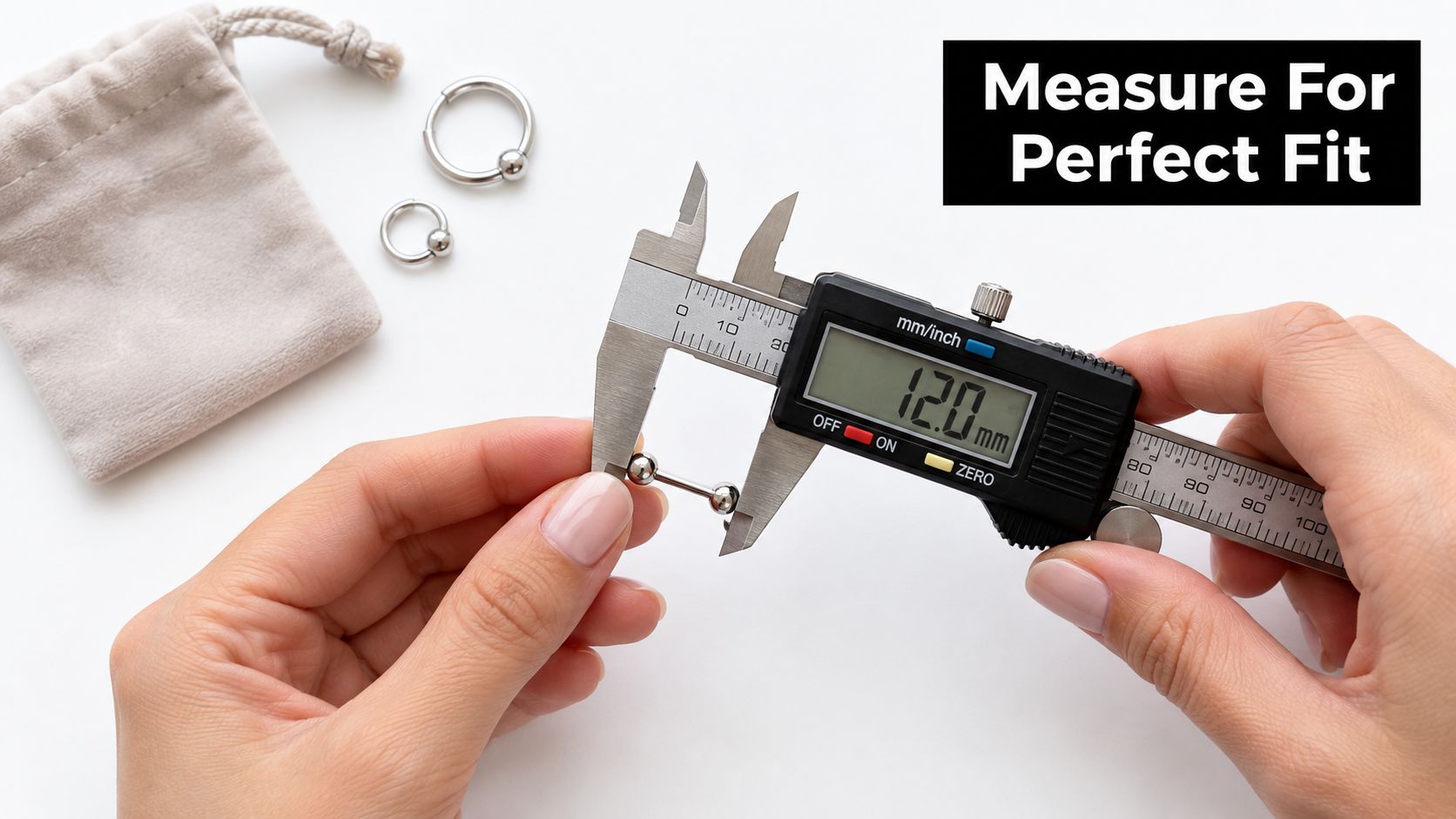
If you have a digital caliper, measure the jewelry rather than your body whenever possible. Remove a barbell only if the piercing is fully healed and the jewelry can be taken out without force. For a straight barbell, measure the wearable post between the ends, not the beads or decorative attachments.
Measure the right dimension
- Gauge: Measure the thickness of the post or bar. Match the result to a gauge-to-millimeter chart.
- Straight jewelry length: Measure the wearable section between the ends.
- Curved barbell length: Follow the manufacturer's measurement method, because brands may define wearable length differently.
- Ring size: Measure the inside diameter, not the outside edge or the thickness of the ring.
- Threading: Check whether the piece is internally threaded, externally threaded, or threadless before assuming another component will fit.
A ruler can help with a rough check, but calipers provide a more useful reading for small jewelry. Avoid squeezing soft tissue with the tool or taking measurements while the area is irritated.
Here's a visual demonstration of how a caliper can be positioned:
If the piercing is fresh, swollen, painful, or showing signs of embedding, don't remove the jewelry to measure it yourself. Ask a piercer to assess the fit and recommend a replacement. Gauge matching is only one part of a safe fit.
Finding Your Perfect Jewelry at Bodycandy
Choosing body jewelry gets easier when you treat sizing as a combination of measurements rather than a single number. Start with gauge in millimeters, then confirm the wearable length or inner diameter. After that, check the material, finish, threading style, and whether the piece suits a healed or fresh piercing.
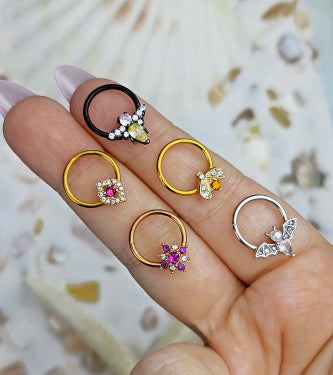
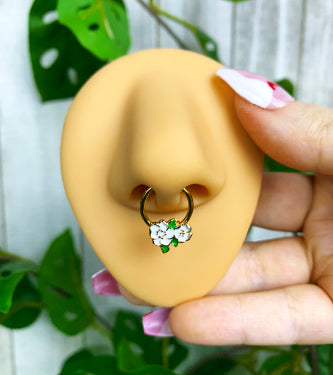
BodyCandy offers collections including nose rings, belly rings, nipple rings, and other body jewelry, so you can compare styles across different piercing types. Use the product details to find the listed gauge and dimensions, then compare them with your current jewelry or the measurements confirmed by your piercer.
For sensitive skin, focus on verified material information rather than relying on appearance. An attractive finish doesn't prove that the alloy or coating is appropriate for a new piercing. If you're unsure, ask your piercer about compatible materials and wait until the piercing is ready for a jewelry change.
The right piece should express your style without ignoring fit. A comfortable bar length, suitable ring diameter, compatible thickness, and body-safe material all matter more than choosing the smallest or trendiest option.
Ready to match your piercing with jewelry that fits? Browse the BodyCandy collection for nose rings, belly rings, nipple jewelry, and other styles, then confirm your gauge, wearable dimensions, and material before ordering. If your piercing is fresh, swollen, or difficult to measure, take the product details to a qualified piercer for a final fit check.