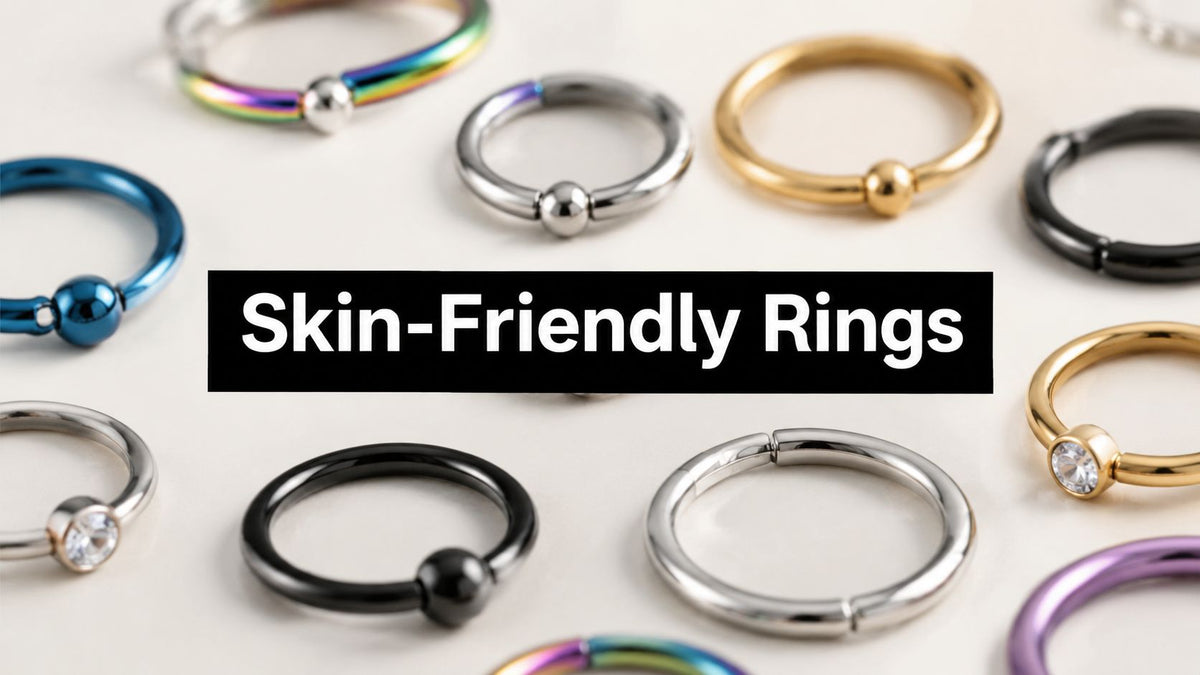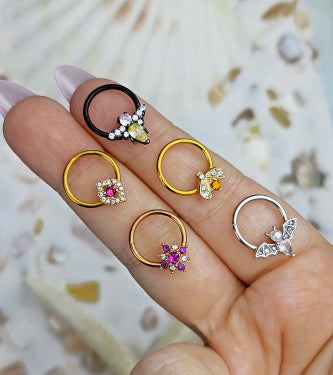




















You're scrolling through belly rings when one stops you. The black finish is glossy, dramatic, and exactly right with your favorite crop top, but then a practical question appears: is the dark color safe for your piercing, especially if it's still healing?
That's the question to ask. A black navel ring isn't defined by color alone. The finish sits over, or develops on, a base metal, and that hidden material affects comfort, allergy risk, and how the jewelry holds up against moisture, friction, clothing, and movement. Fit matters just as much. A ring can look perfect online and still press, rotate, or tug once it's on your body.
Why Black Navel Rings Deserve a Closer Look
A black navel ring can be a minimalist accent, a bold statement piece, or the finishing touch on a festival outfit. The color works with almost everything, which is why black belly jewelry has staying power beyond a single trend cycle. The navel itself is also an established piercing location, not a niche placement. A major England-based survey reported navel piercings at 33% of all piercings in its dataset, ahead of nose piercings at 19%, ears at 13%, tongue at 9%, nipple at 9%, eyebrow at 8%, lip at 4%, and genital piercings at 2% (navel piercing survey details).
That popularity has a downside. Product listings often make the color easy to see and the engineering hard to find. “Black” might mean PVD-coated titanium, anodized niobium, plated steel, or an unspecified alloy. Those choices don't behave the same way when the ring rubs against skin or clothing.
The finish isn't the whole story
A PVD finish on implant-grade titanium can be a practical choice for everyday wear. Black niobium gets its color from an oxide layer rather than a separate decorative coating. Plated jewelry may look wonderfully dark at first, but wear around threading, edges, and moving parts can expose the material underneath.
Your body also needs a design that suits its shape. Gauge, wearable length, top decoration, bottom weight, and the way your navel folds when you sit all influence comfort. A dangling piece may look playful but feel awkward if the charm catches on clothing. A floating design may sit more naturally than a classic curved barbell for some anatomy.
Practical rule: Judge a black navel ring by its base metal, finish method, dimensions, and fit. The color is only the visible part.
For a new piercing, follow your professional piercer's advice and use jewelry intended for initial wear. Navel piercings heal slowly, typically taking 6 to 12 months to fully heal, and irritation can extend that process (navel piercing healing timeline). A healed piercing gives you more styling flexibility, but it still deserves jewelry that doesn't pinch or shed its finish.
How Black Finishes Are Actually Made
A product called a “black navel ring” can be made in several ways. The first step is to find the material and finish details, rather than assuming every dark ring uses the same process.

PVD coating
Physical vapor deposition, or PVD, is a bonded surface treatment. Manufacturers place the jewelry in a vacuum chamber and apply a very thin black layer to the metal. Think of it as a tightly attached shell, not a coat of household paint. PVD is widely described as tough and scratch-resistant, but the base metal still determines whether the jewelry suits your skin (PVD body jewelry finish explanation).
That distinction matters. PVD can make a nickel-containing alloy black, but it doesn't make that alloy nickel-free or transform it into implant-grade titanium. If the coating eventually wears through, the exposed substrate becomes the part touching your skin.
Anodizing
Anodizing changes the oxide layer on a metal through controlled electrical conditions. It doesn't add a conventional decorative film in the same way plating does. Niobium can be anodized to create a naturally dark appearance, and sellers should identify the base metal clearly.
Titanium can also be anodized into many colors, but a true black appearance generally requires a coating rather than titanium anodizing alone. That's why “black titanium” deserves a closer look at the product description.
Plating and painted finishes
Plating deposits a black layer over another material. It can create an even, high-shine appearance, but the layer is usually thinner and more vulnerable to rubbing, especially around screw threads and contact points. Painted or enamel finishes sit farther toward fashion jewelry territory and may be less suitable for constant skin contact.
Use product language as a clue, not a guarantee. Look for:
- Named base metal: Implant-grade titanium, niobium, or clearly identified steel is more useful than “premium metal.”
- Finish disclosure: PVD, anodized, plated, or painted tells you how the color was created.
- Nickel information: This matters most if you've reacted to jewelry before.
- Dimensions: Gauge, wearable length, and end sizes help you assess fit.
- Seller support: A reputable listing should answer material and care questions directly.
PVD Versus Anodized Versus Plated Finishes
A shopper choosing a black navel ring is comparing more than shades. The finish works like the outer shell of a phone, while the base metal underneath determines much of the skin-contact experience. Match both to your wearing habits, sensitivity, and tolerance for replacing jewelry when the surface changes.
| Finish | PVD-Coated | Anodized Niobium | Plated |
|---|---|---|---|
| How color is created | A thin black surface layer is bonded to the base metal | The metal's oxide layer is changed through an electrochemical process | A black deposited layer is applied over another material |
| Main advantage | Smooth appearance and strong resistance to ordinary scratching | No separate cosmetic coating is required for the color | Often delivers a deep look at a lower cost |
| Main concern | The coating can eventually wear or flake | Abrasives and strong chemicals can dull or alter the finish | Rubbing can reveal the base metal |
| Best consideration | Verify the substrate, especially for sensitive skin | Confirm that the ring is niobium | Treat it as fashion jewelry if the finish isn't durable |
PVD for regular wear
A PVD-coated ring can suit frequent wear when its underlying metal is implant-grade titanium. The process creates a smooth, polished appearance that can retain its color during ordinary use. The label “PVD” describes the treatment, so the product listing should also name the substrate. A black PVD ring made from an undisclosed alloy leaves skin compatibility uncertain.
Anodized niobium for minimal surface treatment
Anodized niobium suits shoppers who want color formed through the metal's surface oxide rather than a separate black coating. Niobium provides a naturally biocompatible substrate, while the finish still needs protection from abrasive cleaning and aggressive chemicals.
“Anodized black” identifies the coloring process. Check the product page for the metal name, and confirm that the ring is niobium before treating the finish description as a material description.
For a closer look at how anodizing works in body jewelry, read this overview of anodized titanium jewelry.
Plated for occasional style changes
Plated jewelry can create the high-contrast look that works for an outfit or event. Its black layer may wear unevenly as moving parts, clothing, moisture, and contact points apply friction. Once the base metal shows through, its appearance and skin suitability become part of the decision.
For frequent wear, verified PVD over a listed implant-grade metal or anodized niobium offers a more considered choice. Plated jewelry fits short-term styling better. Retire it when the finish begins to change, especially if the exposed metal causes irritation.
Base Metals That Make a Black Ring Safe to Wear
The black surface doesn't decide whether a ring is comfortable. The substrate metal and its allergy profile do. Mayo Clinic recommends nickel-free jewelry metals such as titanium for people concerned about nickel allergy, because nickel is a common trigger for contact dermatitis (Mayo Clinic guidance on nickel allergy).
Implant-grade titanium
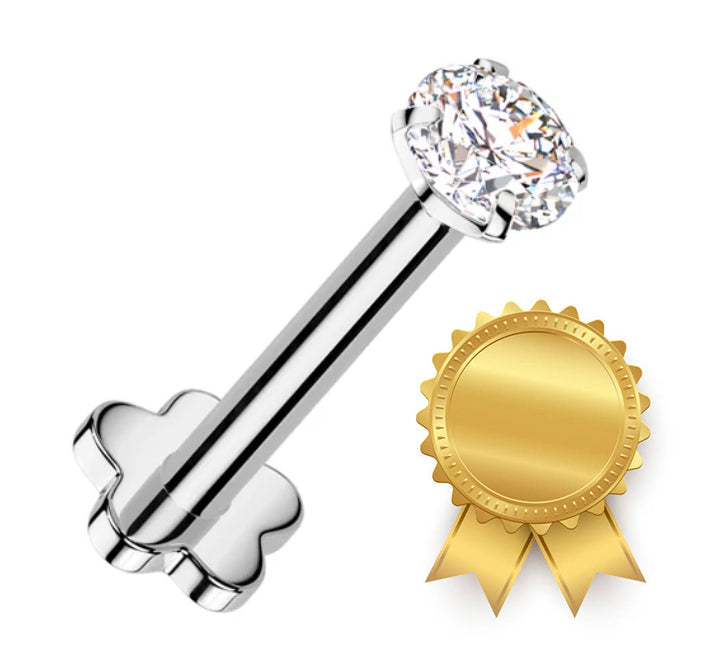
Look for implant-grade titanium, commonly identified with the ASTM F136 designation. It's lightweight, corrosion-resistant, and widely used for sensitive or healing piercings. PVD works well over titanium when the manufacturer clearly discloses both the titanium grade and the black treatment.
A black titanium listing that only says “titanium color” isn't specific enough. You want the actual base metal named, not just a marketing description.
Niobium
Niobium is naturally biocompatible and can be anodized to create a dark finish without relying on a separate cosmetic coating. That makes it an appealing option for people who want a black appearance and minimal surface treatment.
The product page should still state that the piece is niobium. “Anodized black” describes the process, not necessarily the metal, so don't use the finish name as a substitute for the material name.
316L surgical steel
316L surgical steel is durable and commonly used in body jewelry. It contains trace nickel, which many wearers tolerate because the nickel is tightly bound within the alloy, but it isn't the same as a nickel-free metal. If you've had itching, rash, swelling, or persistent irritation from jewelry, titanium or niobium may be the more cautious direction.
Skip mystery alloys, brass, copper, and low-grade steel for a piercing piece. They may discolor, irritate, or react unpredictably, especially when the finish begins to wear.

Decoder rule: If a listing says only “black belly ring” and doesn't name the metal, treat the description as incomplete.
You can also use this titanium body jewelry guide to understand why the base metal deserves as much attention as the finish.
Styling Black Navel Rings for Every Look
Black jewelry has one major styling advantage: it creates definition without forcing your outfit into a particular color family. The trick is to choose the silhouette and amount of sparkle based on where you're wearing it.
Minimalist daily wear
Start with a slim black PVD titanium curved bar and simple bead or stone. Pair it with a neutral tee, high-waisted denim, or a fitted ribbed top. The dark jewelry becomes a deliberate accent instead of competing with the rest of your outfit.
Keep nearby jewelry restrained. Silver septum jewelry, a small ear cuff, or a single black ear plug can echo the color without making the look feel overworked. A monochromatic palette makes the navel piece look intentional.
Festival and going-out outfits
A dangle style changes the mood immediately. Look for crystal clusters, black opals, or aurora borealis stones when you want movement and reflected light. These pieces work especially well with bright clothing because the black setting gives the sparkle a strong outline.
Use a dangle as a statement accessory rather than an automatic everyday choice. A heavier or more active design can catch on clothing, so check that the charm hangs freely and doesn't press into the navel when you bend or sit.
Athleisure and swimwear
For leggings, activewear, and bikini tops, choose a low-profile curved bar that stays close to the body. A small black end or flat detail gives you the color contrast without adding a piece that snags during movement.
Your styling checklist can stay simple:
- Match the silhouette: Slim bars suit everyday outfits, while dangles bring movement to evening looks.
- Repeat the color carefully: One black ear accent or dark septum ring is usually enough.
- Watch the weight: Decorative pieces should fit your anatomy and wearing plans.
- Consider the neckline: Crop tops reveal the ring, while high-waisted clothing can create pressure around it.
A black navel ring should look like part of your wardrobe, not an accessory fighting it.
Finding the Right Fit for Your Anatomy
Two people can wear the same black navel ring and have completely different experiences. The difference may come from the depth of the piercing, the shape of the navel hood, how the skin folds while sitting, or how much room the jewelry needs to move.
Many navel rings use a 14-gauge thickness. Common barbell lengths include 10mm for shallower navels and 12mm for deeper tissue, but those measurements aren't universal guarantees. A professional piercer should assess your anatomy and measure the wearable space, especially for a healing piercing.
| Anatomy Type | Recommended Gauge | Barbell Length | Best Ring Style |
|---|---|---|---|
| Shallow navel | 14 gauge | 10mm may suit a shorter wearable area | Low-profile curved bar or floating design |
| Deeper tissue | 14 gauge | 12mm may allow more room | Standard curved barbell |
| Hooded or shallow upper fold | 14 gauge | Measure carefully before choosing | Floating navel ring with a flush profile |
| Inverted navel | 14 gauge | Fit depends on the fold and tissue depth | Curved design with a smaller top disk or reverse style |
Floating and classic designs
A floating navel ring usually sits flush and can hide the lower ball beneath the navel hood. That profile may feel more comfortable on a shallow or hooded piercing than a traditional piece with a prominent bottom end.
A classic curved barbell suits many standard placements because its shape follows the natural curve of the piercing. It still needs enough clearance to avoid pressure when you bend.
Inverted anatomy
An inverted navel often needs a curved bar with a smaller top disk or a specially shaped design. A straight barbell can pinch the skin instead of following the body's contour. In this situation, choosing the right shape matters more than choosing between glossy black and matte black.
Threadless jewelry can also reduce snagging compared with externally threaded designs, but your piercer should decide what's appropriate for a healing placement. Never force a ring that feels tight, rotates constantly, or leaves pressure marks.
Caring for a Black Navel Ring Without Ruining the Finish
Your cleaning routine needs to protect two things at once: the piercing and the black surface. Fresh navel piercings can show redness, swelling, tenderness, and clear or whitish discharge during early healing, so avoid treating normal healing fluid as a reason to scrub aggressively (navel piercing care guidance).
Start with a gentle daily rinse. Use warm water and a mild, fragrance-free liquid soap, then rinse thoroughly. If your piercer recommends saline, follow that advice. Pat the area dry with a clean paper towel instead of rubbing it with a shared bath towel.

Keep harsh products away
Avoid alcohol, hydrogen peroxide, chlorinated pools, hot tubs, harsh body washes, and leave-in creams or self-tanner that sit on the jewelry. Chlorides and sulfates can gradually affect PVD and plated layers, even when the underlying metal remains intact.
Tight clothing creates another problem. Belts and high-waisted garments can rub against a healing navel piercing and delay recovery, according to body and surface piercing health guidance.
Watch the finish during routine cleaning:
- Faint bronze or gray halos: Stop wearing a plated piece if the base color is showing.
- Dull contact spots: Light surface scratches on quality PVD may be cosmetic, but inspect the area for exposure.
- Flaking near threading: Retire the jewelry, since loose finish can irritate the piercing.
- Persistent redness or pain: Remove nothing from a healing piercing without professional advice, and contact your piercer or a healthcare professional.
Use a soft cloth or cotton swab only when your piercer approves it, and never use abrasive brushes. A gentle weekly clean can remove buildup, while a dry pouch keeps the ring from rubbing against other jewelry. Remove or protect it during workouts and tanning when your piercer says the piercing is ready, since sweat, friction, and products can shorten the life of a finish.
For more detail on caring for coated pieces, follow this aftercare guide for coated and plated body jewelry.
Shop the Black Navel Ring Collection at BodyCandy
The right black navel ring starts with a practical match. If your skin is sensitive, prioritize a clearly identified implant-grade titanium or niobium base and confirm how the black color is created. If you're shopping for an occasional outfit piece, a plated design may fit your plans, but inspect it before every extended wear and replace it when the surface changes.
Your anatomy should guide the shape. Classic curved barbells work for many standard placements, floating designs sit close beneath the navel hood, and reverse belly buttons can provide a better profile for inverted anatomy. Dangle belly rings bring sparkle and movement, but they need enough clearance to hang freely without catching or pressing when you sit.
BodyCandy offers black navel jewelry in options that include PVD-coated titanium, anodized titanium styles, and plated fashion pieces. The selection also includes classic curved barbells, black gem designs, dangle options, reverse belly button styles, and floating silhouettes. Use the available material, gauge, and length filters to narrow your search instead of choosing by color alone.
Read the listing carefully before buying. Confirm the base metal, finish method, measurements, and whether the design suits a healed or healing piercing. A darker finish can be the style you want, but the hidden engineering is what makes the piece comfortable enough to enjoy.
BodyCandy offers a broad selection of black belly rings, including curved, gem, dangle, floating, and anatomy-conscious styles for different looks. Visit BodyCandy to compare materials, gauge, length, and finish details, then choose the black navel ring that fits your lifestyle and your piercing.