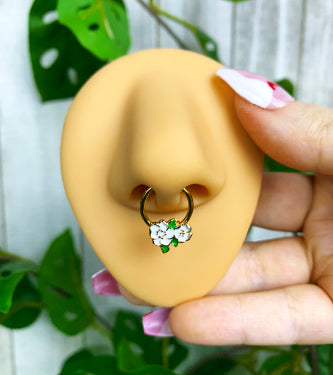




















Recycled metal jewelry is jewelry made from previously used, refined metal instead of freshly mined ore, and once it's refined it can match the same purity and alloy performance as new metal. In global gold supply, recycled gold made up 27.2% in 2023, and recycled gold reached 1,370 tonnes in 2024, up from 1,234 tonnes in 2023 and 1,163 tonnes in 2022, so this isn't some tiny side quest, it's a real material stream (World Gold Council and LBMA data).
You're probably staring at a product page wondering if “recycled” means anything useful or if it's just marketing glitter. If you wear body jewelry, that question gets sharper fast, because what's in the metal, how it was refined, and what touches your skin all matter just as much as the sustainability label.
What Recycled Metal Jewelry Actually Means
Recycled metal jewelry sounds simple, but the word recycled gets tossed around in a few different ways. In plain English, it means the metal came from existing material, then got collected, refined, and made into something new instead of coming straight from ore in the ground. That's the part that matters most when you're reading a product page and trying to figure out whether the claim is real or just decorative copy.

The three labels people mix up
Recycled metal usually means the raw metal came from scrap, old jewelry, manufacturing leftovers, or other recovered material. Reclaimed often gets used as a looser synonym, though some sellers use it to mean recovered from older products specifically. Upcycled is different again, because that usually means the old item itself was remade into a new form, not melted down and re-refined.
That distinction matters in body jewelry because you're not only buying a vibe, you're buying a metal that sits against skin for hours. A necklace can get away with fuzzy language more easily than a piercing stud, where alloy quality and finish really do show up in comfort.
Why this is a global supply story
This isn't just boutique craftsmanship talk. The World Gold Council reported that recycled gold made up 27.2% of total global gold supply in 2023, and the LBMA said recycling accounted for about 28% of total global gold supply from 2010 to 2021, with old jewelry contributing well over 90% of total scrap (World Gold Council and LBMA data). That means a huge share of recycled precious metal already moves through an established secondary-material system.
Practical rule: if a listing says recycled but doesn't say what metal was used, how it was refined, or whether it's a finished alloy, you still don't know enough to judge it.
For you, the takeaway is simple. Recycled metal jewelry is not a separate species of jewelry, it's the same metal category with a different source story. The question is whether that source story is clear enough to trust.
How Recycled Metal Gets From Scrap to Your Piercing
A recycled piece does not begin life as a finished ring, hoop, or labret. It starts as scrap. That scrap can come from old jewelry, estate lots, manufacturer leftovers, or e-waste streams, and then it has to be collected, sorted, tested, refined, and re-alloyed before it can safely become wearable again.

If you have ever looked at a drawer full of old studs and wondered whether they can re-enter the supply chain, this BodyCandy guide on reusing and recycling old body jewelry is a useful companion read. It speaks directly to the kind of scrap that often matters in piercing circles, the pieces people already own.
From scrap to clean metal
The LBMA notes that old jewelry makes up well over 90% of total scrap in the gold-recycling mix, which shows how much of this system depends on existing jewelry re-entering circulation (World Gold Council and LBMA data). After collection, the material gets refined. A peer-reviewed paper on precious metals recovered from e-waste describes hydrometallurgy as a liquid-chemical method that selectively recovers precious metals and can run on a small scale with lower capital investment and reduced discharge of organic chemicals (academic source).
That matters because “recycled” does not mean “melted once and ready.” It means the metal goes through an industrial recovery process that strips away contaminants and separates the useful metal from everything else. For body jewelry buyers, that step is a bit like resetting a tangled cord back into a clean spool. The source material may be messy, but the finished stock can still be controlled and consistent.
What to ask for: refinery name, recycled-content statement, and proof that the metal was tested before fabrication.
Why testing and remaking matter
A source on recycled-metal standards says these metals can be refined to 99.99% purity, then alloyed back into familiar jewelry specs like 925 sterling silver and 950 platinum (recycled-metal standards FAQ). In plain terms, the final quality comes from the alloy recipe and the maker's control, not from whether the starting metal was newly mined or recovered. That is the part piercers care about most, because a clean origin story does not help much if the finished alloy is wrong for skin contact.
If you are shopping online, a seller should be able to tell you what the finished metal is, not just where the scrap came from. That matters for pierced ears, lips, and noses, where finish, alloy control, and threading all affect wear much more than the backstory printed on the product page.
Recycled vs Mined Metal and the Real Environmental Tradeoff
The cleanest environmental difference shows up before the jewelry ever reaches the display case. One industry sustainability review says recycled gold production reduces emissions by 80% compared with mined gold, and gives a very concrete example, a 2-gram pair of gold earrings made from recycled materials emits about 280 grams of CO2, compared with 2.8 kilograms of CO2 for the same pair in mined gold (sustainability review). That's not a symbolic difference, it's a big upstream change.
What that means for body jewelry buyers
For body jewelry shoppers, the point isn't to turn every purchase into a morality contest. It's to understand that recycled precious metals can cut a lot of mining-related impact before the piece ever touches your skin. If you're choosing between two visually similar studs or hoops, that upstream difference can be part of the decision.
The same sustainability review also says 75% of leading fashion jewelry brands used 100% recycled silver in key collections in 2024 (sustainability review). That's a useful clue that recycled silver isn't fringe anymore. It's showing up in mainstream collections, which helps explain why body jewelry sellers now talk about recycled precious metals in the same breath as everyday wear.
The broader recycling reality
The U.S. Geological Survey reports that only 18 metals have end-of-life recycling rates above 50%, including silver, gold, copper, nickel, platinum, titanium, and zinc (USGS). That number is important because it separates technical recyclability from actual recycling rates. A metal can be recyclable in theory and still not make it back into the supply chain efficiently.
The International Energy Agency's selected-metals chart shows the same basic pattern, recycling rates vary a lot by metal, so the broader chain of collection, sorting, and processing is doing a lot of work behind the scenes (IEA chart). For body jewelry, that means recycled gold and silver are common talking points for a reason, while other metals can be harder to source in recycled form.
This Earth Day jewelry guide is a useful companion if you want a broader look at eco-minded jewelry choices alongside recycled metals.
Purity, Alloys, and Skin Contact
Body jewelry gets more interesting than fine-jewelry marketing. Once recycled metal has been refined, the metal itself can be just as pure as newly mined feedstock. That matters because piercing jewelry is not judged by its backstory alone. It has to hold up as a finished object, with the right alloy, the right surface, and the right threading or shape for skin contact.
For body jewelry, the key question is what the metal turns into after processing, not just where the scrap came from. A source on recycled-metal standards says recycled metals can be refined to 99.99% purity, and that recycled input can still become standard 925 sterling silver or 950 platinum after alloying (recycled-metal standards FAQ). So recycled does not automatically mean lower quality, and it does not automatically tell you whether a piece is suitable for a piercing.
What matters more than the source
For a piercing piece, the wearable quality comes from the final alloy recipe, the polish, and the maker's process. A recycled silver ring can still be perfectly made, while a poorly made newly mined ring can still be a mess. The origin story matters, but it does not override metallurgy.
That is where material testing comes in. A seller can say “recycled silver” and still leave you guessing about the actual alloy family, which is like knowing the ingredients without knowing the recipe. For piercing jewelry, that missing detail matters because different metals behave differently against skin, and the same label can hide very different outcomes once the piece is worn.
Recycled silver streams can carry trace contaminants such as lead, tin, cadmium, and antimony, which is why manufacturers rely on XRF verification and refining controls before fabrication. XRF testing is useful because it checks the metal composition without guessing from the label. If a brand cannot explain how it verifies the alloy, that is a reason to ask more questions before the piece goes anywhere near fresh tissue.
How to read the label like a piercer
This material guide is a good reference point if you are comparing metal families, because the label on the page should line up with what you are wearing. If you see sterling silver, remember that sterling is an alloy, not pure silver. If you see platinum, the maker should still tell you the exact spec and finish.
The practical check is simple. Ask what the base metal is, what alloying metals were added, and whether the final piece was tested after fabrication, not just before it was shaped. That question matters even more in body jewelry, where a finish that looks clean can still hide alloy choices that are fine for an earring, but less appropriate for a piercing.
Simple takeaway: recycled input is about sourcing, but skin-contact performance is about the final alloy and fabrication quality.
That is why a recycled metal piece can be a smart choice without being automatically the right choice for every piercing. Freshly healed skin, metal sensitivities, and threading style still matter just as much as the sustainability story.
Why the “Eco-Friendly” Label Deserves a Second Look
A recycled claim is a better starting point than a vague green vibe, but it still leaves important questions unanswered. One contrarian analysis argues that recycled precious metals have “no positive impact on mining practices worldwide” and are not as ethical as fairtrade metals (contrarian analysis). That is a sharp claim, and it deserves attention because it pushes past the easy assumption that recycled always means best.
Proof beats vibes
What shoppers usually need is not another round of praise for recycled metal, but clearer documentation. The gap shows up all over jewelry marketing. Some pages say recycled, reclaimed, or upcycled without explaining what percentage is recycled, what refinery handled it, or whether the final alloy was verified.
If you want the claim to mean something, ask for:
- Chain-of-custody records, so the metal can be traced from source to finished piece.
- Refining documentation, so you know the scrap was processed, not just relabeled.
- Alloy disclosure, so you know what is touching your skin.
- Independent verification, when the brand has it, because outside checks are stronger than self-claiming.
Where the terminology gets slippery
Buyer guidance on recycled metals notes that these materials can come from old jewelry, estate lots, or e-waste streams, and that traceability plus purity testing are still major supply-chain challenges (buyer guidance). That is the part mainstream coverage often glosses over. A seller can have a real recycled supply chain and still fail to explain it well enough for you to trust the piece.
For body jewelry, the question gets more specific. You are not just asking whether the metal is recycled, you are asking whether it is low-nickel, properly refined, and clearly described. That is a different standard than a cute pendant necklace gets. A hoop for a fresh piercing can look polished and still be the wrong alloy for skin that is still healing.
Smart Buying Tips for Recycled Body Jewelry
Start with the listing, not the branding language. If a page says recycled silver or recycled gold, look for the exact metal, the finished alloy, and any note about verification. A glossy product photo can hide a lot, and a green adjective on its own does not tell you whether the piece is suitable for piercing wear.
Three real shopping scenarios
Small handmade shop: Ask who refined the metal, whether the shop buys scrap or finished stock, and whether they can show supplier paperwork. Handmade sellers often know more than their product pages reveal, but they do not always write it down clearly. A direct question can expose that difference fast.
Large jewelry chain: Look for product-level specificity. A chain should be able to say whether the piece uses recycled content, how much if disclosed, and whether the claim is backed by third-party documentation rather than a marketing phrase. If the description stays vague, the sustainability claim may be doing more work than the metal itself.
Body-jewelry retailer: Check the page for both material details and piercing-relevant specs. Recycled content is only part of the story, because body jewelry also has to make sense for wear against healing or sensitive skin. You want the metal type, the alloy, and the threading or post details all in one place. For example, BodyCandy states on product pages that its gold and platinum settings are SCS-Certified 100% Recycled Precious Metals, which gives you a more concrete claim to evaluate than a generic recycled label.
Buyer rule of thumb: if the seller can't answer what the metal is, where it came from, and how it was verified, the sustainability story is too soft to trust.
Red flags that usually mean greenwashing
- No alloy details, which is risky for sensitive skin and piercing compatibility.
- Only one sustainability buzzword, with no chain-of-custody or refinery info.
- Claims that sound absolute, but don't mention whether the piece is 100% recycled content or only partially recycled.
- Vague “ethical” language, with no proof of sourcing or testing.
If you're shopping online, compare recycled metal claims the same way you'd compare thread type or post gauge. A pretty description does not tell you how the piece will behave in a piercing, and specific details do.
Caring for Recycled Pieces So They Last
Recycled metal still needs normal jewelry care. Gold, silver, and platinum can all pick up grime, dullness, and wear from sweat, lotion, makeup, and sleeping on the same side every night. The metal's source doesn't protect it from daily life.
A simple care routine that actually sticks
Wash solid metal pieces with mild soap, warm water, and a soft brush or cloth, then dry them thoroughly before reinserting them. Sterling silver can tarnish over time, so a polishing cloth helps bring back the shine. Platinum is durable, but it still benefits from gentle cleaning and separate storage so it doesn't rub against harder pieces.
Avoid harsh chemicals, chlorine, and aggressive cleaning methods on plated pieces. Ultrasonic baths can be risky for certain finishes, so if you're not sure how a piece is built, gentle hand cleaning is the safer move.
What body jewelry wearers forget
Body jewelry lives in a warm, moist environment, which means buildup happens faster than it does with a ring you only wear to dinner. If you sleep in your jewelry, choose a side that doesn't get crushed, and don't let lotions sit around the area before the piece goes back in.
If a piece starts to pit, bend, or lose its finish badly, retire it instead of trying to rescue it forever. Some jewelry is worth polishing. Some jewelry is just done.
Recycled Metal Jewelry Questions Worth Asking
Is recycled the same as reclaimed or upcycled? Not exactly. Recycled usually means recovered metal was refined into new usable stock, reclaimed is often used more loosely, and upcycled usually means the old item itself was transformed.
Can recycled jewelry tarnish? Yes. Tarnish depends on the metal and finish, not just the source. Sterling silver can tarnish whether it started as mined or recycled.
Is it safe to wear in the shower? Sometimes, but showering still speeds up wear for many finishes and can leave soap residue behind. If the piece is plated or delicate, skip the shower.
Is recycled jewelry worth the price? If the seller gives you clear sourcing, real alloy details, and solid workmanship, it can be worth it. If the recycled claim is the only thing they're selling, probably not.
Ready to shop with fewer guesswork headaches and more metal know-how? BodyCandy carries body jewelry with material details that help you compare recycled content, finish quality, and piercing-friendly design in one place. Visit BodyCandy to browse pieces that fit your style and your standards, then bring your best questions to the comments if you want help reading a product page like a pro.