













Is 18K gold the safe choice for a belly ring, or does the stamp just make you feel better about a piercing that's still healing?
That question matters because karat measures gold content, not safety. An 18K mark tells you how much of the metal is gold. It says nothing about the other 25%, how the piece is built, or whether your navel is ready for it.
Shopping for belly button rings gold 18k puts you between two pitches: the luxury story and the cheap dupe. Neither one answers the question you need answered, which is whether this specific ring will heal well in this specific piercing.
So let's take it apart properly. The numbers, the fit, the nickel, the healing clock and the price, in the order that keeps you out of trouble.
What 18K Gold Means Inside a Belly Ring
Is 18K better than 14K for a belly ring? Better for gold content, yes. Better for your piercing, not automatically.
18K means 75% gold by mass. Karat runs on a 24-part scale, and 18 of those parts are gold, which is why the same standard appears as 750 parts per thousand in fineness notation. The gold jewelry market analysis walks through that math and the alloy side of it, and both numbers matter when you're reading a product page.
The other 25% is not filler. It's silver, copper, palladium or platinum, chosen to add hardness, shift the color and hold up better than near-pure 24K gold. That durability is the whole reason 18K exists as a body jewelry grade.
| Karat | Gold content | Fineness | Piercing suitability |
|---|---|---|---|
| 24K | 99.9% | 999 | Too soft for body jewelry, scratches and deforms |
| 18K | 75% | 750 | Common solid choice, alloy must be checked |
| 14K | 58.3% | 583 | Most common US standard, alloy must be checked |
| 10K | 41.7% | 417 | Highest alloy share, check nickel content closely |
What the Karat Does Not Cover
A stamp describes the gold alloy. It doesn't describe every component bolted onto it.
Plating, gemstone settings, threaded ends, hinged clickers and soldered charms can all be a different metal from the bar they sit on. That's how a ring gets sold as 18K when only the post is 750 and the dangling charm is brass with a gold wash. The claim isn't exactly false. It's narrower than you assumed.
Why 18K Is Standard in Europe and 14K Is Standard in the US
European shoppers buy 18K as their default gold grade, while US buyers more often reach for 14K and 10K. Neither market is getting it wrong. Karat preference follows local convention, price sensitivity and how much wear a piece takes.
For navel jewelry, 18K sits in a sensible spot. Enough gold that it feels premium against the skin, and a hard enough alloy to survive waistbands, seatbelts and gym clothes.
Where the Stamp Should Be
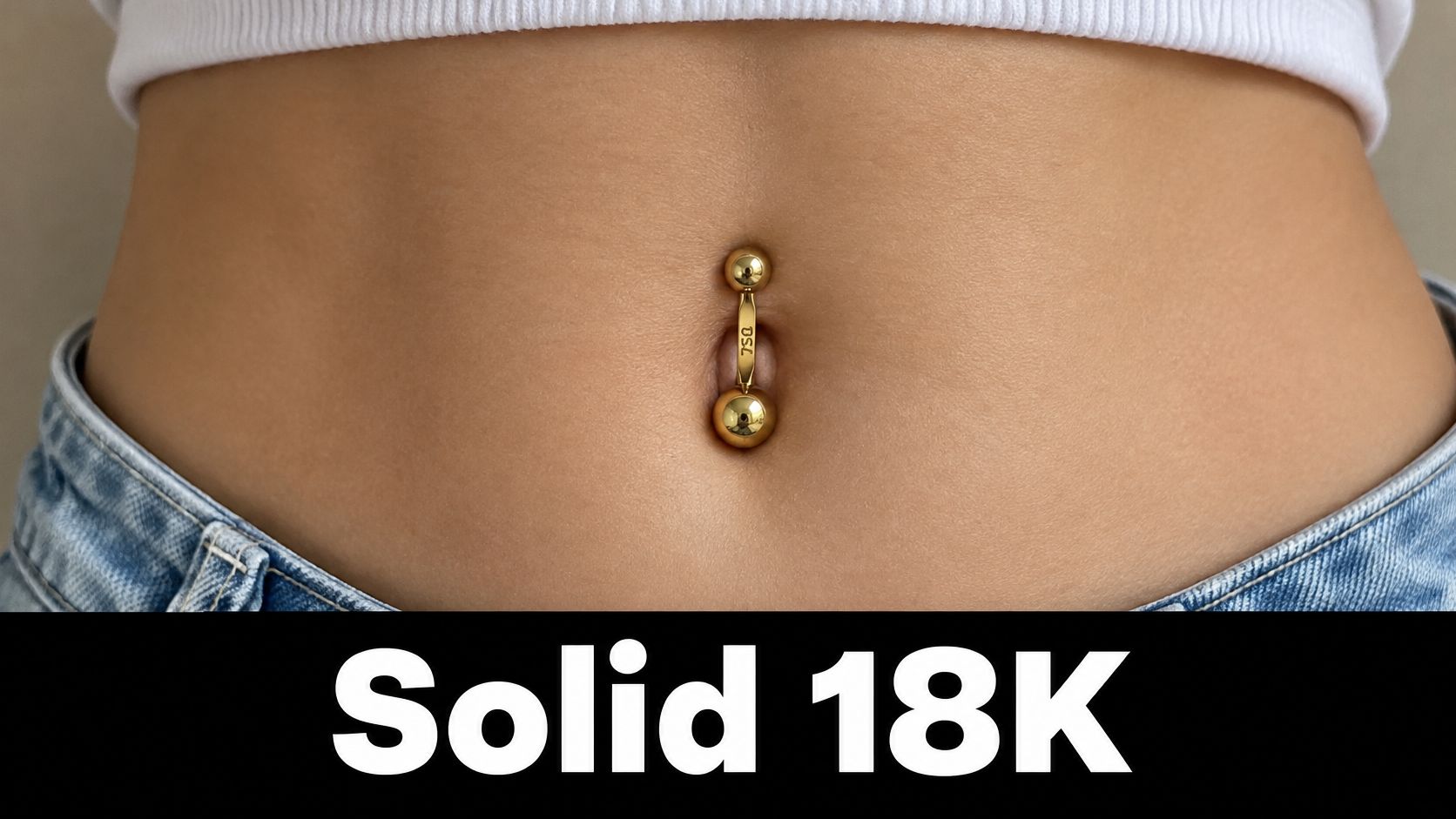
Look for 750 or 18K struck into the metal itself, on the bar or the ball. A hallmark printed on the box, the poly bag or the product title tells you nothing about the ring inside.
Ask for a close-up photo of the stamp before you order. Hallmarking rules vary by country, so treat the mark as a starting point rather than a guarantee, and let the alloy disclosure finish the job.
How to Size Gauge, Bar Length and Ball Diameter
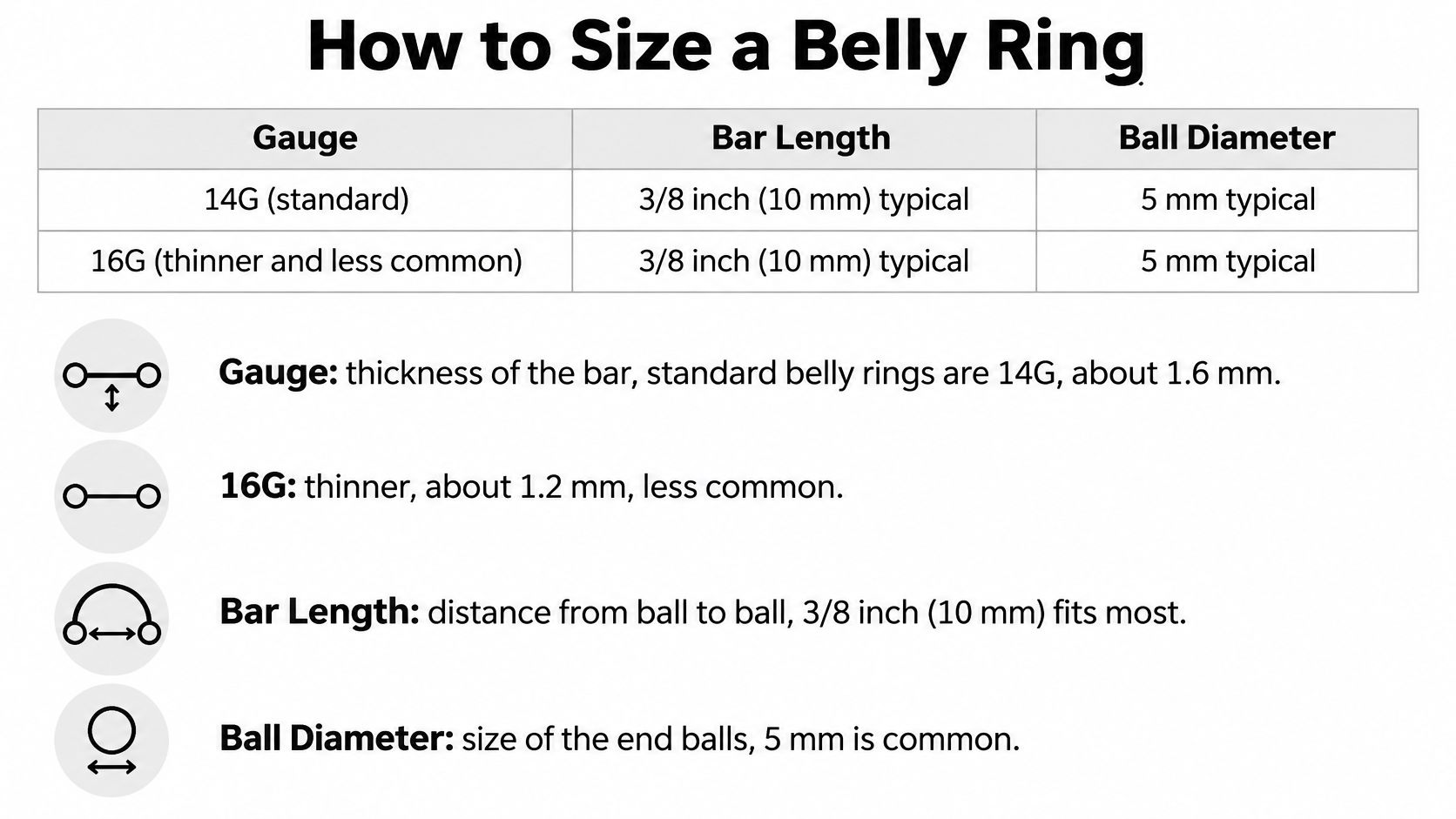
A beautiful 18K ring in the wrong length will irritate faster than a plain one that fits. Size comes before style, every time.
| Measure | Common value | What it changes |
|---|---|---|
| Gauge (standard) | 14G (1.6 mm) | Fit through the piercing and tissue |
| Gauge (thinner) | 16G (1.2 mm) | Lighter feel, check with your piercer first |
| Bar length | 3/8 in (10 mm) | Snug fit on a flat navel |
| Bar length | 7/16 in (11 mm) | Comfortable for average navels |
| Bar length | 1/2 in (12 mm) | Room for mild swelling |
| Bar length | 5/8 in (16 mm) | Extra clearance for swelling or a fuller belly |
| Ball diameter | 5 mm | Subtle visible profile |
| Ball diameter | 8 mm | Bolder visible profile |
Gauge Sets the Thickness
14G is the belly ring standard, and that's a bar roughly 1.6 mm thick. A 16G bar is about 1.2 mm and feels lighter, but it's less common in navel jewelry, and thinner metal has less support in a fresh piercing. Clear 16G with your piercer before you size down.
Bar Length Decides Comfort
Length is measured between the ball ends, not across the whole piece. 3/8 inch (10 mm) sits snug on a flat navel. 7/16 inch (11 mm) and 1/2 inch (12 mm) cover most average navels, while 5/8 inch (16 mm) leaves extra room for swelling or a fuller belly.
Too short is the dangerous mistake, because a bar pressing into healing tissue starts to embed quickly. Too long is merely annoying: extra length catches on waistbands and snags on everything.
Ball Diameter and Drop Length
The balls are what people see. 5 mm stays subtle, 8 mm reads bolder, and the size is purely aesthetic as long as the threading matches the bar.
Dangles add a fourth number nobody puts on the listing: drop length. Measure how far the charm hangs, then ask yourself whether that's where your jeans waistband sits.
One 18-karat gold navel piercing listing priced at €280 shows how these figures look on a real page: a 1.6 mm thickness with 5 mm and 8 mm zirconia balls. That's a 14G bar with a mixed ball set, and it tells you more than the word "premium" ever will.
Still deciding on shape before you commit to a measurement? The navel ring styles, materials and sizing crash course covers the silhouettes first.
Practical rule: Buy the length your piercer measures while you're standing, not the length you guess while sitting. Navels change shape with posture, weight and pregnancy.
How to Verify Solid 18K Before You Buy
What proves a belly ring is solid 18K, rather than gold-colored? Check the mark, the alloy details and the construction. Each check catches a different problem.
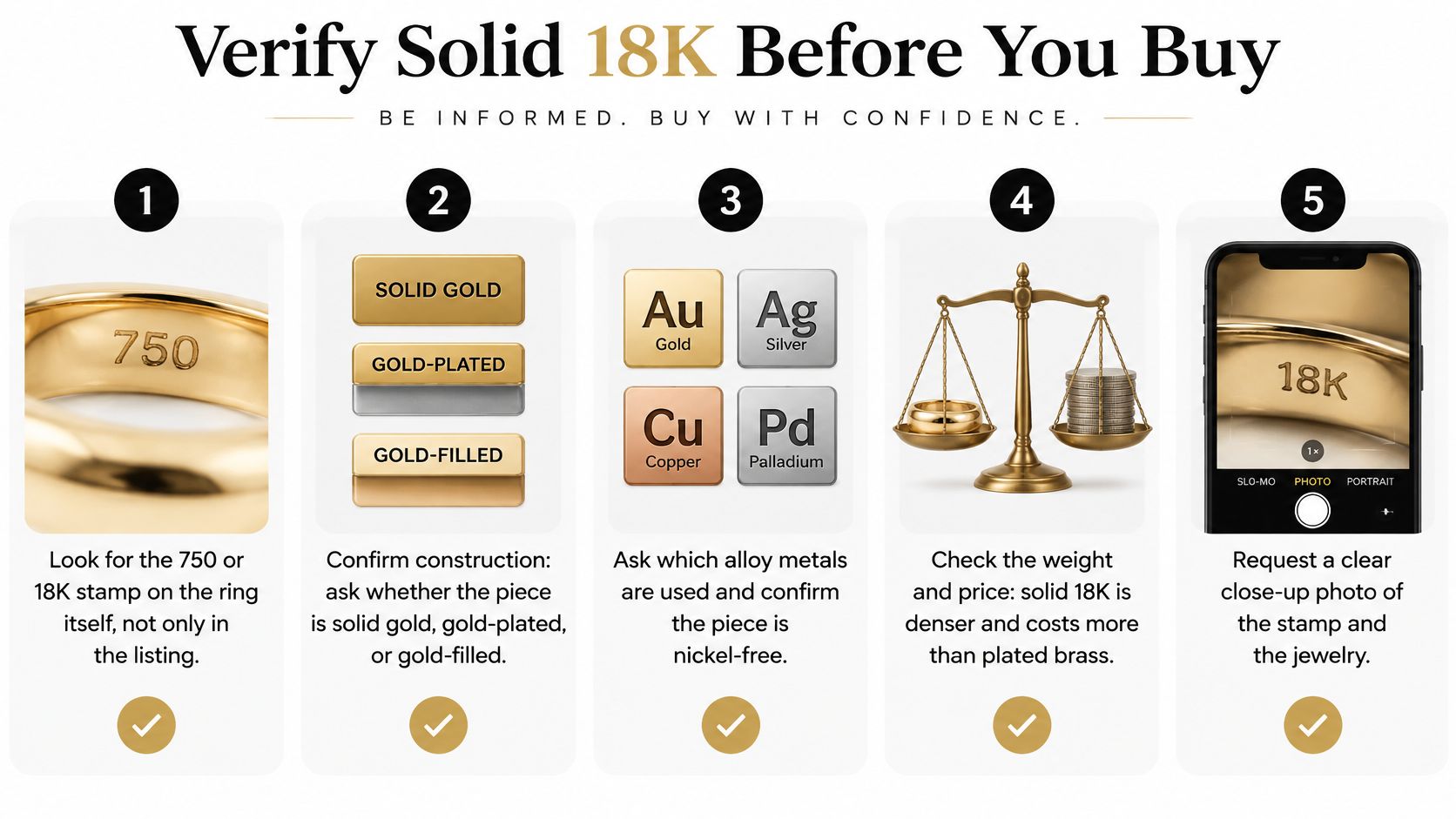
- Look for a hallmark on the jewelry. Check the bar or ball, not just the product listing. A stamp is a useful clue, but ask the seller to confirm that the whole piece is solid 18K, not merely finished in gold.
- Confirm the construction in writing. The Association of Professional Piercers advises against gold-plated, gold-filled and sterling silver jewelry for new or unhealed piercings. Its guidance emphasizes appropriate material, size, design and construction for healing (APP consumer guidance). For a fresh piercing, a coating that can wear through is a poor trade-off.
- Ask what makes up the remaining 25%. 18K gold is 75% gold; the other metals form the alloy. Get the alloy details rather than accepting “solid gold” as a complete answer.
- Check the threads and fit of the ball. With internally threaded jewelry, the thread sits inside the bar, leaving a smooth section to pass through the piercing. The ball should attach securely and sit flush. Rough edges or a loose fit can irritate the channel.
- Confirm the gauge and bar length with your piercer. Belly rings are commonly sold in 14G, but the right length depends on your piercing. A neat-looking short bar is a bad choice if it presses into the tissue.
- Keep the receipt and product details. Save the listing or packaging that identifies the material and construction. If the jewelry does not match what you were sold, those details help you explain the discrepancy.
For more on the difference between solid, plated and filled gold, read this guide to real gold jewelry.
If the seller cannot identify the alloy or confirm solid construction, choose another ring. Gold content tells you how much gold is in the piece; it does not, by itself, guarantee that the jewelry suits a healing piercing.
Nickel, White Gold and Allergy Risk Explained
"Hypoallergenic" isn't a material. It's a marketing word, and an 18K stamp doesn't earn it.
Yellow gold is normally alloyed with silver and copper, which is part of why it has the better reputation. White gold often gets its color from nickel, a leading cause of jewelry allergy, and cobalt in an alloy can trigger the same reaction in sensitive skin.
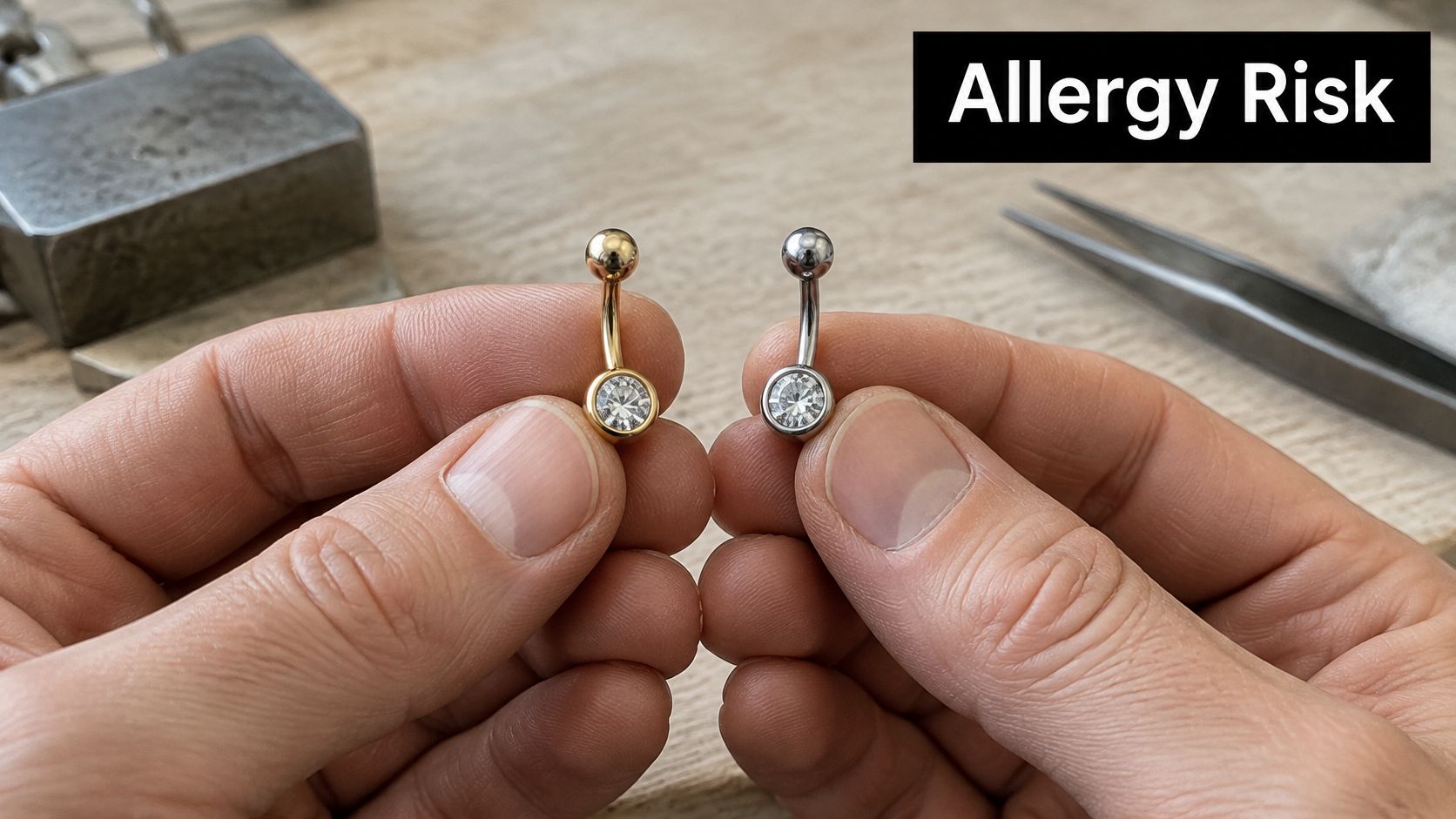
Here's the benchmark worth carrying into a product page. Under European Union restrictions, piercing post assemblies inserted into pierced body parts must release less than 0.2 micrograms of nickel per square centimeter per week, while other jewelry intended for direct, prolonged skin contact is held to 0.5 micrograms (EU nickel restriction). A navel ring isn't classified like an ear post, so read those figures as a shopping yardstick rather than a legal test you can apply to your own jewelry.
Irritation Is Not Allergy
Irritation comes from the outside: friction, sweat, soap residue, a waistband sawing at the site, a snag in the shower. It settles once you remove the cause.
Allergic contact dermatitis comes from the metal. It itches, reddens, scales, sometimes weeps, and it returns every single time that metal touches your skin. Nickel and cobalt drive most jewelry cases.
Plating Is a Temporary Promise
Abrasion, sweat and cleaning wear through plating and expose whatever sits underneath. A plated ring that behaved in month one can turn your piercing angry by month six, and the sudden reaction confuses people who assume the jewelry hasn't changed.
It has. The coating has.
What to Do Instead
- Buy solid 18K with a documented alloy. Nickel-free in writing beats gold-colored in the photo.
- Ask for nickel release test documentation if you have a known nickel allergy. A supplier who tests can usually show it.
- Get patch tested by a dermatologist if reactions keep returning. Guessing which metal is responsible wastes money and healing time.
- Stop wearing the piece if itching, redness, scaling or swelling persists. Swap to something you can verify.
Paying more for 18K doesn't remove risk. The 25% decides how your skin answers.
Healing Time, Clothing and Warning Signs
A navel piercing is one of the slow ones. Expect 12 to 18 months of on-and-off tenderness, redness or crusting, and a year or longer before it has settled, as Cleveland Clinic guidance on infected belly button piercings sets out.
No karat shortens that clock. The jewelry supports healing. It doesn't perform it.
Clothes and Jewelry Weight
High-waisted jeans, belts and elastic waistbands rub the site repeatedly, and that friction delays healing even when everything else is right.
Weight matters just as much. A heavy dangle on a three-month-old piercing puts extra strain on it with every step, which is how migration starts. Wear the light bar first and save the statement piece for later.
Water, Sport and the Eye Patch Trick
Keep the piercing out of lakes, pools and hot tubs while it heals. If exposure is unavoidable, a waterproof wound-sealant dressing helps protect it.
For contact sports or tight clothing, a hard vented eye patch worn over the navel under your clothes and secured with tights or an elastic bandage cuts irritation without pressing on the jewelry (APP aftercare guidance). It looks strange. It works.
The Daily Routine
Rinse with sterile wound-wash saline one to three times a day. Skip alcohol, hydrogen peroxide, Betadine, Hibiclens, harsh soaps and ointments, because they irritate healing tissue and slow the process rather than speeding it (APP troubleshooting guidance).
Pat dry with clean paper towel. Don't rotate the jewelry. Don't pick the crust.
| Sign | Usually normal | Get it checked |
|---|---|---|
| Tenderness | Dull ache when pressed, easing over weeks | Pain that keeps increasing |
| Redness and swelling | Mild, settling within days | Gradually worsening or spreading |
| Discharge | Clear fluid or whitish crust | Foul smell, yellow or green discharge |
| Clothing irritation | Mild rubbing with tight waistbands | Persistent rash that does not settle after changing clothes |
When to Call Someone
Use the table as your decision point. Progressively worsening redness or swelling, pain that intensifies rather than fades, or foul-smelling yellow or green discharge all justify professional medical advice.
If you suspect an infection, don't pull the jewelry out on your own. Removing it can let the channel close over the infection, and a clinician should make that call.
More on sorting ordinary healing from an actual problem sits in our guide to belly piercing problems.
What Drives the Price of Solid 18K Rings
Metal cost sets the floor under every solid piece. The average gold price in the third quarter of 2024 was US$2,474 per troy ounce, 28% higher than in the third quarter of 2023, according to the World Gold Council's jewellery analysis.
When that number moves, it lands in your cart. What happens after the metal price is where designs start to differ.
- Gold weight. Two rings that look identical in a photo can differ by several grams. Weight is the biggest single cost driver, and it's also why a heavier piece feels different against your navel.
- Solid against hollow or plated. A hollow ball and a plated bar use a fraction of the gold. Both can carry a gold color and neither carries a 750 stamp through the whole piece.
- Stones. Cubic zirconia keeps a design affordable. Lab-grown diamonds sit mid-range. Natural diamonds push the price into another category entirely, usually without improving the piercing experience.
- Labour and finish. Hand-finished ends, hand-set stones and internally threaded construction all take time at the bench, and that time shows up in the price.
The Cheap Ring Problem
A suspiciously cheap "18K" belly ring is usually plated, hollow, or a lower karat with a confident title. Sometimes it's all three.
You can't spot it from the thumbnail. You can spot it by asking for the stamp photo, the gram weight and the alloy, which is exactly why those three questions are worth asking before you pay.
Run a Value Test, Not a Price Comparison
Compare price per gram among pieces that are all confirmed solid. Compare the same specifications, same gauge, same length, same ball size, rather than two different designs at two different price points.
A ring at twice the price isn't overpriced if it carries twice the gold. It's overpriced when it carries the same gold and a better photo.
Shop a Solid 18K Belly Ring You Can Heal With
What should you buy once you know your preferred style and fit? Choose by the product details, not the styling photo.
Look for a clear description of the metal and construction, and make sure the bar matches the size your piercer measured. For a fresh piercing, 18K is a gold-content number, not a safety guarantee. Solid construction, a documented nickel-free alloy and jewelry that suits the healing stage matter more.
BodyCandy offers belly rings in the standard 14G gauge, with styles including plain barbells, dangles, hoops and solid 14k gold. Its belly ring options also include F136 titanium, 14k gold, rose gold and handcrafted pieces. BodyCandy's gold jewelry range includes belly rings and nose studs, so you can compare options across piercing types.
Open a few product pages and check the gauge, bar length, ball diameter and stated metal. A careful comparison helps you avoid choosing by appearance alone.
Save heavy fashion dangles for after healing. Extra movement and weight can irritate a settling navel piercing, while a simpler piece is often easier to wear during that period.
If your piercing is new, swollen or changing shape, ask a professional piercer to check the fit before changing jewelry. Anatomy determines the right length, and a poor fit can cause problems that are harder to address later.
Choose a piece that suits both your piercing and your style. BodyCandy sells solid 14k gold body jewelry alongside F136 titanium, rose gold and handcrafted options. Its belly rings come in standard 14G, with styles ranging from plain barbells to dangles and hoops. Browse BodyCandy for a ring that fits your piercing.