















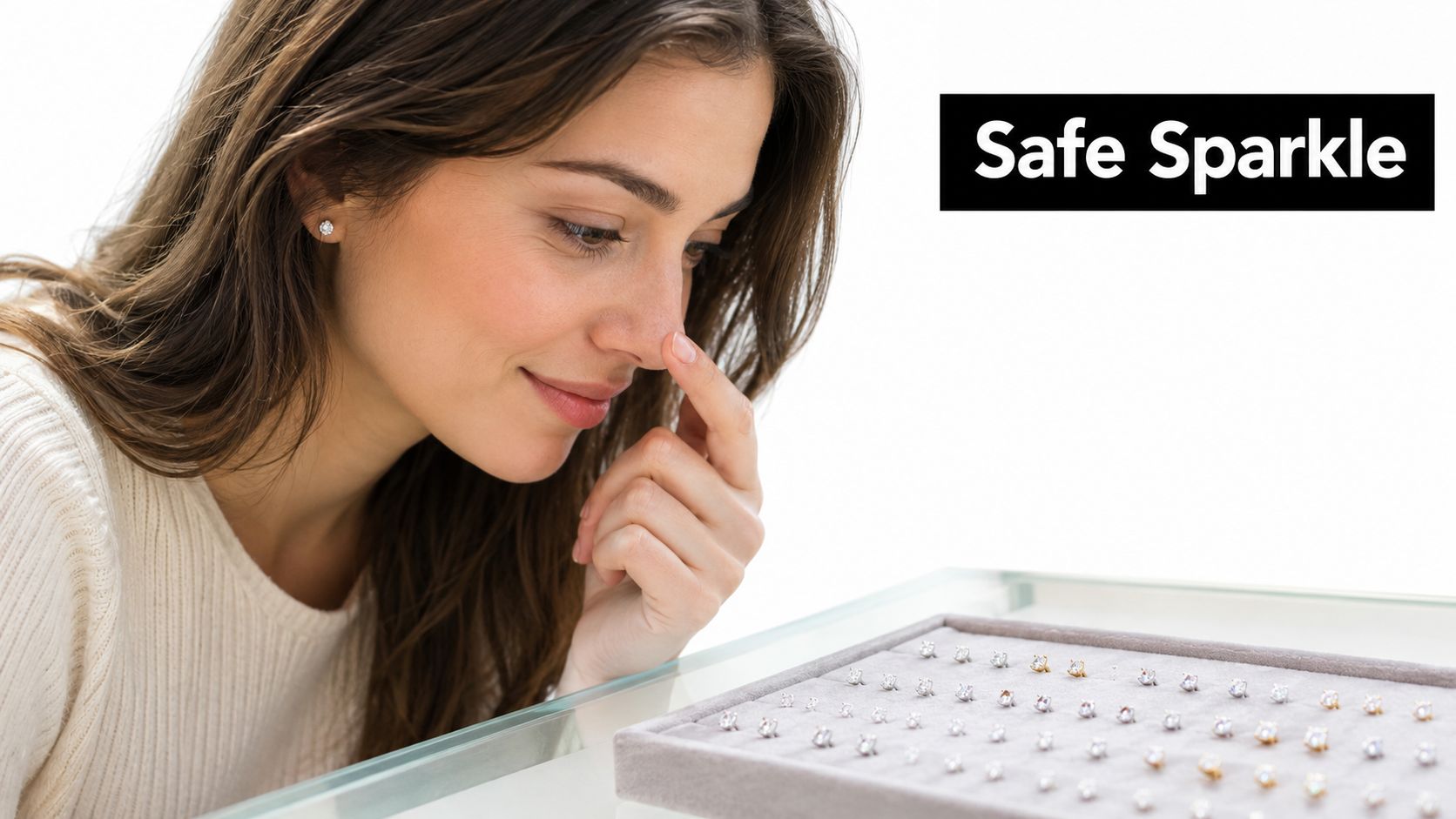
You're standing at a jewelry counter with a tiny row of sparkling nose studs in front of you. One catches the light perfectly, but then the practical questions start: Is it real diamond or just a diamond look? Will the metal irritate your nose? Is that setting comfortable enough for everyday wear, and is your piercing healed enough for the switch?
A titanium nose stud with a diamond or diamond-look stone can give you the sparkle you want without making comfort an afterthought. The trick is to shop beyond the word “hypoallergenic” and check the titanium grade, stone setting, post length, backing, and healing stage.
Why a Titanium Nose Stud with a Diamond Just Makes Sense
The pretziest stud on the display isn't automatically the smartest choice. A tall setting can snag on clothing, a mystery alloy can irritate sensitive skin, and a post that's too short can press into a swollen piercing. The best titanium nose stud diamond combination balances skin comfort, secure construction, and the amount of sparkle you want to wear.
Titanium has become a foundation material for nose studs because implant-grade versions such as ASTM F136 and ASTM F67 are used in medical devices and are widely treated as safer choices for fresh or sensitive piercings. That medical-use connection matters more than a vague product description that only says “hypoallergenic.” You want a material with a recognized specification, not just a marketing promise.
The comfort and sparkle combination
Think about two shoppers. The first has a fresh nostril piercing and needs jewelry that won't add unnecessary irritation during healing. The second has a fully healed piercing but remembers how quickly cheaper earrings make their skin itchy. Both may appreciate titanium, but they still need different designs and different timing.
A simple, low-profile clear stone can work as an everyday look, while a more decorative top may suit a healed piercing better. In both cases, the titanium post is only part of the story. The backing, prongs, bezel, polish, and any coating also need attention.
Practical rule: Choose the safest wearable foundation first, then choose the sparkle.
A 2025 systematic review found a strong association between piercings and nickel allergy in the general population. The review included 5,333 people and reported an odds ratio of 5.9, with a 95% confidence interval of 3.6–9.4. Among dermatitis patients in a sample of 20,330, the odds ratio was 3.6, with a 95% confidence interval of 2.3–5.8. The review also reported a risk of developing nickel allergy after piercing of 4.6 for women and 2.8 for men, which helps explain why nickel-free materials receive so much attention in nose jewelry. You can read the systematic review on piercing and nickel allergy for the full findings.
For a closer look at the material side of body jewelry, explore this guide to titanium body jewelry. The short version is simple: a little sparkle feels much better when the jewelry underneath it is designed for your skin and your piercing stage.
What Makes Titanium Actually Safe for Your Nose
You find a sparkly titanium nose stud, but the product page only says “titanium.” Pause before buying. For a nose piercing, the useful question is whether the piece is made from implant-grade titanium, with a recognized specification such as ASTM F136 or ASTM F67.
Start with the grade
ASTM F136 identifies Ti-6Al-4V ELI, an engineering-grade titanium alloy used in implant applications. ASTM F67 identifies commercially pure titanium used in comparable medical contexts. These standards tell you far more than labels such as “titanium colored” or “titanium plated.”
A titanium-coated stud has a different base metal beneath its surface. The coating may wear or chip, especially around threads or a decorative setting, exposing that underlying material. Check whether the listing confirms solid titanium, names the grade, and identifies the material used for the post, top, prongs, and backing. If those details are missing, treat the description cautiously.
For ASTM F136, the alloy composition is controlled. It contains about 5.5–6.5% aluminum and 3.5–4.5% vanadium, along with ultra-low interstitial impurities. Its typical Young's modulus is around 110–114 GPa, and its minimum tensile strength is around 860 MPa. The practical takeaway is simpler: the metal can be made thin and comfortable while resisting permanent bending during ordinary insertion and removal.
Why the surface matters
Titanium naturally develops a passive TiO2 surface layer. This protective layer gives the metal high corrosion resistance and helps limit ion release in moist, chloride-rich conditions similar to nasal tissue. Lower surface ion release can reduce irritation and metal sensitization, which helps explain why implant-grade titanium suits fresh piercings and long-term wear.
Mayo Clinic lists titanium among jewelry metals less likely to trigger nickel-allergy reactions. Its nickel allergy guidance can help if jewelry has caused a rash or itching before.
| Grade | What It Is | Best For |
|---|---|---|
| ASTM F136 | Implant-grade Ti-6Al-4V ELI alloy | Fresh piercings, sensitive skin, and long-term wear |
| ASTM F67 | Implant-grade commercially pure titanium | Sensitive piercings and medical-use applications |
| Generic “titanium” | A description without a confirmed standard | Only after the seller confirms the exact material |
| Titanium-coated | A different base metal with a titanium surface layer | Usually not the first choice for a fresh or reactive piercing |
A decorative diamond does not make an unspecified metal safer. Before buying, search the listing for ASTM F136 titanium or another recognized implant-grade specification. Then confirm that the stone setting, prongs, backing, and post are identified. Once the piercing is fully settled, a low-profile setting is less likely to snag during daily wear. A titanium post paired with mystery metal can defeat the reason you chose titanium.
Picking the Right Diamond or Diamond-Look Stone
The stone is the fun part, but the setting controls much of your comfort. A tiny clear stone can look bright and polished without creating a tall snag point, while a large or raised design may catch on towels, masks, scarves, or sweaters.
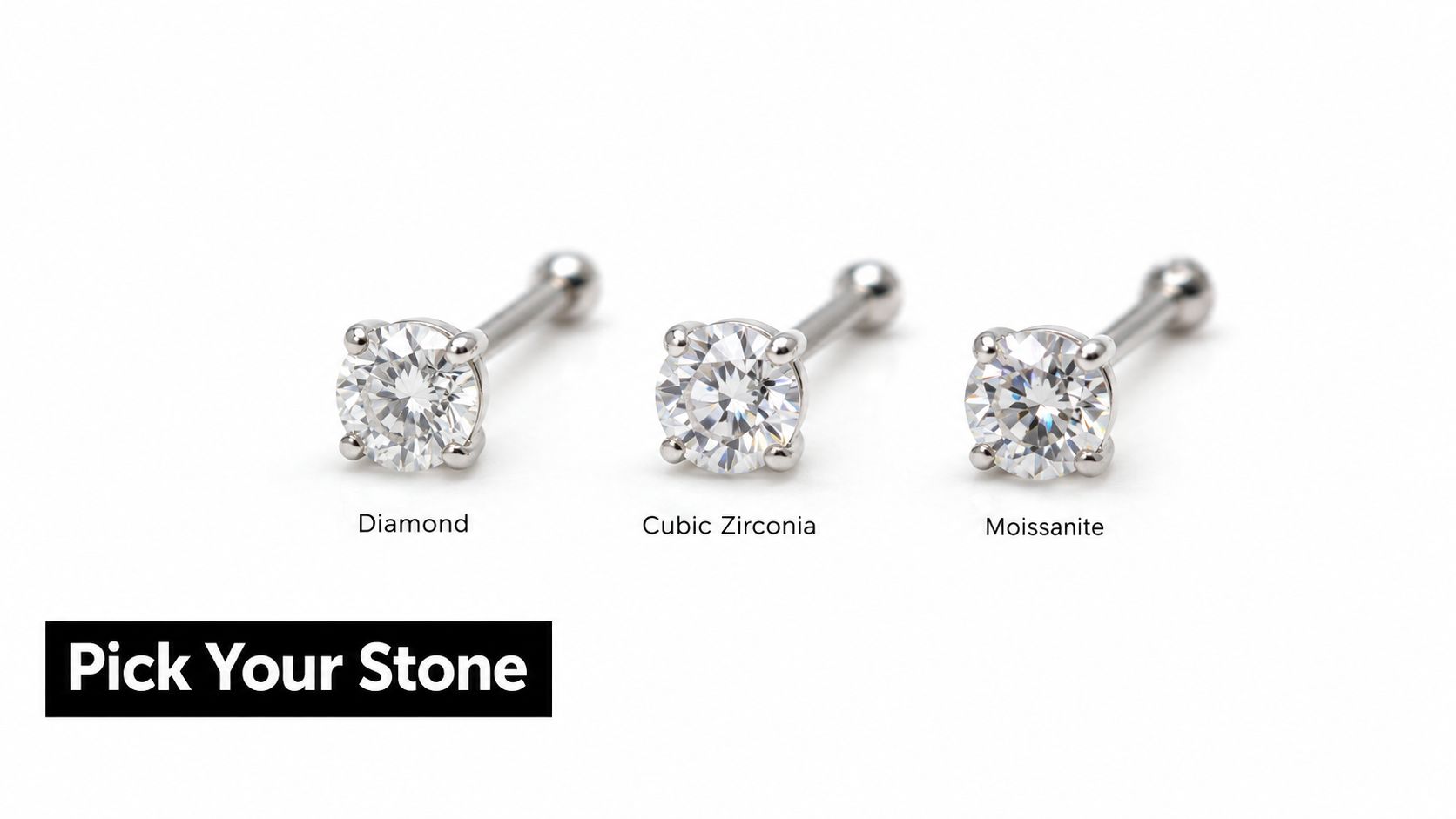
Diamond, CZ, or moissanite
A genuine diamond offers natural sparkle and long-term durability, even in a very small nose stud. It makes sense when the stone itself matters to you, you're choosing a special piece, or you want a classic material pairing that you'll keep wearing for a long time.
Cubic zirconia, usually called CZ, gives you a bright diamond look without requiring a genuine diamond. A clean cut and smooth surface matter more than chasing a large top. Clear CZ titanium nose studs have become a popular choice for shoppers who want visible sparkle while keeping the piece approachable for everyday wear.
Moissanite has its own lively appearance and can show more colorful flashes in certain lighting. Some people love that extra fire, while others prefer the more familiar look of diamond or clear CZ.
A guide to cubic zirconia versus diamond can help if you're unsure which look fits your style. For a nostril stud, the stone is small enough that the overall design, setting, and fit often affect your experience more than the label alone.
Let the setting do its job
Look closely at how the stone sits in the top. A bezel setting surrounds the stone with a smooth rim and creates a clean, low-profile shape. A prong setting can let more light reach the stone, but exposed prongs need a careful finish and secure construction.
Watch out for sharp edges, uneven metal, or a stone that looks loose when you gently inspect the piece. A setting that traps product residue or debris can become annoying around a piercing, especially if the top is oversized or difficult to clean.
A smaller stone in a smooth, secure setting usually wears better than a larger stone that constantly catches.
Cut also changes the look. Round stones create a traditional point of light, princess cuts look crisp and geometric, and elongated shapes can add a more directional detail. Keep the top proportional to your nostril and your routine. If you wear glasses, masks, face coverings, or chunky knitwear, a lower profile may save you a lot of daily fuss.
The best splurge depends on your priorities. Choose a genuine diamond when the natural stone and long-term keepsake value are central to the purchase. Choose a well-finished CZ when you want clear sparkle, a titanium foundation, and an easy everyday style without making the stone the entire event.
Here's a closer look at how the options compare in motion and appearance:
Getting the Size and Back Type Just Right
A nose stud can be made from excellent titanium and still feel wrong if the fit doesn't match your piercing. You'll need to think about gauge, post length, top diameter, and backing style as a set rather than choosing whichever number looks smallest.
Gauge and top size
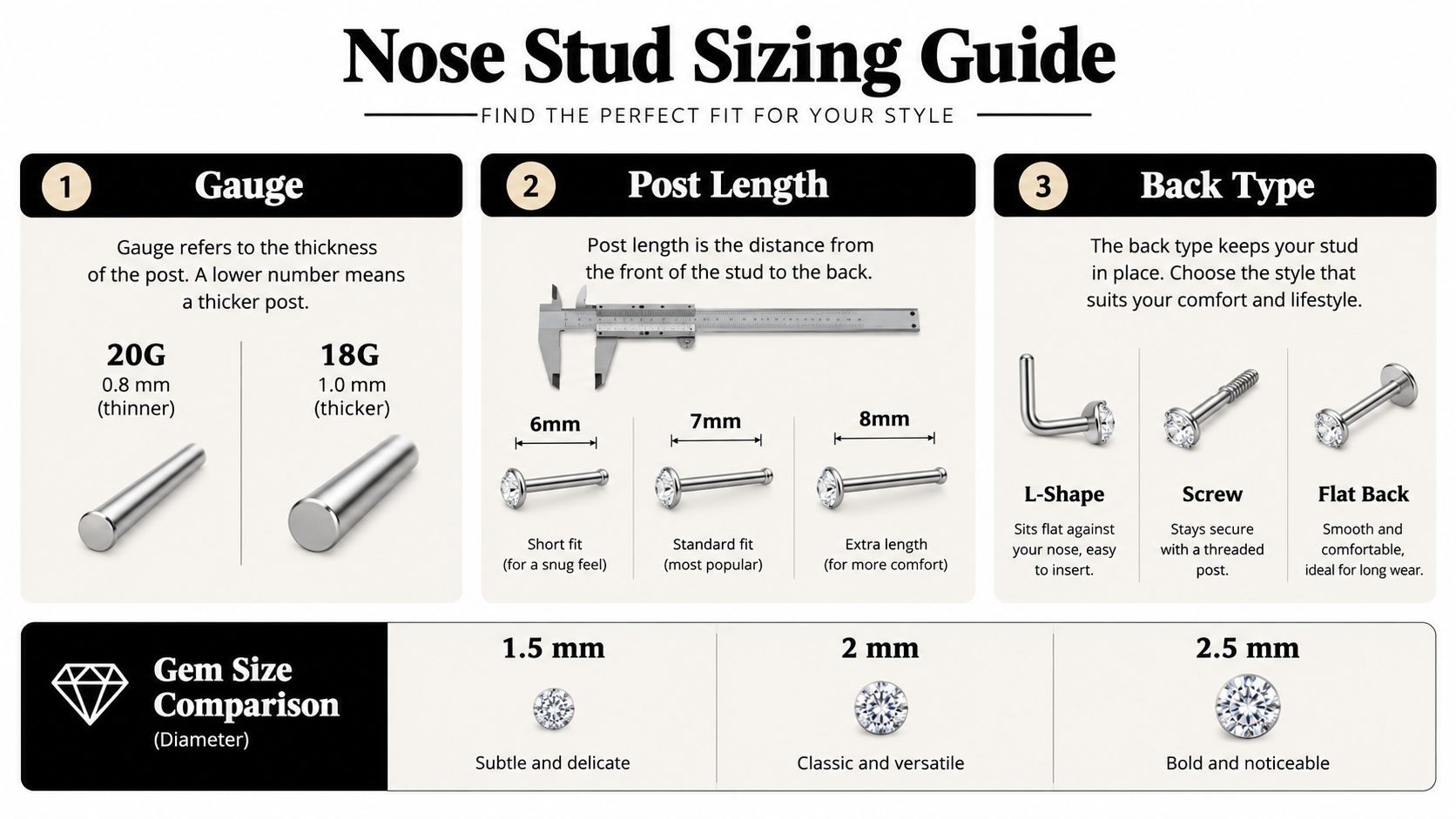
Gauge describes the thickness of the post. Common nose jewelry listings may show 20G or 18G, and those sizes aren't interchangeable for every piercing. If you're replacing an existing piece, check the original packaging or ask your piercer rather than guessing from a product photo.
The decorative top has its own measurement. A 1.5mm top gives a barely-there point of light. A 2mm top has more visual presence while remaining subtle, and a 2.5mm top reads as a bolder sparkle. None is automatically better. Your choice depends on your nose shape, personal style, and how much attention you want the jewelry to attract.
Post length and backing
Post length needs to allow for your anatomy and any remaining swelling without leaving a long section that moves constantly. A piercer can assess the fit in person, especially if the piercing is new or still changing.
For the backing, each style has a different personality:
- Flat back: A straight post with a flat disc inside the nose. It sits neatly and can be comfortable for healed piercings and sleeping.
- Screw back: A threaded or twisted design that offers a secure everyday feel when it's fitted correctly.
- L-bend: The post bends inside the nostril and stays in place without a separate threaded backing.
- Bone style: A straight post with a small end, generally more appropriate for a fully healed piercing because insertion can be less forgiving.
A flat-back labret may be the easiest choice for a fresh piercing because the inside disc avoids a curved section pressing against tissue. That doesn't mean every flat back fits every nose. The disc still needs to sit comfortably, and a post that's too short can create pressure.
For practical measuring help, use this nose ring sizing guide. If you already have a comfortable stud, measure its post length and top diameter, then compare those measurements with the new listing. Don't measure only the visible stone. The post and backing determine how the piece sits.
Fit check: The stud should sit securely without digging in, rotating constantly, or leaving a long section that catches on everything.
If a piercing is fresh, let a professional choose the initial length. If it's healed and your current jewelry feels loose, you may be ready for a more snug post, but a piercer can confirm that downsizing won't create pressure.
How Titanium Stacks Up Against Other Nose Stud Metals
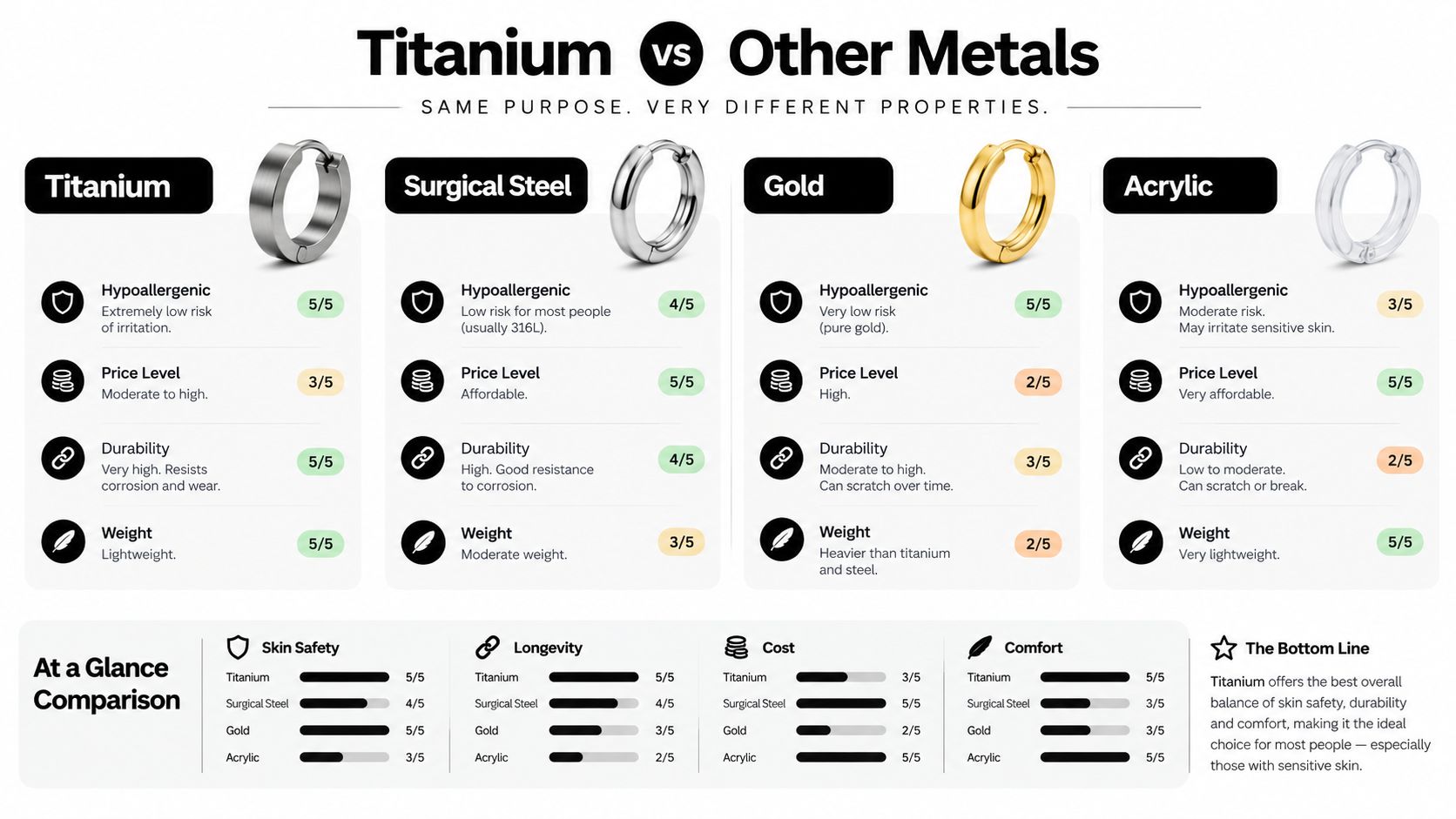
A titanium nose stud with a diamond can be a smart everyday choice, but titanium is not the only material available. Surgical steel, solid gold, acrylic, and bioplast each bring different trade-offs. The right comparison depends on whether your piercing is fresh or healed, how your skin reacts, and how much you value design variety over a cautious material choice.
A quick material match
Titanium is a strong starting point for fresh piercings, nickel-sensitive wearers, and anyone who wants a lightweight stud for daily use. Look for a confirmed implant-grade specification, especially ASTM F136, rather than trusting the word “titanium” by itself. It may offer fewer decorative designs than other metals, but that simpler selection can make the buying decision safer.
Surgical steel is durable, widely available, and often sold in more shapes and finishes. Some alloys contain nickel, so it suits a fully healed piercing better than a fresh one. If you have no history of metal reactions and want more style variety at a lower cost, surgical steel may be practical. If you have experienced itching or irritation from jewelry, stay with implant-grade titanium instead.
Solid gold offers a warm color and polished appearance. Check the karat, alloy, and construction, because solid gold is different from plated jewelry. Plating can wear away and expose another metal underneath. A qualified piercer or jeweler can help assess the composition if you react to particular alloys.
Acrylic and bioplast are light and flexible. Those traits can help in specific situations, but they are better treated as purpose-specific choices than as the default for a fresh piercing or permanent daily wear.
| Material | Skin-sensitivity considerations | Strengths | Check before buying |
|---|---|---|---|
| Titanium | Often chosen for nickel-sensitive wearers | Lightweight, corrosion-resistant, implant-grade options | Confirm ASTM F136, ASTM F67, or another recognized standard |
| Surgical steel | May contain nickel | Durable and widely styled | Ask about the exact alloy and use with healed piercings |
| Solid gold | Depends on karat and alloy | Warm color and decorative appeal | Confirm solid construction and alloy details |
| Acrylic or bioplast | Intended for particular short-term or flexible uses | Light and adaptable | Check suitability, finish, and replacement guidance |
Compare the whole piece
A listing may advertise a titanium post while leaving the decorative top, backing, or prongs unspecified. Ask whether the complete wearable piece uses the stated material. For a diamond nose stud, inspect the setting closely. Rough prongs, exposed edges, or a stone that catches on towels can irritate the outer skin even when the post itself is appropriate.
If the seller cannot identify the metal used in each component, choose a listing with clearer specifications. A lower price or trendier shape is not useful if the jewelry causes irritation or must be removed. For a healed piercing, compare comfort, fit, and maintenance alongside appearance.
Healing Timeline, Daily Care, and When to Switch to Diamond
A fresh nose piercing needs patience. Complete healing commonly takes roughly 2–6 months, depending on the site and the individual, according to Healthline's nose-piercing care guidance. That range is a reason to avoid treating a calm-looking surface as proof that the inside has finished healing.
Keep the first jewelry simple
During healing, keep the original implant-grade titanium jewelry in place unless a qualified piercer recommends a change for fit or a medical professional advises otherwise. A decorative diamond or CZ top can add bulk, movement, or extra edges before the channel is ready.
Clean with sterile saline once or twice daily, following your piercer's aftercare instructions. Wash your hands before touching the area, avoid twisting the stud for entertainment, and don't scrub crust away aggressively. Let saline soften buildup, then leave the piercing alone.
Signs you're ready for a decorative switch
Look for a consistently calm piercing rather than one good morning. It should have:
- No ongoing tenderness: Touching nearby skin shouldn't produce persistent soreness.
- No recurring crust or discharge: Occasional minor changes can happen, but repeated buildup deserves attention.
- No swelling or pressure: The post shouldn't feel tight or embed into the tissue.
- No painful jewelry movement: A gentle professional change shouldn't feel like forcing the channel open.
Even after these signs appear, ask a professional piercer to confirm the timing and fit. They can select the correct post length and check whether a prong, bezel, or flat-back design suits your anatomy.
A calm surface isn't the same as a fully healed piercing.
If irritation appears after switching, stop treating the jewelry as a styling challenge. Don't keep rotating the stud or repeatedly changing pieces to find a solution. Contact your piercer for a fit and material check, and seek medical advice if you notice concerning symptoms.
Once the piercing is fully healed, your titanium nose stud diamond can become an easy daily signature. Keep the setting clean, check that the backing remains secure, and be careful around towels, clothing, scarves, and skincare products.
Your Next Step to the Perfect Sparkly Stud
A titanium nose stud with a diamond works best when three decisions line up: the metal, the setting, and the fit. Before ordering, check:
- Material: Choose implant-grade titanium, preferably ASTM F136.
- Construction: Look for a smooth polish, secure stone setting, suitable backing, and no questionable mixed materials.
- Fit: Match the gauge, post length, top size, and backing to your piercing stage.
A fresh piercing needs simple, correctly fitted jewelry while it settles. Save decorative sparkle for a fully healed piercing, then ask a professional piercer to confirm the fit. Watch out for a tall top that catches on towels or a backing that presses inside the nostril. A low-profile design is easier to wear every day.
BodyCandy offers titanium nose studs and nose jewelry with diamond and CZ details. Compare each specification carefully, then choose a secure, comfortable piece that suits both your piercing and your style.