

















Q: I'm flying internationally soon. Will my piercings set off the metal detector or cause a problem at security? - Alyssa P.
A: Good news right up front: you can relax and leave your jewelry exactly where it is. Piercings almost never cause a problem at airport security, and this worry is way bigger in people's heads than it is in real life. The metal detectors at security are tuned for big stuff, weapons and the like, not the tiny bit of metal in a piercing. Most body jewelry is small and often made of titanium or gold, which usually doesn't trigger anything at all. Plenty of people fly with a full ear stack, a nose stud, and more, and walk straight through without a beep.
And even in the rare case something does chime, it's genuinely not a big deal. Security handles pierced travelers all the time. Usually it's just a quick wave of a handheld wand or a light pat-down and you're on your way. Nobody's going to make you feel weird about it, and you're not doing anything wrong by having piercings.
A few things that make it even smoother:
-
You do not have to take them out. This is the big one. If your piercing is fresh and still healing, leaving it in is actually the safer move, since taking jewelry out and trying to get it back in through a healing piercing at an airport is a headache you don't want.
-
If you're extra nervous, wear simpler pieces that day. A couple of studs instead of your most elaborate stack just means less to think about. Totally optional, though.
-
Stick to quality metal. Titanium and solid gold are travel-friendly and comfy for long flights, which matters more than the detector ever will.
-
If they ask, just tell them. A quick "those are piercings" is all it takes. Easy.
Bottom line: fly with confidence. Your piercings are not going to derail your trip, you don't need to remove anything, and if a wand comes out, it's a ten-second thing. Go enjoy the vacation.
Q: I get keloids easily. Does that mean piercings are just off the table for me forever? - James
A: Not necessarily, and I'm really glad you asked instead of just assuming the answer was no. But this is one where I'm going to be straight with you rather than just telling you what's easy to hear, because your skin deserves the honest version.
First, a distinction that trips a lot of people up. Not every bump next to a piercing is a keloid. Way more often, those little bumps are irritation bumps or hypertrophic scars, and those come from things you can control, like the piece being too long, too much movement, or getting bumped a lot. Those usually calm down once the cause is fixed. True keloids are different. They grow beyond the original spot and don't tend to go away on their own. So step one is actually knowing which one you're dealing with, and that's not something to guess at.
Which brings me to the honest part: if you genuinely get true keloids, this is a conversation for a dermatologist before a piercer. A derm can look at your history, tell you your actual risk, and sometimes even help you plan around it or treat a keloid early if one starts. Anyone who promises you a totally risk-free piercing without knowing your skin isn't being straight with you.
If you do decide to move forward, a few things genuinely stack the odds in your favor:
-
Talk to a great piercer and be upfront about your history. A good one will take it seriously and help you choose placements that tend to be lower-drama.
-
Metal matters more for you than most. Stick with implant-grade titanium or solid 14K gold to keep irritation as low as possible, since irritation is often what kicks things off.
-
Follow aftercare like it's your job. Saline spray, hands off the jewelry, no twisting, and downsize on schedule. Less irritation, less to react to.
-
Watch it early. If something starts forming, don't wait it out. Early is when it's most manageable, and your derm will want to know.

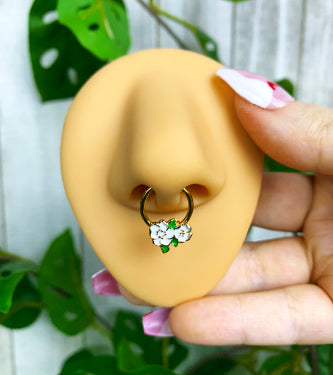
Pink Double Gem Horseshoe Nose Ring - Solid Titanium Anodized
Disclaimer: Body Candy is only here to give you fun and helpful advice and information when it comes to getting pierced. Always consult a professional piercer to make sure a new piercing is right for you!