












You're browsing belly rings, spot a cute piece labeled 16G, and suddenly the sizing chart looks like it was designed to mess with you. Is 16 gauge smaller or larger than the standard? Will it fit your navel? And can a thinner ring hurt a healed piercing?
The short answer is yes, 16 gauge navel rings can be a great fit in specific situations, but they aren't the default choice for most fresh navel piercings. Gauge, bar length, jewelry weight, and your piercing's history all matter. Let's break it down without the confusing jargon.
Decoding the 16 Gauge Measurement
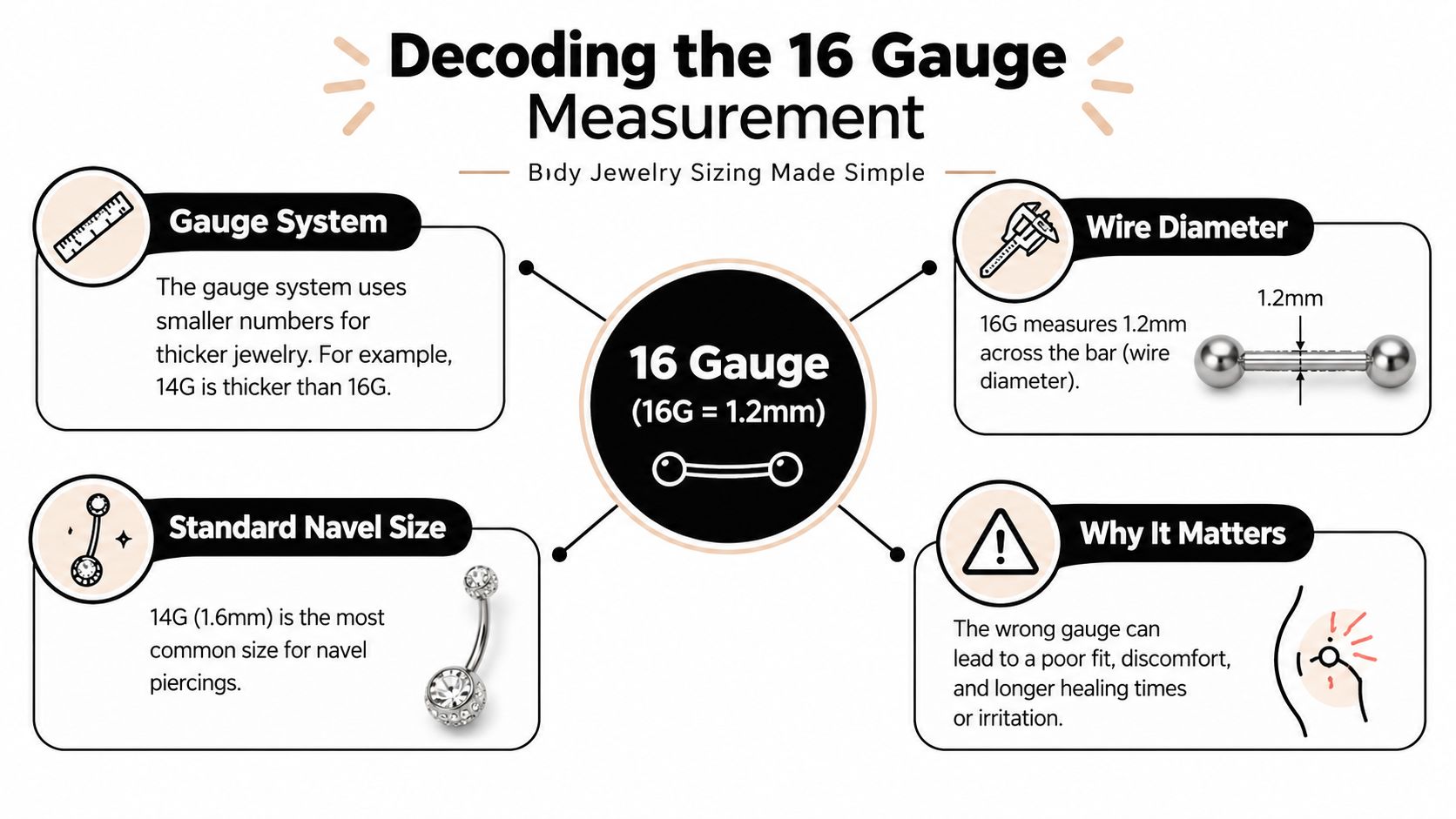
Gauge measures the thickness of the jewelry bar, not the length or the diameter of a ring. The strange part is that the gauge system runs backward. A larger gauge number means a thinner piece of jewelry, so 16G is thinner than 14G, not thicker. The standard progression places 16G between 18G and 14G, and body jewelry commonly uses even-numbered gauges. You can review the broader system in this guide to the standards of gauge sizing for body jewelry.
For a concrete measurement, 16 gauge is about 1.291 mm thick and 0.051 inch across according to the BME gauge reference. Retail sizing charts may round that figure and list 16G as 1.2 mm, so don't panic when both measurements appear. They describe the same general jewelry size using slightly different rounding conventions.
The reverse-number rule
Use this quick mental shortcut while shopping:
- Lower number: thicker jewelry.
- Higher number: thinner jewelry.
- 14G: about 1.6 mm, the usual navel reference size.
- 16G: about 1.2 mm, a narrower alternative.
- 18G: thinner than 16G in the standard progression.
That difference may look tiny on a product page, but your piercing can notice it. A 16G bar has less material supporting the tissue than a 14G bar, which is one reason professional sizing advice treats it as a specific-fit option rather than an automatic replacement.
Gauge also isn't the whole fit. A curved barbell's wearable length determines how much room the jewelry gives your anatomy. Two 16G navel rings can feel completely different if one is too short, too long, or carries a heavy charm. Think of gauge as the bar's thickness and length as the amount of space your piercing gets to breathe.
How 16G Compares to the Standard 14G Navel Size
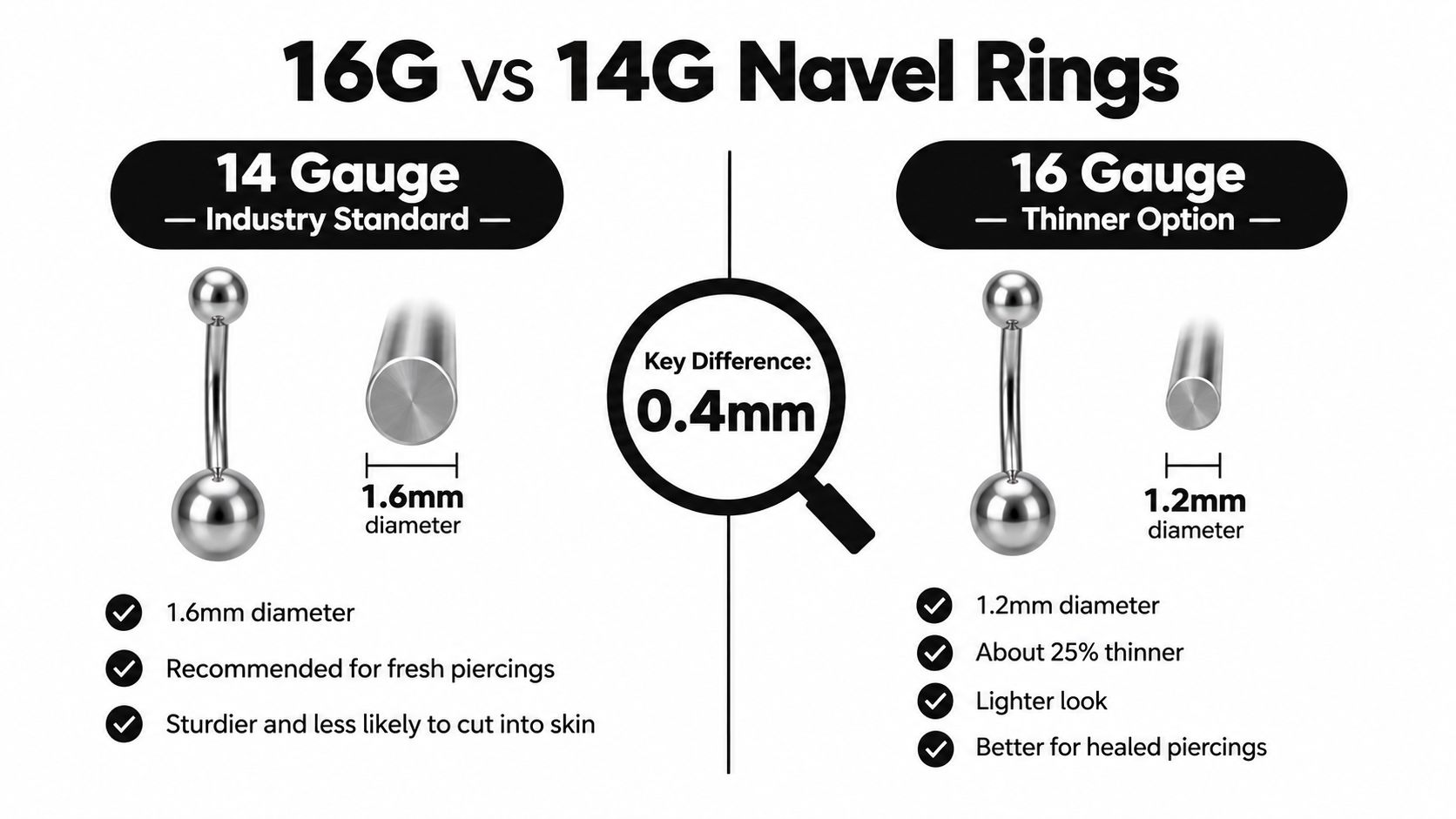
Most fresh navel piercings are fitted with 14G jewelry, which is about 1.6 mm thick, while 16G jewelry is about 1.2 mm thick. That makes 16G the slimmer option, as confirmed by BodyCandy's gauge size explanation. Gauge numbers can feel backward, but the practical takeaway is simple: moving from 14G to 16G means moving to a narrower bar.
Why 14G is usually the starting point
A thicker bar generally gives a fresh navel piercing more structural support during healing. That matters because the navel moves constantly as you sit, bend, twist, dress, and sleep. Several sizing guides identify 14G as the typical or gold-standard navel size, while describing 16G as less common and more appropriate for healed or partially closed piercings. The navel sizing guide from Dear Mr Villain also warns that a thinner post can act like a cheese-cutter under repeated pressure.
A professional piercer may select 14G for a new piercing because it offers a sturdier foundation. That doesn't mean every body has identical needs. Anatomy varies, and a piercer may recommend a different configuration after inspecting the tissue, the navel fold, and the way the area moves.
When 16G can make sense
A healed piercing may tolerate 16G when the jewelry is lightweight, the fit is comfortable, and the piercing has naturally settled at that size. A 16G piece can also make sense when a piercing has partially closed after being left without jewelry, or when a professional recommends a narrower bar for a specific anatomy.
The important word is healed. A thinner ring isn't automatically safer just because it slides in easily. If the piercing is fresh, irritated, migrating, or still changing, switching gauges without professional advice can create problems rather than solve them.
Avoiding the Cheese-Cutter Effect
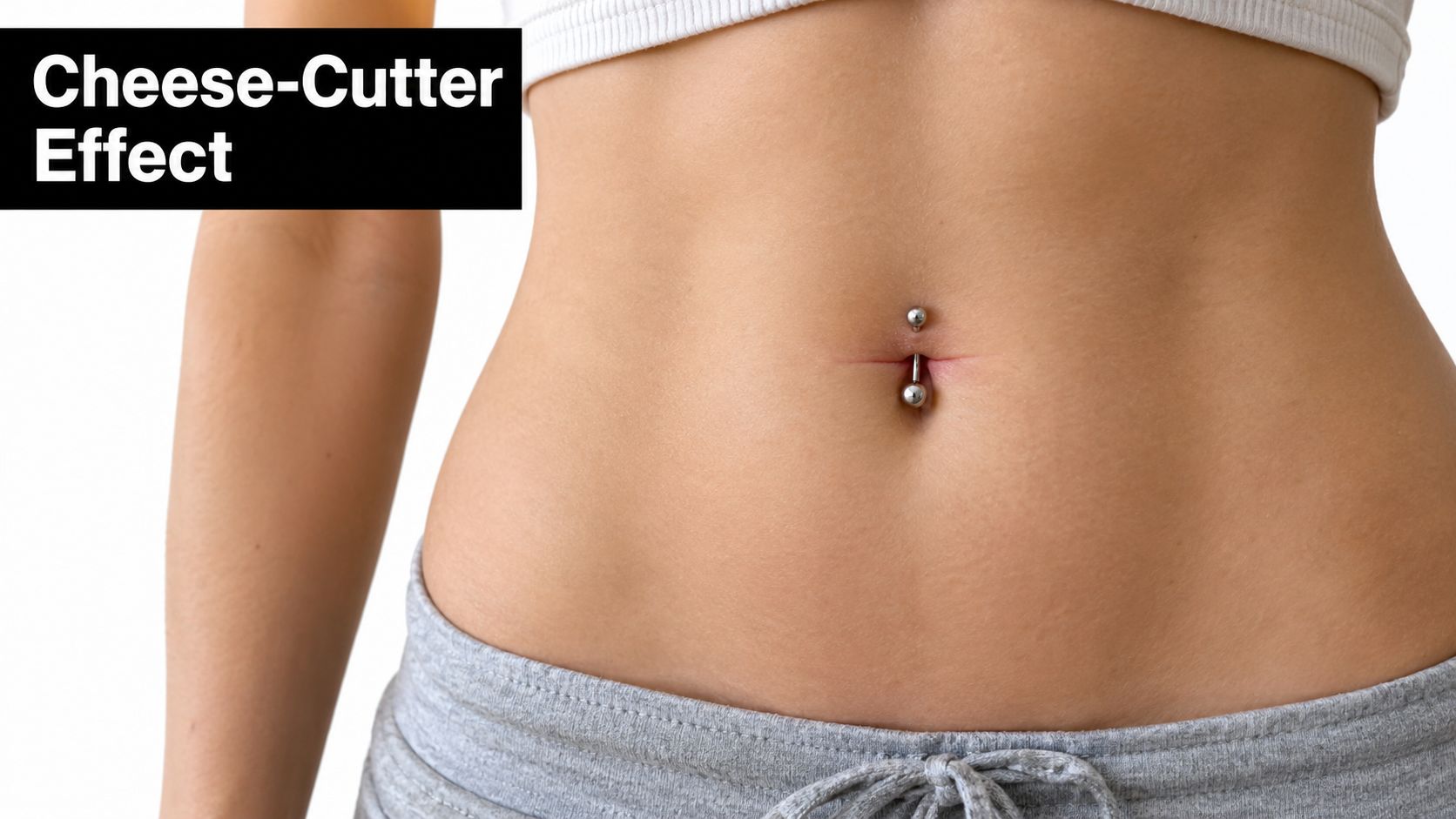
A ring catches on your waistband as you sit, and the tug lands on the same thin strip of skin. The cheese-cutter effect happens when thin jewelry bears too much pressure against the surrounding tissue, as explained in this guide to the cheese-cutter effect. Instead of staying centered in the piercing channel, the jewelry may gradually pull through the skin when friction, movement, and weight keep stressing one narrow point.
A 16G navel ring does not automatically cause migration. A lightweight, well-fitted ring in a calm, healed piercing places a very different demand on tissue than a thin bar carrying a large dangling charm in a fresh or repeatedly irritated piercing.
Why weight and movement matter
A thinner bar concentrates force over a smaller area. Add a heavy pendant, clothing that repeatedly snags, or pressure from bending at the waist, and the jewelry can tug in the same direction again and again. Medical guidance on body piercing notes that overly thin, heavily weighted jewelry can contribute to migration and rejection. The American Academy of Family Physicians guidance reinforces why the jewelry design matters alongside the metal.
A 16G ring may suit a stable, healed piercing when it is light, comfortable, and supported by enough tissue. Stick with the standard 14G choice when the piercing is new, irritated, migrating, exposed to frequent pulling, or carrying noticeable weight. A professional piercer can assess the tissue and placement before a thinner ring creates a problem.
Watch for warning signs:
- A shifting placement: The jewelry seems closer to the surface.
- A thinning strip of skin: The tissue between the entry and exit points looks narrower.
- Persistent pressure marks: The ends or charm leave deep lines that do not settle.
- Ongoing irritation: Redness, tenderness, or discharge continues instead of calming.
Bar length has a job
Gauge describes thickness, but bar length controls pressure and movement around your anatomy. Navel sizing guides commonly list healed lengths around 3/8 inch to 7/16 inch, while one industry guide identifies 11 mm, or 7/16 inch, as the actual bar length in some navel rings. The navel ring size guide from TummyToys explains how that length is measured.
A bar that is too short can pinch the tissue. One that is too long can flip, snag, and move excessively. Correct gauge cannot fix either fit problem.
Practical rule: Choose gauge, wearable length, and jewelry weight as one package. A thin bar needs a calm, well-healed piercing and a design that does not constantly pull on it.
If migration or rejection seems possible, do not force a thicker bar through the channel or keep wearing jewelry that creates pressure. Ask a professional piercer to assess the placement and recommend the next step.
Choosing the Right Materials and Styles for 16G
A narrower bar deserves thoughtful styling. The material should be body-safe and durable, while the design should keep unnecessary weight away from the piercing. Implant-grade titanium is a popular choice for sensitive skin because it's lightweight and nickel-free. Solid gold can also work when it's appropriate for body jewelry and free from problematic plating or unknown alloys.
Surgical steel is another common option, though sensitivity varies from person to person. If you know your skin reacts to certain metals, tell your piercer before choosing a piece. A beautiful ring that triggers irritation isn't a style win.
Match the design to the gauge
Start with the simplest version of the jewelry you're considering. A lightweight curved barbell or a small, low-profile end places less demand on a 16G piercing than a dramatic, swinging pendant. Minimal doesn't mean boring. A polished bead, colored gem, or compact decorative end can still give you an edgy look without turning the jewelry into a tiny wrecking ball.
Use this filter before buying:
- Lightweight details: Prefer small ends and restrained charms.
- Smooth surfaces: Avoid rough finishes or snag-prone edges that can scrape the channel.
- Secure threading: Check that the ends fasten firmly and don't wobble.
- Comfortable curvature: The bar should follow your anatomy instead of pressing into the navel fold.
- Quality material: Choose a reputable body-jewelry material with clear specifications.
A solid hoop may look delicate, but it isn't automatically the best navel option. Hoops can rotate and catch more easily than a curved barbell, depending on your anatomy and daily activity. If you're unsure which shape suits your piercing, compare the construction and material guidance in this navel ring styles, materials, and sizing guide.
The fun part is choosing a look that fits your body instead of forcing your body to fit the trend. For 16G jewelry, keep the silhouette intentional and the weight under control.
Healing, Aftercare, and Troubleshooting Fit Issues
Switching to a 16G navel ring should feel like a careful wardrobe change, not a wrestling match. If the jewelry catches, stings, pinches, or requires force, stop. A fully healed piercing may accept a narrower piece more easily, but a comfortable insertion doesn't prove that the new jewelry is the right long-term choice.
A calm routine for a changed piercing
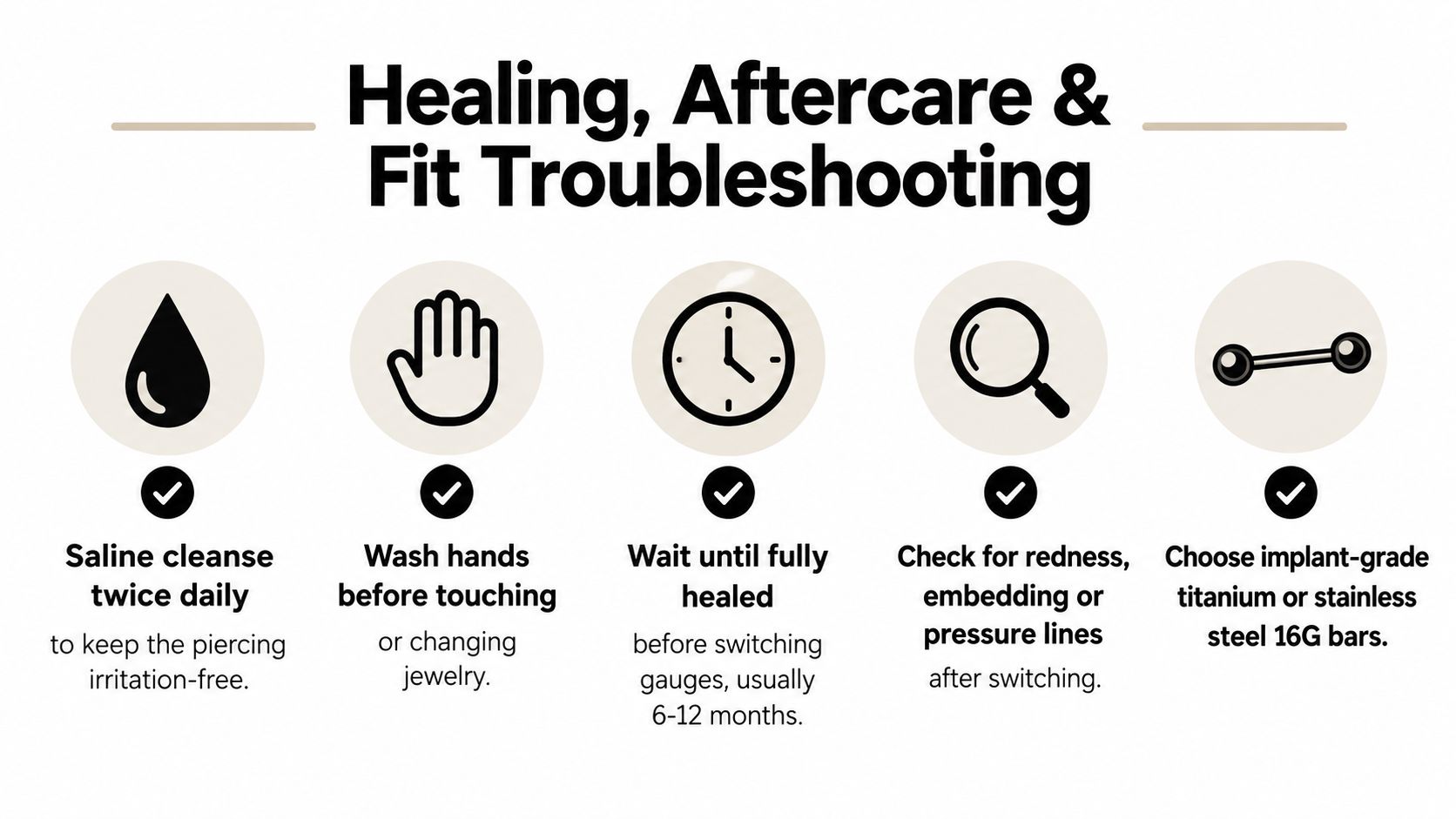
Keep your aftercare boring and consistent. Wash your hands before touching the jewelry, clean the area gently with sterile saline, and avoid twisting the ring just to check whether it moves. Tight clothing, repeated snagging, and friction from waistbands can irritate the channel even when the jewelry itself is made from a suitable material.
Don't change gauges during active healing unless your professional piercer directs you to do so. If you're transitioning from a thicker bar, a piercer can check whether the channel is stable and whether the new length gives your anatomy enough room.
Listen to the fit, not just the label. A 16G ring can be the right thickness and still be the wrong length, shape, material, or weight.
What common problems mean
If the ring feels tight, look for pinching, deep pressure marks, swelling, or ends that appear to sink into the skin. Remove pressure from the area and contact a professional piercer rather than trying to push, twist, or stretch the jewelry yourself.
If the ring slides around, flips upward, or catches on clothing, the bar may be too long or the design may be too active for your routine. A professional can measure the wearable length and recommend a more stable configuration.
Redness that worsens, heat, significant swelling, unusual discharge, or visible migration needs professional attention. Don't cover up those signs with a larger charm or a tighter ring. Jewelry problems and possible health concerns aren't the same thing, so seek medical care when symptoms are severe or concerning.
Finding Your Perfect Belly Ring at BodyCandy
Use this quick checklist before you add 16 gauge navel rings to your cart:
- Confirm the gauge. 16G is about 1.2 mm, while 14G is about 1.6 mm, as shown in this body piercing jewelry size chart.
- Check your piercing history. Fresh or healing navels generally call for the standard 14G approach, while 16G is usually a healed, partially closed, or anatomy-specific option.
- Measure wearable length. Don't guess from the charm size. The bar needs enough room for your tissue without creating excess movement.
- Keep weight modest. A thin post and a heavy dangling design are a risky combination.
- Inspect the fit after changing. Look for pressure, embedding, redness, snagging, or a change in the piercing's position.
- Ask a piercer when unsure. A quick in-person assessment can prevent an expensive style experiment from becoming a painful problem.
The right ring should sit comfortably, move with your body without dragging on the tissue, and suit your anatomy. If your piercing was originally fitted at 14G, don't treat 16G as a casual upgrade or downgrade. It's a different support level, and your long-term options may change if the channel settles around the thinner jewelry.
BodyCandy offers navel jewelry in a range of gauges, lengths, materials, and designs, so you can compare a standard 14G piece with a specialized 16G option instead of guessing from appearance alone. Choose the ring that matches your piercing's history, your anatomy, and the way you live.
Ready to make your next belly ring choice with fewer surprises? Explore the navel jewelry selection at BodyCandy, compare 14G and 16G styles, and pick a lightweight piece that fits your piercing story. If the fit feels questionable, pause the checkout and ask a professional piercer before you give your navel a new accessory.