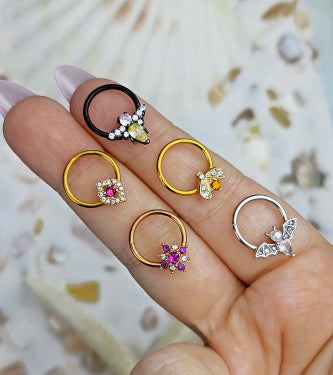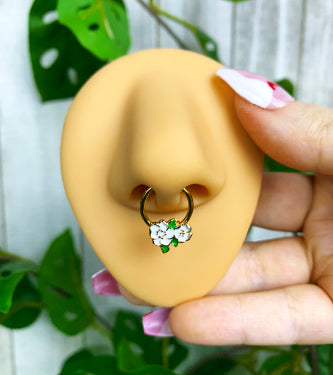


















So, you love your septum piercing, but let's be real—sometimes life calls for it to go into stealth mode. Lucky for you, the two best ways to hide a septum ring are super easy: flipping up a horseshoe ring or swapping it out for a nearly invisible retainer.
Once you master these simple tricks, you'll never have to choose between your awesome personal style and, well, anything else.
Keeping Your Piercing Undercover When You Need To
Septum piercings are awesome, but they don't always get a warm welcome in every situation. Whether it's for a new job with a strict dress code, a formal family event, or just a day you want a more low-key look, knowing how to make your piercing disappear is a total game-changer. And the best part? It’s incredibly easy.
The great thing about the septum is that it's one of the simplest piercings to conceal. Unlike a nostril or lip piercing, you don't need any makeup or weird bandages. With the right jewelry, it can vanish in seconds. This flexibility is a huge plus, especially when you're dealing with:
- Strict Workplaces or Schools: Many professional settings have dress codes that aren't exactly piercing-friendly. A quick flip-up or a discreet retainer keeps you in compliance without forcing you to ditch your style.
- Family Gatherings: Trying to dodge a lecture from that one conservative aunt? A hidden piercing helps keep the peace during the holidays.
- Contact Sports: If you're an athlete, hiding your jewelry is a smart move. It prevents your ring from getting snagged or causing an injury during a game.
- Medical Procedures: Sometimes you'll be asked to remove all metal jewelry for scans like an MRI. A non-metallic retainer is the perfect solution here.
Bottom line: knowing how to hide your septum piercing puts you in control. You get to decide when to show it off and when to keep it your little secret. It's truly the best of both worlds.
Quick Guide: How to Hide a Septum Ring
The two most effective ways to hide your septum piercing are flipping it up or using a retainer. Feeling a little torn between the two? Here’s a quick comparison to help you choose the best approach for your lifestyle.
| Method | Best For | Visibility | Healing Piercing Safe? |
|---|---|---|---|
| Flipping Up a Horseshoe Ring | Short-term, quick changes (e.g., for a work shift). | Completely invisible when done correctly. | No, only for fully healed piercings. |
| Using a Septum Retainer | Long-term concealment, including the entire healing period. | Nearly invisible, especially with clear materials. | Yes, the safest option for new piercings. |
Ultimately, whether you choose to flip it or swap it, you have great options for keeping your septum piercing on the down-low. Many people keep a stylish horseshoe barbell for daily wear and have a retainer on hand just in case. It's all about having the flexibility to adapt.
Mastering the Flip-Up for Instant Discretion
The flip-up is the classic trick for a reason—it's fast, free, and works like a charm with the right jewelry. This move is your secret weapon for those moments when you need your piercing to vanish instantly. Think of it as the ultimate "now you see it, now you don't" for your septum.
To pull this off, you'll need a horseshoe barbell. It’s the go-to style for this slick maneuver. We’ll walk you through perfecting the technique without bugging your piercing.
The Right Jewelry Makes All the Difference
Before you even try to tuck it away, let's talk about your jewelry. For a truly invisible flip, the diameter of your horseshoe ring has to be just right for your unique anatomy.
If the ring is too wide, the ends might still peek out of your nostrils. A little too small, and it can feel pinchy and put uncomfortable pressure on your septum once it's flipped. The goal is for the ring to sit snugly inside your nostrils without you even noticing it's there. The balls or decorative ends should also be small enough that they don't create a weird bulge from the side.
How to Perfect the Flip
Ready to give it a try? The motion is simple, but being gentle is absolutely key.
- First and foremost, always start with clean hands. You don't want to introduce any unwanted germs to your piercing.
- Next, carefully hold both balls or ends of your horseshoe ring between your thumb and forefinger.
- In one smooth, careful motion, push the jewelry upward and slightly back, guiding the ends into each nostril until they're tucked away.
- Do a quick check with your phone's selfie camera to look up into your nostrils. The jewelry should be completely out of sight and feel secure, not tight or painful.
The most crucial rule of the flip-up: Only try this on a fully healed piercing. Messing with a fresh piercing can lead to irritation, infection, and a much longer healing time. Patience is your best friend here!
This simple trick has been a lifesaver for piercing lovers, especially as septum piercings surged in popularity. In fact, Google Trends showed a 350% increase in searches for "septum piercing" from 2010 to 2020 in the US and UK. The flip-up, which involves rotating a horseshoe-style ring (typically 16-gauge, the standard for about 85% of initial piercings) upward, makes it totally invisible.
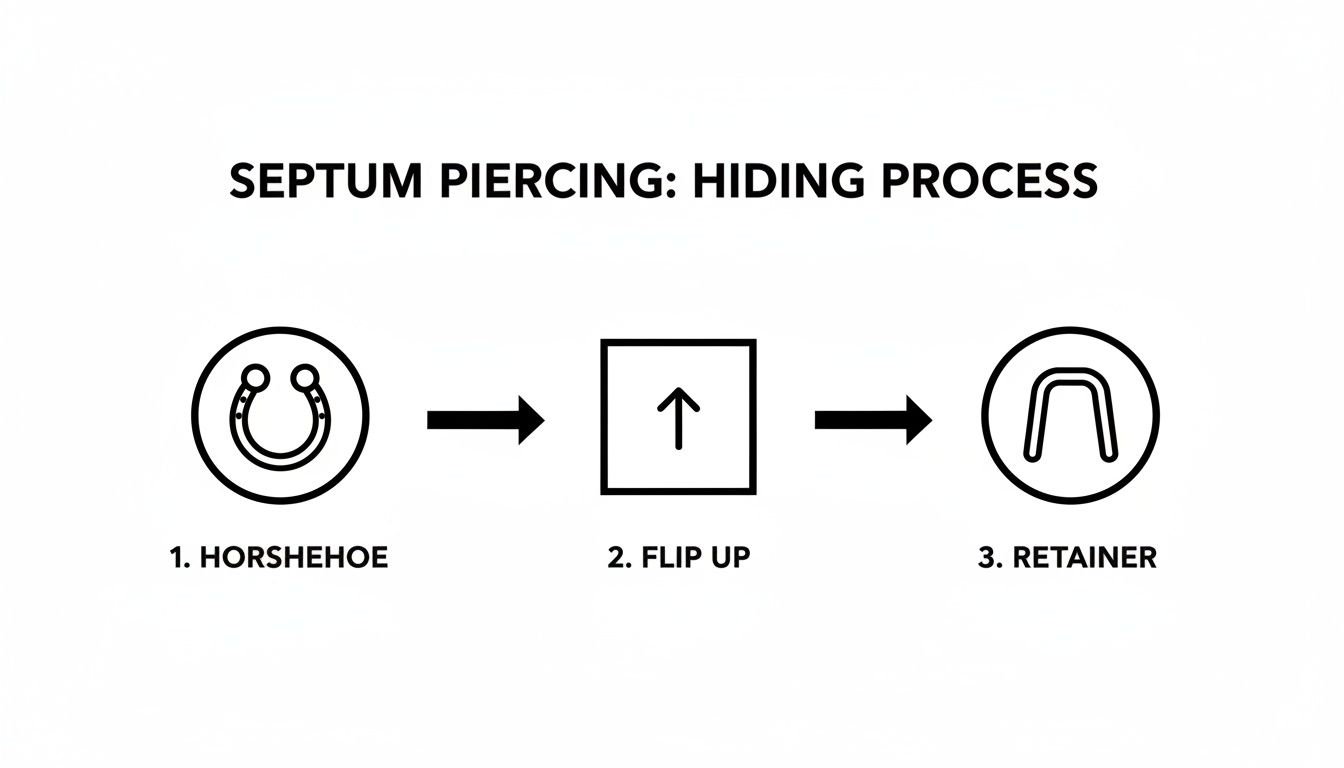
As you can see, both methods get the job done, but swapping to a retainer is often the better choice for newer piercings or if you need to keep it hidden for a long time.
If you're still exploring the look or aren't quite ready to commit, you can always test the waters. We have a great guide to faking it in style with clip-on septum jewelry. It’s a perfect way to see how you feel before taking the plunge.
Using Septum Retainers for Long-Term Concealment
Sometimes, flipping your jewelry up just isn’t a practical long-term solution. Or maybe your piercing is brand new and still healing. In these cases, septum retainers are the undisputed champs of going incognito.
Think of them as your piercing’s secret identity—specialized jewelry designed specifically to be discreet and comfortable for extended wear. They are, without a doubt, the best way to hide a new septum piercing.
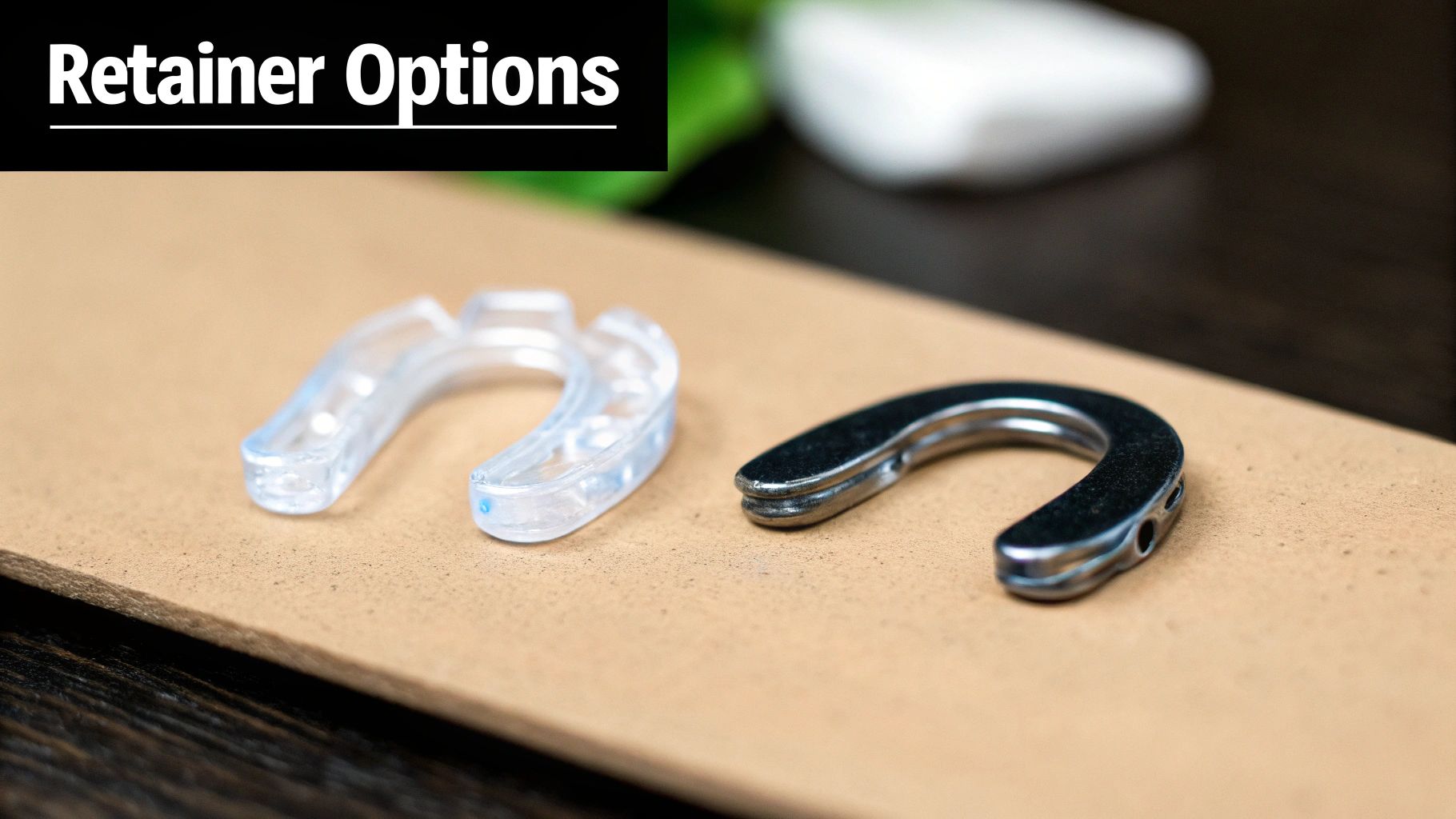
Unlike a standard horseshoe ring that you have to flip up and down, a retainer is built for one job: to keep your piercing open without being seen. This makes them the absolute safest choice for a fresh piercing, since they cut down on the movement and irritation that can cause those dreaded healing bumps and other problems.
Choosing Your Perfect Undercover Agent
Septum retainers come in a few different shapes and materials, so you’ve got options to find the perfect one for your nose and your lifestyle. The most popular styles are designed to be almost completely invisible once they're flipped up.
- Staple-Shaped Retainers: These look exactly like you'd imagine and are usually made from body-safe metals like titanium. You can wear them flipped down for a super minimal look, or just tuck them up into your nostrils to make them disappear.
- U-Shaped Retainers: Pretty similar to the staple shape, these give you a comfortable, low-profile fit that's ideal for wearing all day, every day.
- Clear Retainers: For maximum stealth, nothing beats a clear retainer. They’re typically made from glass, BioFlex, or high-quality acrylic, which makes them practically vanish against your skin.
Pro Tip: If you know you'll need to hide your piercing for work or school right after you get it, just ask your piercer to put a retainer in from the start. They can flip it up for you, and you can leave it that way for the entire healing process. It's the best way to guarantee a smooth, irritation-free experience.
It’s no surprise that retainers have blown up in popularity. Since the mid-2010s, sales have shot up by an incredible 400%, and they now make up 30% of septum jewelry sales on sites like BodyCandy. These 'U' or staple-shaped pieces, often made of clear bio-flex or glass, are practically invisible in 98% of lighting conditions.
This makes them the go-to for long-term hiding, especially during that crucial 6-8 week initial healing phase. Trying to flip standard jewelry during this time can lead to infection in 22% of cases, so a retainer is a much safer bet.
Making the Switch to a Retainer Safely
Changing your jewelry for the first time can feel a little nerve-wracking, but it’s easy once you get the hang of it. If your piercing is still new, we always recommend having a professional piercer do that first swap for you. It’s the best way to avoid any trouble.
Once you’re fully healed, you can totally change it yourself. Just remember the basics: always start by washing your hands thoroughly and cleaning both the new retainer and your piercing. A tiny bit of water-based lubricant can make sliding the new jewelry in much easier. Take your time, be gentle, and never force it.
If you want to dive deeper, you can explore more about why retainers are such a great choice for keeping your mods less visible in our detailed guide.
Navigating Piercing Policies at Work and School
Let's be real—a huge reason anyone needs to know how to hide a septum ring is to keep the peace at work or school. Whether you’re stepping into a new corporate gig or just trying to get through the school year without dress code violations, figuring out where your piercing fits in can be a little nerve-wracking.
But here’s the good news: you almost never have to choose between your job and your jewelry. With the right approach, you can walk into any professional or academic setting without giving your septum a second thought. It’s all about striking a balance between self-expression and, well, paying the bills.
Understanding the Dress Code
First things first, you need to know the rules of the game. Get your hands on the employee handbook or student guidelines and see what it actually says. Some places have a hard "no facial piercings" rule, while others are surprisingly chill about small, discreet jewelry. Don't just guess.
If the policy is a bit vague, use your eyes. Are managers, supervisors, or senior students rocking any visible piercings? That’s often a better indicator of the day-to-day culture than a dusty old rulebook. When in doubt, though, it’s always smarter to play it safe and keep it hidden until you know for sure.
Your Strategy for Staying Under the Radar
Once you know what you’re up against, you can pick your strategy. For most nine-to-five jobs and school environments, a high-quality retainer is your absolute best friend. A clear glass or flexible BioFlex retainer is practically invisible once flipped up, giving you a set-it-and-forget-it solution for the entire day.
This is especially critical in professional settings. Workplace rules are a huge factor, accounting for about 55% of the reasons people need to hide their piercings. Recent surveys show that a staggering 68% of US companies and 72% in Europe still ban visible facial piercings, so it’s no surprise that 40% of Gen Z employees are searching for clever ways to conceal their jewelry.
The retainer method is the undisputed champ here, with an 82% effectiveness rate reported in a poll of 2,500 BodyCandy customers. Clear acrylic pieces, in particular, are 99% invisible under typical office lighting.
When your piercing needs to be completely off the radar for hours on end, a retainer isn't just a good idea—it's the best tool for the job. It offers a level of peace of mind that simply flipping up your jewelry can't, especially if you’re worried about it slipping down mid-meeting.
Now, if the rules are a little more relaxed, a properly sized horseshoe that tucks away cleanly is a fantastic option. The secret is making sure the jewelry is small enough to disappear completely into your nostrils. For a deeper dive, be sure to check out our complete guide on hiding piercings for work and school. This kind of flexibility means you’re ready for whatever life throws at you, all while keeping your piercing your own little secret.
Hiding Methods to Approach with Caution
While flipping up a horseshoe or swapping in a retainer are your go-to moves for hiding a septum piercing, you've probably stumbled across other "hacks" online. Let's get real about the methods you should think twice about and the ones you need to avoid completely. Your piercing's health always, always comes first.
The Absolute No-Go: The Makeup Method
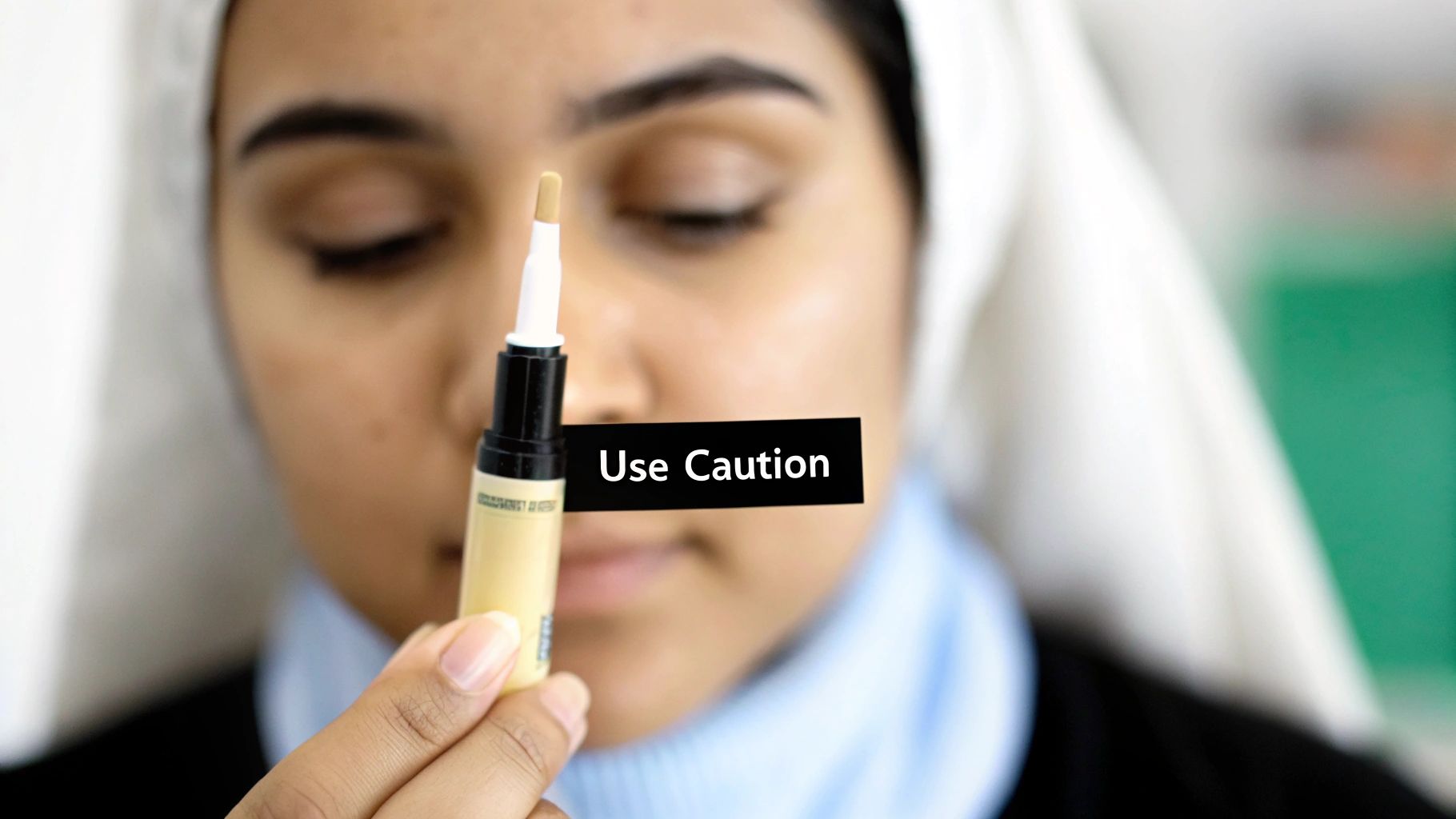
Let's just get this one out of the way right now: never, ever cover your piercing with makeup. It might seem like a genius quick fix to dab some concealer on the piercing holes or the ends of your jewelry, but trust me, this is a recipe for disaster.
Makeup is packed with pigments, oils, and other ingredients that can get trapped inside the fistula—that's the little tunnel of skin your jewelry sits in. This can lead to some seriously gnarly problems.
- Infection Risk: Bacteria loves the warm, moist environment created when makeup smothers a piercing. This can quickly spiral into a painful infection.
- Irritation and Bumps: The chemicals in cosmetics can easily irritate the delicate healing tissue, causing redness, swelling, and those dreaded irritation bumps that are a nightmare to get rid of.
- Clogged Fistula: Thick products like foundation and concealer can physically block the piercing, trapping lymph fluid and dead skin cells inside. At best, this will delay healing; at worst, it could lead to an abscess.
Think of your piercing as an open wound, especially if it's still healing. You wouldn't rub foundation into a fresh cut, so you definitely shouldn't be putting it in or on your piercing. Stick to the jewelry-based solutions.
The Risky Business: Just Taking It Out
Tempted to just pop your jewelry out for a few hours to get through a meeting or an event? This is a huge gamble, particularly with a piercing that isn't fully mature. Septum piercings can be surprisingly fast to shrink or even close up entirely.
A piercing that's less than a year old can start to close in a matter of minutes to hours. Even well-established piercings that are years old can shrink enough to make getting jewelry back in difficult and painful. You could end up tearing the delicate tissue, causing a fresh wave of irritation, and basically starting your healing journey all over again.
Why risk it when a simple, clear retainer can keep your piercing open and healthy without any of the drama?
A Sneaky But Not Hidden Alternative
If your goal isn't total invisibility but just being a bit more low-key, downsizing your jewelry is a fantastic strategy.
Swapping out a flashy, ornate clicker for a tiny, snug-fitting seamless ring or a small-gauge horseshoe can make a world of difference. While it's not truly a way to hide a septum ring, it makes your piercing far more subtle for everyday situations where you just want to tone it down. This is the perfect compromise for a more relaxed workplace or family gathering.
Your Septum Hiding Questions Answered
Even with all the best tricks up your sleeve, you probably still have a few questions about hiding your septum ring. Don't worry, you're not the only one! Let's clear up some of the most common concerns so you can feel totally confident keeping your piercing under wraps.
We're tackling the big ones everyone asks, from the timing of your first flip-up to making sure your hidden jewelry is actually out of sight.
Can I Flip Up My Septum Ring Right After Getting It Pierced?
This is a huge one, and the answer is a firm no. You absolutely have to wait until your piercing is fully healed before you start messing with it. A new piercing is an open wound, and flipping it up and down is just asking for trouble—it can cause major irritation, invite bacteria in, and drag out your healing time. Just think of it like picking at a scab; it never helps.
Give your piercing about 2-3 months to heal up completely. Patience is everything here! If you know you'll need it hidden from day one for work or school, your best move is to ask your piercer to put in a retainer that can stay flipped up for the entire healing journey.
What Is the Best Material for a Septum Retainer?
The material your retainer is made from makes a huge difference, especially if your piercing is new or your skin is sensitive. You want something your body is going to get along with.
- For New or Sensitive Skin: We always, always recommend implant-grade titanium or glass. These materials are biocompatible, which basically means your body is extremely unlikely to have a bad reaction to them. They're the gold standard for a reason.
- For Flexibility and Comfort: BioFlex or PTFE (a type of flexible plastic) is another fantastic choice. It's incredibly lightweight and comfortable for long-term wear. It's also perfect for doctor's appointments or MRIs where you can't have any metal.
- For Maximum Invisibility (Healed Piercings Only): Once you're 100% healed, clear acrylic is a super popular and affordable option when you need to be in full stealth mode. Just be sure to wait until you're fully healed before popping one of these in.
At BodyCandy, we carry all these options because we know there's no one-size-fits-all solution for piercings. Finding the right material for your body is the secret to keeping your piercing happy and healthy while it's hidden.
Will My Septum Piercing Close If I Take It Out for a Few Hours?
Honestly, it's a risky game to play. How fast a piercing closes really depends on how old it is. A fresh piercing (anything less than a year old) can start to shrink and close up in a matter of minutes. It’s shockingly fast.
Even a well-established piercing you’ve had for years can shrink, making it tough or even painful to get jewelry back in later. You could end up hurting the fistula (the healed tunnel of flesh). Instead of chancing it, it's always safer to use a retainer or just flip up your horseshoe. That way, your piercing stays open, healthy, and ready for you to show it off again.
How Do I Know If My Flipped-Up Ring Is Visible?
Worried a little bit of metal might be peeking out? There’s a super simple way to check. Just grab your phone and open up the selfie camera.
Tilt your head back and look right up your nostrils—like you're checking for bats in a cave. The ends of the jewelry should be tucked away neatly and shouldn't be visible from the bottom of your nose. You can also try flaring your nostrils a bit to see if anything pops into view. After you do it a few times, you'll get the hang of it and know by feel when it's perfectly hidden.
Ready to find the perfect piece to keep your septum piercing your little secret? BodyCandy has a huge selection of high-quality septum retainers and perfectly sized horseshoes designed for easy flipping. Shop our collection now and master the art of disguise