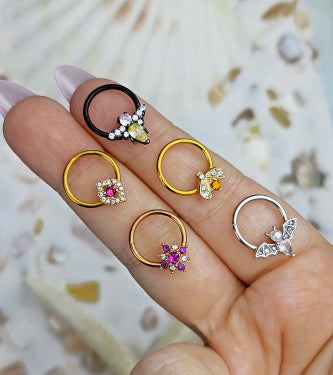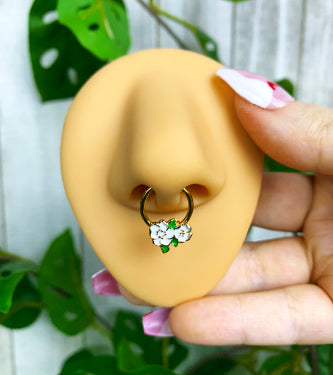









You've probably done it already. You opened five tabs, scrolled through nose rings, belly rings, barbells, clickers, hoops, and flat backs, and still thought, “Cute, but not me.”
That feeling is exactly why custom jewelry ideas hit so hard. You don't just want sparkle. You want a piece that fits your piercing, your vibe, your skin, and your story.
Custom jewelry isn't some tiny niche anymore. The customized jewelry market was valued at USD 42.25 billion in 2026 and is projected to reach USD 104.89 billion by 2032, according to Research and Markets' jewelry market report. Translation: more people want pieces that feel personal, and body jewelry deserves a place in that conversation.
Generic custom jewelry guides usually stop at necklaces and rings. Body jewelry is different. A custom navel curve, a nostril stud with a tiny symbol that sits comfortably, or an industrial bar built around your anatomy has way more going on than “pick a font and engrave your name.”
Your Jewelry Should Be as Unique as You Are
You know that moment when you spot a piece online that is almost right. The gem color is perfect, but the post is wrong for your piercing. The shape is cute, but it would poke, spin, or sit crooked. Body jewelry gets personal fast, because you are not just choosing something pretty. You are choosing something your body has to live with.
A custom body jewelry idea usually starts with a simple question. What do you want this piece to say before you ever speak?
For one person, that answer is quiet and polished, like a septum ring with a clean profile that feels more like part of their face than an accessory. For someone else, it is a navel piece that nods to a moon phase, a pet, a birthstone, or a tiny symbol only a few people would understand. That shift matters. You stop settling for whatever happens to be in stock and start building around your style, your anatomy, and your daily life.
Why custom means more for body jewelry
Personalized jewelry is getting more attention right now, and that makes sense. People want pieces with identity. For piercing jewelry, that trend matters for a bigger reason than self-expression alone.
A body jewelry design has more jobs to do than a necklace or standard ring. It needs to suit the piercing placement, use materials your skin can handle, and stay comfortable when you sleep, work out, talk, or get dressed. A piece can be meaningful and still fail if it catches on everything or leaves your piercing angry by day three.
Practical rule: A beautiful custom design still misses the mark if it pinches, twists, or irritates the piercing.
Body jewelry follows a different set of rules
Regular custom jewelry can get away with being oversized, heavy, or purely decorative. Piercing jewelry does not have that luxury. A nostril screw, rook barbell, labret top, or curved navel bar has to account for movement, pressure, healing history, and the small details of your anatomy.
It helps to picture custom body jewelry like tailoring. A jacket can look amazing on the hanger and still fit badly at the shoulders. Piercing jewelry works the same way. The idea might be gorgeous, but the ultimate success is how it sits, feels, and behaves once in your piercing.
The strongest custom ideas usually bring together three things:
- Personal meaning that reflects your taste or story
- Body-safe materials that suit long wear
- Piercing-specific design that fits the placement comfortably
When those pieces line up, your jewelry feels less like decoration and more like it belongs there.
Finding Your Unique Custom Jewelry Idea
Some people already know exactly what they want. Many, however, do not. These individuals often have a mood, a color, a memory, or a screenshot folder that makes no sense to anyone else. That's enough to start.

Start with the piercing, not just the theme
A great custom concept usually gets clearer when you match it to a placement.
A few examples:
- Nostril piercing: tiny celestial star, miniature gem cluster, subtle initial, tiny paw print silhouette
- Navel piercing: dangling charm with a meaningful symbol, birthstone combo, heart or crescent motif
- Industrial piercing: custom bar with a sleek form, tiny decorative elements spaced along the bar, a design that feels architectural
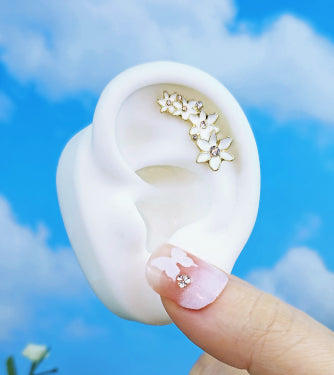
- Flat back earring: micro symbol, hidden engraving, tiny bezel-set stone in your favorite shade
- Septum ring: delicate patterning, soft gothic detailing, or something minimal that reads polished instead of flashy
That's why “I want something custom” gets easier when you finish the sentence with “for my rook,” “for my navel,” or “for my helix.”
Themes that actually translate well into body jewelry
Some ideas sound cool in theory but get muddy once they're shrunk down. Others work beautifully.
Here are a few that usually hold up well:
Celestial
You love moons, stars, constellations, suns, and that dreamy night-sky energy. This theme works well because the shapes are recognizable even at a smaller scale. A tiny star end on a flat back or a moon charm on a belly ring can still read clearly.
Gothic romance
Think black stones, thorn-like curves, cathedral-inspired shapes, tiny hearts, crosses, lace-like metalwork, or rose details. For body jewelry, this theme often works best when one element stays bold and the rest stay clean.
Minimal symbols
Tiny lightning bolts, initials, coordinates, geometric shapes, a single dot, or a line motif. Minimal doesn't mean boring. It often ages better because it's easier to wear every day.
If you want a piece you'll still love years from now, a simple symbol with strong meaning usually beats an overly busy design.
Pull meaning from real life
The best custom jewelry ideas often come from things you already care about, not trends you're trying to force.
Try pulling from:
- A memory: concert date, city skyline, map outline, favorite place
- A relationship: matching symbols, pet reference, shared phrase, handwriting-inspired idea
- A personal marker: zodiac constellation, birthstone, initials, favorite number
- A fandom detail: game icon, tiny weapon silhouette, creature motif, pixel-inspired shape
Visible or secret
This choice changes the whole vibe.
A visible personalization piece announces itself. People notice the symbol, stone, or shape right away.
A hidden personalization piece keeps the meaning close to you. Think a short engraving on the inside, a tiny detail only visible up close, or a symbol disguised inside a cleaner design.
Both are good. The right one depends on whether you want your jewelry to start conversations or keep a private story tucked into your look.
Choosing the Right Materials for Your Piercing
This part matters more than people think. In regular jewelry, material affects appearance and price. In body jewelry, material also affects comfort, wearability, and how your skin reacts.

Think of material like fabric for your skin
You wouldn't choose the same fabric for gym clothes, a winter coat, and fancy evening wear. Body jewelry works the same way. The right material depends on where you're wearing it, whether the piercing is fresh or healed, and how reactive your skin tends to be.
If you want a deeper breakdown of common metals, BodyCandy's guide to what metal body jewelry is made of is a useful starting point.
The main material choices
Implant-grade titanium
Titanium is the one people reach for when sensitivity is a concern. It's lightweight, durable, and widely preferred for piercings that need a gentler material choice.
It's especially helpful when you know your skin gets cranky fast or when you want a custom piece that feels light enough for everyday wear.
316L surgical stainless steel
Surgical steel is common, sturdy, and often more budget-friendly. A lot of people wear it comfortably in healed piercings.
The catch is simple. It may not be the right pick if you're sensitive to certain metal content or you already know your skin reacts easily.
14k solid gold
Gold can look gorgeous in body jewelry, especially if you want a custom piece that feels polished and elevated. It works best when the quality is solid and the design is made with piercing wear in mind.
Gold also needs thoughtful design because softer metals can behave differently than harder ones in thin or delicate areas.
Niobium
Niobium deserves a shoutout for people who love color. It can take on vivid anodized tones and gives you a more unusual palette than standard silver or gold looks.
Match the material to the situation
A quick way to narrow your choice:
| Situation | Material direction |
|---|---|
| New or temperamental piercing | Lean toward titanium |
| Healed piercing, simple everyday piece | Surgical steel can work for many people |
| Luxe look for an established piercing | Consider solid gold |
| You want unusual color without coatings | Look at niobium |
Worth remembering: “Pretty” and “piercing-friendly” are not automatically the same thing.
Ask these questions before ordering
- Is the piercing healed or still touchy
- Do you react to certain metals
- Will you wear this daily or only sometimes
- Does the design need to be lightweight
- Will the piece have stones, charms, or moving parts
A custom piece should never force you to choose between style and comfort. If a design only works in a material your body hates, it isn't the right design yet.
Ways to Personalize Your Body Jewelry
You spot a cute custom design online, then realize it was clearly made with a necklace in mind, not a piercing that has to sit comfortably in skin all day. Body jewelry personalization works a little differently. The design has to look like you and behave well in a very small, very specific space.

A good custom body piece usually changes one of four things: the message, the shape, the color, or the movement. If you keep those buckets in mind, the whole process gets easier fast.
Laser engraving for tiny details
Engraving works well for people who want meaning without adding bulk. Initials, dates, a short word, zodiac symbols, or a private little message can sit on a disk end, charm, or other flat visible surface.
For piercings, that surface area matters a lot. A tiny engraved end is like writing on a grain of rice. You need enough room for the detail to stay readable without turning the piece chunky or awkward against the piercing.
Charms and dangles for movement
Charms change the mood of a piece almost instantly. A tiny moon, butterfly, spike, gem drop, or heart can make a navel piece feel softer, sharper, or more playful.
Movement is fun, but body jewelry has limits that regular jewelry does not. A charm that looks perfect in a product photo may twist, snag, or tap against the skin if it is too long or too heavy for the piercing placement. That is why one well-chosen dangle often beats a cluster of extras.
Stones and color choices
Color can personalize a piece even if you skip text completely. Birthstones are popular, but you can also choose stones based on your everyday makeup colors, the metals you already wear, or the vibe you want the piercing to give off.
This is also where piercing-specific planning helps. A large stone can look amazing in a healed navel piercing but feel annoying in a nostril or forward helix. Prong height, stone size, and how far the setting sticks up all affect daily comfort.
CAD and 3D printing for fully custom shapes
Some ideas need more than a premade end or an engraved charm. If you want a shape that is unusual, anatomy-specific, or hard to explain with words alone, digital design helps turn the concept into something a jeweler can produce.
As explained in Westpack's article on custom jewelry ideas and technology, CAD is used to visualize designs, 3D printing can create detailed wax models, and laser engraving adds fine detail. For body jewelry, that precision matters because tiny changes in spacing, symmetry, and stone placement can affect how the piece sits in the piercing.
Four personalization routes that work well
-
Text-based details
Good for initials, dates, short mantras, and hidden messages. -
Symbol-driven design
A strong choice if you want something personal that still feels subtle. -
Color-led customization
Useful if your style is tied to certain stones, anodized tones, or metal colors. -
Fully custom form
Best for unusual motifs, anatomy-aware shapes, or ideas you cannot find ready-made.
A rough sketch helps. So does a screenshot, a reference photo, or even a note that says “I want this to feel delicate but slightly weird.” That kind of direction gives a designer something real to work with, especially for body jewelry where tiny details change wearability as much as appearance.
Getting the Perfect Fit Sizing and Design for Comfort
You can have the coolest design on earth and still hate wearing it if the fit is wrong. In body jewelry, fit isn't a finishing touch. It's the foundation.

Size affects more than appearance
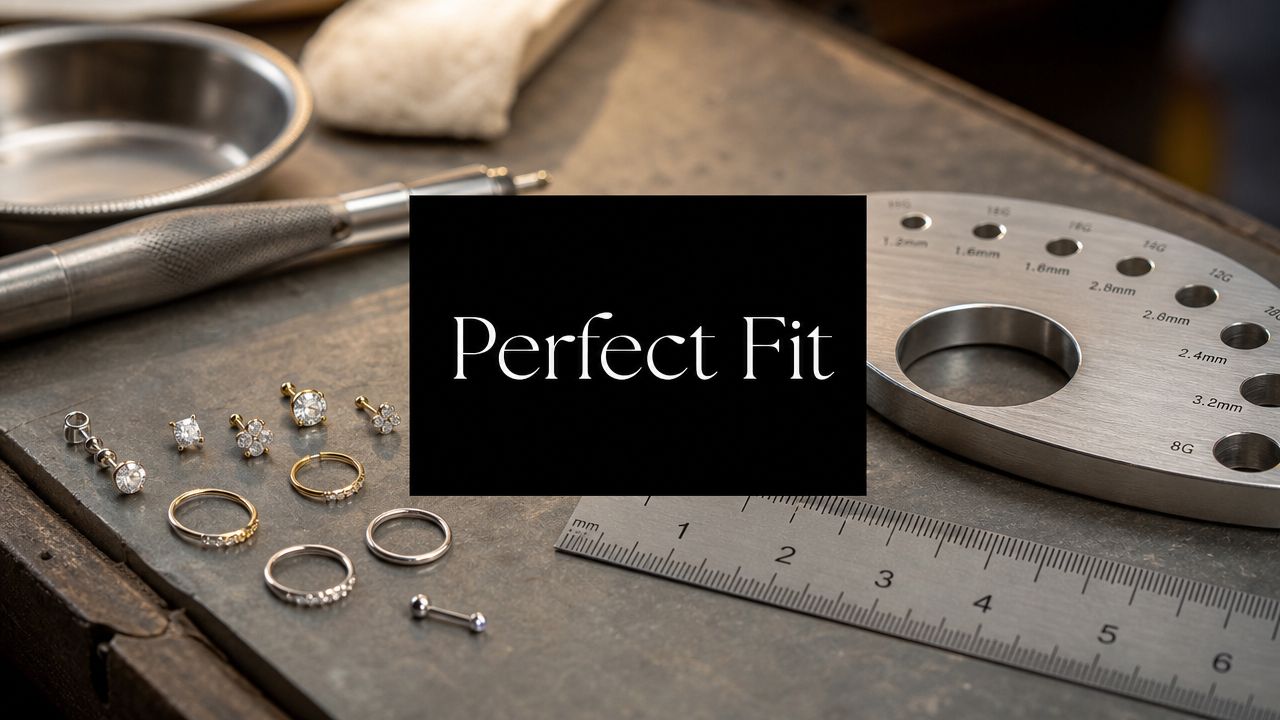
People usually focus on how a custom piece looks from the front. Your piercing cares about different things. It cares about gauge, length or diameter, weight, edge smoothness, and whether the jewelry sits naturally with your anatomy.
A nostril piece that's too bulky may catch constantly. A navel ring with an oversized dangle may feel annoying in daily movement. A barbell with the wrong length can create pressure that ruins the whole experience.
Small design choices can make a big difference
One of the most important production realities in custom jewelry is minimum feature size. According to Gabriel Fine Jewelers' overview of how custom jewelry is designed, CAD models are reviewed for things like band width and element thickness because small changes affect structural strength, comfort, and whether the piece can be cast successfully.
That matters for body jewelry in very practical ways:
- Thin decorative points can bend or feel sharp
- Tiny unsupported details may not hold up well
- Heavy front-facing elements can make a piece rotate oddly
- Overly thick designs may feel clunky in smaller piercings
A body jewelry design should be scaled for the piercing, not just shrunk from a larger jewelry concept.
Measure first, customize second
If you don't know your current size, start there. Use jewelry that already fits well as your reference. Measure carefully, and if you're unsure, ask a professional piercer before locking in a custom order.
This video gives a helpful visual if sizing terms still feel confusing:
Comfort questions worth asking
Before approving a design, ask:
- Will this snag on hair, clothes, or towels
- Does the front detail stick out too far
- Is the piece balanced, or will it tilt
- Are there edges that need to be softened
- Is this realistic for daily wear
The right fit makes a custom piece feel effortless. The wrong fit turns it into drawer jewelry.
The Custom Order Process From Idea to Inbox
You finally have the idea. Maybe it is a tiny opal end for your helix, a curved barbell with a star detail for your rook, or a nostril stud that feels more like you than anything sitting in a standard product grid. Then the custom form opens, asks for measurements, materials, placement, and design notes, and the whole thing can suddenly feel more technical than expected.
That is normal.
Custom body jewelry usually moves in a few clear stages: concept, review, approval, production, and delivery. Once you know the order, it feels less like sending your idea into a void and more like working with a jeweler on a piece that has to look good and behave well in a piercing.
Start with a clear brief
You do not need a polished sketch. You need useful information.
A good custom request usually includes the piercing type, the style of jewelry, your preferred metal, your target measurements, and a few visual references. For body jewelry, that last part matters in a very specific way. A pretty design on a ring or pendant may not translate well to a healed conch, nostril, or eyebrow piercing, so your references should show the vibe you want, not just random jewelry you like.
Helpful details to send:
- Reference images that show shape, mood, and level of detail
- Piercing placement such as septum, helix, tragus, navel, or nipple
- Jewelry type such as flat back stud, curved barbell, captive ring, or clicker
- Material choice based on sensitivity and wear plans
- Measurements from jewelry that already fits comfortably
- Required details such as stone color, symbol, finish, or engraving
A messy mood board with good notes beats a vague “something cute” every time.
Review the design like a wearer, not just a shopper
Once a jeweler turns your idea into a mockup or render, slow down and inspect it from a body jewelry angle. You are not only checking whether it looks pretty on a screen. You are checking whether it will sit correctly, feel balanced, and make sense for the piercing it is meant for.
Ask practical questions. Will the decorative end look oversized on a small lobe stack? Will the gem setting press against skin in a snug piercing? Does the design stick out more than you expected? Body jewelry is tiny engineering. A millimeter can change comfort fast.
If you want a clearer sense of timing and what happens after you submit an idea, BodyCandy's guide to custom jewelry turnaround and ordering gives a helpful overview.
Approval is the point to catch problems
After the mockup comes your approval. This is your last easy chance to fix details before the piece goes into production.
Speak up if something feels off. Ask for the gem to sit lower. Ask whether the top can be softened so it snags less. Ask whether the end looks too heavy for the post size. Custom body jewelry works best when you treat the review step like a fitting room for the design, not a final exam where you are scared to ask questions.
Production takes time for a reason
Once you approve the design, the maker can move into production. That may include creating the model, casting or machining the metal, polishing, setting stones, engraving, and final quality checks. Body jewelry often needs extra care here because wearability matters as much as appearance. Clean threading, smooth finishes, and secure settings are part of what makes the piece worth waiting for.
Here is what makes the process easier on both sides:
| Better custom experience | What that looks like |
|---|---|
| Specific inspiration | “Small crescent moon end with a dark opal center for a healed helix” |
| Honest wear goals | “I want this for daily wear, not special occasions only” |
| Clear comfort limits | “Nothing sharp, bulky, or likely to catch on hair” |
| Openness to revision | Small changes often make a body jewelry design more wearable |
Good custom orders are collaborative. You bring the taste, the piercing context, and the fit information. The jeweler brings the technical skill to turn that idea into something you will want to put in the moment it hits your inbox.
Caring for Your Custom Creation
Once your custom piece arrives, the goal is simple. Keep it looking good and feeling good.
Cleaning depends on the material and the design. A polished metal piece with no stones is usually easier to maintain than something with engraving, settings, or dangling details. Be gentle, clean it regularly, and don't use harsh methods that could scratch finishes or loosen decorative elements.
Storage matters too. Keep custom jewelry separate so it doesn't rub against harder pieces, especially if it has delicate details. If a piece has a special finish, tiny engraved area, or gemstone setting, treat it like the tiny artwork it is.
For day-to-day care basics, BodyCandy's guide on how to properly care for your body jewelry covers the habits that help jewelry stay wearable longer.
Your custom piece should feel personal every time you put it in. A little care protects the design, the finish, and the meaning you built into it.
Ready to turn your idea into something you can wear? Browse BodyCandy for personalized styles, body jewelry inspiration, and pieces that help you build a look that feels like yours.