

















You're browsing diamond rings when one design catches the light from every angle. It looks wider, brighter, and far more dramatic than the classic solitaire you first imagined. Then the questions start: Is it a three-stone ring or a three-row ring? Will it feel comfortable all day? Are the smaller diamonds secure, and should you choose natural or lab-grown stones?
A 3 row diamond ring is a high-impact design, but sparkle is only the beginning. The row arrangement, stone proportions, setting construction, metal, sizing, and maintenance all affect whether the ring feels like a brilliant everyday favorite or a beautiful piece that spends most of its time in the jewelry box.
What a 3 Row Diamond Ring Actually Is
A three-row diamond ring has three parallel lines of diamonds running across the top of the band. That's different from a single-row band, which has one line of stones, and different from a three-stone ring, which has one center stone bordered by two side stones. The names sound similar, so this distinction trips up plenty of shoppers.
Look at the ring from above. You'll usually see a central line of diamonds framed by two outer lines. The rows may contain matching stones in a consistent pattern, or they may graduate from larger stones in the middle to smaller accents along the edges. Some designs use closely packed pavé stones for a nearly continuous surface of brilliance, while others leave more visible metal between individual settings.
Common formats
Three-row designs show up in several familiar categories:
- Anniversary bands often use three parallel rows to create a substantial symbol of a milestone.
- Wide cocktail rings use the extra surface area for a bold, fashion-forward look.
- Pavé eternity styles may carry stones around much or all of the band, creating sparkle from multiple viewing angles.
You'll find these rings in white gold, yellow gold, rose gold, and platinum. A three-row style can work as an engagement ring, a wedding band, an anniversary piece, or a fashion ring. The right choice depends on how much finger coverage you want and whether you'll wear it occasionally or continuously.
Three rows naturally create more visual width than a solitaire or narrow band. They also place more stones, settings, and metal against your finger, so the ring can feel more substantial even when its profile is relatively low.
Practical rule: Judge a three-row ring from the top, the side, and underneath. The top shows the sparkle, the side reveals height and snagging risk, and the underside shows how easily you'll clean between the rows.
The broader diamond-jewelry market provides useful context, although it doesn't isolate three-row rings. One forecast estimates the global diamond-jewelry market at US$102.70 billion in 2026, with a projected US$143.55 billion by 2033 and a 4.9% compound annual growth rate, while another estimate places the market at US$96.3 billion in 2025 and projects US$160.5 billion by 2034 at 5.8% annual compound growth. These totals include many diamond-jewelry formats, not specifically three-row rings, so they shouldn't be treated as sales figures for this design. Fairfield Market Research's diamond-jewelry overview does show why this style belongs to a large, internationally distributed category.
How the Three-Stone Structure Shapes the Look
Start with a top-down mental image. See one central row running lengthwise across the finger, with two outer rows sitting beside it. The center row often acts as the visual anchor, while the outer rows add width, continuity, and extra flashes of light.
That's the basic anatomy of a three-row ring. It isn't the same structure as a three-stone ring, where one center diamond sits between two side diamonds. In a three-row ring, each line can contain several stones, and the overall appearance depends on how the rows relate to one another.
Proportion changes the personality
A uniform three-row design gives you a clean, graphic look. Each row appears similar in stone size and spacing, so the eye reads the ring as a broad, even band. A graduated design places more visual emphasis on the center row and can feel softer or more traditional.
Stone shape changes the effect, too. Round diamonds create a lively, repeating rhythm. Baguettes or other elongated shapes can make the rows look more architectural. Mixed cuts introduce texture, but they require careful coordination so the arrangement feels intentional rather than uneven.
Total carat weight means the combined weight of all the diamonds in the ring, not just the most noticeable row or center stone. A ring listed at 3.00 total carat weight distributes that weight across the design, so it may look wide and continuous rather than centered on one prominent diamond. This three-stone proportion guide also illustrates why the breakdown matters. Two rings with the same total carat weight can look completely different depending on how much weight sits in the center versus the sides.
Match the layout to your hand
A broad horizontal layout can make the finger look wider because the eye follows the ring from side to side. A more tapered or graduated arrangement can guide the eye toward the center and create a lengthening effect. Neither result is automatically better.
Try asking yourself:
- Do you want the ring to read as a bold band or a central statement?
- Do you prefer repeated symmetry or a clear focal point?
- Will the ring sit beside an engagement or wedding band?
- Does the outer edge stop comfortably before the finger curves?
The best proportion is the one that balances the ring's width with your finger and your usual styling.
Setting Styles That Change Everything
The setting holds the diamonds in place, controls how much metal you see, and changes how the ring behaves during wear. Three-row designs commonly use prongs or bezels, and many pavé versions use a shared-prong arrangement between neighboring stones. The Gemological Institute of America describes prong and bezel settings as common choices for three-stone rings, and the same practical differences apply when evaluating multi-row construction. GIA's guide to three-stone ring settings offers a useful foundation for comparing them.
Prongs
Prongs are narrow metal supports placed around a stone. They expose more of each diamond, which can make a three-row ring look bright and airy. The trade-off is exposure. Diamond edges and prongs can catch on clothing, hair, or textured surfaces, especially when the rows sit high above the finger.
Inspect the prongs closely. Look for consistent shapes, rounded and polished tips, level stones, and enough clearance between neighboring rows. GIA bench-setting guidance identifies useful construction benchmarks, including a prong angle of approximately 70 to 80 degrees, a finished prong height around 75% to 85% of the stone's table height, and contact covering roughly 33% to 50% of the crown distance. GIA's research on diamond cut quality and setting construction explains why properly fitted bearings and balanced contact matter.
Bezels
A bezel surrounds the diamond with a thin metal rim. It gives the ring a cleaner, more enclosed outline and protects more of the stone's edge from impact. The look is often modern and low-profile, although the additional metal can reduce the open, floating appearance of prong-set rows.
Ask whether the bezel is even around each stone and whether the metal leaves enough of the diamond visible for the design you want. A thick or poorly positioned rim may make the rows look heavier than expected.
Shared prongs
A shared-prong setting lets adjacent stones use one prong between them. This reduces visible metal and can create an almost continuous wall of sparkle. It also makes inspection important, because one worn or damaged prong may affect neighboring stones.
Before buying, ask how the ring should be cleaned between rows, how often the settings should be inspected, and whether the design is intended for daily wear. For metal terminology and care basics, BodyCandy's crash course on buying and wearing gold jewelry is a helpful companion.
Reading the 4Cs for a Multi-Row Design
The 4Cs, cut, color, clarity, and carat, still matter in a three-row ring. Their priorities shift because you're evaluating a group of stones that need to look coordinated, not one diamond performing alone under a spotlight.
Cut comes first. Diamond proportions, including crown and pavilion angles, table size, girdle thickness, symmetry, and polish, influence brightness, fire, and scintillation. If one row contains poorly balanced stones, pavilion light leakage can make those diamonds look darker even when their color, clarity, and carat weight appear similar. GIA's round-brilliant cut analysis examined more than 1 million proportion sets, validated with more than 70,000 human observations of nearly 2,300 diamonds, making its diamond-cut explanation a strong reference for understanding why proportions matter.
| C Factor | Center Stone Priority | Side Stone Priority |
|---|---|---|
| Cut | Highest priority, because it often anchors the ring's sparkle | Match cut quality and visual brightness across every row |
| Color | Choose a tone that works with the metal and surrounding stones | Prioritize consistency so one row doesn't look noticeably warmer |
| Clarity | Look for a clean appearance at normal viewing distance | Visual cleanliness matters more than chasing a flawless grade |
| Carat | Use it to control focal point and overall scale | Compare the combined weight and distribution, not just stone count |
Color should be evaluated across the entire layout. A slightly warmer stone may be difficult to notice alone but more apparent beside brighter stones. Clarity can sometimes be relaxed for small accent diamonds when inclusions aren't visible without magnification, but the final standard should be a consistent, lively appearance.
The buying test: Ask to compare the center and side stones under the same lighting. A three-row ring succeeds when the rows look like one composition, not three unrelated groups.
Request grading documentation for the center and larger accent stones when available. For smaller rows, ask whether the diamonds are matched by cut, color, clarity, fluorescence, and size. If you're comparing diamond jewelry with alternatives, BodyCandy's guide to cubic zirconia versus diamond can help separate appearance from material choice.
Natural vs Lab-Grown in a Three-Row Build
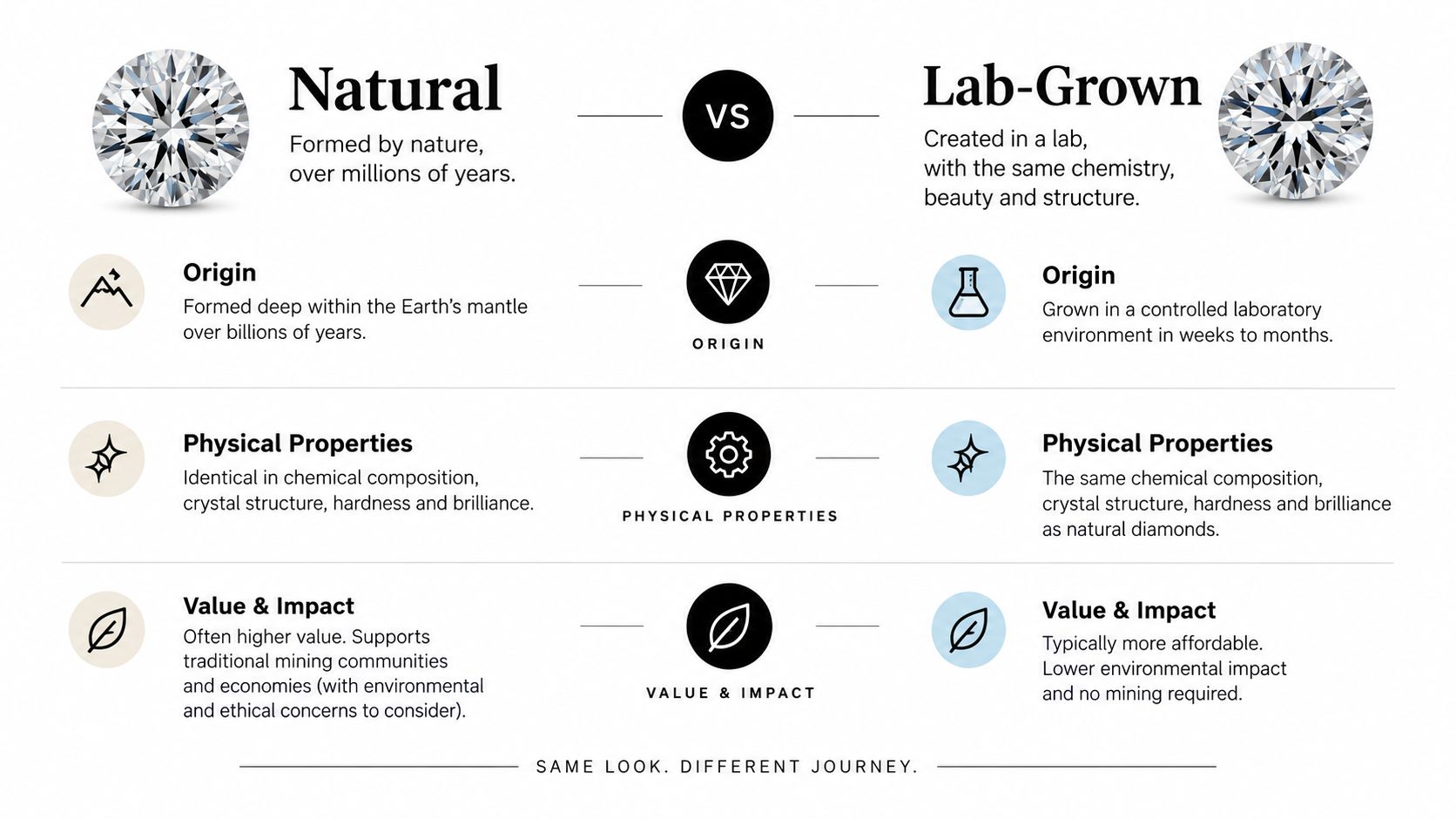
Natural and lab-grown diamonds can both create a beautiful three-row ring, but they suit different priorities. The fairest comparison starts with the whole ring rather than the center stone. You're buying a group of diamonds, plus the setting labor, metal, matching process, and future care.
Lab-grown stones can make a larger-looking multi-row design more accessible because the budget doesn't have to stretch across as many natural diamonds. Recent U.S. retail data reported that lab-grown diamond sales rose about 13% in 2025, while units rose 19% and average retail prices fell roughly 5%. The same data reported that natural-diamond sales declined about 2%, units fell 10%, and average retail prices increased nearly 9%. National Jeweler's 2025 retail analysis provides the market context, but those figures don't predict the price of a specific ring.
The difference becomes especially noticeable when the design uses many stones. A lab-grown build may let you prioritize a wider band, stronger matching, or a more elaborate setting. A natural-diamond build may appeal to you if geological rarity and traditional provenance matter more than maximizing visible coverage.
Will mixing origins look different?
Origin alone doesn't determine whether the rows look visually harmonious. Matching cut, color, clarity, fluorescence, and melee size matters more for the ring's surface appearance. Still, mixed-origin jewelry should be disclosed clearly, and you should ask how the stones were graded and documented.
Appraisal and resale expectations can also differ, so don't buy either option assuming it will behave like a guaranteed investment. Choose natural stones when rarity and tradition are central to the meaning of the ring. Choose lab-grown stones when you'd rather direct more of your budget toward size, coverage, or design complexity.
The latest U.S. data also reported that lab-grown engagement-ring sales reached 47% in 2025 and 51% in the first half of 2026, which shows how relevant this choice has become for shoppers. Those figures describe engagement rings in that market, not every three-row ring or every country.
Sizing, Comfort, and Everyday Wear
A three-row ring can feel snugger than a narrow solitaire because more metal and stone coverage contact the finger. Don't guess from a ring worn on another finger or from an online size chart alone. GIA notes that the two hands may differ, and for a right-handed person, the left ring finger is typically about half a size smaller than the right, with the reverse commonly applying to a left-handed person. GIA's ring-sizing guidance explains why professional measurement of the actual finger matters.
Build comfort into the choice
Ask a jeweler to measure the specific finger where you'll wear the ring. A professional uses metal finger gauges, or ring sizers, in half-size increments. If the band is unusually wide, measurement should be taken from the center of the band rather than its edge.
A wide ring may need a different fit from a narrow ring, but don't automatically order a larger size. Too much looseness can let the ring rotate, shift the rows, and expose the setting to more contact. Try the ring on for long enough to notice pressure at the sides, restricted finger movement, or a sharp inner edge.
Comfort check: Close your hand, type, and slide the ring against a neighboring finger. A ring that looks perfect while your hand is still may feel very different during ordinary movement.
Metal choice matters if your skin reacts to certain alloys. Ask for the complete metal composition rather than relying on a broad “hypoallergenic” label. Platinum, gold alloys selected with care, and other disclosed materials may suit different wearers, but your own sensitivity and past reactions should guide the decision.
Clean a densely set ring gently with mild soap, lukewarm water, a soft brush, and a lint-free cloth. Work the brush between the rows without forcing bristles under loose stones. Avoid harsh chemicals, and remove the ring for activities that expose it to heavy impact, abrasive debris, or strong cleaning products. For another practical sizing reference, see BodyCandy's quick ring-sizing guide.
The De Beers consumer research summary reports that the average natural-diamond jewelry purchase rose from 1.65 total carats in 2023 to 1.86 carats in 2025. That trend makes construction and comfort more important, because a larger overall design usually brings more settings and cleaning surfaces. The De Beers consumer-trends update is useful context, but it doesn't establish a universal comfort standard for every ring.
Matching the Right Ring to the Occasion
Choose the ring by starting with your routine, then refine the look. A design worn every day needs smooth edges, secure settings, manageable width, and a metal that works with your existing jewelry. A ring reserved for celebrations can prioritize height, dramatic coverage, or a more elaborate shared-prong surface.
| Occasion | Metal Pick | Setting Type | Carat Range |
|---|---|---|---|
| Daily wear | A metal that matches your existing pieces and skin preferences | Low-profile prong, bezel, or secure pavé | Lower overall coverage |
| Anniversary milestone | Your preferred precious metal | Graduated rows with a stronger focal point | Moderate to higher overall coverage |
| Cocktail event | Yellow gold or another high-contrast choice | Bold shared-prong design | Higher visual impact |
| Bridal styling | Metal that complements the engagement ring | Tapered or coordinated multi-row setting | Proportional to the paired ring |
These are style directions, not fixed rules. A slim three-row band with smaller accent stones can stack neatly and feel less dominant. A wider anniversary ring with a prominent center row can stand alone and make the ring itself the occasion.
Let proportion lead the budget
Don't compare only the total carat number. Compare how much of that weight sits in each row, how evenly the stones are matched, how complex the setting is, and whether the ring will require specialized maintenance. Cost per stone and construction quality can reveal differences that a single total-carats figure hides.
If you're pairing the ring with another band, bring the existing piece when shopping. Matching metals can create a unified set, while a deliberate mixed-metal combination can give the stack more contrast. The ring should fit your hand, your wardrobe, and the amount of attention you enjoy receiving.
Quick Answers Before You Buy
Is a three-row ring always expensive? No. The price depends on the diamonds' origin and quality, total weight, metal, setting, and labor. Lab-grown stones may give you more visible coverage within a set budget, while natural stones may suit buyers who value rarity and tradition.
Should you automatically size up? No. A wide band may feel tighter than a narrow one, but professional sizing is safer than adding space by guesswork. Measure the specific finger and try on a ring with a similar width.
Do shared prongs loosen faster than four-prong settings? Not automatically. Security depends on sound construction, proper contact, regular inspection, and how you wear the ring. Check that neighboring stones sit level and that no prong feels sharp, thin, or mobile.
Do all three rows need the same cut grade? They need compatible cut quality and visual brightness. A dull-looking stone can interrupt the pattern even when the ring's overall carat weight is impressive.
Will yellow gold make the diamonds look yellow? The metal can create warm contrast, but the diamonds' appearance still depends on their own color and surrounding stones. Judge the finished ring in normal viewing conditions, not only under display lighting.
How should you clean between rows? Use mild soap, water, a soft brush, and a lint-free cloth. Fragile or complex settings deserve professional advice before ultrasonic cleaning, because strong vibration isn't suitable for every construction.
Is a three-row ring practical for daily wear? It can be, if the profile, setting security, edge finish, and sizing suit your routine. Remove it for high-impact or abrasive activities and arrange professional inspections when the ring's construction calls for them.
Ready to choose a ring that combines bold coverage with thoughtful construction? Explore the jewelry selection at BodyCandy, compare styles that suit your look, and use these setting, proportion, and comfort checks before you buy.