














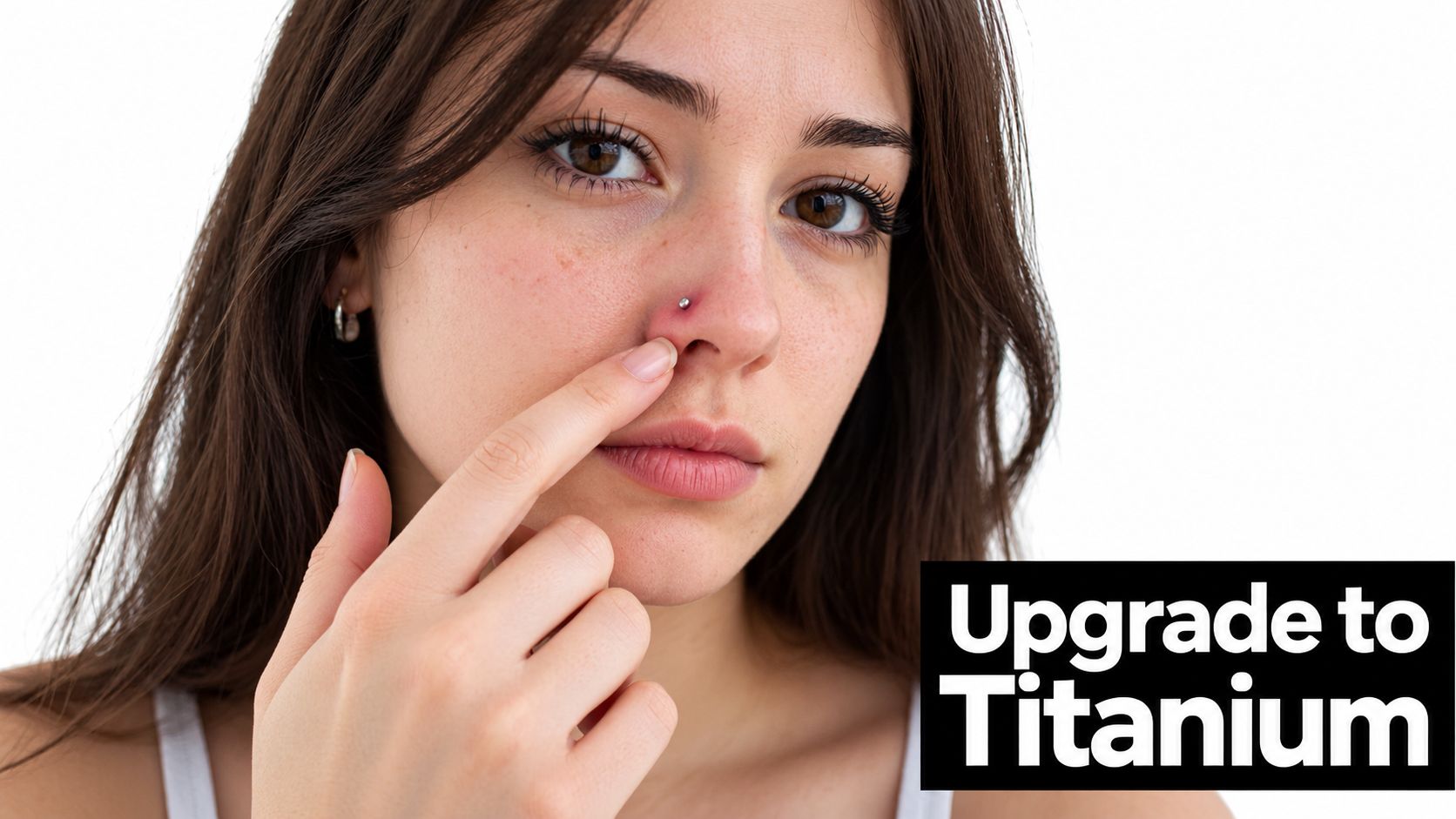
You've got a fresh nostril piercing, you're following your aftercare routine, and yet the area still looks red, tender, or annoyingly angry. Before blaming your nose, inspect the jewelry. The metal, shape, gauge, and fit can all influence how comfortably a piercing behaves.
A titanium nose screw can be a smart option because it combines a secure corkscrew-style post with implant-grade material. But titanium isn't a magic cure, and a screw that fits badly can still cause trouble. The right choice depends on both what the jewelry is made from and how it sits in your anatomy.
Why Your Nostril Piercing Deserves a Titanium Upgrade
A nostril piercing can look tiny and still demand serious attention. The inside of your nose is curved, soft, and exposed to movement from sleeping, wiping your face, wearing masks, and accidentally catching the jewelry on clothing or towels. If the jewelry is too long, it may spin. If it's too short, it can press into tissue. If its bend doesn't match your nostril, every adjustment can create more irritation.
A nose screw looks like a small curved post, often described as a pig-tail or corkscrew shape. The decorative end stays visible on the outside, while the curved section rests inside the nostril and helps keep the jewelry from sliding straight out. Unlike a straight stud, it doesn't rely on a separate backing.
Why the shape matters
That security makes a titanium nose screw appealing for people who regularly lose L-shaped studs or knock loose jewelry while changing clothes. It can also work well for everyday wear once the piercing is ready for a jewelry change.
The trade-off is insertion. You need to guide the curve through the piercing channel instead of pushing a straight post directly through. Never force it. If the screw catches, twists sharply, or causes pain, stop and ask a professional piercer to assess the jewelry and the piercing.
Practical rule: Secure jewelry still needs a comfortable fit. A screw that stays in place but rubs, pinches, or pulls isn't doing its job.
Titanium becomes especially useful when your skin reacts to unidentified alloys. Implant-grade titanium is widely described as nickel-free and hypoallergenic, and its stable surface helps limit metal ion release compared with many conventional metals in body-jewelry material guidance. That doesn't mean every irritated piercing needs a material swap. Swelling, friction, incorrect sizing, and poor placement can all create similar symptoms.
The best upgrade is therefore not “buy titanium.” It's choosing verifiable implant-grade titanium, matching the screw to your nostril, and treating persistent symptoms as a fit or health issue rather than assuming the metal is always responsible.
The Science Behind Implant-Grade Titanium
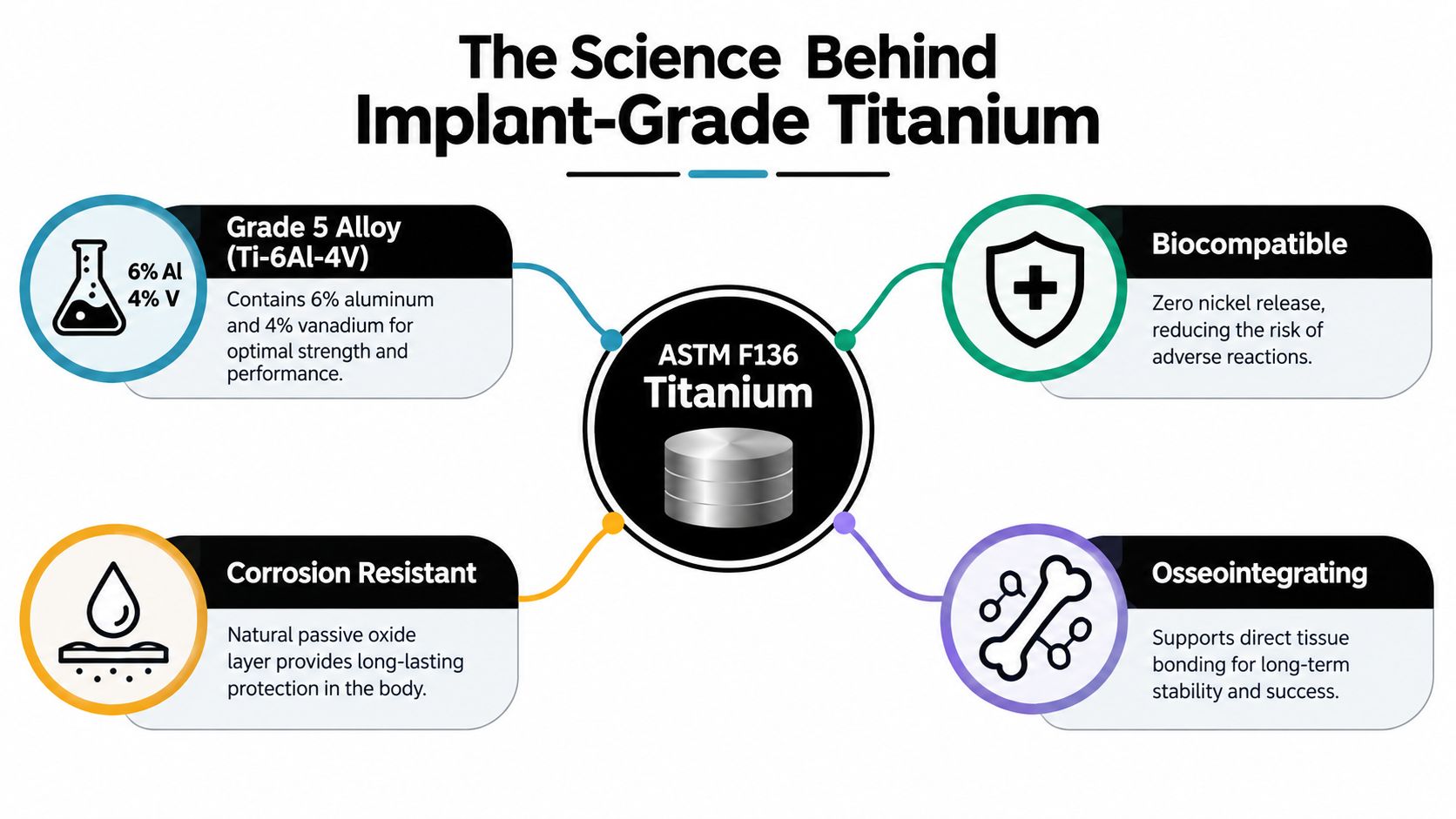
A product can say “titanium” and still leave important questions unanswered. For nose jewelry, implant-grade titanium should identify a defined material, commonly ASTM F136 titanium, also known as Ti-6Al-4V ELI. Its specification includes 5.5–6.5% aluminum and 3.5–4.5% vanadium, with oxygen capped at 0.13% and iron at 0.25% or less. These composition limits are summarized in material guidance for body jewelry.
Those figures describe what the alloy contains. ASTM F136 also ties it to surgical-implant requirements, giving the label more meaning than a product described only as “titanium.” Check for the grade or standard in the product details, preferably with documentation from the maker or retailer.
The oxide layer doing the quiet work
Titanium forms a thin, passive titanium-oxide layer across its surface. Minor scratches can disrupt it, but the layer reforms quickly. That self-renewing barrier helps reduce ion release and maintain corrosion resistance while the jewelry meets sweat, saline, and nasal tissue fluids.
Titanium is highly resistant to neutral chloride solutions and is generally associated with very low corrosion rates in chloride environments, according to this discussion of metallic biocompatibility. Its protection comes from the metal's surface chemistry, not from a fragile decorative coating.
Material check: Look for “ASTM F136” or “Ti-6Al-4V ELI” in the product description. “Titanium-colored” and “titanium-coated” describe appearance or construction, not the same solid alloy.
Implant-material literature commonly describes titanium as nickel-free and biocompatible. A guide to titanium body jewelry can provide broader context on grades and jewelry materials. Rare sensitivities can still occur, and “hypoallergenic” does not mean impossible to react to. Persistent redness or discomfort may also come from friction, pressure, contamination, or a poor fit.
The practical takeaway is simple: verify the grade, then assess how the screw sits in your nostril. A suitable alloy cannot correct jewelry that presses into tissue, moves excessively, or follows an unsuitable piercing angle.
Nailing the Perfect Fit and Gauge Size
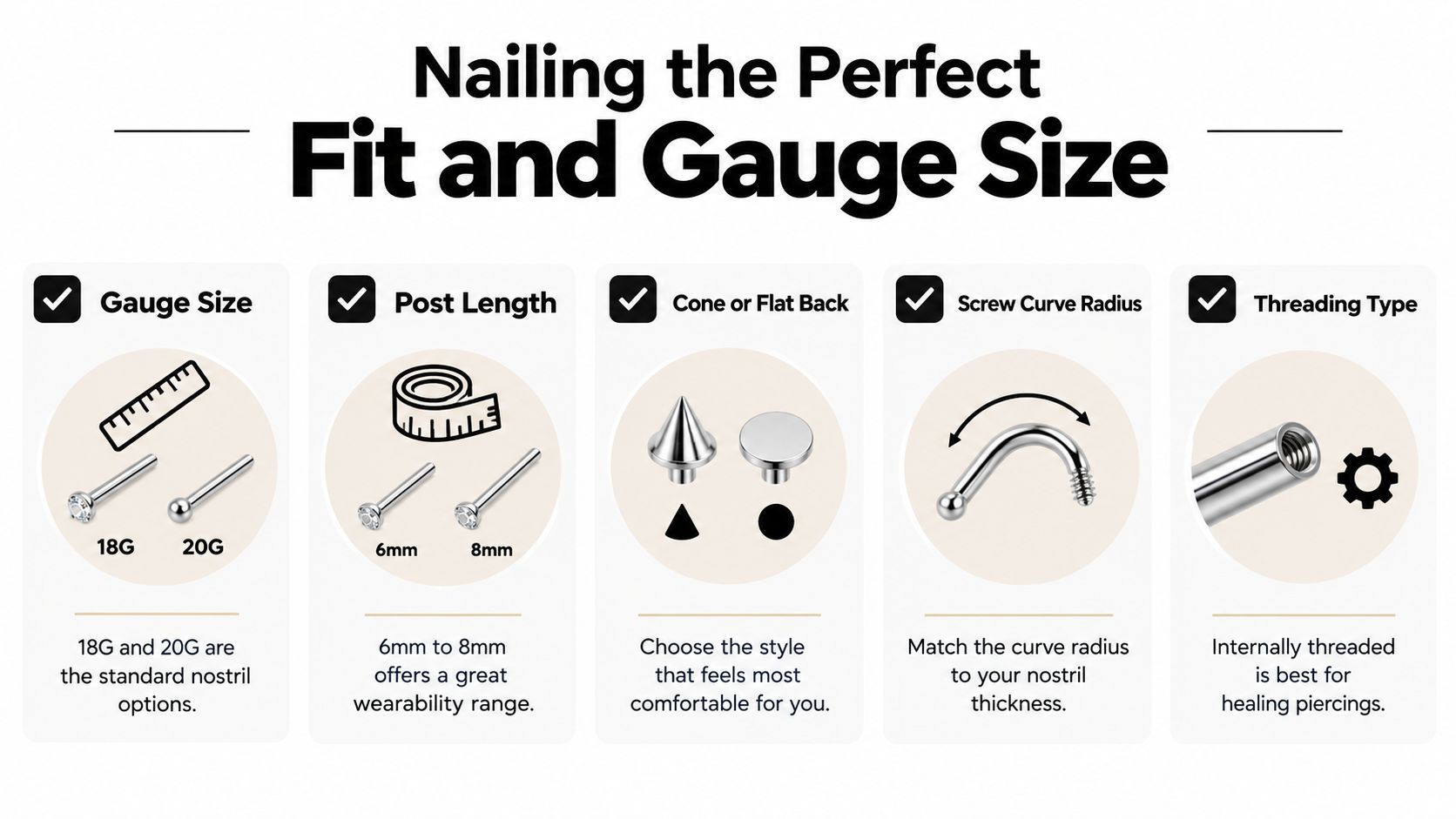
A titanium nose screw can be chemically compatible and still feel awful if its dimensions don't match your piercing. Start with gauge, which measures the thickness of the post. The counterintuitive part is that a smaller gauge number represents a thicker piece of jewelry.
For nostril jewelry, 18 gauge and 20 gauge are common options, and some sizing guidance identifies 18 gauge as the most common size for nostril screws in a nostril-jewelry sizing guide. Don't switch between them casually if your piercing channel is established. A professional piercer can help you confirm what you currently wear.
Measure the fit, not just the look
Gauge is only the thickness. You also need the correct wearable length and curve.
- Check your current jewelry. If it fits comfortably, ask the original piercer or a reputable jewelry retailer to identify its gauge and wearable length. Don't measure the decorative top as part of the post.
- Watch for movement. A post that rotates constantly may be too long. Extra movement can catch on fabric and encourage irritation.
- Look for pressure. Jewelry that leaves a deep mark, disappears into tissue, or feels tight needs professional attention rather than a tighter screw.
- Match the bend. Nose screws are made for different sides and curve directions. A left-side screw may not sit correctly on the right nostril.
- Test insertion gently. The curve should follow the existing channel. If you have to push, twist, or search for the exit, stop.
Length changes as swelling settles
Fresh piercings may need room for swelling, while a settled piercing often feels better with a closer fit. A long post can spin and snag, but downsizing too soon can create pressure or embedding. Let a piercer decide when the tissue is ready for a shorter wearable length.
Use this nose-ring sizing guide as a terminology reference, then confirm your individual measurements with a professional. Your nose isn't a standard template, so the “average” size is only a starting point.
Titanium vs Surgical Steel and Gold
Material choice gets clearer when you compare biocompatibility, durability, cost, and appearance. Titanium usually suits healing piercings and people avoiding nickel, while surgical steel and gold can work well in established piercings when their composition is known.
| Material | Nickel Content | Corrosion Resistance | Price Point | Best For |
|---|---|---|---|---|
| Implant-grade titanium | Nickel-free | Excellent resistance in chloride environments | Typically costs more than surgical steel but less than solid gold, and rarely needs replating | Fresh piercings, sensitive skin, continuous wear |
| Surgical steel | May contain trace nickel, depending on alloy and certification | Durable, but depends on the specific alloy and finish | Typically the most affordable of the three | Wearers who tolerate the alloy and want broad style access |
| Solid gold | Depends on alloy composition | Generally suitable when the alloy and finish are appropriate | Usually the highest-cost option | Healed piercings and a classic jewelry look |
Surgical steel has an asterisk
“Surgical steel” describes a group of alloys, not one universal recipe. Some contain nickel, which can matter if you have experienced nickel-related irritation before. The label alone cannot confirm how your skin will respond, so ask for the specific alloy and certification before placing it in a healing or sensitive piercing.
Steel can be durable and practical for people who tolerate its composition. Titanium offers a simpler choice when nickel avoidance matters. Its oxide layer helps protect the surface from corrosion without relying on plating, as described in material references for body jewelry.
Gold brings style and alloy questions
Gold provides a warm finish and a traditional jewelry feel, but the word “gold” does not identify one fixed material. Different alloys contain different metals, and plated jewelry has a surface layer that can wear away. For a nose piercing that is still settling, solid jewelry with clearly identified composition is a safer starting point than mystery plating.
Your priorities can guide the decision:
- Sensitive skin: Implant-grade titanium is the clearest nickel-free option.
- Budget-conscious styling: Certified surgical steel may work if you already tolerate its alloy.
- Luxury finish: Solid gold can suit a healed piercing when its alloy and construction are clearly identified.
- Low-maintenance everyday wear: Titanium combines corrosion resistance with a light feel and rarely needs replating.
One detail deserves equal attention to the metal: a material can be suitable while the jewelry still fits poorly. A screw that presses, spins, or catches can irritate the piercing regardless of whether it is titanium, steel, or gold. Choose the composition first, then judge the design and construction by how calmly it sits in your nostril.
Busting Myths About Metal Sensitivities and Fit Risks
“Titanium is hypoallergenic” is useful shorthand, but it isn't a guarantee that every titanium nose screw will suit every person. Persistent redness, swelling, tenderness, or discharge can result from pressure, friction, movement, contamination, placement, or an unsuitable jewelry design.
Mechanical irritation often deserves attention first. A curve that doesn't match your nostril can press against the channel. A post that's too long can rotate and snag. A decorative end that catches on towels or clothing can tug the outer opening. Independent piercing and medical guidance discusses irritation, tearing, loose jewelry, aspiration, infection, and nose-specific complications, including septal hematoma and nasal-wall damage in this clinical overview of body piercing complications.
Read the symptoms as clues
A useful troubleshooting approach is to inspect the jewelry before assuming allergy.
- Pressure or indentation: The wearable length may be too short, or swelling may not have settled.
- Constant spinning: The post may be too long, allowing excessive movement.
- Pain during insertion: The curve, gauge, or direction may not match the channel.
- Irritation after snagging: Mechanical trauma may explain the flare-up better than the metal.
- Persistent or worsening symptoms: A piercer or healthcare professional should evaluate the area.
A secure screw can still shift, pinch, or tear tissue if the bend and length don't match your nostril.
True titanium sensitivity appears to be unusual, but “rare” doesn't mean impossible. A review of titanium exposure notes that there are no epidemiological studies establishing the prevalence of titanium allergy in the general population and no reliable diagnostic test. A 2024 case report also documented allergic contact dermatitis from titanium after an aesthetic procedure in the medical literature review and case evidence.
That uncertainty matters if you've reacted to titanium before or if symptoms continue after a professional fit check. Don't diagnose yourself by swapping jewelry repeatedly. Ask a piercer to verify the material, gauge, curve, and fit, and seek a dermatologist's evaluation when symptoms remain unexplained.
You can also learn how finishes and color treatments fit into the safety conversation through this guide to anodized titanium jewelry. A colored titanium surface doesn't erase the need for correct sizing or sensible aftercare.
Your Action Plan for Choosing and Caring for Your Screw
Shopping gets easier when you treat the product description like a checklist, not a vibe. A stylish end is nice, but the underlying material and measurements determine whether the jewelry belongs in your nose.
Verify the basics before buying
Look for:
- Material standard: The listing should identify implant-grade ASTM F136 titanium or Ti-6Al-4V ELI.
- Gauge: Confirm whether the screw is 18 gauge or 20 gauge, then match it to your existing piercing.
- Side and curve: Choose the bend that corresponds to your nostril.
- Wearable length: Check the post measurement and avoid guessing if your anatomy is unusual.
- Finish and end: Make sure the decorative coating or color treatment is clearly described.
- Closure security: Confirm that the top and post are constructed to stay together during normal wear.
BodyCandy offers titanium nose screws, including an 18 Gauge 1/4 Black ASTM F-136 Titanium Cone End Left Side Nose Screw and an 18 Gauge 1/4 Gold Hue ASTM F-136 Titanium Ball End Left Side Nose Screw, giving shoppers material, gauge, side, and end details to compare.
Keep aftercare calm
For nostril-piercing aftercare, neutral medical guidance recommends sterile saline with 0.9% sodium chloride as the only ingredient in this medical aftercare guidance. Apply it gently, keep your hands clean, and avoid twisting the screw to “check” whether it's still there.
Over-cleaning can irritate the piercing, so more scrubbing isn't better. Skip harsh chemicals, aggressive rubbing, and unnecessary jewelry movement. If the area becomes increasingly painful, swollen, hot, or abnormal, contact a qualified piercer or healthcare professional instead of trying to solve the problem with repeated product changes.
The formula is simple: verified titanium, correct dimensions, gentle saline, and professional help when symptoms don't settle. That combination gives your nostril a much better chance than chasing random metals or forcing jewelry that doesn't fit.
Ready to match your piercing with a secure, skin-conscious style? Explore the titanium nose screw options at BodyCandy, compare the material and sizing details, and choose a piece that fits your anatomy as carefully as it fits your look.