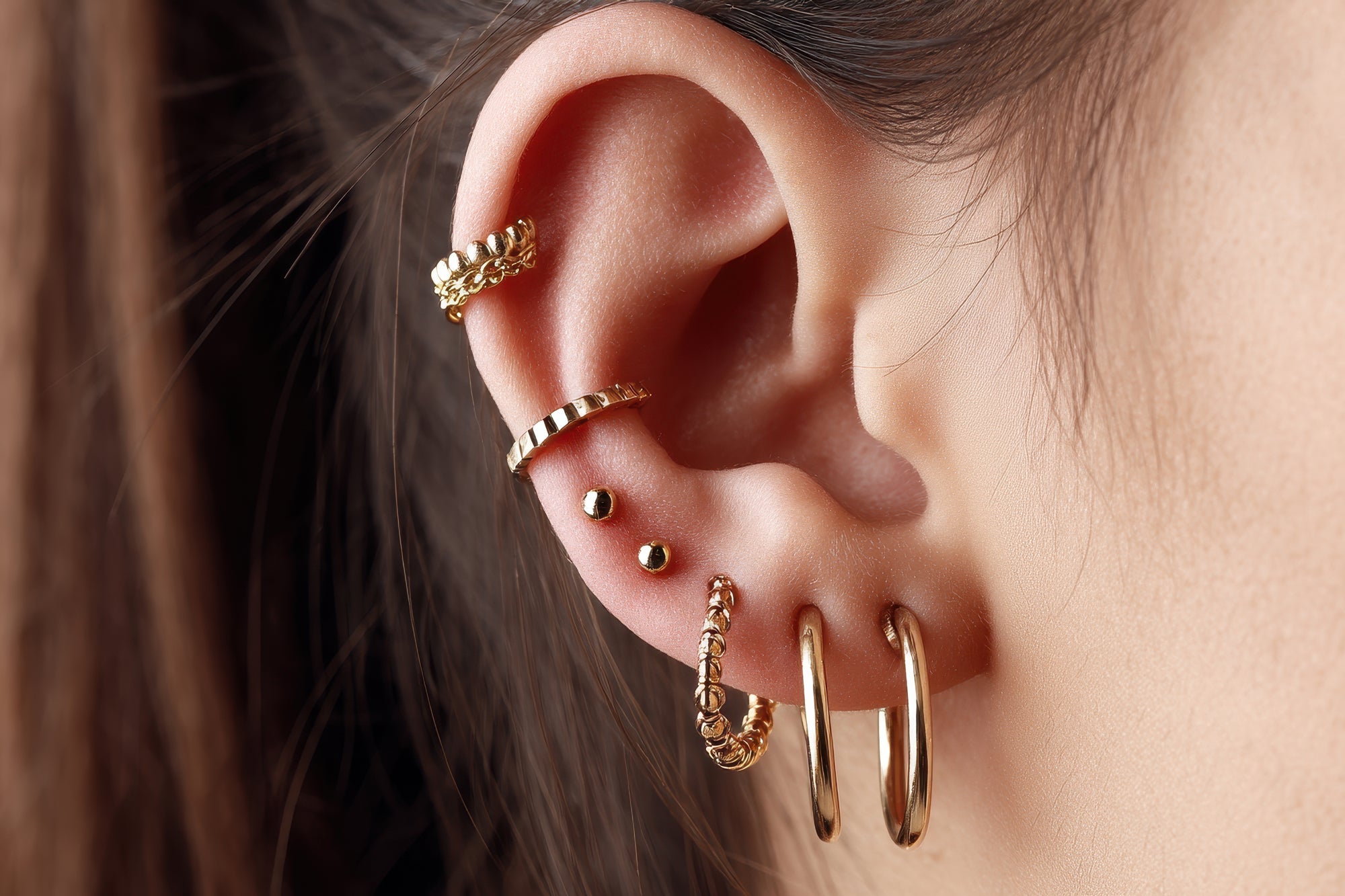














Let's cut right to it. Finding the right belly button ring size can feel a little confusing at first, but we've got you. The most common, industry-standard size is a 14 gauge (1.6mm) bar that's 3/8" (10mm) long. This is the size most professional piercers use for a reason—it's the sweet spot for a safe, comfortable piercing.
Your Quick Guide to Standard Belly Ring Sizes
So, you got your navel pierced and are ready to dive into the world of cute jewelry, but you’re feeling a little stuck on sizing. It's way less complicated than you might think! That standard 14g, 3/8" (10mm) barbell is the go-to size that professional piercers typically use for initial piercings.
Why is this the magic number? A 14g bar is sturdy enough to prevent pesky irritation and keep the piercing from migrating, while the 10mm length gives your new piercing just enough room to breathe without being so long that it snags on everything.
Of course, your perfect fit really comes down to your unique anatomy. The standard size is a fantastic starting point, but it's not a one-size-fits-all situation. Depending on your navel's shape and the thickness of the tissue, you might need a different length.
To give you a quick cheat sheet, here’s a look at the most common industry-standard sizes you'll come across on a belly button ring size chart.
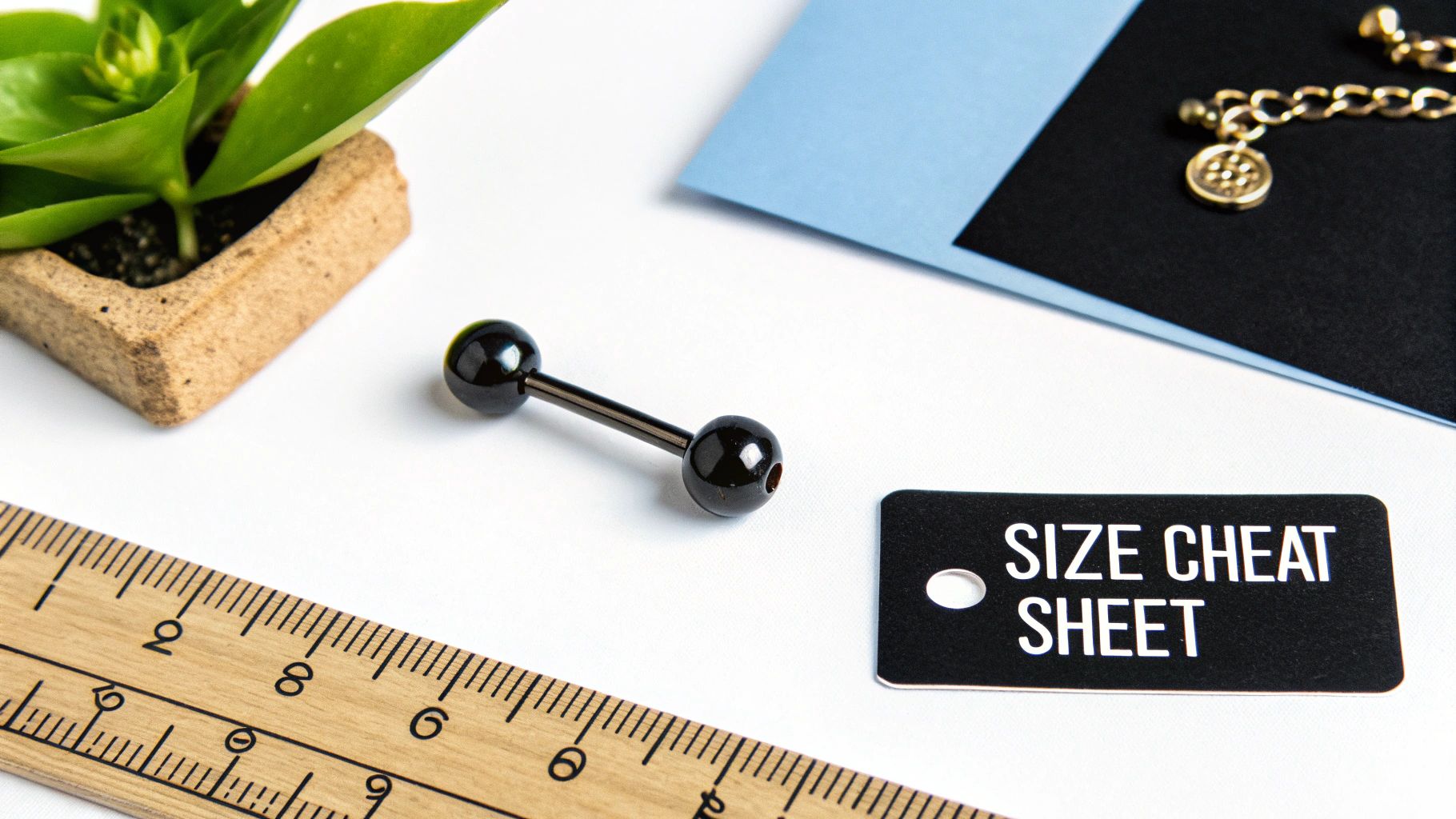
Standard Belly Button Ring Sizes At a Glance
This table breaks down the most common sizes you'll encounter when shopping for belly rings, covering both the thickness (gauge) and the length of the barbell.
| Measurement | Standard Size (Gauge/Imperial) | Metric Size (mm) | Common Use |
|---|---|---|---|
| Gauge | 14g | 1.6mm | The industry standard for most navel piercings. |
| Gauge | 16g | 1.2mm | A thinner alternative, sometimes used for specific anatomy or styles. |
| Length | 3/8" | 10mm | The standard length for initial and healed navel piercings. |
| Length | 5/16" | 8mm | A shorter bar for shallow piercings or once fully healed. |
| Length | 7/16" | 11mm | A slightly longer bar to accommodate initial swelling or deeper piercings. |
| Length | 1/2" | 12mm | An extra-long bar used for significant initial swelling or unique anatomy. |
This should give you a great head start. Most people will find that the classic 14g, 3/8" (10mm) jewelry fits them perfectly, but it's always good to know the other options exist in case you need a more custom fit.
Understanding Belly Ring Gauge and Thickness
So, what exactly is a "gauge" anyway? When you start diving into the world of body jewelry, this is one of the first and most important terms you'll come across.
Think of gauge (often shortened to "g") as simply the measurement for how thick the barbell is—the part that actually goes through your piercing. Getting this right is a huge part of finding jewelry that not only looks amazing but also keeps your navel piercing happy and healthy. It's truly the foundation of a great fit.
One weird quirk with body jewelry gauges you'll need to remember: the higher the number, the thinner the metal. It feels a bit backward at first, but a 16g barbell is actually thinner than a 14g one. It’s the standard system used across the piercing world, so once you get the hang of it, you’ll be a pro.
The Standard Size And Why It Matters
For navel piercings, the industry gold standard is 14 gauge (14g), which measures 1.6 millimeters thick. This isn't just a random number; piercers choose this size for a very critical reason. A 14g bar is substantial enough to provide stability while your piercing is healing, which is crucial for preventing irritation and lowering the risk of rejection.
Ever since the navel piercing trend exploded in the 90s, 14g has remained the top choice, making up over 70% of initial piercings done by professionals. The Association of Professional Piercers even recommends 14g to minimize the risk of the jewelry migrating.
You might also see 16g (1.2mm) jewelry out there, but it’s generally considered too thin for a fresh navel piercing. Using a barbell that’s too skinny can lead to the dreaded "cheese-cutter effect," where the jewelry slowly slices through the skin over time. Nobody wants that! Sticking with 14g ensures your piercing stays secure and also gives you the widest selection of cute jewelry to choose from. If you want to get more familiar with the lingo, check out our deep dive into the anatomy of a belly ring.
Pro Tip: Always stick to the same gauge your piercer used. If you downsize to a thinner gauge, the piercing hole itself can shrink. This makes it a real pain (sometimes literally!) to switch back to a thicker, standard-size barbell later on.
Choosing the Perfect Barbell Length for Your Piercing
Okay, so you’ve got the gauge figured out. Now, let's dive into the next critical piece of the puzzle on your belly button ring size chart journey: the barbell length.
The length is the wearable part of the bar, measured in a straight line right between the top and bottom balls. Nailing this measurement is just as important as the gauge for keeping your piercing comfy and happy. Remember, your anatomy is totally unique, so the "perfect" length is all about what fits your body.
A barbell that’s too short is a major problem. It can pinch your skin, create painful pressure, and in worst-case scenarios, even lead to the jewelry embedding into your tissue—yikes! On the flip side, a bar that's too long will snag on everything, from your high-waisted jeans to your blankets. This isn't just annoying; it can seriously irritate or even damage your piercing.
Finding Your Fit
The standard and most common length for a belly ring is 3/8" (10mm). For a huge majority of people, this size fits perfectly once their piercing has fully healed.
But not everyone's navel has the same depth. While 10mm (3/8 inch) is the go-to for about 65% of belly rings sold, your unique anatomy might need something a little different. That's why you'll see options like a shorter 5/16" (8mm) for shallower navels or a longer 7/16" (11mm) for deeper ones. To get a better sense of how anatomy influences jewelry choices, you can explore our overview of different belly piercing styles.
The Goal: You want the barbell to sit flush against your skin. The top and bottom balls should rest comfortably without digging in or leaving a big, awkward gap.
Keeping these details in mind is how you find a fit that feels like it was custom-made for you. Sizing studies show that while 10mm is standard, up to 35% of wearers need an adjustment for ultimate comfort, often moving to an 11mm or 12mm bar. The secret is to find that sweet spot—a perfect balance between snug and spacious.
How to Measure Your Belly Button Ring at Home
So, you're ready to become your own belly ring sizing expert? It's way easier than it sounds, and you can totally figure out your perfect fit right at home. Once you get the hang of this, you’ll be able to shop for any style with confidence, knowing it's going to look and feel great.
You only need a couple of things: a belly ring that already fits you well and a ruler or a digital caliper that shows millimeters (mm). Stick with millimeters—it’s the standard in the piercing world and will give you the most accurate measurement.
Measuring Barbell Length
Getting the right length is all about measuring the wearable area of the barbell. This is the single most important part for making sure your new jewelry is super comfortable.
- Take Your Jewelry Out: First things first, carefully unscrew one of the balls and remove your belly ring.
- Isolate the Bar: Lay the barbell down flat against your ruler. You want to measure only the bar itself.
- Measure Between the Ends: Check the distance from the inside of the top ball to the inside of the bottom ball. Do not include the balls or any charms in this measurement. That number, in millimeters, is your barbell length. Simple as that!
This little guide shows you exactly what to look for—the difference between a bar that's too short, just right, or way too long.
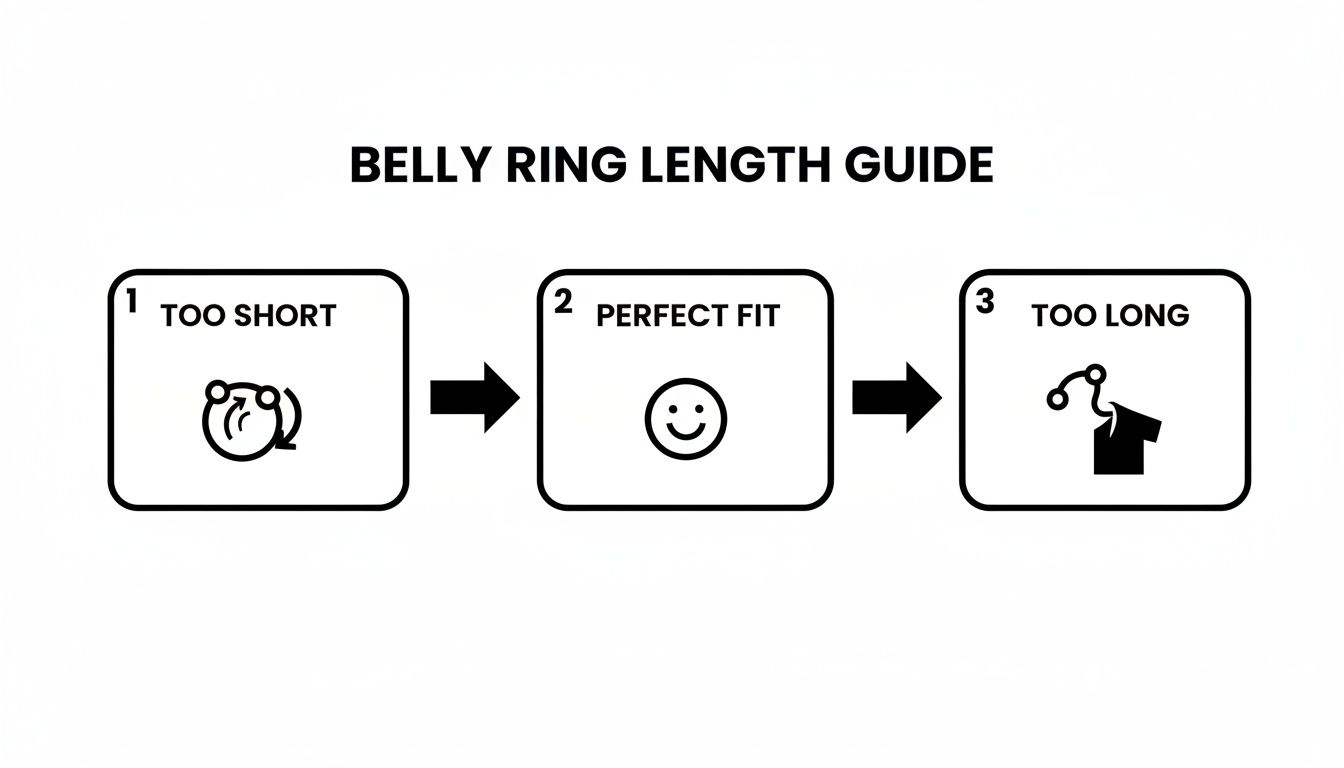
The goal is to find that sweet spot where the jewelry sits flush with your skin. It shouldn't pinch you, but you also don't want a huge gap.
Confirming Your Gauge
Figuring out your gauge at home is mostly about a quick visual comparison. The industry standard is 14g (1.6mm), so it’s almost certain that your current barbell is this size.
If you happen to have a 16g (1.2mm) piece of jewelry around (maybe from an ear piercing), you’d notice it’s visibly thinner. For a healthy navel piercing and the best selection of awesome jewelry from Bodycandy, sticking with 14g is your best bet.
Sizing for New vs. Healed Piercings
So, you just left the piercing studio with a brand-new belly piercing, and you’re obsessed with the cute ring you picked out. But did you know that piece of jewelry isn't your forever size? It’s a common surprise, but there's a huge difference between the jewelry for a fresh piercing and what you'll wear once it's fully healed.
Your piercer will start you off with a longer barbell, and there's a very good reason for that: swelling. Swelling is a totally normal, expected part of the healing process. That extra barbell length gives your body the room it needs to do its thing without the jewelry getting too tight, causing pain, or embedding into your skin.
The All-Important Downsize
Once that initial healing phase is over (usually after a few months) and the swelling has totally gone down, it’s time to downsize. This just means swapping out that long starter bar for a shorter one that fits more snugly and comfortably.
Seriously, this step is absolutely crucial. Sticking with a barbell that’s too long can create a whole mess of annoying, and sometimes painful, problems.
- Snagging: A longer bar catches on everything—your high-waisted jeans, your blankets, your towel after a shower. All that tugging can seriously irritate, and even damage, your piercing.
- Irritation Bumps: The constant movement and snagging can cause those stubborn, angry little bumps to form around the piercing holes.
- Migration: In some cases, the persistent pulling from a long barbell can cause the piercing to shift or "migrate" from its original spot. That's something you definitely want to avoid.
Downsizing to a proper fit is the secret to a happy, healthy piercing for years to come. Whether you have a standard navel piercing or are rocking something different like one of these bottom belly piercings, getting the length right at each stage is non-negotiable.
Pro Tip: Always, always go back to your professional piercer for your first downsize. They have the expert eye to see how you're healing and can recommend the perfect length for your specific anatomy, making sure the switch to your new, perfectly-fitted jewelry is a smooth one.
Solving Common Belly Ring Sizing Problems
Is your belly ring feeling too tight, too loose, or just plain annoying? You're not alone. Getting that perfect, comfortable fit is everything for a happy piercing, and sometimes it takes a little detective work to get it right. Let's dig into the most common sizing hiccups and figure out how to fix them so you can get back to loving your look.
If your jewelry feels like it’s pinching or you notice the balls are sinking into your skin, you're almost certainly dealing with a barbell that’s too short. This is one of those problems you need to solve right away to avoid pressure, nasty irritation, and a serious issue called embedding, where your skin actually starts to grow over the jewelry.
Is Your Barbell Too Short?
This is easily one of the most frequent issues, especially if you've already downsized from your initial piercing jewelry. A short bar puts constant pressure on your piercing, which is basically a recipe for an angry, irritated navel.
The Fix: The solution here is pretty straightforward—you need a longer barbell. Take a quick measurement of the distance between your piercing holes and swap out your current piece for one that matches that length, or is even a millimeter longer to be safe. For instance, if you're wearing an 8mm bar that's clearly too snug, try moving up to the standard 10mm (3/8") barbell. This gives your piercing the breathing room it desperately needs.
Is Your Barbell Too Long?
On the other hand, a barbell that's too long can be just as much of a headache. You'll know it's too long if it’s constantly getting snagged on your clothes or flipping upward when you move. All that extra movement can lead to ugly irritation bumps and might even cause your piercing to migrate over time.
The Fix: Time to downsize! If that 12mm bar is always catching on your favorite sweater, switching to a snugger 10mm (3/8") or even an 8mm (5/16") barbell should solve the problem instantly. The goal is to have the jewelry sit flush against your skin, with little to no extra bar showing.
Belly Button Ring Size Conversion Chart
Tired of trying to translate gauges into millimeters and inches into… well, anything that makes sense? We’ve got you. Finding the right fit for your belly button ring can feel like a puzzle, especially when sizes are listed differently everywhere you look.
This is your ultimate cheat sheet for taking all the guesswork out of sizing. Use it to instantly convert gauge thickness to millimeters and barbell lengths from inches to millimeters (and back again!). Whether you’re comparing jewelry from different shops or just trying to figure out a product description, this chart puts all the info in one convenient place.
Gauge and Length Conversion Chart
Here's the chart you've been looking for. Go ahead and bookmark this page or grab a screenshot—it clearly lays out all the common sizes so you’ll never be confused again. We’ve included the most common gauges and lengths you’ll run into for navel jewelry, making it your go-to reference for every purchase.
Quick Tip: Remember, with gauges, the number is inverse to the size. A 16G bar is actually thinner than the standard 14G bar.
| Gauge (G) | Thickness (mm) | Length (Inches) | Length (mm) |
|---|---|---|---|
| 14G | 1.6mm | 1/4" | 6mm |
| (Standard) | 5/16" | 8mm | |
| 3/8" | 10mm | ||
| 7/16" | 11mm | ||
| 1/2" | 12mm | ||
| 16G | 1.2mm | 1/4" | 6mm |
| (Thinner) | 5/16" | 8mm | |
| 3/8" | 10mm | ||
| 7/16" | 11mm |
Think of this table as your trusty translator. Having these conversions handy means you can shop with confidence, knowing exactly what size you're getting no matter how it's listed.
Your Top Belly Ring Sizing Questions Answered
We get tons of questions about navigating the world of belly button ring size charts, so we’ve put together the most common ones we hear. This is your final stop to clear up any confusion so you can find that perfect fit and rock your navel piercing with total confidence.
You've got the basics down—gauge, length, how to measure—but some real-world situations can still feel a little fuzzy. Let's tackle those lingering questions head-on.
What Happens If I Wear the Wrong Gauge Belly Ring?
This is a bigger deal than most people think. If you pop a thinner ring (like a 16g) into a piercing that was made for a standard 14g, you're setting yourself up for the dreaded "cheese-cutter effect." It’s exactly what it sounds like: the jewelry can slowly slice through your skin over time or cause the piercing to migrate.
And trying to go the other way? Forcing a thicker gauge into your piercing is an absolute no. You could easily tear or damage the delicate skin, which is not only painful but also opens the door for infection. It’s always best to stick with the gauge your piercer used, and for navels, that's almost always 14g.
Can I Switch From a 14g to a 16g Belly Ring?
You can, technically, but we really advise against it for long-term wear. What happens is your piercing hole can actually shrink down to fit the smaller 16g bar.
This makes it a real struggle—and sometimes even painful—to go back to the standard 14g size later on. Besides the hassle, it seriously limits your jewelry collection, since the vast majority of cute, high-quality navel rings are made in the 14g size.
How Do I Know If My Belly Ring Bar Is Too Short?
Trust us, your body will send some pretty clear signals. The number one red flag is any kind of pressure or embedding.
If the top or bottom ball is digging into your skin, creating a little crater, or the whole area just feels tight and leaves red marks, your barbell is definitely too short. A well-fitting ring will always have a tiny sliver of the bar visible between your skin and the ball on either end.
Does Pregnancy or Weight Change Affect My Belly Ring Size?
Absolutely! Your body is dynamic, and major changes like weight fluctuations or pregnancy will almost certainly change the distance between your piercing holes. Your old trusty jewelry might suddenly feel way too tight.
During pregnancy, it's super important to switch to a special, extra-long and flexible maternity belly ring. These are usually made from materials like PTFE or Bioflex that can safely accommodate a growing belly without putting any stress on the piercing. After any big body changes, it's always a good idea to re-measure to find your new perfect size.
Ready to put all this sizing knowledge into practice? At BodyCandy, we have a massive collection of 14g belly rings in every style you can possibly imagine. Shop our full collection of belly button rings today!