



















Conch piercings are always a favorite. What’s not to love when a piercing is so versatile, timeless, and anatomically flexible? Let’s take a moment to break down this perennial favorite.
What is it?
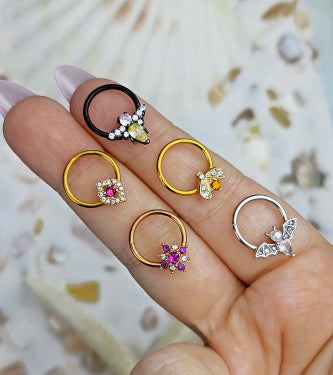
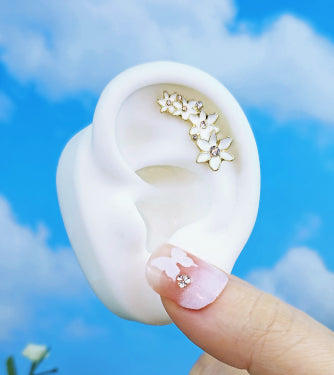
A standard conch piercing goes horizontally through the outer edge of the inner cup around the ear opening. Typically, they are about midway between the upper curve of the cup area and the anti-tragus. While they need to be performed with straight jewelry to heal properly, a popular look is to wear a large-diameter circular ring like a segment ring or captive ring, that goes around the helix. However, a conch piercing can be done anywhere within that cup area. An inner conch piercing is in the lower portion and an outer conch is higher up and not as deep in the ear.
How many?
This is a piercing that can be done in multiples, although it is recommended that you not get more than two performed at one time. Double and triple conch piercings are possible and even more, depending on how much space you have to accommodate the jewelry.
Types of Conch Piercings
The Outer Conch
- at the outer portion of the ear
- it’s the one you commonly see styled with a ring in it.

The Inner Conch
- deeper within the ear
- more likely to be suited to straight jewelry like a flatback labret
- Inner conch piercings are great for showing off jewelry with cool ends. (Another great argument for threadless jewelry!) If you have a particular end that you really want to show off, the inner conch is a great place to highlight it.

The Contra Conch
- done horizontally through the ridge of cartilage that runs along the outer edge of the conch area. It’s where a snug piercing would go but is placed horizontally through the top of that ridge.
- The contra conch is a newer piercing so if you’re looking to get in on the cutting edge of something uncommon, this is a good way to go.

The Punched Conch
- a standard conch piercing but performed with a dermal punch or biopsy punch.
- This is a great option if you are planning to stretch your piercing or just want to be able to wear larger-gauge jewelry in it without having to stretch up from 16-gauge.

Healing and aftercare
A conch piercing can take anywhere from six to twelve months to fully heal. This is dependent on your health, your body’s ability to heal, and making sure your piercing doesn’t get injured or slept on. The aftercare is the same as many other popular piercings. Spray it twice a day with a sterile saline wound wash solution, then rinse with clean water. Pat it dry with a clean paper towel, using clean hands.

That’s conch piercings in a nutshell. This is a piercing that is unlikely to go out of style anytime soon. So if you are looking for a look that is classic and yet still on-trend, the conch piercing offers multiple options to give your ear a little extra sparkle…. or a lot! Happy piercing!