

















You're probably here because you opened five tabs, saw “0.5 carat,” “CTW,” “round brilliant,” and a price swing that made absolutely no sense. One pair looked tiny, one looked bold, and somehow they were both labeled almost the same thing. Diamond earring shopping does that to people.
The annoying part is that most of the confusion has nothing to do with whether you're “bad” at jewelry. Sellers often use terms that sound obvious but aren't. And with studs, the details matter because what you care about is pretty simple: how big they'll look on your ear, how sparkly they'll be, whether they're comfy enough for real life, and whether the price feels fair.
That's where 0.5 carat diamond earrings get interesting. They sit right in that sweet spot where lots of shoppers want everyday sparkle without going full red-carpet drama. But there's one giant catch. “0.5 carat” can mean two very different things.
If you've ever stared at a listing and thought, “Cute, but will these show up once my hair is down?” you're asking the right question.
Your Guide to Nailing the Perfect Diamond Studs
Shopping for diamond studs usually starts with a vibe. You want something polished, wearable, and easy. Maybe you're replacing your daily earrings with something a little more grown-up. Maybe you're buying your first real diamond studs. Maybe you're gifting someone and trying not to accidentally buy a pair that's way smaller than expected.
A classic scenario goes like this. You find one listing for 0.5 carat diamond earrings. Then another. Then another. One photo looks delicate. Another looks much more noticeable. Prices are all over the place. Suddenly you're zooming into earlobe photos like a detective.
That confusion is normal because the label alone doesn't tell you enough.
With studs, the biggest mistakes usually come from focusing on the wrong detail first. People hear “carat” and assume that settles the size question. It doesn't. For earrings, visual size and comfort matter just as much, sometimes more, than the raw weight number.
Quick reality check: The pair that looks better on you isn't always the one with the flashiest spec line. It's the one that gives you the right amount of sparkle, sits well on your ear, and matches how you actually dress.
A good everyday pair should feel easy. You put them on, they work with a messy bun, a blazer, a tee, or a date-night outfit, and you don't spend the whole day thinking about them.
The first thing to sort out is the wording sellers use. That one detail changes everything.
Decoding Carat Weight CTW vs Per Stud
This is the part that trips up almost everyone.
When a seller says 0.5 carat diamond earrings, they might mean 0.50 carat total weight, or they might mean 0.50 carat per stud. Those are not the same purchase, and they do not look the same on your ear.
The easiest way to think about it
It's similar to splitting dessert.
If a menu says you're getting 0.50 carat total weight, that total is shared by both earrings. So the pair adds up to 0.50 carat, which usually means each stud is about 0.25 carat.
If a listing says 0.50 carat per stud, each earring is that size on its own. Together, the pair totals 1.00 CTW.
That's the difference between “shared total” and “each one individually.” Same number in the listing. Very different look in real life.

What that means visually
According to Whiteflash's diamond earring size guide, a 0.5-carat diamond earring is typically discussed as either 0.5 carat per stud or 0.50 carat total weight for the pair. For round brilliant stones, common face-up diameters are about 5.1 mm for 0.50 carat and about 4.1 mm for 0.25 carat.
That might sound like a tiny difference on paper. On the ear, it isn't.
Here's the practical comparison:
| Listing style | What you're actually getting | Typical face-up look |
|---|---|---|
| 0.50 CTW | About 0.25 carat per ear | Smaller, subtle, easy everyday sparkle |
| 0.50 carat per stud | 0.50 carat in each ear | More noticeable, stronger visual presence |
Why people get disappointed
A lot of shoppers picture the larger version when they read “0.5 carat.” Then the earrings arrive and they're not wrong exactly. They're just 0.50 CTW, not 0.50 each.
That's why the smartest question to ask isn't “Is this 0.5 carat?” It's this:
- Is the weight for the pair or for each earring?
- What is the millimeter diameter of each stone?
- What setting is being used?
The words to look for before you buy
Some listings make this super clear. Some bury it in the specs. Before you hit checkout, scan for:
- CTW or total weight means the number is for both earrings together.
- Each, per stone, or per stud means the size applies to one earring.
- Millimeter size tells you more directly how large the earrings will look.
If you remember one thing, make it this. CTW tells you the total. Millimeters tell you the look.
That little translation trick will save you from most diamond stud shopping regret.
The 4Cs Simplified for Epic Earring Sparkle
The 4Cs can get very textbook, very fast. For earrings, you don't need the lecture version. You need the “what matters when these are on my ears” version.
Here it is: for studs, cut is the star.
Cut is what makes people notice your earrings
A diamond can have the right weight on paper and still look underwhelming if the cut isn't doing its job. Sparkle is what your eye catches first, especially with earrings, because you're usually seeing them from a conversational distance, not through a jeweler's loupe.
According to Grand Diamonds' stud earring size guide, a 0.5-carat round diamond typically measures about 5.0 to 5.2 mm in face-up diameter, but that physical size depends heavily on the cut. A deep-cut diamond can weigh the same and still face up smaller than a well-proportioned stone.
That's the sneaky part. Two diamonds can both be 0.50 carat, but one can look smaller once it's set and worn.

How to think about each C for earrings
Cut
This is your sparkle budget. If you want lively, bright studs that don't look sleepy, this is the place to care the most.
A well-cut stone reflects light better and can also look more pleasing face-up. That matters more than chasing a weight number that sounds impressive.
Color
With everyday studs, individuals don't need to obsess over getting the iciest possible diamond. Earrings are small, worn at the sides of the face, and not usually inspected from two inches away. If the overall look is bright and clean, that's what observers focus on.
If you're trying to keep your budget sane, color is often an area where shoppers can be more flexible than they think.
Clarity
Same general idea. Tiny internal features don't matter much if you can't see them while wearing the earrings. For studs, “looks clean to your eye” is often more useful than getting lost in grading language.
Carat
Carat still matters, obviously, because it affects presence. But it shouldn't boss around the whole decision.
If you choose based only on carat, you can end up with earrings that are technically heavier but visually less impressive.
Practical rule: For everyday studs, don't shop by carat alone. Shop by cut first, then confirm the millimeter size, then decide whether the rest of the specs fit your budget.
The smart trade-off
If I were helping a friend choose 0.5 carat diamond earrings for daily wear, I'd push her toward sparkle and visible size over fussy spec bragging rights.
Try this decision order:
- Look at the cut quality first
- Check the millimeter diameter
- Decide how white you want the stone to look
- Choose clarity based on what's eye-clean to you
- Then judge whether the price feels worth it
That order tends to produce earrings that look better in actual life, not just on a product chart.
Choosing Your Perfect Setting and Metal
You finally find a pair of 0.5 carat diamond earrings that looks great on paper. Then you notice the setting, the metal, and the back style, and suddenly it feels like you need a jewelry degree.
You do not.
The setting and metal decide a huge part of how your studs wear day to day. They affect how big the diamonds look from across the room, how comfortable they feel by hour ten, and whether they read as classic, polished, modern, or a little glam.

Setting styles and how they change the look on your ear
A diamond stud setting works like the frame around a picture. Same diamond, different frame, different vibe.
| Setting | How it looks on the ear | Why shoppers choose it |
|---|---|---|
| Prong | Open, bright, classic | Lets in more light and shows more of the diamond |
| Bezel | Clean, smooth, modern | Feels protected and low-fuss for everyday wear |
| Halo | Bigger, dressier, extra sparkly | Adds visual size around the center stone |
Prong settings
Prong studs are the familiar classic for a reason. Less metal covers the diamond, so you see more stone and more sparkle. That matters a lot with 0.5 carat earrings, where small design choices can change whether they look delicately pretty or surprisingly punchy.
If your goal is that crisp, everyday diamond-stud look, prongs are usually the easiest win.
Bezel settings
A bezel wraps metal around the diamond like a neat little rim. It gives the earring a smoother outline, which many people prefer if hair, scarves, or sweaters are always getting involved in their life.
The trade-off is visual size. Because the metal surrounds the stone, the diamond can look a little more tucked in than it would in a prong setting. Some people love that sleek effect. Others miss the airy sparkle.
Halo settings
Halo studs add a ring of smaller diamonds around the center. The result is more flash and a larger overall face-up look on the ear.
This style is great if you want your earrings to read bigger without putting every dollar into a larger center diamond. For daily wear, though, it usually feels dressier than a plain stud, so it depends on whether your personal style is quiet and clean or more glow-all-the-time.
Metal changes both the color story and the comfort
Metal is not just the background. It changes the whole mood.
- Yellow gold looks warm, traditional, and rich
- White gold feels bright and polished
- Rose gold looks softer and a little more romantic
- Platinum feels weightier and more substantial
- Titanium can be a good pick for sensitive ears
If your ears get irritated easily, start with comfort first and style second. Pretty earrings are not that pretty when you cannot wait to take them off.
Gold purity can also confuse people fast, especially if you are comparing 10K, 14K, and 18K options. If you want a quick refresher, BodyCandy explains the differences in this guide to real gold jewelry basics.
How to match the setting to real life
Here's the simple version.
If you want the most sparkle for the money, start with prong studs. They usually show off a 0.5 carat pair best.
If you want easy, smooth, wear-them-with-everything earrings, look at bezel studs.
If you want your earrings to have more presence the second someone sees your face, halo studs can create that fuller look.
And if you already know your ears are picky, choose the metal the same way you choose shoes for a long day. Comfort first, regrets never.
Great everyday studs should look good on Monday mornings, dinner dates, airport runs, and random mirror checks in bad bathroom lighting.
That is the sweet spot.
Budgeting for Bling How Much Should You Spend
Diamond stud pricing gets wild fast, and this is exactly why shoppers feel like they're missing a secret code.
The short answer is that 0.5 carat diamond earrings can sit in very different price zones depending on whether you're looking at natural diamonds, the setting metal, diamond color, and whether the listing is for the pair or for each earring.
According to ItsHot's diamond earring pricing guide, the price for 0.5-carat diamond earrings can range from $550 to over $3,800 total. That same guide lists examples including 14K gold 0.5-carat white diamond stud earrings at $595, 14K gold 0.5-carat black diamond stud earrings at $195, 0.50 ctw natural diamond stud earrings at $770, and 1 ctw at $2,570.
Why the price spread is so big
A few things push the number around:
- Diamond type. Natural diamonds and other alternatives don't land at the same price.
- Color and appearance. Even within the same carat weight, diamond color can shift cost.
- Total carat weight. Moving up in size usually raises price faster than people expect.
- Setting metal. Gold and platinum don't price out the same way.
- Brand positioning. Retail markup and branding change what you pay.
Spend smarter, not louder
If your goal is “they look amazing on me,” you don't need to chase the most expensive version of every spec.
A practical way to shop is:
- Get the right size format first. Make sure you know whether you're paying for CTW or per stud.
- Favor sparkle over braggy grading details. A lively stone usually beats a technically heavier one that looks sleepy.
- Choose the setting intentionally. A prong setting can help a diamond look more open and bright.
- Consider alternatives if you want the look for less. If you're comparing sparkle options overall, this guide to cubic zirconia versus diamond can help you sort the difference in plain language.
A good budget question to ask
Don't ask only, “What's the cheapest 0.5 carat pair?”
Ask, “What combination gives me the visible size, comfort, and sparkle I want?”
That question usually leads to a better buy.
Styling, Gifting, and Pro Buying Tips
You are getting dressed, your hair is up, and your earrings need to do a lot of work fast. That is where 0.5 carat diamond studs shine. They add light to your face, play nicely with casual clothes or sharper outfits, and do not ask for much in return.

How to style them without overthinking it
For everyday wear, placement changes the whole vibe.
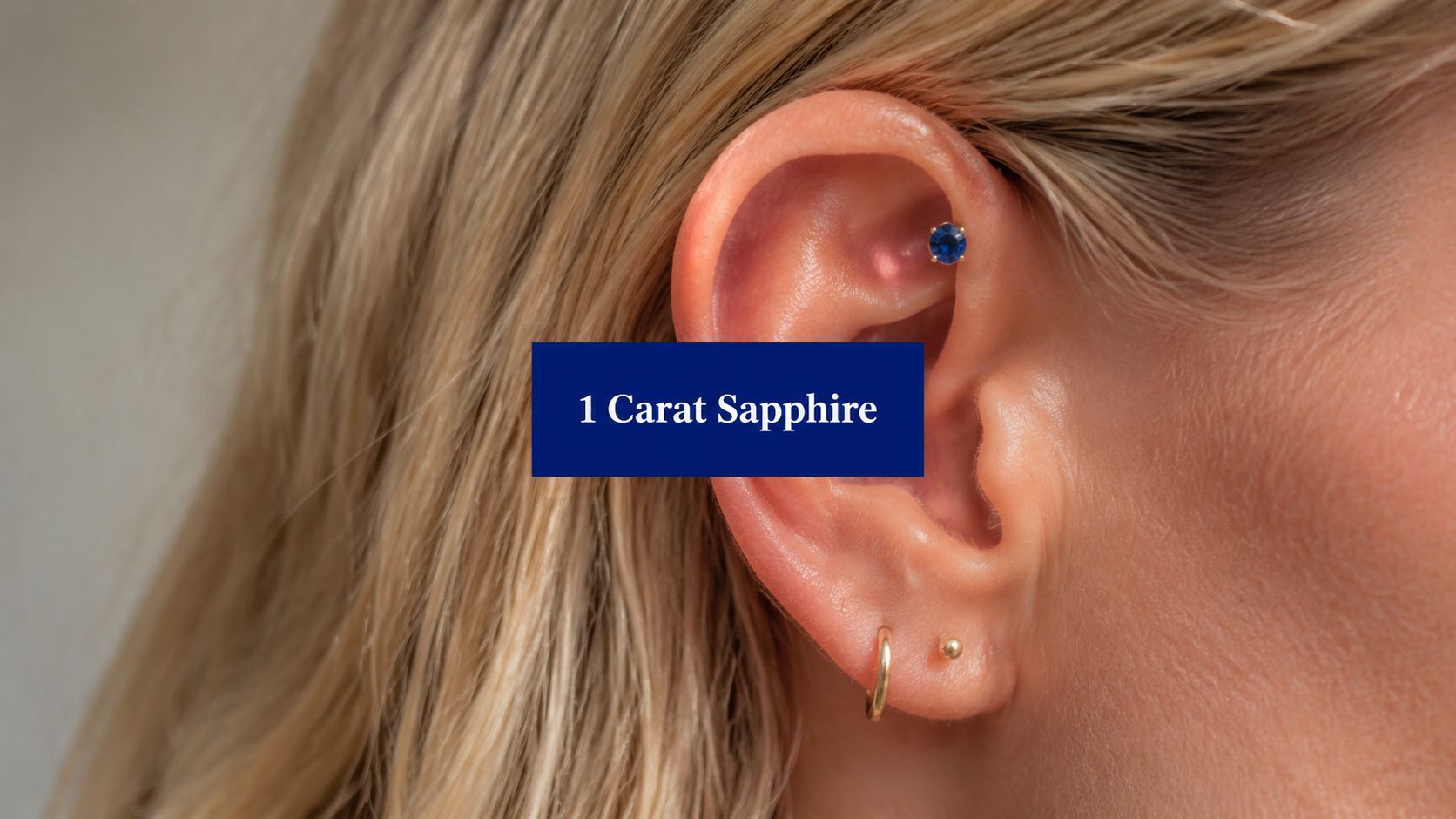
In a first lobe piercing, 0.5 carat studs usually read as your main sparkle. They frame your face and give that clean, polished look even if the rest of your jewelry is minimal. In a second lobe, the same pair feels more styled and a little more fashion-forward, especially if you already wear a hoop or chunkier stud in front.
If you love an ear stack, use the diamonds like the white T-shirt of the lineup. They keep everything grounded. Then add tiny huggies, slim hoops, or plain metal studs around them so the ear still looks balanced instead of crowded.
A simple rule helps here. If the diamonds are your brightest piece, let them have a little breathing room.
If you're buying them as a gift
Surprise earrings can go very right or very wrong, and size confusion is usually the reason. A listing that says 0.5 carat may mean the pair together or each stud on its own. Those are two very different looks on the ear, so checking the wording matters more than shoppers expect.
Millimeter size helps even more than carat language for gifting because it gives you a clearer picture of what the recipient will see in the mirror. If they wear subtle jewelry every day, a smaller, balanced look often gets more wear. If their style is bolder, they may want more visual presence.
Use this quick checklist before you buy:
- Check whether the weight is total carat weight or per stud
- Look for the millimeter measurement in the product details
- Match the metal color to jewelry they already wear often
- Ask yourself whether their style is classic, minimal, glam, or stack-focused
- If they like mixing pieces, browse gift-friendly earring set ideas from BodyCandy
One more buying move that saves regret
Read the product details slowly. Yes, really.
For earrings, the smartest buy is usually the pair that looks bright, feels comfortable, and fits the wearer's real-life style. That means checking the backing type, the setting profile, and whether the seller clearly explains what you are getting. You do not need lab-level diamond knowledge. You just need enough clarity to avoid paying for specs that will not change how the studs look on your ears day to day.
For another angle on the daily-wear question, this video is a useful watch:
The best everyday studs are the pair you reach for on a rushed morning, a workday, and a dinner out. If they look good on you and feel easy to wear, that is the win.
Your Diamond Earring Questions Answered
Are 0.5 carat total weight studs big enough for daily wear
For a lot of people, yes. A diamond educator in this video on 0.5 carat earrings for everyday wear suggests that 0.5 carat total weight can be big enough for daily wear for many shoppers, especially when the cut is bright and lively. The same advice points shoppers toward brilliant cut quality and suggests considering lab-grown stones if they want more visible size for the budget.
Should I care more about carat or how big the earrings look
For studs, how big they look usually matters more. Face-up size and sparkle are what people see. That's why checking the millimeter measurement and paying attention to cut is so useful.
Are prong settings better than bezel settings
Not better for everyone. Prongs usually give a more open, classic diamond look. Bezels feel sleeker and more contained. If you want maximum visible diamond, prongs often win. If you want a smoother, more modern feel, bezels make a lot of sense.
What makes everyday diamond studs worth wearing
Comfort, easy styling, and enough sparkle to show up without feeling high-maintenance. The best pair is one you can wear with a hoodie, a work outfit, and a dinner look without needing to swap earrings every time.
Ready to find your next ear-staple piece? Browse BodyCandy for earrings and jewelry styles that fit your vibe, then build a look that feels like you.