













If you’re new to piercing, you may be dreaming of how the ear piercing you want will look when it’s all healed up. All the cute jewelry you’ll wear, all the fun shopping you’ll do! However, that’s not the jewelry you’ll be getting pierced with. And even if you don’t love the jewelry you’re pierced with, you only have to keep it in until the piercing is healed. So today we’re going to talk about ear piercing jewelry, what shape, what gauge, and what you can wear afterwards. Please note that you should be getting pierced with ASTM F-136 titanium unless you have some rare issue that requires you to use a different metal. Also, all piercing jewelry should have enough extra room to accommodate the post-piercing swelling and don’t forget to downsize it on the schedule your piercer recommends.

Lobes
Your earlobes should be pierced with a flatback labret stud. This is jewelry that won’t move around in the piercing and disrupt the healing process. Ear lobes are typically pierced with 18 gauge jewelry, but if you plan to eventually stretch them, you can discuss getting a larger gauge piercing with your trusted piercer. You should not be pierced with earrings that have butterfly backs. They are extremely difficult to keep clean and accumulate debris and fluids quickly. If you are given a choice, get the flatbacks. And remember, only needle piercings and never gun piercings.

Straight Jewelry
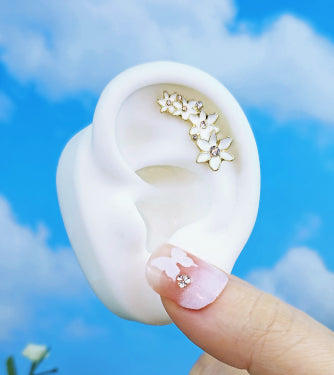
The same style of jewelry is used for numerous piercings on the ear. The ubiquitous flatback labret will show up repeatedly because it works so well for so many piercings. This includes tragus, conch, helix, flat, and variations thereof like the vertical helix. These are typically pierced at 16 gauge with very simple jewelry. Many people like the look of a conch piercing with a large circular ring going around the outside of the ear, but the movement of the jewelry will make it less than ideal for healing. That lack of motion is one of the reasons that flatback labrets are so often used for so many piercings.

Curved Jewelry
There are a few cartilage piercings that require a curved barbell for piercing. Rook, anti-tragus, and snug piercings are the three most common. These are also typically done at 16 or 14 gauge. The jewelry is identical to more common curved eyebrow rings so once you’re healed, you can easily use eyebrow jewelry in your rook, so long as the length of the jewelry is adequate. Again, you don’t have to love the style or the look of the jewelry as it can be changed as soon as your piercing heals entirely.

Circular Jewelry
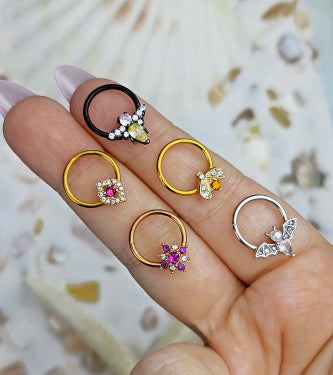
This really only applies to daith piercings and orbitals. You should not have your daith pierced with anything but a simple horseshoe or possibly a captive bead ring. These particular piercings require circular jewelry to heal properly and it’s vital that there not be a seam on the jewelry like you might find on a segment ring or clicker. That seam can find its way inside the fistula and irritate those fragile new cells that are forming inside.

Industrial
This is done with an extra-long, 14 gauge straight barbell. Always. Do not get them as separate piercings because they will heal at an angle that prevents you from connecting the two with a single barbell. After it heals, you can use small barbells connected by a chain or a barbell with a charm on it, but for the healing process it is important to keep everything clean and as immobile as possible.
Some people don’t like the simple look of piercing jewelry, which is a style and choice and entirely fair. However, the good news is that once your piercing has healed you can change that jewelry out and rock whatever kind of look your heart desires. It’s worth sporting some “boring” jewelry for the duration of the healing process than run the risk of having issues caused by inappropriate jewelry down the line. Embrace it while you’ve got it, because you won’t have to wear it forever. Happy piercing!