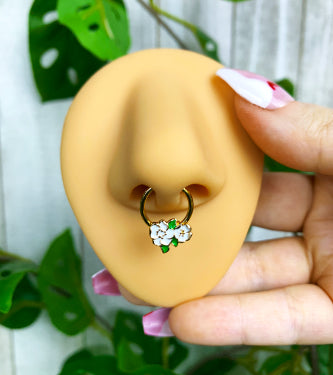
Captive Bead Rings

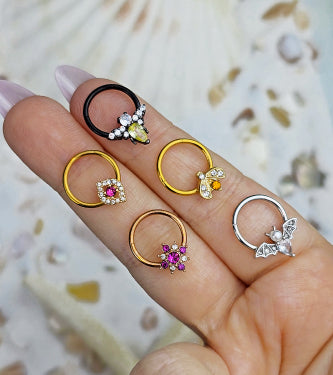
The original piercing hoop: a ring that grips a bead by tension, no hinge to fail and no thread to strip. Plain steel balls, CZ gems, faux opals, glitter, charms and themed beads, from the 16G 3/8 inch ring that fits septum, lip, eyebrow and cartilage to the 14G 1/2 inch that nipples take, in 316L steel, PVD colors and solid 14k gold. Since 1999.


Captive Bead Ring Fit & How-To Guide

Fit: gauge is the wire, diameter is the inside of the hoop. 16G with a 3/8 inch (10mm) diameter fits most septum, lip, eyebrow and cartilage piercings, 5/16 inch (8mm) for a snugger fit; 14G with 1/2 inch (12mm) is nipple and conch territory, where the ring needs room to clear swelling. Beads run 3mm on 16G and 4mm on 14G. Match the gauge and diameter you wear now; both are on every product page. Rings are for healed piercings: heal on the bar your piercer placed, then switch to the hoop.

Opening one without pliers: at 16G and 18G, push the bead out sideways with a thumb, seat the new bead in one dimple, and press the other end onto it. If the ring is tight, open it a hair by twisting the ends sideways, out of the circle, never by pulling the gap wider. A bead that keeps escaping means the ring was opened too far; close it a touch and it grips again. Thick 14G and 12G rings want ring-opening pliers, and lost beads are replaceable by gauge and bead size.

Metal: most captives here are 316L surgical steel, the everyday standard, with a trace of nickel locked in the alloy that most people never notice; gold-tone, rose-tone, black and rainbow are PVD, IP or anodized finishes over steel, and the title names the finish. Skin that argues with steel goes to solid 14k gold (yellow is nickel-free) or implant-grade titanium. Nothing here is plated mystery metal.

Captives by piercing and metal:

FAQ

The original piercing hoop: a ring with a small gap whose two ends grip a removable bead by tension. You will see it written as CBR or BCR (ball closure ring); same thing. No hinge to fail, no thread to strip, and the bead is where the color lives: plain steel balls, CZ gems, faux opals, glitter and themed beads. Fixed-bead versions, where the gem bead is set rather than loose, are called tension captives.

At 16G and 18G you can usually do it by hand: hold the ring, push the bead out sideways with a thumb, then seat the new bead in one dimple and press the other end onto it. If the ring is tight, open it a hair by twisting the ends sideways (out of the circle), never by pulling the gap wider, which deforms the hoop. Thick 14G and 12G rings want ring-opening pliers. We have a step-by-step with photos on the blog, linked below.

Gauge is the thickness of the wire, diameter is the inside of the hoop. 16G with a 3/8 inch (10mm) diameter fits most septum, lip, eyebrow and cartilage piercings, 5/16 inch for a snugger fit; 14G with 1/2 inch (12mm) is nipple and conch territory, where the ring needs room to clear swelling. Beads run 3mm on 16G and 4mm on 14G. Match the gauge and diameter you wear now; both are on every product page.

Almost any healed one: septum, nipple, lip, eyebrow, daith, conch, helix and lobe; many people use the same 16G 3/8 ring across several. Rings are for healed piercings: heal on the stud or bar your piercer placed, then switch to the hoop. Smaller captives are one of the few rings piercers will swap in early, but that is their call.

Most are 316L surgical steel, the everyday standard; it holds a trace of nickel locked in the alloy, fine for most people. Gold-tone, rose-tone, black and rainbow versions are PVD, IP or anodized finishes over steel, and the title names the finish. For skin that reacts to steel, the solid 14k gold captives are nickel-free in yellow, and implant-grade titanium rings live on the titanium pages. Nothing here is plated mystery metal.

Yes, that is the whole point of a captive. Match the gauge and bead size (3mm for 16G, 4mm for 14G) from our replacement balls, including dimpled captive beads in steel, acrylic and gem styles. A good tip from the pros: a bead that keeps escaping means the ring has been opened too wide; close it a touch sideways and it will grip again.